
Best overall: Myvellum for turning spoken life stories into a printed book. Best for written family prompts: Storyworth. Best for daily journaling: Day One. This 2026 guide compares 7 of the best memoir writing apps and story-collection options, including what each one requires to reach a printed book.
- Myvellum is the best memoir writing app here for guided voice interviews and a printed hardcover or softcover book.
- Choose Storyworth if you want to answer written prompts; choose Day One if you want an open-ended journal.
- Check the print route before choosing: a journal export is not the same as a built-in book service.
Why this matters
The hardest part of a memoir is often deciding what to say next. A guided interview, a written prompt and a blank journal solve that problem in different ways. In 2026, your best choice depends on how you want to tell the story and what must happen before someone can hold it as a book.
A print service is a meaningful distinction. Some options collect stories as part of a book-making process; others help you record material that you must later prepare for an independent printer. If a physical keepsake is the goal, decide how much of that work you want to handle yourself.
What makes the best memoir writing apps?
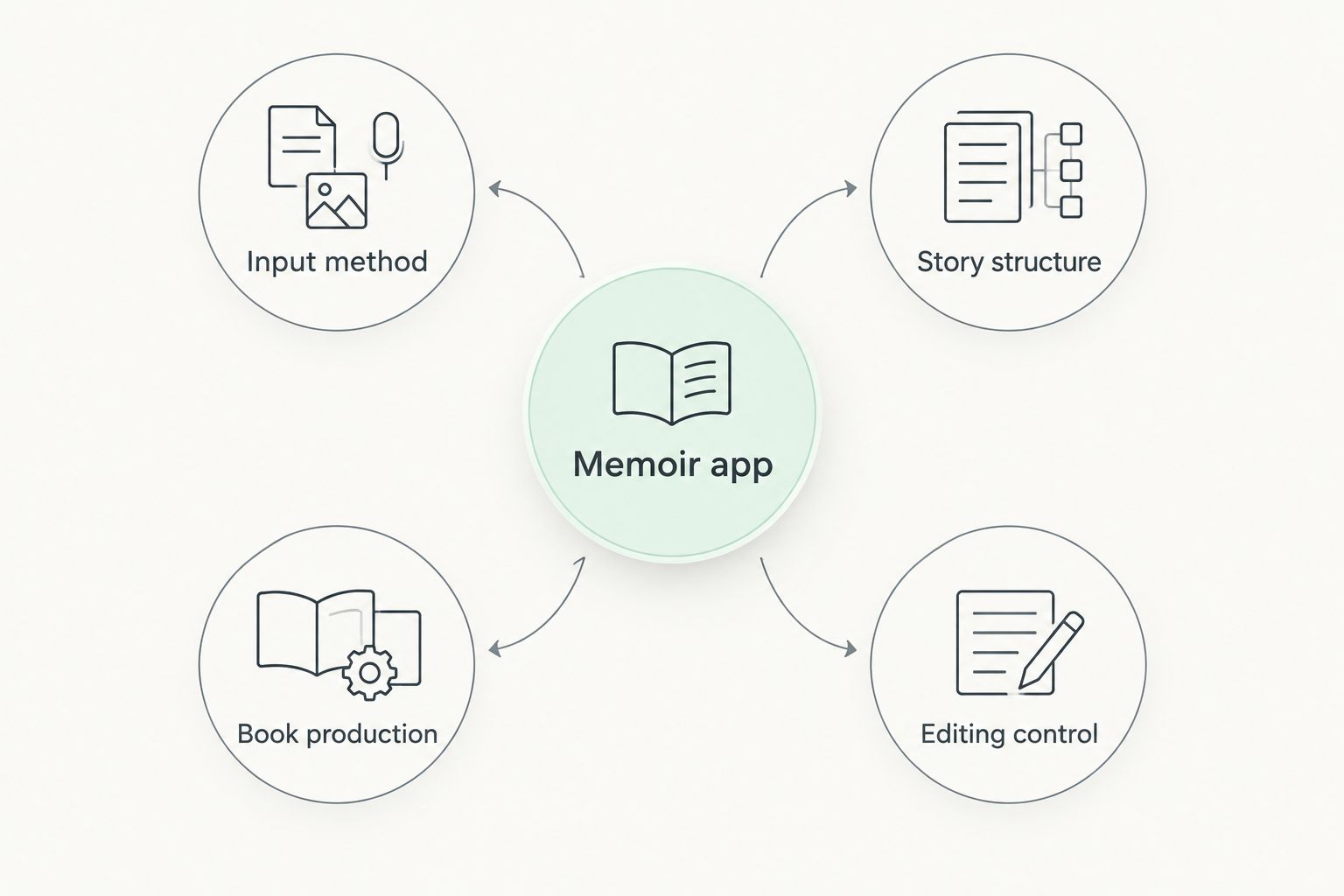
Use these criteria to choose a memoir app in 2026. A polished writing space is not enough if its input method keeps the storyteller from contributing or its print route adds work you did not plan to do.
- Input method: Can the storyteller speak, type or use another method they will keep using?
- Story structure: Do prompts help them cover a life story, or is the format an open journal?
- Book production: Is a printed book part of the service, or will you need a separate printer?
- Editing control: Can you shape the collected material into a story you want to preserve?
- Reader fit: Is the result meant for private reflection, family sharing or a physical keepsake?
These criteria work together. Choose an input method first, then check the book route; an easy recording process does not remove the need to review the final story.
Best memoir writing apps at a glance
| Option | Best for | Standout approach | Key limitation |
|---|---|---|---|
| Myvellum | A guided spoken memoir with a printed book | Voice-driven interviews across 12 structured chapters | The chapter format is less open-ended than a blank journal |
| Remento | Preserving spoken responses | Voice-first story collection | Review the written story before treating it as final |
| Storyworth | Families who prefer written prompts | Questions sent to a storyteller for written answers | Typing is a barrier for reluctant writers |
| Meminto | People who want question-led storytelling | Prompt-based story collection | A fixed question path can leave personal themes unexplored |
| Storii | Storytellers who prefer phone calls | Stories collected by phone | A phone-first workflow is not an open writing workspace |
| LifeBio | Guided life review | Biographical questions | A question-led format gives less freedom than a blank page |
| Day One | Independent daily journaling | Open-ended journal entries | A printed memoir needs a separate preparation and print route |
1. Myvellum: best memoir writing app for a guided printed keepsake
Myvellum guides individuals through 12 structured interview chapters using their voice, then produces a personalized printed hardcover or softcover book. The defined chapter path gives a storyteller a way to move from spoken memories to a life story without starting from a blank document.
Myvellum pros:
- Voice input suits someone who would rather tell a story than type it.
- Structured interviews provide a starting point for each chapter.
- The stated outcome is a personalized printed book, with hardcover and softcover formats.
Myvellum cons:
- A chapter-led interview offers less freedom than open-ended journaling.
- Someone who wants to write every passage directly should choose a writing-first option.
Best for: A storyteller who wants guided voice interviews and a physical family keepsake. Verdict: Buy if that is the outcome you want; check the current service details before starting.
2. Remento: best for preserving spoken responses
Remento centers spoken storytelling. It gives people a way to answer prompts aloud rather than compose every memory as prose, making the original way someone tells a story part of the appeal.
Remento pros:
- Speaking lowers the writing burden.
- Prompts give the storyteller a subject to respond to.
- Recorded responses retain the storyteller's spoken delivery.
Remento cons:
- Spoken answers still need review when you want a coherent written narrative.
- A prompt-led collection is less flexible than an unrestricted journal.
Best for: A family that puts particular value on hearing a storyteller's voice. Verdict: Buy for that purpose, but review how the final book presents the recordings and text before you commit.
3. Storyworth: best for written family prompts
Storyworth uses questions to invite written stories from a family member. Its approach fits a storyteller who enjoys receiving a topic, thinking about it and replying in their own words; those responses can become a printed book.
Storyworth pros:
- Questions remove the pressure of choosing every topic.
- Written responses give the storyteller direct control over their wording.
- The book outcome keeps family readers in view.
Storyworth cons:
- The process relies on someone willing to write responses.
- A short answer to a prompt can leave a significant memory underdeveloped.
Best for: Families whose storyteller prefers typing to talking. Verdict: Buy when written answers are realistic; skip it if typing is the obstacle stopping the story.
4. Meminto: best for question-led story collection
Meminto organizes life stories around questions and a book-making goal. It is a fit when the storyteller wants guidance but does not want to plan a memoir's entire outline independently.
Meminto pros:
- Questions provide clear starting points.
- A story-collection framework helps keep the project focused on a book.
- The format works for someone who prefers answering to drafting from scratch.
Meminto cons:
- Preset questions will not cover every family's most meaningful subjects.
- The resulting story needs an editorial pass for gaps and repetition.
Best for: A storyteller who wants prompts and a book goal, while remaining willing to add personal context. Verdict: Hold until you have checked that its current question and book workflow fit the person telling the story.
5. Storii: best for stories told by phone
Storii uses phone calls to collect life stories. That makes it distinct from a writing workspace: the storyteller can respond by talking on the phone instead of sitting down to draft chapters.
Storii pros:
- Phone participation avoids a blank writing screen.
- Spoken answers can capture a conversational style.
- Prompts give each call a subject.
Storii cons:
- A phone-first process is not suited to someone who wants to edit prose while writing.
- Check the current book-production route before treating collected calls as print-ready chapters.
Best for: A storyteller who is comfortable answering questions by phone. Verdict: Buy for phone-based collection; hold if direct control over a printed manuscript is your priority.
6. LifeBio: best for guided life review
LifeBio uses biographical questions to help people document their experiences. Its focus is recollection: useful when the main challenge is remembering and organizing life events rather than finding a blank page to write on.
LifeBio pros:
- Biographical questions give memories a starting point.
- Guided reflection helps identify events worth recording.
- The format can support a life-story book project.
LifeBio cons:
- A question-led account can read like separate answers unless you edit it into a narrative.
- Someone with a specific creative structure will want more freedom.
Best for: A storyteller who wants help recalling life events in an organized way. Verdict: Hold until you have checked how your intended book will be assembled and printed.
7. Day One: best for an independent journal you print later
Day One is a journaling app, not a guided memoir-and-print service. It belongs on this list for a different route: write entries over time, choose the ones that tell your story, then prepare and print a book separately.
Day One pros:
- Open entries give you control over subjects and order.
- A journal suits someone who already has a writing habit.
- You can select material for a memoir rather than answer a fixed prompt set.
Day One cons:
- It does not provide a guided life-story interview.
- Turning entries into a coherent printed memoir takes separate editing and printing work.
Best for: A regular journal keeper willing to manage the book project independently. Verdict: Buy for collecting material; skip it if you need the app to guide and produce the printed keepsake.
How we ranked these options
The ranking puts the storyteller's ability to finish first, then weighs structure and the route to a printed book. In 2026, a voice-first service with a stated print outcome takes the default spot for someone who wants to tell a life story aloud. A capable journal ranks lower for that specific goal because its owner must turn entries into a book separately.
This is a fit ranking, not a claim that one input method works for everyone. Before choosing, ask the storyteller how they would answer a difficult memory: aloud, in writing, by phone or privately in a journal. Then confirm what you receive at the end and who handles final edits.
Which memoir writing app should you choose?
Choose Myvellum if you want a guided spoken memoir and a printed hardcover or softcover keepsake. Its 12 interview chapters connect the storytelling method to the intended book. That makes it the default pick in this 2026 comparison for a person who wants to speak their story rather than build a manuscript alone.
Choose Storyworth for a willing writer who likes family prompts. Choose Storii when phone calls are the easiest way to collect stories. Choose Day One only if you want the freedom of a journal and are prepared to manage the later book-making work yourself.
Start telling your life story
Explore guided voice interviews and a personalized printed book.
FAQ
What are the best memoir writing apps for a printed book in 2026?
Myvellum is the best fit here for a guided voice memoir that becomes a printed hardcover or softcover book. Storyworth suits written responses, while a journal such as Day One requires a separate route to print.
Can I write a memoir by speaking instead of typing?
Yes. Myvellum uses voice-driven interviews, while Remento collects spoken responses and Storii uses phone calls. Compare how each service turns those responses into the story you want to keep.
Is Storyworth better than a voice-driven memoir app?
Storyworth is better for someone who wants to answer written family prompts. A voice-driven app is the better fit when typing keeps the storyteller from participating.
Does a journaling app make a printed memoir?
A journaling app can collect material for a memoir, but collecting entries and producing a printed book are separate tasks. With Day One, plan to select, edit and arrange entries before using a printer.
How do I choose between prompts and an open journal?
Choose prompts when you need help deciding what memories to record. Choose an open journal when you already write regularly and want control over the subjects and structure.
What should I check before starting a memoir book?
Check how the storyteller will contribute, how the material can be reviewed and who handles printing. The easiest way to capture memories is not always the easiest way to finish a book.
One last thing
Before you pick a tool in 2026, ask the storyteller to explain one memory in the format they would actually use. If they start talking, prioritize a voice or phone option; if they start writing, consider prompts or a journal. The best memoir writing app is the one that gets their story told and gives you a clear path to the book you want.