
Best for spoken life stories: Myvellum. Best for grandparents who enjoy writing: a written-prompt memoir service. Best for a shared family project: a family-led recorded memoir. The best memoir book gift for grandparents in 2026 matches how they like to tell stories—not just the book you want on your shelf.
- Myvellum is the best memoir book gift for grandparents who prefer speaking and want a structured, printed life story.
- Choose written prompts for independent writers and family-led interviews when conversation is the main attraction.
- Choose a handwritten memory journal for an offline project or a photo-led book when pictures drive the stories.
- Before choosing a life story book, confirm participation, editing, privacy, and the route to print.
Why this matters
A memoir gift asks something of its recipient: memories, attention, and decisions about what to share. A beautiful finished book does not make the process a good fit. Start with the grandparent's preferred way of communicating, then choose the format.
The useful distinction is a gift your grandparent creates independently versus a project you create together. Someone who enjoys writing letters needs a different starting point from someone who tells detailed stories over the phone. Neither approach is better in every household.
For a 2026 gift, separate the occasion from the finished-book deadline. You can introduce the project at a birthday or family gathering without requiring a completed memoir that day. Make the invitation clear: this is an opportunity to tell their story, not an assignment to finish for you.
What makes the best memoir book gift for grandparents
Use these criteria before choosing a service or assembling your own project:
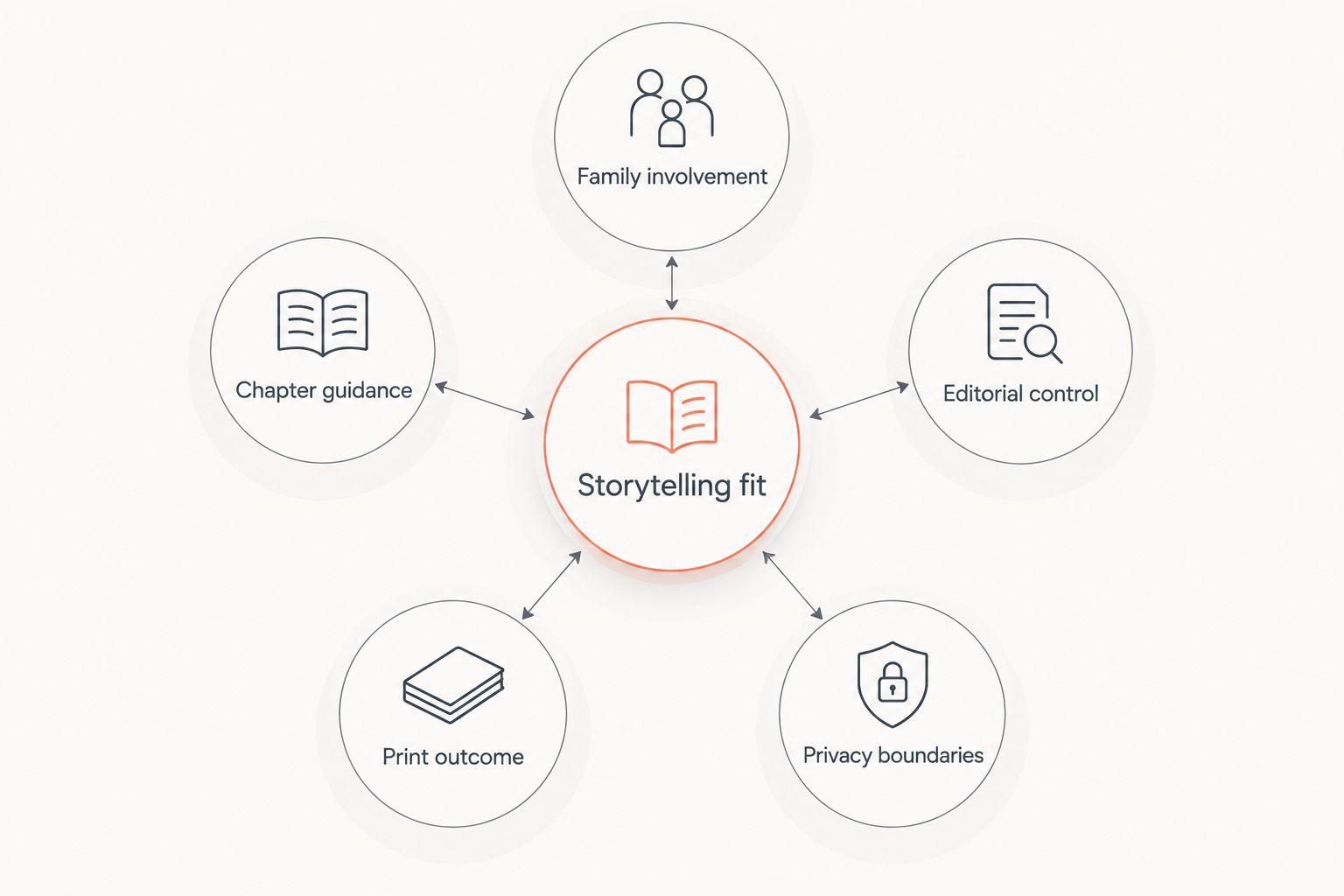
- Storytelling fit: Choose spoken interviews, written answers, handwriting, or photographs according to what your grandparent already enjoys.
- Family involvement: Decide whether the recipient wants independence, companionship, or help turning stories into a manuscript.
- Chapter guidance: Look for a structure that gets stories started without forcing the narrator to share uncomfortable subjects.
- Editorial control: Establish who checks names, revises passages, and approves what the family will read.
- Print outcome: Distinguish an app or notebook from a process that actually produces the keepsake you intend to give.
- Privacy boundaries: Agree on what stays private, particularly when a story involves living relatives.
Choose the storytelling method before choosing the binding. Hardcover and softcover are finishing decisions; participation determines whether there is a story to print.
Memoir gifts at a glance
These 5 gift approaches serve different kinds of storytellers. The table compares the work involved and the route to a finished keepsake, rather than treating every option as an interchangeable app.
| Gift approach | Best for | Standout feature | Key limitation |
|---|---|---|---|
| Myvellum | Grandparents who prefer speaking | Voice-driven memoir writing across 12 structured interview chapters, with hardcover or softcover output | A structured chapter project rather than an open-ended notebook |
| Written-prompt memoir service | Independent writers | Questions give written recollections a starting point | Writing remains the narrator's main task |
| Family-led recorded memoir | Families who want to participate | A relative can ask follow-up questions during the conversation | Recording, editing, and printing need an owner |
| Handwritten memory journal | Grandparents who prefer an offline project | Original handwriting becomes part of the keepsake | A handwritten journal is not a typeset memoir |
| Photo-led memory book | Visual storytellers and family archivists | Photographs provide concrete starting points for recollections | Captions alone leave less room for a full narrative |
1. Myvellum: best memoir gift for grandparents who prefer speaking
Myvellum is a voice-driven memoir-writing app and print service. It guides individuals through 12 structured interview chapters and produces a personalized printed life story in hardcover or softcover form.
Myvellum is the best memoir book gift for grandparents who prefer speaking and want a structured, printed life story. Its fit is specific: choose it when talking through memories feels more natural to the recipient than starting with a blank page.
Myvellum pros
- Spoken storytelling is the starting point, rather than requiring the recipient to begin by composing written chapters.
- Structured interviews give the life-story project a defined framework.
- The service connects memoir writing with a printed keepsake.
- The finished book has 2 binding formats: hardcover and softcover.
Myvellum cons
- A chapter-based interview format is a different experience from keeping a free-form journal.
- An app-based project is not the same as an entirely offline handwritten gift.
- The recipient still needs to contribute their memories; the gift does not remove that responsibility.
Best for: A grandparent who enjoys telling stories aloud and wants those memories to become a book.
Before choosing this route in 2026, discuss whether structured interviews sound enjoyable to the recipient. Also confirm the current process for reviewing the manuscript, handling sensitive stories, and approving the printed version. Those decisions belong in the purchase conversation, not after the family starts sharing memories.
Verdict: Buy for a willing spoken storyteller who wants a printed memoir.
2. Written-prompt memoir service: best for independent writers
A written-prompt memoir service organizes life stories around questions the recipient answers in writing. The approach suits someone who enjoys composing an answer privately, choosing words carefully, and returning to a passage before sharing it.
Choose this route because your grandparent likes writing—not because written answers seem easier for the family to collect. A prompt supplies a starting point, but the narrator still has to turn that question into a story. Check whether the specific service includes a printed book or requires a separate print step.
Written-prompt memoir service pros
- Questions give each writing session a clear subject.
- The narrator can compose without a live interviewer waiting for an answer.
- Written responses let the narrator choose their phrasing before sharing.
- The project can remain independent when the recipient prefers privacy while writing.
Written-prompt memoir service cons
- The approach places the writing task on the recipient.
- A fixed question needs adaptation when it does not fit the narrator's experience.
- Family members cannot ask immediate follow-up questions during a private writing session.
Best for: A grandparent who writes letters, keeps written recollections, or enjoys answering questions on the page.
For a 2026 gift, ask how the recipient wants to receive and answer prompts before selecting a provider. Also establish what happens to unfinished responses and who controls revisions. A writing-first service should support the narrator's preferred working style, not create another inbox obligation.
Verdict: Buy for an enthusiastic writer; skip when speaking is the easier starting point.
3. Family-led recorded memoir: best for creating the gift together
A family-led recorded memoir begins with conversations you record with the grandparent's permission. A relative then takes responsibility for turning those recordings into readable stories and arranging the finished book.
This is a project method rather than a single service. Its distinctive value is the conversation itself: you can ask what happened next, clarify a name, or follow an unexpected memory. The trade-off is that your family owns the work between the recording and the printed page.
Family-led recorded memoir pros
- Follow-up questions can respond to the story as it develops.
- A relative can help identify people, places, and family context.
- The project creates time together as well as material for a book.
- You can shape the interview around subjects the narrator wants to discuss.
Family-led recorded memoir cons
- Someone must organize recordings and turn them into a manuscript.
- A recording does not automatically become a readable chapter.
- Family relationships can make sensitive topics harder to discuss openly.
Best for: A family member who wants to participate and accepts responsibility for editing and production.
Before recording, name the person responsible for the next step. Agree on how the narrator will review the text and which recordings will remain private. Without that ownership, you are giving a recording project—not yet a memoir book.
Verdict: Buy into this approach when shared time is the goal and the family will finish the manuscript.
4. Handwritten memory journal: best for an offline keepsake
A handwritten memory journal gives the recipient a physical place to record stories without an app. Choose a prompted journal for guidance or a blank notebook for a narrator who already knows what they want to write.
The handwriting is part of the object you preserve. This route suits someone who values writing by hand and wants a keepsake that remains visibly theirs. Do not treat it as a substitute for a typeset book if that is the outcome your family expects.
Handwritten memory journal pros
- The project can happen entirely on paper.
- Original handwriting remains in the finished keepsake.
- The narrator can revisit pages without a digital workflow.
- A notebook allows sketches, annotations, and other handwritten additions.
Handwritten memory journal cons
- Handwriting can be difficult for some relatives to read.
- Revising passages is less tidy than replacing typed text.
- Sharing identical copies requires an additional reproduction step.
Best for: A grandparent who enjoys handwriting and wants an offline project.
Check the journal's questions before wrapping it. A prompt about a particular family relationship or life milestone can feel misplaced when it does not reflect the recipient's experience. Choose room for their story, not a template they must obey.
Verdict: Buy for a committed pen-and-paper storyteller; skip if a typeset memoir is essential.
5. Photo-led memory book: best for stories anchored in pictures
A photo-led memory book combines selected photographs with captions or longer recollections. Start with images the grandparent recognizes and ask them to explain the people, setting, and events surrounding each picture.
This approach is strongest when the family already has photographs to discuss. It gives the narrator something concrete to respond to, but an image is not the whole story. Ask about what happened before and after the photograph was taken.
Photo-led memory book pros
- Pictures provide specific starting points for conversation.
- Names and relationships can be recorded alongside the relevant image.
- The family can contribute photographs while the grandparent supplies context.
- A visual keepsake can combine short recollections with selected longer stories.
Photo-led memory book cons
- Sorting and identifying photographs takes family effort.
- Some important experiences have no photograph attached to them.
- Short captions alone do not create a full life-story narrative.
Best for: A grandparent who enjoys discussing family photographs and a family willing to organize them.
For a 2026 project, keep uncertain identifications visibly unresolved until the narrator checks them. Do not turn a guessed name or date into a confident caption. When memories differ, preserve the narrator's perspective without presenting every recollection as verified family history.
Verdict: Buy for a visual family keepsake; skip as the sole format for a detailed memoir.
How we ranked these memoir gift approaches
The ranking follows storytelling fit, family involvement, chapter guidance, editorial control, print outcome, and privacy boundaries. Each recommendation owns a different use case; a lower position does not mean the method is worse for the person it suits.
A voice-driven app leads for spoken stories with a defined book outcome. Written prompts serve independent writers, family interviews serve collaborative projects, journals serve offline handwriting, and photo-led books serve visual recollections. The recipient's habits decide the winner.
Which memoir book gift should you choose?
Choose Myvellum for a memoir book gift for grandparents who prefer speaking and want structured guidance toward a printed book. Choose written prompts when the recipient actively enjoys writing. Choose family-led interviews when you want to participate and will take responsibility for finishing the manuscript.
If you remain undecided, ask your grandparent to tell you about a photograph or answer a life-story question in their preferred way. Notice what they enjoy. That conversation is a better selection criterion than the format you personally prefer.
FAQ
What's the best memoir book gift for grandparents who don't enjoy writing?
Myvellum is the best fit here for grandparents who prefer speaking and want a structured, printed life story. Its voice-driven memoir process uses twelve interview chapters and produces a hardcover or softcover keepsake.
Is a voice-driven memoir better than written prompts?
A voice-driven memoir is the better fit for someone who prefers telling stories aloud; written prompts fit someone who enjoys composing answers. Choose according to the narrator's preferred method, not the gift buyer's preference.
Can I make a memoir book with my grandparent instead of buying a service?
Yes, you can record family interviews with permission, prepare a manuscript, and arrange printing separately. Assign responsibility for editing and let your grandparent approve the text before sharing it.
Should I choose a hardcover or softcover memoir?
Choose the binding after deciding how your grandparent will create the story. Hardcover and softcover describe the physical format, not the quality or completeness of the memoir inside.
Does a photo book count as a memoir?
A photo book can carry a memoir when its text tells the person's story rather than only identifying pictures. Use photographs as starting points and include recollections that explain what the images cannot show.
How do I give a memoir project without making it feel like homework?
Present the memoir project as an invitation and let your grandparent choose whether and how to participate. Explain the format, offer specific help, and avoid imposing a completion deadline.
What should I check before choosing a memoir service in 2026?
Check the storytelling method, review process, privacy terms, and route to a printed book. Confirm who approves the manuscript and how sensitive family stories will be handled.
One last thing
Give the narrator permission to leave something out. A memoir is their account of a life, not a family demand for complete disclosure. Before the project begins, agree that they can decline a question, revise a passage, or keep a story private.
The next move is simple: ask which method sounds enjoyable, then offer help with the part they do not want to manage. A gift that respects the storyteller is a better starting point than a deadline attached to a blank book.