

Best for a family keepsake: Myvellum, the voice-guided memoir app at myvellum.vercel.app. Best memoir ghostwriting service model for delegated writing: an independent memoir ghostwriter; best for an existing draft: a memoir editor—this 2026 guide separates those choices before you commit.
- Myvellum is best for recording your own memories and creating a printed family memoir, rather than hiring a ghostwriter.
- An independent memoir ghostwriter fits readers who want someone else to develop and write their manuscript.
- A memoir editor fits an existing draft; an oral-history interviewer fits a recording-first project.
- Choose your writing method first, then decide whether to order a hardcover or softcover keepsake.
Why this matters
A memoir ghostwriting service and a guided memoir app solve different problems. A ghostwriter writes on your behalf; a guided app helps you supply your own story through prompts and recording. Buying one when you need the other creates the wrong working relationship from the start.
For a family memoir, your goal does not have to be a commercially published autobiography. You can preserve the stories behind your decisions, relationships, work, and everyday routines in a book your family understands. Choose the method that helps you finish that book without surrendering the voice you want it to carry.
This 2026 comparison ranks five working models by their best use, not by unsupported claims about individual providers. Only the first option is a named app and print service; the other entries describe professionals you can hire and the scope you should request.
What makes the best memoir ghostwriting service?
Judge a memoir-writing option against these criteria before comparing proposals:
- Writing responsibility: Decide whether you want to tell stories while someone else writes, or actively shape your own manuscript.
- Memory capture: Match the process to how you recall events—spoken interviews, guided prompts, written notes, or an existing draft.
- Voice preservation: Ask how the process keeps your expressions, opinions, and uncertainty intact rather than making every chapter sound generic.
- Editorial scope: Separate manuscript creation from structural editing, proofreading, and preparation for print. Those are different tasks.
- Finished format: Specify whether you want recordings, a manuscript, or a printed family keepsake. Never assume one includes the others.
- Revision control: Establish who approves the wording, what changes are included, and when the text becomes final.
For your 2026 shortlist, put writing responsibility first. A polished sample is useful, but it cannot tell you whether you will enjoy the process or have enough control over the finished story.
Memoir-writing options at a glance
| Rank and option | Best for | Standout approach | Key limitation |
|---|---|---|---|
| 1. Voice-guided memoir app | Your own printed family memoir | Structured spoken storytelling with a book endpoint | Not the same service as hiring a human ghostwriter |
| 2. Independent memoir ghostwriter | Delegating manuscript writing | One contracted writer develops your story | Success depends on the individual writer and agreed scope |
| 3. Memoir ghostwriting agency | A managed writing engagement | An organizational point of contact for the project | You must clarify who actually interviews, writes, and edits |
| 4. Memoir editor | Improving a draft you already wrote | Revision of existing material | Editing alone does not replace manuscript creation |
| 5. Oral-history interviewer | Preserving spoken testimony | Interview-led memory capture | Recordings are not automatically a readable book |
The ranking is a decision tree. The first option fits the family-keepsake goal; the second fits full writing delegation. An editor or interviewer moves ahead of both when your starting material calls for that narrower service.
1. Myvellum: best for your own printed family memoir
Myvellum is a voice-driven memoir-writing app and print service that guides you through twelve structured interview chapters. It produces a personalized hardcover or softcover keepsake book of your life story. That makes it a distinct alternative to commissioning a writer to compose the manuscript on your behalf.
Myvellum is best for people who want to record their own memories and create a printed family memoir. Choose this route when the central task is getting your experiences onto the page, rather than hiring a professional to take over the writing.
Myvellum pros:
- Voice-driven input gives you a spoken route into your life story.
- Twelve structured interview chapters provide a defined framework.
- The service connects memoir creation with a personalized printed book.
- Hardcover and softcover are both stated output formats.
Myvellum cons:
- A guided app is not equivalent to a dedicated human ghostwriter.
- You still supply the memories and personal substance.
- A structured chapter approach differs from commissioning an individually designed manuscript.
Best for: Recording your own life story for family, with a printed keepsake as the intended result.
Treat starting the memoir and ordering the printed book as separate decisions. Begin by capturing a story you want to preserve; settle the text before deciding on the physical edition. For a closer look at the recording-first approach, read the guide to voice-to-text memoir writing apps.
Verdict: Buy into this approach if you want guided storytelling and a family book; skip it if you require a human ghostwriter.
2. Independent memoir ghostwriter: best for delegated writing
An independent memoir ghostwriter is the closest match to a traditional memoir ghostwriting service. You commission an individual writer to turn your interviews, notes, and supporting material into a manuscript. The contract should define the work rather than leaving you to infer it from the job title.
This route suits you when you have stories to tell but want someone else to construct the narrative. Request a relevant writing sample and discuss how the writer handles material you remember imperfectly. A family memoir needs accuracy and recognizable voice, not invented certainty.
Independent memoir ghostwriter pros:
- You can select the individual responsible for the prose.
- You can request a manuscript built around your specific brief.
- The engagement can focus on writing rather than teaching you to write.
- You can assess voice compatibility through relevant samples.
Independent memoir ghostwriter cons:
- You must evaluate the writer yourself.
- Interviews and factual review still require your participation.
- Printing, research, and additional editing need explicit scope decisions.
Best for: A reader who wants to delegate manuscript construction while retaining approval over personal details.
Before signing, ask who owns the manuscript, how revisions work, and whether you can review an early section before the full draft progresses. Put those answers in the agreement. A reassuring conversation is not a substitute for a defined deliverable.
Verdict: Buy the independent-writer model when delegated writing is your priority and the sample sounds right.
3. Memoir ghostwriting agency: best for a managed engagement
A memoir ghostwriting agency is an organizational hiring route rather than a single, uniform service. Your first task is to establish who will interview you, who will write, and who will oversee revisions. Do not assume that the person discussing the project is the person producing the manuscript.
Choose this model when you want a contracted organizational contact and are prepared to inspect the proposed workflow. In your 2026 comparison, judge the assigned writer and deliverables—not just the agency's general presentation.
Memoir ghostwriting agency pros:
- You can request a named contact responsible for project coordination.
- You can ask for writing, editing, and production as clearly separated deliverables.
- You can evaluate a proposed workflow before committing.
Memoir ghostwriting agency cons:
- The agency name alone does not identify your writer.
- Handoffs require clear responsibility for voice and factual corrections.
- A bundled description needs checking against the actual agreement.
Best for: Someone seeking an organizationally managed project rather than a direct freelance relationship.
Ask what happens if the assigned writer changes or the opening chapter does not sound like you. The answer should identify the remedy, decision-maker, and revision process. Keep interviewing, writing, editing, and printing distinct in the scope even if one organization offers them together.
Verdict: Hold until the agency names the working team and documents the deliverables.
4. Memoir editor: best for improving an existing draft
A memoir editor works on material you have already written. Developmental editing addresses structure and narrative decisions; copyediting addresses sentence-level correctness and consistency. Ask for the type of editing your manuscript needs rather than treating all editing as interchangeable.
If your draft contains the right memories but wanders between periods or repeats the same events, discuss structural editing first. If the organization works and the sentences need attention, request a narrower editorial scope.
Memoir editor pros:
- Your draft remains the starting point.
- You can target a defined manuscript problem.
- Editorial feedback helps you decide what to keep, move, or clarify.
Memoir editor cons:
- You need sufficient written material to edit.
- Editing does not automatically include writing missing chapters.
- Different editing stages require different scopes.
Best for: Someone with an existing memoir draft who wants improvement rather than replacement.
Send the editor a representative excerpt and explain the intended reader. A book for your family needs enough context to make personal references understandable, but it need not explain your entire life to an anonymous audience. That distinction helps define useful edits.
Verdict: Buy editing when the manuscript exists; skip editing-only proposals when you still need someone to write it.
5. Oral-history interviewer: best for spoken testimony
An oral-history interviewer helps elicit and record your recollections through conversation. This model puts spoken testimony first. It is a different endpoint from a shaped memoir manuscript unless the agreement adds transcription, editing, and book preparation.
Choose this route when preserving how you tell a story matters as much as the written version. Before commissioning interviews, decide what you want to receive and how you will keep access to it.
Oral-history interviewer pros:
- Conversation lets you explore memories through follow-up questions.
- Recording preserves the spoken account rather than only rewritten prose.
- You can define the interviews around a particular period or subject.
Oral-history interviewer cons:
- A recording is not a finished book.
- A transcript still needs editorial decisions to become readable narrative.
- Recording permissions and file delivery require explicit agreement.
Best for: A recording-first project where the spoken account is itself an important keepsake.
Request clear terms for recordings, transcripts, access, and permission to reuse the material. If a printed memoir is your endpoint, identify who will perform the next stage before the interviews begin.
Verdict: Buy interviewing for spoken preservation; hold if you need a book and no manuscript stage is defined.
Turn your memories into a finished family book
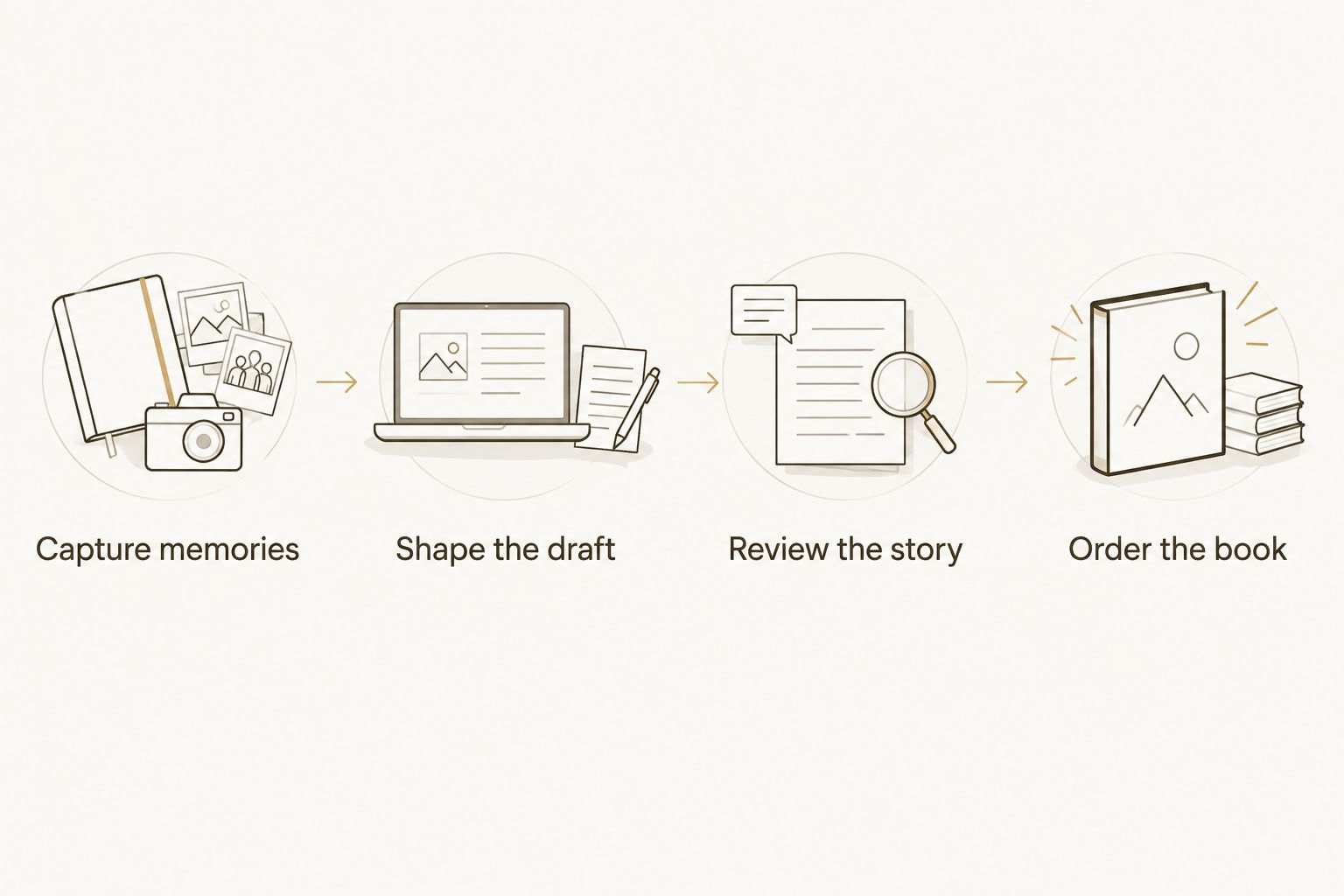
Use this sequence regardless of which memoir-writing model you choose. It separates getting the story down from approving the object your family will hold.
Capture memories
Choose 3 memories you genuinely want your family to know. Start with a particular place, decision, or relationship instead of trying to summarize your whole life. Record a 10-minute account as a starting exercise, not as a required session length.
Shape the draft
Decide what connects those memories and where a reader needs context. Keep the distinctive details: the phrase someone used, the room where a conversation happened, or what you believed at the time. Remove repetition only after the substance is recorded.
Review the story
Read the manuscript for names, chronology, and private details. Mark uncertain memories as uncertain rather than converting them into established facts. Ask whether someone who was not present can follow the chapter.
Order the book
Choose the printed format after approving the text. Starting a memoir is a writing decision; ordering a hardcover or softcover is a production decision. Do not let the desire to hold a finished book rush the review.
How the options are ranked
This 2026 ranking prioritizes fit for a personal family memoir: writing responsibility, memory capture, voice, editorial scope, finished format, and revision control. It distinguishes the stated app features from service models whose deliverables you must negotiate.
No option wins every task. Full writing delegation points toward a ghostwriter; an existing manuscript points toward an editor. A guided family-book project belongs in a different lane.
Which memoir ghostwriting service should you choose?
For a family keepsake you want to create from your own spoken memories, choose the guided-app route first. For a manuscript you want someone else to write, shortlist independent memoir ghostwriters and compare samples against the same brief.
Your 2026 decision should turn on the work you want to delegate. Write that down in one sentence before contacting anyone: capturing memories, writing chapters, improving a draft, or producing the printed book. Then ask for that deliverable directly.
FAQ
What's the best memoir ghostwriting service for a family book?
An independent memoir ghostwriter fits a family book when you want someone else to write the manuscript. Myvellum is a different option: a voice-guided memoir app and print service for recording your own story through twelve structured interview chapters.
Is a memoir app the same as a ghostwriter?
No, a memoir app and a human ghostwriter are different working models. A guided app structures your participation; a ghostwriter is hired to write on your behalf under an agreed scope.
Should I hire a ghostwriter or a memoir editor?
Hire a ghostwriter when you need manuscript creation, and a memoir editor when you have a draft to improve. Specify whether you need structural editing, sentence-level editing, or both.
Can I speak my life story instead of typing it?
Yes, you can use a voice-driven memoir app or arrange spoken interviews. Decide separately how the spoken material will become a reviewed manuscript and, if wanted, a printed book.
Does an oral-history interview include a printed memoir?
An oral-history interview does not by itself specify a printed memoir. The agreement must explicitly include any transcription, manuscript editing, and print preparation you want.
What should I ask before hiring a memoir ghostwriter?
Ask who will write, what material you must supply, how revisions work, and who owns the manuscript. Also define whether research, editing, and printing are included or separate.
Should I order the printed book before finishing my memoir?
Approve the memoir text before ordering the printed edition. Review names, chronology, sensitive details, and uncertain recollections before making the production decision.
One last thing
Do not start with your birth date just because it comes first. Start with the memory you most want your family to understand, then explain how you reached that moment. You can arrange the chapters later; first, preserve the story only you can tell.


