

Best overall for speaking your life story into a printed book: Myvellum. Best for private, handwritten reflection: a prompt journal. Best for family-led storytelling: a recorded interview. This 2026 guide compares memoir writing prompts tools by how you capture memories, organize them, and turn them into something your family can read.
- Myvellum is the best fit for voice-driven memoir writing prompts tools with structured chapters and a printed keepsake book.
- A prompt journal suits handwritten reflection, but you must handle editing and book production separately.
- Recorded interviews suit family conversations; a text document suits writers who want control over their memoir structure.
- Photo-led prompts help you start with specific scenes rather than broad life-summary questions.
Why this matters
A prompt helps you remember. A memoir tool also needs to help you do something with that memory. For your 2026 project, choose the format that gets stories out of your head and into a readable sequence—not simply the longest question list.
What makes the best memoir writing prompts tools
- Capture method: Speaking, handwriting, typing, or responding to photographs should match your preferred way of telling stories.
- Prompt specificity: Questions should elicit scenes, decisions, and relationships—not only dates.
- Structure: Memories need a sequence readers can follow.
- Editorial control: You need to check names, meaning, and sensitive details.
- Finished output: Decide whether you want private notes, recordings, a manuscript, or a printed book.
Memoir writing prompts tools at a glance
| Tool or approach | Best for | Standout feature | Key limitation |
|---|---|---|---|
| Myvellum | Spoken stories with a printed-book goal | Voice-driven guidance through twelve structured interview chapters | Its defined chapter structure is not a blank-page writing approach |
| Prompt journal | Private, handwritten reflection | Questions and answers share a physical notebook | Editing and book production remain separate tasks |
| Recorded interview | Family-led storytelling | A relative can ask follow-up questions aloud | Audio still needs selection and organization for a readable memoir |
| Text document with a prompt bank | Author-controlled drafting | Questions, scenes, and revisions sit in an editable manuscript | You create the structure yourself |
| Photo-led prompts | Scene-first memory gathering | An image gives each story a concrete starting point | The photo collection does not cover every important experience |
These options solve different problems. The app supplies a defined memoir workflow; the other approaches are self-directed tools you assemble around your own writing or family conversations.
1. Myvellum: best memoir prompt tool for spoken-to-print stories
Myvellum is a voice-driven memoir-writing app and print service. It guides you through twelve structured interview chapters and produces a personalized hardcover or softcover keepsake book of your life story.
Myvellum is best for people who want to tell their life story aloud and turn it into a printed memoir. Its defining distinction is the connection between guided interviews and a physical book, rather than a collection of questions that leaves you to build the finished project yourself.
Where the structure helps
A chapter framework gives your 2026 memoir a defined container. You can approach the project as a series of conversations instead of facing an empty manuscript, then assess whether the resulting story reflects the experiences you want to preserve.
A guided format is still a choice about how to work. If your main goal is experimental prose, a narrowly focused essay, or a completely custom outline, start by deciding whether a structured life-story interview matches that goal.
Myvellum pros:
- Voice-driven capture suits people who prefer speaking to drafting.
- Twelve structured interview chapters provide a defined framework.
- The service produces a personalized printed keepsake book.
- Hardcover and softcover formats are part of the stated offering.
Myvellum cons:
- A defined interview framework is less open-ended than creating your own blank-page outline.
- The memoir-and-print format is a different fit from a project focused only on preserving original audio.
Best for: An individual who wants guided spoken storytelling and a printed family keepsake.
Verdict: Buy if guided interviews and a printed life-story book match your goal.
2. Prompt journal: best memoir prompt tool for handwritten reflection
A prompt journal pairs questions with space for handwritten answers. You can use a notebook and write your own questions, keeping the capture process separate from any publishing decision.
This approach puts the writing session first. You can leave a question unfinished, revisit an earlier answer, or write a memory that does not fit the planned topic without reorganizing an entire manuscript.
Use questions that invite a scene
Replace a broad question such as What was your childhood like? with a concrete invitation: Describe the place where your family gathered after dinner. The second question gives you a setting, people, and an action to reconstruct.
A journal is a collection stage, not automatically a finished memoir. If you want other people to read the work, you must decide which entries belong together and which need context.
Prompt journal pros:
- Handwriting keeps the capture process separate from screen-based drafting.
- You can change the questions and answer order yourself.
- Entries can mix lists, scenes, sketches, and reflections.
Prompt journal cons:
- Handwritten pages need transcription if you want an editable digital manuscript.
- Repeated answers and scattered memories require later sorting.
- Producing a finished book is a separate project.
Best for: Someone who enjoys handwriting and wants to explore memories before choosing a final format.
Verdict: Buy if the notebook itself supports your writing habit; skip it if handwriting is the obstacle.
3. Recorded interview: best memoir prompt tool for family conversations
A recorded interview combines a recording device with an interviewer and a question list. The interviewer listens for an unfinished thought, an unfamiliar name, or a meaningful detail and asks a follow-up question.
The distinguishing feature is conversation. A relative can ask why a decision mattered or what happened next, while the storyteller concentrates on recalling the experience rather than composing polished paragraphs.
Make the listener useful
Before recording, agree on who will hear the material and which topics are off limits. During the conversation, ask about specific moments without supplying the answer: What do you remember about arriving? is a different question from You must have been frightened, right?
For a 2026 family memoir project, keep the original recording separate from the edited written story. The recording preserves the conversation; the manuscript presents a selected account for readers.
Recorded interview pros:
- Follow-up questions can explore details a fixed prompt leaves unresolved.
- The recording preserves the speaker's voice and phrasing.
- A family member can participate without asking the storyteller to write.
Recorded interview cons:
- Someone needs to arrange and lead the conversation.
- Recordings need review, selection, and organization before becoming readable chapters.
- Questions from relatives can steer the account unless the interviewer leaves room for disagreement.
Best for: Families who want a shared storytelling process and an original spoken record.
Verdict: Buy recording equipment only if you need it; choose this approach when you have a willing interviewer.
4. Text document: best memoir prompt tool for author-controlled drafting
A text document with a prompt bank puts questions and draft passages in one editable workspace. You write an answer, move it into the outline, and revise it as part of the manuscript.
This approach suits someone who wants to make the editorial decisions directly. You can organize the memoir around a relationship, a place, or a turning point rather than treating every period of life as equally important.
Keep prompts separate from prose
Use a clearly marked area for unanswered questions and another for manuscript text. Otherwise, an interesting question can remain embedded in a chapter long after you have answered it elsewhere.
Your 2026 draft does not need to begin with birth and proceed year by year. Choose an opening that introduces the memoir's central experience, then add earlier context where the reader needs it.
Text document pros:
- You can rearrange scenes and chapters directly.
- A prompt bank can change as the memoir's focus becomes clearer.
- Drafting and revision happen in the same manuscript.
Text document cons:
- You must supply the interview questions and chapter structure.
- A document alone does not provide a guided interview process.
- Preparing a printed book remains separate unless you arrange that service.
Best for: A writer who wants control over scope, sequence, and sentence-level editing.
Verdict: Hold off on a dedicated memoir purchase if an editable document already fits your writing process.
5. Photo-led prompts: best memoir prompt tool for specific scenes
Photo-led prompting starts with an image and asks you to describe what surrounds the visible moment. A photograph becomes the starting point for questions about place, relationships, events, and what happened outside the frame.
The useful distinction is between identifying the image and telling its story. A caption names the people; a memoir passage explains why that day mattered to you.
Ask beyond the frame
Start with the visible details, then ask what the picture cannot show. Who took the photograph? What happened before everyone gathered? What did you understand about the occasion then, and what do you understand now?
Do not force certainty. If you cannot identify a person or date, mark the uncertainty in your working notes rather than turning a guess into a confident sentence.
Photo-led prompts pros:
- Each image provides a concrete starting point.
- Questions can connect a scene to a broader relationship or life change.
- The approach gives relatives a shared object to discuss.
Photo-led prompts cons:
- Events without photographs need a different starting point.
- Images alone do not establish dates, motives, or what happened outside the frame.
- A collection of photo stories still needs a memoir structure.
Best for: Someone who finds broad life-summary questions difficult but can begin with a particular scene.
Verdict: Skip a separate tool purchase at first; use the photographs you already have to test this approach.
How we ranked these memoir prompt tools
The ranking prioritizes a clear path from memory capture to a finished result. The criteria are capture method, question specificity, structure, editorial control, and output—not an unsupported claim about which tool produces better writing.
The first option connects guided spoken interviews with a printed keepsake. Each remaining option earns its place through a distinct working style: handwriting, family conversation, direct manuscript editing, or photo-based recall.
Turn a prompt answer into a readable memoir passage
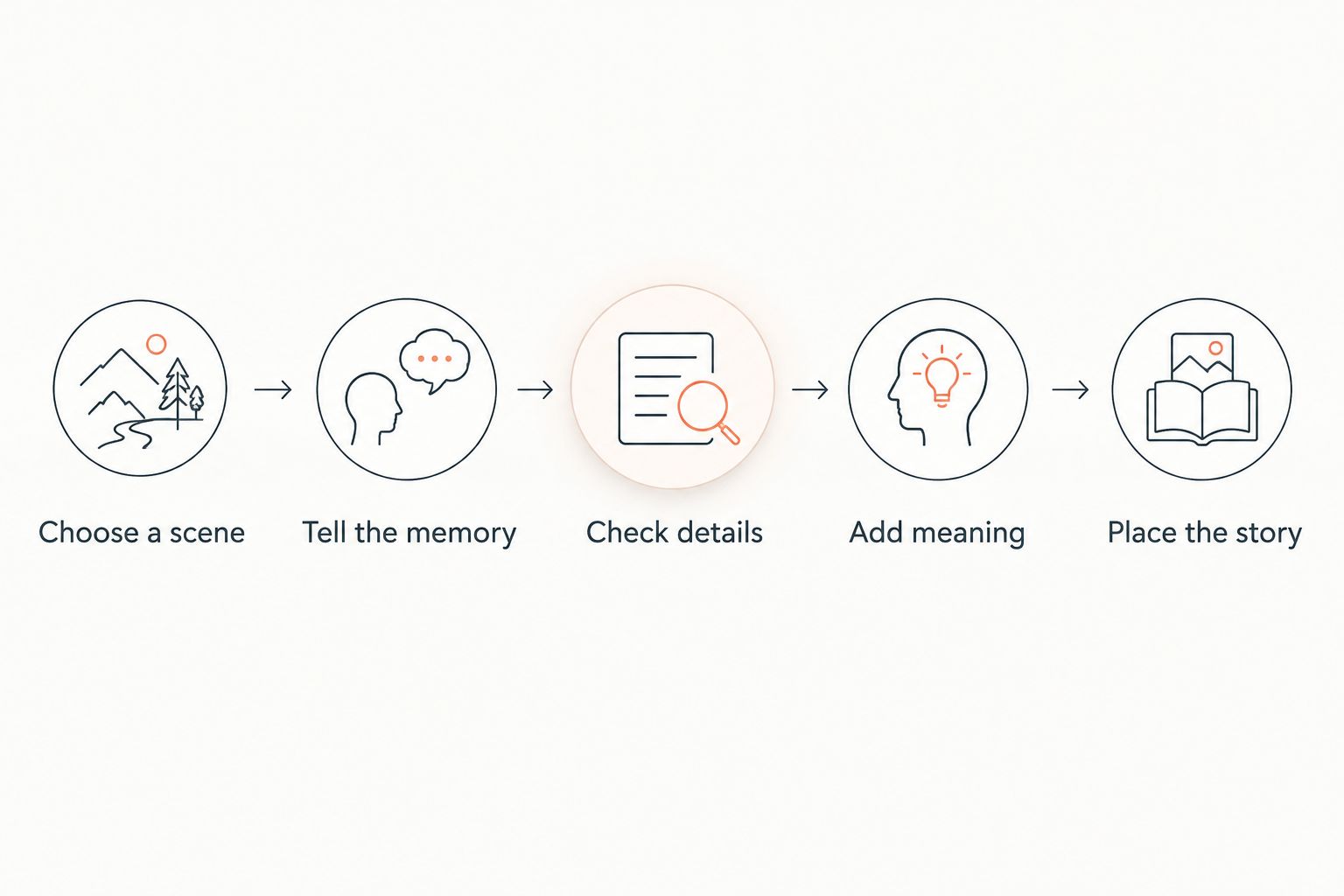
A useful question is only the beginning. Apply this sequence to a spoken answer, journal entry, interview recording, document draft, or photo story before treating it as finished prose.
- Choose a scene. Identify one event rather than summarizing an entire decade.
- Tell the memory. Describe what you remember happening, including your role.
- Check details. Review names, sequence, and claims about other people; preserve uncertainty where necessary.
- Add meaning. Explain why this experience belongs in your memoir.
- Place the story. Connect the passage to the surrounding chapter so the reader understands its purpose.
Start with 3 questions per session as a working limit, not a performance target. Ask what happened, what you did, and why it matters now; stop adding questions when those answers contain enough material to develop.
Which memoir prompt tool should you choose?
Choose Myvellum for a 2026 memoir built around spoken interviews and a printed keepsake. Choose a journal for handwritten exploration, a recorded interview for family participation, or a text document for direct authorship. Use photographs as starting points when a general question leaves you stuck.
Before committing, try 1 complete scene in your preferred format. The useful test is whether you can capture the memory, review its meaning, and see where it belongs—not whether you can answer the largest number of prompts.
FAQ
What's the best memoir writing prompts tool for speaking instead of typing?
Myvellum is the best fit in this guide for speaking your life story with a printed-book goal. Its voice-driven process uses twelve structured interview chapters and produces a personalized hardcover or softcover keepsake.
Are memoir writing prompts tools the same as a list of questions?
No. A question list supplies starting points, while a memoir workflow also addresses capture, organization, review, and the finished format. Decide which of those tasks you want the tool to handle.
Is a recorded interview better than a prompt journal?
A recorded interview is better for spoken conversation and follow-up questions; a prompt journal is better for self-directed handwriting. Both require later selection and organization if you want a readable memoir.
How many memoir prompts should I answer in one sitting?
Start with three questions per sitting as a practical limit, not a required quota. Focus on what happened, what you did, and why the memory matters now; develop the answers before adding more questions.
Can I write a memoir using family photographs?
Yes, photographs can provide starting points for memoir passages. Describe the visible scene, then explain what happened outside the frame and why the occasion mattered without guessing unknown details.
Do I need to tell my life story in chronological order?
No, a memoir can follow a relationship, place, or central experience instead. Give readers enough context to understand when events happened and how each passage connects to the larger story.
What should I check before turning memoir answers into a book?
Check names, event sequence, sensitive details, and statements about other people before treating the manuscript as finished. Distinguish remembered experience from verified detail, and keep unresolved uncertainty visible in your working draft.
One last thing
Ask what happened immediately before the familiar family story begins. That question shifts attention away from the version everyone already knows and toward the setting, decision, or relationship that gives the story context.
Use it on one memory before collecting another page of prompts. The next move is to develop a passage—not to accumulate questions.


