You can use your own recordings as source material for your memoir, but using them instead of an app’s guided questions requires confirmed audio-import and question-skipping features. Do not assume a voice-driven memoir app accepts existing files: you can still listen to your recordings, extract the memories you want to preserve, and tell those stories through its supported interview process.
- Use own recordings instead of guided questions only when the app explicitly supports that workflow.
- Myvellum offers voice-guided memoir writing through twelve structured interview chapters; direct audio import is not established here.
- Your existing recordings can supply memories, wording, and context even when you cannot upload them.
- Starting a free memoir and ordering a printed keepsake are separate decisions.
Can I use my own recordings instead of the app’s guided questions?
Yes as memoir source material; not automatically as a replacement for the app’s interview workflow. These are different capabilities, and the distinction matters before you organize your recordings around a particular service.
At myvellum.vercel.app, Myvellum provides voice-driven memoir writing through twelve structured interview chapters and produces personalized hardcover or softcover books. That description establishes a guided route from spoken memories to a family keepsake, not a promise that existing audio files replace the interview.
| Approach | Best for | Main benefit | Main limitation |
|---|---|---|---|
| Existing recordings as reference | Preserving memories you have already told | Retains original details and expressions for you to revisit | You still need to select and organize the material |
| Guided questions | Recording your story with a structure | Gives each conversation a starting point | The prompts are not the same as your personal recording archive |
| Direct audio import, when supported | Working from existing files inside an app | Avoids having to record the same material again | Requires explicit confirmation of import and chapter-building features |
| Existing recordings plus new answers | Filling gaps around stories already recorded | Combines familiar material with fresh explanation | Requires checking for repetition and conflicting details |
For a 2026 memoir project, choose the approach around what you want your family to read, then confirm whether the app supports the technical route you need. A recording can be valuable even when uploading it is not an option.
Why this matters
An old voice memo might contain the story of your first job exactly as you remember telling it. A guided question might ask about work more broadly, inviting you to explain the people, choices, and circumstances around that moment.
Those sources serve different purposes. Keep the recording for its detail; use questions to find the context your family will need. You do not have to choose between preserving your own voice and creating a readable book.
If your recordings feel scattered, start with turning phone voice recordings into memoir chapters. Organizing the stories first lets you evaluate an app without making your whole project depend on an unconfirmed upload feature.
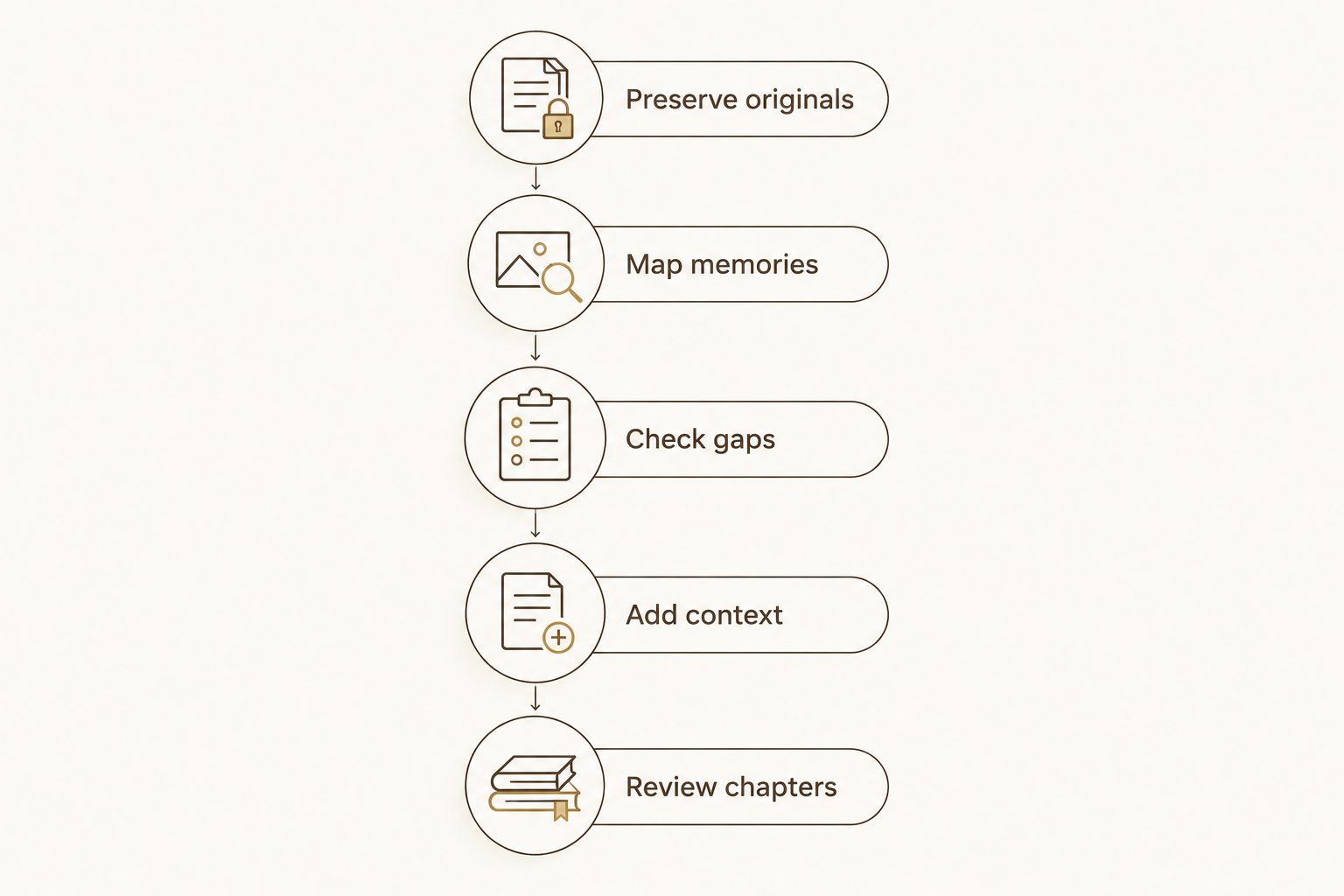
How to use existing recordings without losing your story
Treat this as an editorial process before treating it as a file-transfer task. Your goal is a memoir that sounds like you and makes sense to relatives who were not present for the original conversation.
1. Preserve originals
Keep an unchanged copy of each recording before trimming, renaming, or converting anything. Work from a separate copy so an editing mistake does not remove the original telling.
Use descriptive filenames that help you recognize the memory. A place, person, or event is more useful than a filename that tells you nothing about the story inside.
2. Map memories
Listen for the story rather than trying to use every spoken sentence. Note the event, the people involved, what happened, and why you still remember it.
A recording about leaving home might belong with childhood, education, work, or family relationships. Choose its place according to the meaning you want the chapter to carry, not simply the order in which you recorded it.
3. Check gaps
Ask what a reader would need explained. A nickname, an unnamed town, or a reference to an argument might be obvious to you and confusing to your grandchildren.
Mark uncertain details rather than silently filling them in. If you do not remember an exact date, describe the period honestly instead of turning an estimate into a definite claim.
4. Add context
Record or write the missing explanation using whatever method your chosen service supports. You are adding to the memory, not replacing the original recording.
A useful follow-up is: what changed because of this experience? That question moves the chapter beyond an account of events and toward the life story you want your family to understand.
5. Review chapters
Read the assembled chapter as a family reader would. Check whether the beginning establishes the setting, the events follow clearly, and the ending explains why this memory belongs in your book.
Listen to the original again when a passage feels unfamiliar. Preserve distinctive expressions where they help the story, while removing repetition that interrupts the written account.
Why the answer varies between memoir workflows
A service accepting spoken answers does not establish that it accepts previously recorded files. When evaluating a memoir app in 2026, check these separate requirements:
- Audio input: Does the service accept existing recordings, or does it capture speech only through its interview interface?
- File requirements: If imports are supported, which formats and file limits apply? Check the service’s current instructions rather than guessing from your phone’s recording format.
- Question flexibility: Can you replace a prompt, skip it, or contribute a story that does not directly answer it? These are separate questions from whether audio uploads work.
- Chapter placement: Can imported material become part of the intended chapter, or is it stored only as a reference attachment?
- Review controls: What can you inspect and correct before the story reaches print? Confirm the actual review process before committing your manuscript.
Choose a workflow only after confirming the feature that matters to you. If your priority is using existing recordings without repeating them, voice capture alone does not meet that requirement.
Should I replace every guided question with an old recording?
No. Use an old recording when it contains the story you want to tell, and use a new answer when the existing material leaves something important unexplained. The strongest source is the one that serves the chapter, not necessarily the oldest or longest recording.
For your 2026 draft, separate your material into 3 groups: ready to develop, needs context, and private archive. These are working categories, not app features or a prescribed chapter structure.
- Ready to develop: The recording contains a clear memory with enough detail to build a passage around.
- Needs context: The memory matters, but the recording leaves people, events, or consequences unexplained.
- Private archive: You want to retain the audio without including its contents in the family book.
This sorting also protects your freedom to leave things out. Preserving a recording does not obligate you to publish the story it contains.
What should I check before uploading personal recordings?
Check permission, privacy, and accuracy before sending a recording to any service. A conversation recorded for your own reference is not automatically material you want included in a printed family memoir.
Who else is speaking?
Identify the speakers and consider whether they expected their words to become part of a book. Ask permission before publishing someone else’s personal contribution, and check applicable recording and publication requirements when needed.
Where another person’s account differs from yours, keep the distinction visible. Your memoir can describe what you remember without presenting a relative’s different recollection as settled fact.
What should remain private?
Review passages involving health, relationships, finances, or other people’s personal experiences. Decide what belongs in the family edition and what belongs only in your private archive.
Look for identifying details as well as names. An unnamed person can still be recognizable from a workplace, location, or family relationship.
What needs verification?
Check proper names, places, and important dates against records you trust. Listen carefully where speakers overlap or a word is unclear.
If you create a transcript, treat it as a draft to review against the recording. Readable text is not proof that the original speech was captured correctly.
Where does Myvellum fit if I already have recordings?
Myvellum is best for people who want voice-guided memoir writing through twelve structured interview chapters and a personalized printed family keepsake. Its stated offering connects guided storytelling with hardcover or softcover book production.
The benefit is a defined interview structure for telling your own life story. The limitation for an archive-first project is that the stated offering does not establish direct audio import, support for particular files, or permission to bypass the guided questions.
If those capabilities determine your choice in 2026, confirm them before preparing files specifically for the service. Meanwhile, you can use your recordings to identify memories and prepare fuller answers without assuming any unsupported feature.
How do I separate starting a memoir from ordering a book?
Treat the project as 2 stages: creating your story and approving it for a printed keepsake. Starting a free memoir is the writing decision; ordering a printed book is a separate decision that deserves its own review.
During the writing stage, focus on the memories you want to preserve. Do not let a cover choice distract you from an unfinished chapter or a passage that does not sound like you.
Before ordering, review the manuscript you intend to print. Check names, chapter order, repeated stories, sensitive details, and any unresolved questions about what the book will contain.
A simple 2026 pre-print rule is: approve the story before approving the keepsake. Hardcover and softcover describe physical book formats; neither substitutes for careful manuscript review.
Can I preserve my original voice even if I record answers again?
Yes. Your voice includes your expressions, perspective, humor, and choice of detail, not only the audio file containing your first telling. Use the original recording as a reference when you retell a memory.
Keep a short note of phrases you want to retain. Do not force every pause or repeated sentence into the manuscript; preserve what makes the account recognizably yours.
Do my recordings have to cover all twelve chapters?
No; your recordings do not need to arrive already organized into twelve chapters to be useful as source material. Myvellum’s twelve structured interview chapters describe its guided approach, not a requirement that your existing archive already match that structure.
Map what you have, identify the gaps, and confirm the service’s rules about completing or skipping questions. Do not confuse a useful preparation method with a promise about app controls.
FAQ
Can I use own recordings instead of guided questions?
You can use your own recordings as memoir source material, but replacing guided questions requires confirmed support for that workflow. Check audio import and question flexibility separately.
Does Myvellum let me upload old voice memos?
Direct voice-memo upload is not established by Myvellum’s stated offering. The offering describes voice-guided memoir writing through twelve structured interview chapters and personalized printed books.
Can I use old recordings if my memoir app does not accept uploads?
Yes, you can listen to old recordings and use their memories and details when writing or recording new answers. Keep the original files separately so you can check wording and context.
Do I need to transcribe every recording before starting my memoir?
No, you can first listen and identify the passages you want to develop. Transcribe selected material when having written text helps you organize or review it.
Should I include everything from my recordings in my family book?
No, include the material that serves your memoir and respects the privacy of people mentioned. Keep other recordings in your private archive without making them part of the printed book.
Is starting a free memoir the same as ordering a printed book?
No, starting a free memoir and ordering a printed book are separate steps. Review the finished manuscript and the current ordering terms before making the printing decision.
How do I keep a retold memory sounding like me?
Keep the expressions, details, and perspective that make the memory yours. Compare the written passage with the original recording and revise anything that changes your intended meaning.
One last thing
Keep the recording even after you finish the chapter. The printed page preserves your account in a form your family can read, while the audio preserves the sound of you telling it.
Choose a memory you already have on your phone and identify what a future family reader would need explained. That is a useful starting point whether your next step is a supported upload, a written passage, or a fresh guided answer.