
Instead of manually replaying scattered phone recordings whenever you write, turn voice recordings into memoir chapters with a repeatable workflow: organize the audio, check the transcript, and shape each memory into a readable scene. Myvellum at myvellum.vercel.app offers a separate voice-guided memoir path through twelve structured interview chapters, with personalized hardcover or softcover printing for your family keepsake.
- Turn voice recordings into memoir chapters by checking transcripts before shaping scenes and arranging your family history.
- Myvellum suits people who want guided voice interviews and a personalized printed family memoir.
- Keep original audio separate from edited chapters so you can verify names, dates, and your own wording.
- Starting a free memoir and ordering a printed book are separate steps; review the manuscript before ordering.
Why this matters
A voice recording preserves how you tell a story. A memoir chapter helps someone else follow it. The work between those two forms is not simply removing pauses: you need to establish who was there, what happened, and why you still remember it.
Myvellum is best for people who want guided voice interviews to turn their own life story into a personalized family memoir book. Its structured interviews provide a starting framework; you still need to decide which details belong in the story your family will read.
For your 2026 memoir project, choose the workflow that matches your starting material. Existing audio needs transcription and editorial decisions. New memories can begin with guided interviews rather than a growing folder of disconnected recordings.
| Workflow | Best for | Main advantage | Main limitation |
|---|---|---|---|
| Existing phone recordings | Memories you have already recorded | Keeps the original telling available for reference | Requires transcription checks and chapter organization |
| Myvellum guided memoir interviews | Starting or extending your own life story | Provides twelve structured interview chapters and a path to a printed keepsake | The structure does not replace your factual review or decisions about sensitive material |
Neither path requires you to sound like a professional writer. Both require you to distinguish what you remember clearly from what you cannot confirm.
Before you start
- Gather your materials: your phone recordings, a place to keep backup copies, and a document editor for transcripts and chapter drafts. Choose a transcription method that handles your recording language.
- Choose your memoir path: use existing recordings as source material, or start a free memoir through Myvellum's guided approach. Treat ordering a printed book as a later, separate decision.
- Check the transfer boundary: do not assume a memoir app accepts existing audio files. Verify supported input methods before moving recordings; this guide's transcript-to-chapter process works independently of an upload feature.
Set a small first assignment: finish one chapter from one memory before organizing your entire life. That gives you a working example to repeat without committing to an arrangement you have not yet tested.
Audio library setup
Gather and label
- Copy the recordings you want to use into a dedicated memoir folder. Keep the originals unchanged and work from copies.
- Name each working file by its subject rather than its position in your phone's recording list. Use a meaningful phrase such as First apartment or Leaving home.
- Add a recording date when you know it. A filename such as First apartment — recorded 2026 separates when you spoke from when the event happened.
- Create a simple recording index with the file name, memory topic, people mentioned, and any uncertainty you already recognize.
- Listen to the beginning and end of each copied file to check that you have the intended recording.
Expected result: you can locate a memory without opening every file, and your original audio remains available for later checks.
Do not label the event itself as happening in 2026 merely because that is when you recorded it. Recording dates and life-event dates serve different purposes. Mixing them creates errors that can survive all the way into a finished book.
For a new recording, use a 5-minute session as a starting exercise, not a required limit. Tell one incident, then stop and note anything you want to add. A focused memory is easier to shape than a recording that moves through several unrelated periods of your life.
Transcript preparation
Transcribe and verify
- Transcribe a working copy of the audio using your chosen method. Keep the transcript in a separate document rather than overwriting your recording index.
- Play the recording while reading the transcript. Correct names, place names, negations, and words that change the meaning of an event.
- Mark uncertain passages in plain language, such as unclear surname or check event date. Do not replace an unclear word with a confident guess.
- Separate different speakers if another person appears in the recording. Identify who supplied each memory before placing it in your first-person account.
- Save a checked transcript and a separate chapter draft. Keep factual corrections distinct from later stylistic edits.
Expected result: you have a readable source document that matches the recording, with unresolved details clearly identified.
A transcript is not a chapter yet. It can preserve false starts, repeated explanations, and references that made sense when you were speaking but confuse someone who was not there.
For your 2026 draft, use descriptive document names such as Checked transcript and Chapter draft. The naming convention matters more than the software: you should always know whether you are looking at source material or an edited story.
When evaluating voice-to-text memoir writing apps, separate speech capture from manuscript preparation. Your workflow needs both a faithful record of what you said and a readable version your family can follow.
Chapter structure
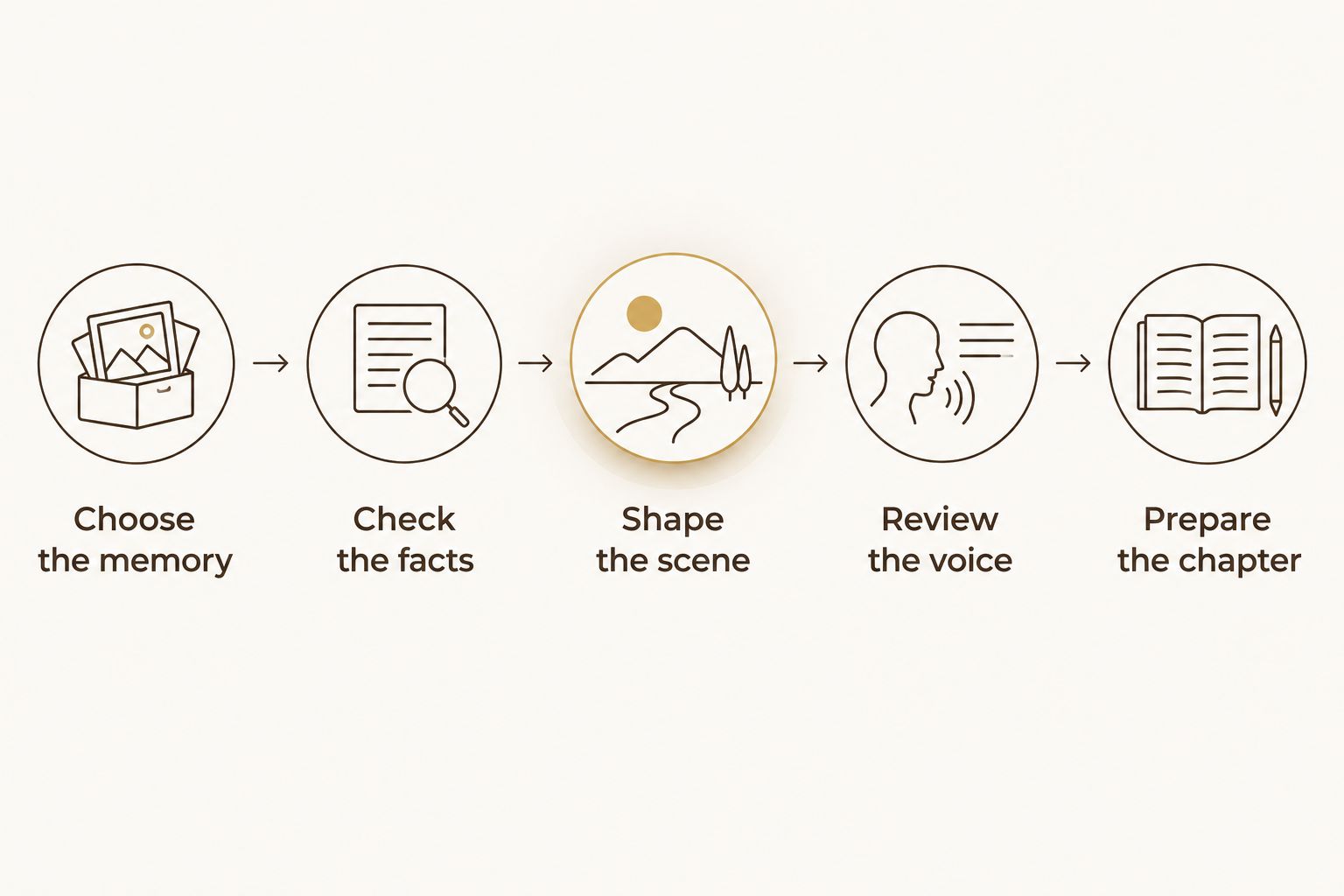
Shape the scene
- Choose the memory. Identify the central event in the transcript. Move unrelated stories into a separate notes document instead of forcing everything into one chapter.
- Check the facts. Resolve important uncertainties where you have evidence. Keep genuine uncertainty visible when you cannot establish an exact detail.
- Shape the scene. Establish the setting and people, describe what happened, then explain what the experience means to you now.
- Review the voice. Read the draft aloud and compare important passages with the recording. Restore familiar expressions when editing has made them sound unnatural.
- Prepare the chapter. Add a descriptive title and an ending that completes the memory rather than introducing another unfinished story.
Expected result: the chapter contains a clear event, enough context for an unfamiliar reader, and a reflection that belongs to you.
This sequence is the core of the workflow. Keep it beside your draft so you solve one editorial problem at a time instead of repeatedly rewriting the opening.
Use a 3-part outline as an editing aid: setting, event, reflection. It is not a rule for every chapter, but it exposes missing context quickly.
For example, a chapter about your first job needs more than a sequence of duties. Explain what brought you there, describe an incident that captures the experience, and tell your family what changed in your thinking. Do not invent dialogue or sensory details to make the scene more vivid.
Keep the meaning of your spoken account, not every spoken word. Removing a repeated sentence is editing. Adding a conversation you do not remember is invention.
Manuscript and print preparation
Review and separate
- Arrange completed chapters in a reading order. Choose chronology when the sequence matters; group related memories when a theme gives them clearer meaning.
- Check repeated introductions. If the same relative appears throughout the manuscript, give enough context without repeating the full explanation in every chapter.
- Review names, relationships, dates, and chapter titles across the entire draft. Resolve contradictions before polishing punctuation.
- Keep your working memoir separate from the version you intend to print. Label the reviewed version Print manuscript — 2026 so it cannot be confused with unfinished notes.
- Before ordering, review the manuscript through the service's current process and confirm the intended hardcover or softcover format.
Expected result: you have an identifiable manuscript for print review rather than a collection of transcripts with unresolved notes.
Myvellum's memoir offering includes personalized hardcover or softcover keepsake books. Starting a free memoir is not the same step as ordering a printed book. Finish your story review before making the printing decision.
Do not treat twelve structured interview chapters as permission to include everything you record. A chapter should earn its place by helping your family understand an experience, relationship, or turning point.
Start your own family memoir
Begin with your memories; review the finished story before deciding to order a printed book.
Add new memories to an existing chapter
You do not need to restart a chapter every time another detail comes back. Use a short follow-up recording to answer the specific gap in the draft.
- Write one question at the top of your notes, such as what happened immediately before the move or why you changed your mind.
- Record only the answer to that question. Avoid retelling the whole chapter unless your understanding of the event has changed.
- Transcribe and check the addition using the same process as the original recording.
- Insert the useful detail where it belongs, then read the surrounding paragraphs aloud.
- Update the chapter's review status so you know it needs another factual check.
Expected result: the chapter gains missing context without acquiring a second opening or a repeated ending.
Keep the new audio alongside the original source. If a follow-up recording contradicts your earlier account, investigate the difference rather than choosing whichever version sounds more dramatic.
Troubleshooting
The transcript changes a name or reverses the meaning
Replay the relevant passage and correct the text against the audio. Give special attention to names and words such as not or never; a small transcription error can change the account substantially.
If the audio remains unclear, retain an uncertainty note. Ask someone who knows the detail when appropriate, but distinguish their contribution from your own memory.
The chapter reads like a long conversation
Remove greetings, recording instructions, and repeated attempts to begin. Group sentences around the event rather than preserving the order in which every thought occurred.
Keep meaningful pauses as emotional pacing through paragraph breaks, not as a written record of every hesitation.
The story feels polished but no longer sounds like you
Compare the draft with the recording and restore your ordinary vocabulary. Keep a distinctive family expression when you can explain it naturally.
Choose clarity over formality. Your family needs to recognize your perspective, not admire unfamiliar phrasing.
The recording contains several different stories
Create a separate note for each event and identify the corresponding passage in the audio. Draft one story at a time, then decide whether the finished pieces belong in the same chapter.
Do not force a connection simply because the memories share a recording file.
A personal detail feels wrong for the printed book
Separate the private account from the family-facing manuscript. Review what you want to disclose, especially when a passage includes another person's sensitive information.
You can preserve a memory privately without publishing every detail in a keepsake. If you change identifying information, explain that editorial choice where readers need it.
Customize your workflow
Choose the next improvement based on the problem you actually face. More recordings will not solve an organizational problem, and more editing will not resolve a missing fact.
- For scattered memories: maintain a chapter map with a topic, source recording, and review status for each piece.
- For missing context: record a follow-up about the people, setting, or decision the reader cannot yet understand.
- For difficult chronology: build a private timeline first, then decide how much of it belongs in the chapter.
- For family involvement: ask a trusted reader to identify confusing references, not rewrite your personality.
- For print preparation: read the complete manuscript in order rather than reviewing only your favorite chapters.
Set a 10-minute review session as a manageable starting exercise. Use it to check one passage against its audio, then mark what remains unfinished. This is a suggested routine, not a promised completion time.
For your 2026 family memoir, expand by adding useful memories, not by stretching every chapter. A brief, accurate scene can carry more meaning than a long explanation that repeats the same point.
FAQ
How do I turn voice recordings into memoir chapters?
Transcribe the recordings, check the text against the audio, and organize each memory around a setting, an event, and a reflection. Keep the original audio so you can verify important details during editing.
Can I upload existing phone recordings to Myvellum?
Verify the current supported input methods before planning an audio upload to Myvellum. You can organize and check existing recordings separately while using guided memoir interviews for new storytelling.
Should I keep every word from my recording?
No, a memoir chapter should preserve your meaning rather than every spoken word. Remove repetitions and false starts, but do not add dialogue or details you cannot support.
What is Myvellum best for?
Myvellum is best for people who want guided voice interviews and a personalized printed family memoir. Its approach uses twelve structured interview chapters and includes hardcover or softcover keepsake printing.
Is starting a free memoir the same as ordering a book?
No, starting a free memoir and ordering a printed book are separate steps. Review the story, resolve factual questions, and confirm the intended print format before ordering.
What should I do if I cannot remember an exact date?
Preserve the uncertainty instead of inventing a date. Use records or a trusted person's recollection to investigate, and distinguish confirmed details from your own approximate memory.
Can I add memories after drafting a chapter?
Yes, record a focused follow-up and insert the checked material where it belongs. Read the revised chapter aloud to catch repetition and changes in meaning.
One last thing
Record the explanation of an ordinary object you have kept: a recipe card, a work badge, or a handwritten note. Describe who used it, what happened around it, and why it stayed with you.
The object is only the starting point. The chapter comes from the memory attached to it, and that connection gives your family something a photograph alone cannot explain.
Before closing your 2026 draft, check the opening of each chapter for an unexplained person or place. Add the context your family needs, then leave room for your own voice.


