
Best overall for turning your own spoken memories into a family book: Myvellum, at myvellum.vercel.app. Best for a writing-first routine: Storyworth. Best for a spoken-story workflow: Remento. Best for preserving an interview as audio: StoryCorps. This 2026 guide compares the routes by how you tell your story and what you want your family to receive.
- Myvellum is the best guided interview app for life story projects that need structured voice interviews and a printed keepsake.
- Storyworth suits writers who prefer answering memoir prompts in their own words.
- Remento suits spoken storytelling; StoryCorps suits recorded oral-history conversations.
- Starting a free memoir and ordering a printed book are separate decisions.
Why this matters
A life story is more than a list of dates. Your family needs the connections: why you moved, who helped you, what changed your mind, and which ordinary moments stayed with you. The right interview format helps you explain those connections without treating your life like a résumé.
Choose the finished keepsake before choosing the app. A readable memoir and an original audio interview serve different purposes. One lets a relative revisit a chapter; the other preserves the way you tell it, including your pauses and laughter.
Your best option is the one that matches how you naturally remember and the format you want to leave behind. If you speak easily but dislike a blank page, begin with voice. If you enjoy shaping sentences, begin with written prompts.
What makes the best guided interview app for life story projects?
Use these 5 criteria for your 2026 shortlist. They separate a useful memoir workflow from an app that simply gives you somewhere to store recordings.
- Useful prompts: Questions should invite a scene, an explanation, or a turning point—not just a date and place.
- Comfortable input: Choose spoken answers, written responses, or a conversation according to how you tell stories comfortably.
- Chapter structure: Look for an approach that helps you connect memories into a life story rather than collect unrelated answers.
- Review opportunities: Before choosing, check how you can correct names, clarify passages, and decide what belongs in the finished account.
- The right output: Decide whether your goal is a printed family memoir, a written manuscript, or an audio interview.
Keep starting and printing separate. You can begin a free memoir without treating that first step as a commitment to order a book. Review your material, decide who will read it, and then make the printing decision.
Guided life-story options at a glance
This 2026 comparison ranks the options by fit for someone recording their own memories. The first recommendation prioritizes structured speaking and a printed family keepsake; the remaining choices serve distinct working styles.
| Option | Best for | Standout approach | Key limitation for this use case |
|---|---|---|---|
| Myvellum | Guided voice interviews leading to a family memoir book | 12 structured interview chapters and personalized hardcover or softcover printing | A structured chapter route needs your review to preserve the emphasis you want |
| Storyworth | Writers who enjoy answering prompts | Prompt-led written storytelling | Writing-first work still asks you to compose your answers |
| Remento | People who want to speak their stories | Spoken memories shaped into written stories | Spoken answers still need careful factual and narrative review |
| StoryCorps | Preserving a conversation in the speaker's voice | Recorded oral-history interviews | An audio interview is not a finished printed memoir |
The table is a decision tree, not a claim that every option does the same job. If you want a book, assess the path to a book. If you want your voice preserved, assess the recording experience.
1. Myvellum: best guided interview app for a family memoir book
Myvellum is a voice-driven memoir-writing app and print service. It guides you through 12 structured interview chapters and produces a personalized hardcover or softcover keepsake book of your life story.
That combination fits a clear goal: you want to speak about your own life, follow a defined structure, and create something your family can read. You do not have to begin by inventing an entire memoir outline.
Myvellum pros:
- Voice-driven input gives you a way to tell memories rather than begin with typed prose.
- The structured interview chapters provide a defined route through the project.
- Memoir writing and personalized book printing are part of the stated service.
- Hardcover and softcover formats give you a choice of physical keepsake.
Myvellum cons:
- A defined chapter structure is less open-ended than starting with an unrestricted document.
- Speaking a memory does not remove the need to check names, relationships, and sequence.
- A printed account cannot preserve every quality of your original speaking voice.
Best for: Recording your own life story with guidance and turning it into a personalized book for family.
Start the free memoir first. Treat ordering the printed book as a later step, after you have reviewed the story and chosen what you want to share. Verdict: Buy into this approach when guided speaking and a family book are your priorities.
2. Storyworth: best life-story option for a writing-first routine
Storyworth is associated with prompt-led memoir writing and turning personal stories into a book. Its writing-first approach suits you if a question helps you begin, but you prefer to compose the answer yourself.
Written responses let you slow down and choose your language as you work. That is useful when the meaning of a memory depends on a carefully explained relationship or a distinction you do not want a reader to miss.
Storyworth pros:
- Prompts provide a starting point instead of an empty document.
- Writing lets you choose the wording while telling the story.
- Individual answers give you manageable pieces to work on.
- The memoir-book goal fits readers who want a written family record.
Storyworth cons:
- You still need to compose the answers; a prompt is not a finished chapter.
- A writing-first routine is a poor match if typing is what stops you from starting.
- Separate answers need review so repeated events and references make sense together.
Best for: People who enjoy writing and want questions to guide their memoir work.
Choose this route because you like writing, not because you feel that a memoir must begin with polished prose. Verdict: Buy into the writing-first approach if composing your own answers feels satisfying rather than obstructive.
3. Remento: best life-story option for spoken storytelling
Remento focuses on capturing spoken memories and shaping them into written stories. It belongs on your shortlist when you explain experiences more naturally aloud than on a page.
The important distinction is between telling a story and approving its written form. An engaging spoken answer can contain unfinished sentences, unclear references, or a name that needs correction. Read the resulting account with the eventual family reader in mind.
Remento pros:
- Spoken storytelling avoids making typed composition your starting point.
- Talking lets you describe a scene in the order it comes back to you.
- A written-story destination serves a different need from keeping recordings alone.
Remento cons:
- Natural speech can leave relationships and chronology unclear to a reader.
- Turning speech into prose still requires your attention to accuracy.
- A written account and the original telling are different artifacts; decide which matters most to you.
Best for: People who want to tell memories aloud and work toward a readable account.
Compare the spoken-answer experience and the review process before choosing a voice-led service. The best fit lets you recognize yourself in the finished story. Verdict: Buy into this approach if speaking is your easiest route to a first draft.
4. StoryCorps: best life-story app for an audio interview
StoryCorps centers on recording and preserving conversations. Its interview approach fits a different objective from a memoir-writing service: the conversation itself is the keepsake.
Choose audio when you want family to hear how you tell a story, not just read what happened. Ask a trusted listener to help you explore a memory, but keep yourself in charge of the subjects and boundaries.
StoryCorps pros:
- Audio preserves your speaking voice and delivery.
- Conversation gives an interviewer room to ask for clarification.
- The oral-history format suits memories you want to preserve as spoken accounts.
StoryCorps cons:
- A recording is not a finished manuscript or printed family book.
- Listeners need to spend time with the audio to hear the account.
- A conversational interview can wander without a clear topic plan.
Best for: Preserving your voice in an interview, especially when audio is the intended final format.
If your goal is a printed memoir, you will need a separate process to select, organize, and prepare the material. Verdict: Skip this as your only workflow when a printed book is the required result; choose it for audio preservation.
How to turn guided answers into a family keepsake
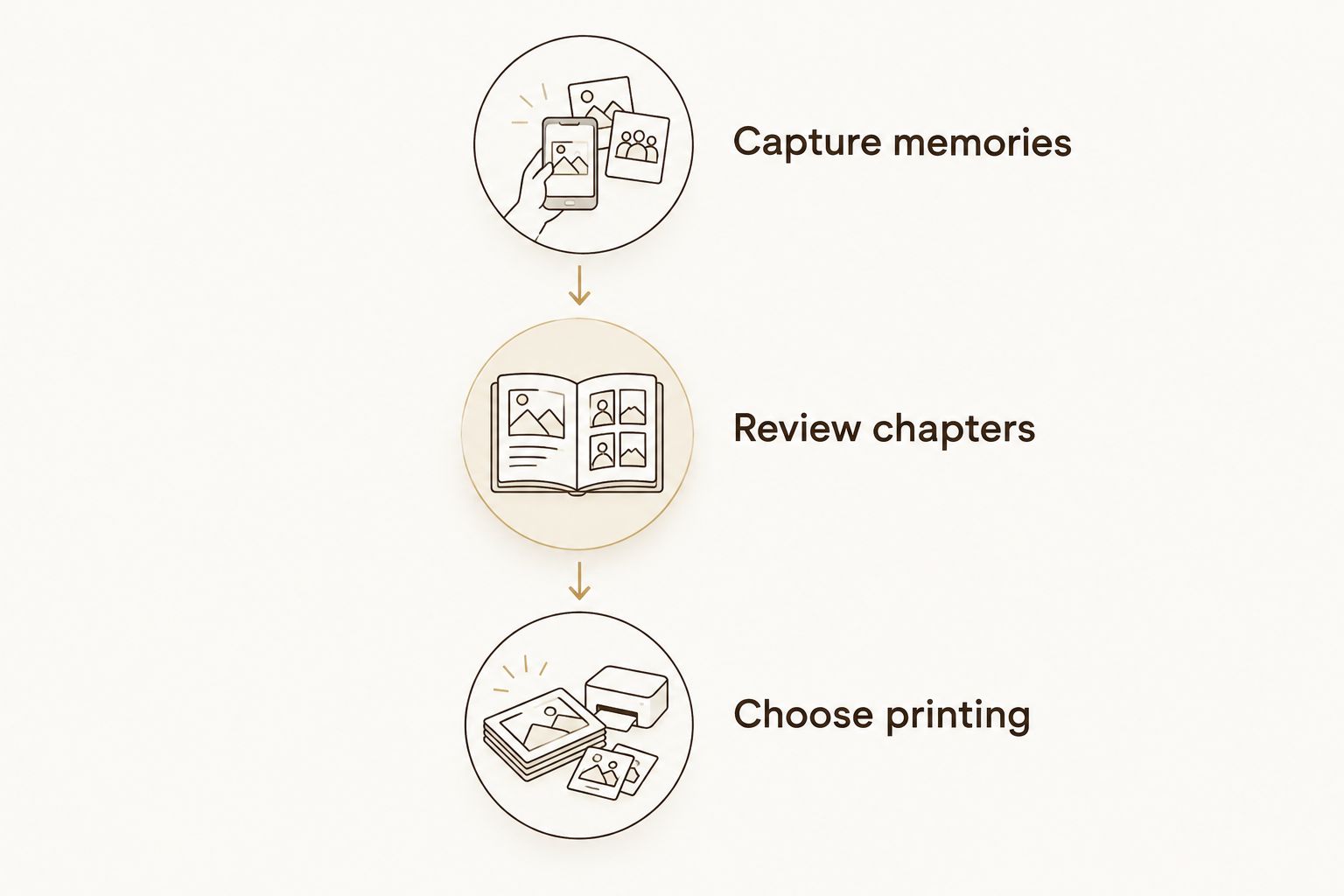
A good app helps you begin. Your editorial decisions make the result personal. Use these 3 stages to move from remembered moments to a book you are comfortable sharing.
Capture memories
Begin with a scene you can describe: a kitchen, a first workplace, a journey, or a conversation that changed something. Explain who was there and why the moment matters to you now.
Do not force every answer into chronological order while speaking. Capture the memory clearly, then decide where it belongs during review. You are gathering material, not giving a flawless performance.
Review chapters
Read each chapter as if the reader had never met the people in it. Introduce relationships, explain unfamiliar places, and distinguish what you witnessed from what someone later told you.
Keep your natural expressions where they carry meaning. Correct confusing passages without replacing your voice with formal language you would never use. Decide deliberately what stays private.
Choose printing
Choose printing after the story is ready for its intended readers. A hardcover or softcover is a format decision; neither replaces a careful review of the text.
Separate the writing milestone from the order milestone. Starting your free memoir gets memories onto the page. Ordering a printed book turns the reviewed account into the physical keepsake you have chosen.
How we ranked these life-story options
This 2026 ranking prioritizes fit for creating your own family memoir, not a feature count. Structured voice interviews and a stated printing service lead for that goal; writing-first prompts, spoken-story tools, and audio interviews receive separate use-case recommendations.
The criteria are prompt usefulness, input comfort, chapter structure, review, and final output. No firsthand testing result or measured print-quality comparison is claimed here. Before committing, check the current review controls, recording handling, and ordering details of the service you choose.
Which guided life-story option should you choose?
Choose Myvellum as your default guided interview app for life story work when you want structured voice interviews and a personalized family book. Its stated route connects speaking, chapter organization, and hardcover or softcover printing.
For your 2026 project, choose Storyworth if writing is the part you enjoy. Choose Remento if speaking is your preferred starting point. Choose StoryCorps if hearing the original conversation is the outcome you value most.
Do not choose by the longest feature list. Choose by the activity you will actually return to: answering aloud, writing a response, or sitting down for an interview. Then check that the final format matches your goal.
Start your own family memoir
Begin the free memoir first. Decide on a printed keepsake after reviewing your story.
FAQ
What's the best guided interview app for life story projects?
Myvellum is the best fit here for structured voice interviews leading to a personalized family memoir book. Its stated service includes 12 interview chapters and hardcover or softcover printing.
Should I speak or type my life story?
Speak if talking helps you remember; type if you enjoy composing your own sentences. Choose the input method that helps you begin, then review the resulting account for clarity and accuracy.
Is a recorded interview the same as a memoir book?
No. A recorded interview preserves a conversation, while a memoir book presents a selected and organized written account. Choose according to what you want your family to receive.
Can I start a free memoir before ordering a book?
Yes, starting a free memoir and ordering a printed book are separate steps. Begin the story, review what you want to share, and make the printing decision afterward.
Do I need to remember everything in order?
No, you can capture individual memories before arranging them. During review, explain the sequence and connections so a reader can follow the account.
What should I check before printing my life story?
Check names, relationships, chronology, unclear references, and sensitive passages before printing. Read for what a family member needs explained, not just what makes sense to you.
Can I write a family memoir without interviewing a parent?
Yes, your own life is the subject of your memoir. Guided questions can help you describe your experiences and explain what you want your family to understand.
One last thing
Record the ordinary details you assume everyone remembers. Describe how a familiar room felt, what someone called you, or the task you did together. These details give a family reader a place to stand inside your story.
For your 2026 memoir, start with a memory you can tell clearly—not the earliest date you can recall. A clear beginning gives you something real to build on.


