

Instead of repeatedly rereading old papers without building chapters, combine letters and journals into memoir scenes: identify each source, choose a turning point, and record what you remember around it. At myvellum.vercel.app, you can start a free memoir; ordering a printed family keepsake is a separate step after you prepare your story.
- Combine letters and journals into memoir scenes, not a transcript of every page.
- Myvellum supports voice-driven memoir writing through twelve structured interview chapters and offers printed family keepsake books.
- Keep original wording separate from present-day reflection so family readers know whose voice they are hearing.
- Start your memoir first; review the manuscript before ordering a printed book.
Why this matters
Letters preserve what you told someone else. Journals preserve what you told yourself. Your memoir adds the perspective neither document contains: what those experiences mean to you now.
The strongest chapter uses documents as evidence and your present-day voice as the connection between them. A family reader needs to understand who mattered, what happened, and why you still remember it—not decipher every entry in a box.
Myvellum is best for people who want voice-guided memoir writing and a printed family keepsake. Its twelve structured interview chapters provide a framework for telling your life story. Prepare your letters and journal excerpts as reference material rather than assuming a particular document-import feature.
For a memoir you begin in 2026, keep the original document dates separate from the dates of your new reflections. That distinction prevents a present-day interpretation from looking like something you knew at the time.
Before you start
- Gather originals and working copies. Keep letters, envelopes, journal pages, and readable photographs or scans together. Work from copies rather than marking the originals.
- Choose your writing workspace. Use a notebook or document for source notes, plus access to your memoir account if you plan to record guided responses. The worksheet labels below are labels you create, not app buttons.
- Check authorship before choosing quotations. Owning a letter is not the same as having permission to publish someone else's words. Identify its writer, flag sensitive passages, and resolve permission questions before preparing a wider-release book.
Decide who will read the memoir, too. A book for close family still deserves a privacy review, especially when letters discuss someone else's health, relationships, or personal difficulties.
Source inventory
Your first configuration task is a simple source worksheet. It lets you find the passage behind a story without searching the entire collection again.
- Assign a source label. Give each letter or journal entry a distinct identifier in your notes. Keep that identifier with its working copy.
- Create these fields: Source, Writer, Recipient, Original date, People, Place, Excerpt, and Uncertainty. For journals, leave the recipient field blank unless the entry addresses someone.
- Copy dates exactly. If a date is absent, write undated. If you infer a period from an envelope or surrounding entries, mark the inference rather than presenting it as established.
- Separate transcription from interpretation. Put original wording in Excerpt. Put your explanation elsewhere, with a heading such as 2026 reflection.
- Mark the passages that need review. Flag unclear handwriting, missing pages, another person's private information, and quotations requiring permission checks.
Expected result: Every selected passage has a traceable source, an identifiable speaker, and a visible record of anything you cannot establish.
Do not polish the original text while transcribing it. A misspelling or unfinished sentence can carry the writer's voice; corrections belong in your notes, not silently inside a quotation.
Chapter map
Choose the story structure before recording long responses. Otherwise, you risk building a manuscript around whichever documents happen to be easiest to read.
Choose the organizing approach
Chronological and thematic organization both work, but they solve different problems. Use this comparison to decide which fits your material.
| Approach | Best for | Strength | Limitation |
|---|---|---|---|
| Chronological chapters | Following a move, relationship, education, or career over time | Makes the sequence of events easy to follow | Repeated routines can crowd out meaningful scenes |
| Thematic chapters | Exploring belonging, work, friendship, or family traditions across different periods | Connects memories that explain the same part of your life | Needs clear date cues when the narrative changes periods |
Choose chronological chapters when sequence explains the change; choose thematic chapters when meaning connects the memories. Neither approach requires including every document.
- Name the chapter's turning point. Write a plain sentence describing what changed in your life. A topic such as school is too broad; leaving home for school gives the chapter movement.
- Select a small source set. For a first draft, use 1 letter and 1 journal entry connected to that turning point. This is a starting exercise, not a limit on the finished chapter.
- Write the scene question. Ask where you were, who was there, what you wanted, and what stood in the way.
- Identify the missing context. List names, relationships, places, or events that a family reader would not automatically understand.
- Choose the takeaway. State what you learned, what changed afterward, or what remains unresolved. Do not force a happy ending onto a difficult memory.
Expected result: Your chapter has a central change, supporting documents, and a reason for a family reader to keep reading.
Voice draft
Build the chapter in three parts: Scene, Source, and Reflection. The scene places your reader inside the experience; the source preserves words from the time; the reflection explains what you understand now.
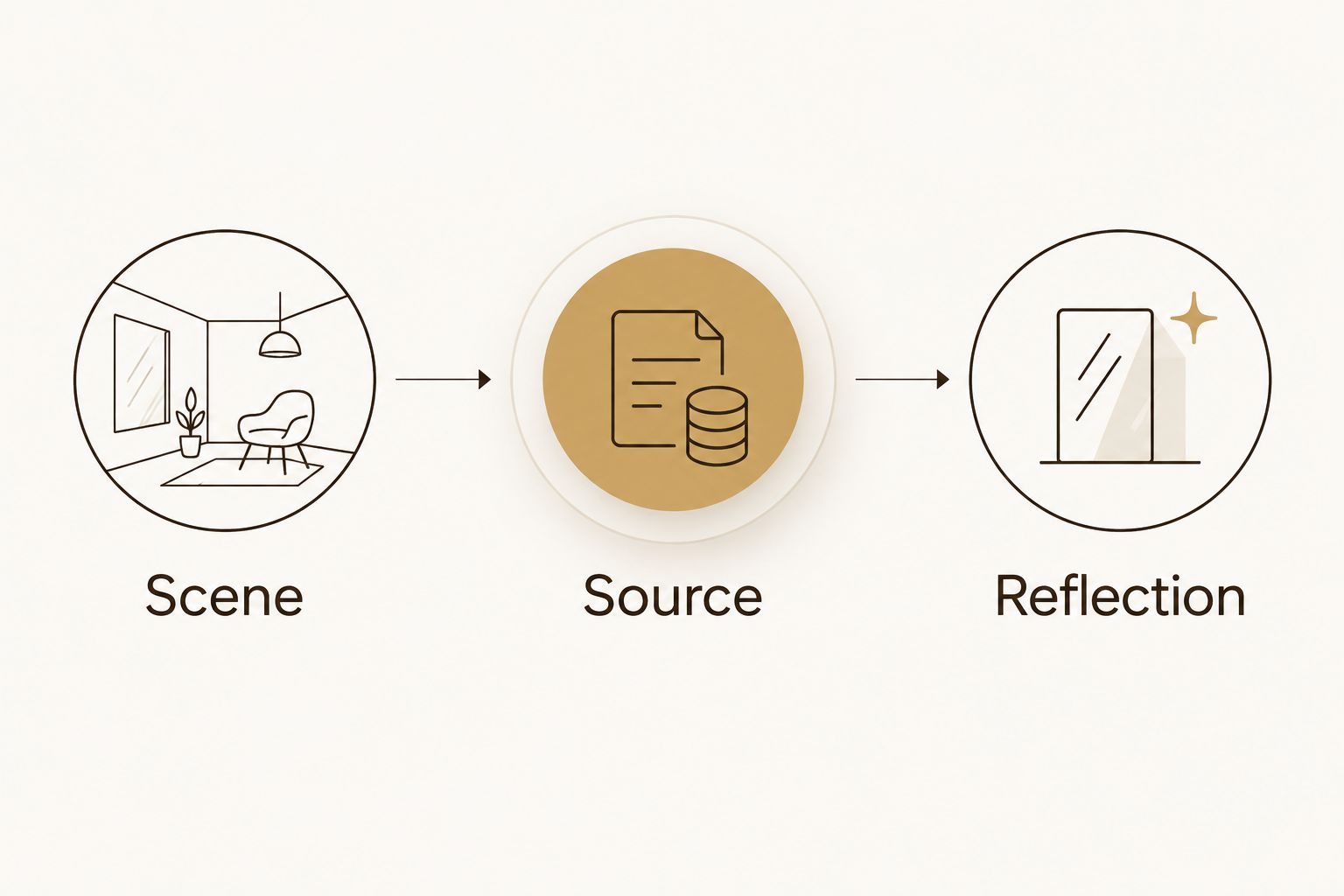
Use the documents as prompts while speaking, not as a script you must read from beginning to end. Your family needs the person behind the handwriting.
- Record the scene. Describe the place, the people, and what happened. Include remembered details only when you actually remember them; leave gaps visible.
- Introduce the source. Identify who wrote the letter or journal entry and when. Explain the relationship before quoting a passage that depends on it.
- Choose a short excerpt. Read the passage that advances the chapter. Summarize surrounding logistics unless their wording matters to the story.
- Add your reflection. Explain what the excerpt reveals and how your understanding has changed. Label this as your 2026 perspective rather than rewriting the younger person's feelings.
- Review the resulting draft. Check names, dates, quotation boundaries, and transitions before treating the chapter as finished.
Expected result: The chapter reads as your story, with documentary support, rather than alternating blocks of unexplained letters and diary entries.
Myvellum's voice-guided memoir workflow can support your spoken recollections. Keep your source worksheet alongside the process, and review any resulting text against the original papers instead of treating a transcription as the final authority.
Manuscript review
A readable draft and a print-ready manuscript are different milestones. Finish the source review before deciding what belongs in the family book.
- Check every quotation. Compare the draft with the original. Keep paraphrases outside quotation marks and make omissions clear rather than joining separated passages into an apparently continuous statement.
- Check every viewpoint. Distinguish what you witnessed, what someone told you, and what you later inferred. A journal records your perspective at the time, not necessarily the whole event.
- Check the chapter's balance. Remove excerpts that repeat a point already made. Add context where the document makes sense to you but not to someone encountering it for the first time.
- Check privacy and permissions. Revisit the flagged passages. Omit unnecessary personal details, seek permission where appropriate, and obtain qualified advice when publication rights remain unresolved.
- Create a dated manuscript version. Use a clear label such as Family memoir draft — 2026, while preserving each document's original date inside the narrative.
Expected result: You have a coherent manuscript whose sources, perspectives, and sensitive passages have been reviewed.
Myvellum offers personalized hardcover or softcover memoir books. Starting a free memoir develops the story; ordering a printed book is the separate production decision. Voice-guided structure helps you begin, but the source comparison and editorial decisions remain yours.
Start your own family memoir
Begin with your memories; treat the printed keepsake as a separate step after manuscript review.
Add a newly discovered letter to an existing chapter
You do not need to rebuild a finished chapter every time another envelope turns up. Update the source inventory first, then decide whether the discovery changes the story or merely repeats it.
- Register the new source. Record the writer, date, excerpt, and uncertainties using the same worksheet fields.
- Compare it with the chapter's central change. Ask whether it adds a scene, corrects a fact, introduces another viewpoint, or duplicates existing material.
- Choose one action. Replace an inaccurate passage, add necessary context, or keep the document in your archive without adding it to the book.
- Record the revision date. A note such as Reviewed in 2026 distinguishes your editorial update from the historical document.
Expected result: The chapter improves without becoming longer simply because the archive grew.
When a new letter contradicts your memory, do not conceal the conflict. Explain what the letter says and what you recall; unresolved differences can belong in an honest memoir.
Troubleshooting
The chapter sounds like a document dump
Fix: Restore the scene before adding another excerpt. Explain what happened and why it mattered, then retain only the passages that contribute something your narration cannot supply.
The handwriting is unclear
Fix: Leave an uncertainty marker in your working transcription. Check the original and related documents, but do not complete a word from guesswork. Paraphrase the passage in the memoir if the unresolved word prevents an accurate quotation.
Letters and journals give different accounts
Fix: Attribute both accounts instead of blending them. Explain what you wrote privately and what you communicated to someone else. Do not invent a motive for the difference.
The draft loses your speaking voice
Fix: Read the chapter aloud beside your source notes. Restore phrases you naturally use and remove formal transitions that obscure your meaning. Keep another writer's quoted voice separate from your narration.
A powerful passage exposes someone else's private life
Fix: Keep the emotional point without automatically printing the private detail. Summarize what affected you, remove unnecessary identifiers, or leave the passage out. A revealing document is not automatically an appropriate inclusion.
Customize your workflow
Build one complete chapter before processing the entire archive. That first chapter reveals which worksheet fields help you and which kinds of context your family needs.
If speaking brings back details that writing does not, record the scene before selecting its quotation. Use the guide to turning phone voice recordings into memoir chapters to develop that part of your process.
Keep three working categories: Include, Revisit, and Archive only. A document can remain valuable even when it does not belong in the book. This separation protects the narrative from becoming a catalog.
FAQ
How do I combine letters and journals into a memoir without copying everything?
Organize the documents around a turning point, then write a scene supported by selected excerpts. Add present-day reflection so readers understand why those words matter to your life story.
Should my memoir follow dates or themes?
Use chronological chapters when the order of events explains a change, and thematic chapters when a shared subject connects different periods. Thematic chapters still need clear date cues so readers can follow the timeline.
Can I use letters written to me by someone else?
Check permission and publication rights before reproducing another person's letter. Possessing the paper does not by itself settle the right to publish its contents, and sensitive passages need a separate privacy review.
What should I do when my journal disagrees with my memory?
Present the journal's account and your recollection as separate perspectives. Explain the difference without inventing a reason or silently changing the original wording.
Do I need to scan every journal page before I start?
No; begin with readable working copies of the passages relevant to your first chapter. Keep their source details and preserve the originals so you can verify wording later.
Can Myvellum help me turn my own memories into a family book?
Myvellum guides voice-driven memoir writing through twelve structured interview chapters and offers personalized hardcover or softcover keepsake books. Keep your document notes available while telling your story and check the manuscript against the originals.
Is starting a free memoir the same as ordering the printed book?
No; starting a free memoir and ordering a printed book are separate steps. Develop and review your story first, then consider the printed keepsake once the manuscript is ready.
One last thing
Check the envelope before setting it aside. An address or postmark can supply context that the letter itself leaves out; record that information separately so you do not confuse mailing evidence with the writer's stated date.
Your archive preserves the words. Your memoir explains the life around them. Keep the passages that help your family understand you, not every passage you managed to save.


