

Instead of manually sending scattered memories and chasing vague replies, share memoir chapters with family through a dated review copy and a single correction record. Keep your original chapter separate, ask specific questions, and approve the revised text before ordering your printed keepsake.
- Myvellum suits people turning their own spoken memories into a printed family memoir through guided chapters.
- Share memoir chapters with family as review copies, not invitations to rewrite your life story.
- Use chapter review to check names, clarify memories, and resolve privacy concerns before book printing.
- Starting a free memoir and ordering a printed book are separate steps; finish family review between them.
Why this matters
A family memoir carries your voice, but its details often belong to shared history. A sibling can help spell a neighbor’s name; a cousin can recognize the house in a story. Those contributions deserve a place in your review process without giving everyone control over the manuscript.
Myvellum is best for people who want to turn their own spoken memories into a guided, printed family memoir. At Myvellum, the voice-driven memoir process follows twelve structured interview chapters and leads to a personalized hardcover or softcover keepsake. The structure helps organize your story; it does not decide which memories you should disclose.
For a memoir you intend to print in 2026, treat family review as a distinct stage between drafting and ordering. Start your free memoir first, then collect useful corrections. Ordering the printed book comes after you approve the text—not simply after relatives have received it.
Before you start
- Prepare a readable chapter and access to your chosen delivery method. Use text in an email, a separate document, or a copy you can read aloud. This workflow does not require a built-in sharing feature in your memoir app.
- Choose a small review group and keep a private original. Start with 1 chapter and 2 relatives whose knowledge matches its subject. These are suggested starting limits, not platform requirements. Ask each person whether they prefer reading or listening.
- Resolve the forwarding question before sharing. A message asking relatives not to forward a chapter is a request, not a technical restriction. Remove material you are not ready to circulate, and keep any sensitive full-length version separate from the review copy.
Put the chapter title, revision label, and review year on every copy—for example, Childhood — 2026 review draft. Give readers a clear task: check details and flag privacy concerns, while leaving final wording to you.
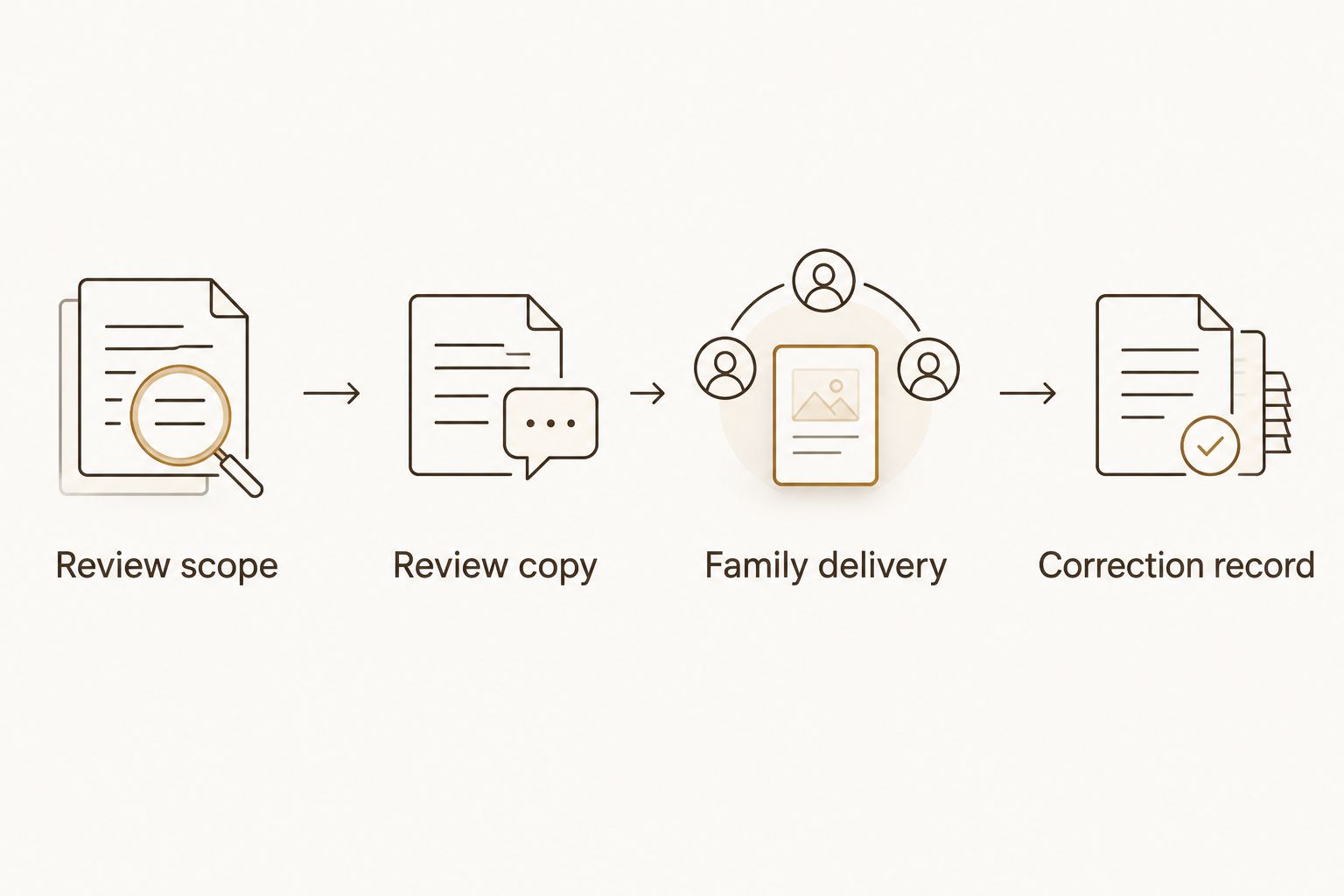
Review scope
- Choose one chapter with a clear purpose. Begin with a memory you feel comfortable sharing, rather than the most emotionally difficult part of your life. A focused chapter makes it easier to see whether the review process works.
- Identify what each reader can contribute. Ask a sibling about household details, a longtime friend about a shared event, or another relative about family names. Do not ask someone to verify an experience they did not witness.
- Set the boundary in your invitation. Explain that you want factual corrections, confusing passages identified, and sensitive disclosures flagged. State that your memoir remains your account, not a jointly authored family history.
- Choose an achievable reply date together. Give readers enough time to read carefully, then agree on when they will respond. Keep the deadline in the invitation rather than assuming everyone shares your printing schedule.
Expected result: you have a defined chapter, named reviewers, and a review brief that separates helpful corrections from stylistic rewriting.
A useful invitation can be plain: ask readers to check names and events, identify anything they cannot follow, and tell you privately about passages that concern them. Avoid asking only whether they like the chapter. Affectionate encouragement is welcome, but it does not tell you what needs attention before printing.
Review copy
- Preserve your original. Keep the chapter you wrote or approved separate from the version you distribute. Make all family-review changes in a working copy so you can compare wording later.
- Label the review copy. Put the chapter title and revision label at the top of the text and in the filename when you use a file. A title such as Childhood — 2026 review draft is easier to recognize than an unexplained attachment name.
- Make passages easy to locate. Use section headings or paragraph labels. Ask reviewers to identify the passage they mean instead of relying on page numbers that change when text moves.
- Choose the delivery format that fits your reader. Use the comparison below rather than making everyone learn the same method.
| Review method | Best for | Advantage | Limitation |
|---|---|---|---|
| Text pasted into email | Short chapters and readers comfortable replying by email | Reader can quote the exact passage in a reply | Separate replies need to be combined manually |
| Attached review document | Longer chapters with headings | Keeps a recognizable chapter structure | Readers must open the file and identify its revision |
| Read-aloud conversation | Readers who prefer listening or discussing memories | Lets you clarify confusing passages together | Feedback needs to be written down afterward |
Expected result: every reviewer receives an identifiable copy in a format they can use. None of these methods makes a chapter private once another person possesses it; share only the material you intend them to receive.
Family delivery
- Address the message deliberately. In your email’s To field, enter only the intended recipients. Send separate messages when you want private replies or do not want reviewers discussing sensitive passages as a group.
- Make the subject recognizable. In Subject, use a descriptive label such as Childhood chapter review — 2026 draft. Match the wording to the label inside the chapter so readers can identify the copy they reviewed.
- Ask 3 review questions. What names, places, or events need correction? Where does the story become hard to follow? Which passages need a privacy conversation before printing? These questions give readers a practical job without inviting a complete rewrite.
- Explain how to respond. Ask readers to quote a short passage or name its heading, describe the issue, and suggest a correction where they know one. Tell them to send sensitive concerns directly to you rather than to the whole family.
Expected result: readers know which draft to read, what to check, and where to send their response.
For an attached document, open the exact attachment before sending it and check its title and contents. For pasted text, inspect the message itself: headings, paragraph breaks, and any accidentally included private notes. A correct file in your folder does not help if you send a different copy.
Correction record
- Collect feedback in one place. Keep a separate review record with fields for the passage, reviewer, concern, proposed change, and your decision. An ordinary document is enough; the point is to avoid losing decisions across messages.
- Classify each response. Separate factual corrections, clarity suggestions, privacy concerns, and differences in recollection. Each category calls for a different response. A misspelled name is not the same problem as two people remembering an argument differently.
- Decide before rewriting. Accept a verified spelling correction, simplify a confusing sentence, or discuss a sensitive disclosure. Where memories conflict, compare the accounts and preserve uncertainty rather than silently treating the latest reply as fact.
- Record your decision and revise the working copy. Mark each item as accepted, declined, or unresolved. When a change affects someone’s concern, send that person the revised passage rather than automatically circulating the whole chapter again.
Expected result: your chapter reflects deliberate decisions, with unresolved questions still visible before you approve it for print.
You do not need to incorporate every suggestion. Your family memoir should sound like you. A relative’s preferred style can stay in the correction record without replacing a phrase that expresses your experience accurately.
Share a revised passage after a chapter changes
Use a narrower review when feedback changes only part of a chapter. Send the affected passage, enough surrounding text to explain it, and a note identifying what you changed. Ask whether the revision resolves the original concern.
This is different from asking everyone to reread the entire memoir. A corrected name needs a focused check; a rewritten account of a family conflict needs enough context for the people involved to understand the new wording.
Send the whole chapter again when a revision changes its meaning or sequence. If you move an event, alter who participated, or add a disclosure that affects another passage, a short excerpt no longer provides adequate context.
Update the revision label every time you circulate changed text. Keep the previous review record, but make clear which decisions remain open. Once you have approved a chapter, reopen it deliberately rather than allowing another reply to become an untracked edit.
Troubleshooting family chapter review
A relative edits the wrong copy
Resend the current review copy with its identifying label and explain which earlier version it replaces. Transfer any useful feedback into your correction record. Do not merge whole files blindly: an older copy can restore sentences you already changed.
Feedback says only that the chapter is lovely
Thank the reader, then ask a focused follow-up about a name, event, or confusing passage. Reassurance and review serve different purposes. A warm response does not establish that every detail is correct.
Two relatives disagree about an event
Separate what each person witnessed from what they heard later. Check available records when relevant, and distinguish your recollection from a claim about everyone’s experience. Do not manufacture certainty to make the chapter read more smoothly.
Private material reaches an unintended reader
Ask the recipient not to forward it and pause further circulation of that version. Remove the passage from future review copies if you do not want it shared. Deleting your own copy does not remove copies already sent to other people.
A reviewer cannot open the attachment
Offer the chapter as pasted email text or arrange a read-aloud conversation. Preserve the same revision label and review questions. Changing the delivery method should not create a different review assignment or an unlabeled new draft.
Customize your workflow before ordering
Once chapter review works, use the same process across the remaining memoir. Myvellum’s twelve-chapter interview structure gives your life story an organizing framework; your review record gives family feedback a separate home. Keep those roles distinct so reviewing does not replace recording your memories.
If spoken memories are still scattered across recordings, the guide to turning phone voice recordings into memoir chapters addresses the drafting stage. Family review works better when readers receive a coherent chapter rather than disconnected fragments.
Before ordering, read the approved memoir from beginning to end. Look for repeated stories, inconsistent names, unexplained relationships, and transitions that stopped making sense after edits. Check that every privacy concern in your record has a decision—not merely a reply.
Keep starting a free memoir separate from ordering its printed book. Starting lets you begin telling your story. Ordering turns the approved manuscript into the hardcover or softcover keepsake described by the service; it should follow your final content decision.
If your 2026 draft includes unresolved passages, settle them before treating it as print-ready. A printed book preserves the wording you approve, including errors or disclosures that remain in the manuscript.
Start your own family memoir
Begin with your memories, review the chapters, then decide when your keepsake is ready for printing.
FAQ
What is the best way to share memoir chapters with family before printing?
The best method is a dated review copy with specific questions and one correction record. Choose email text, an attached document, or a read-aloud conversation according to the reader’s needs, and keep your original separate.
Can I share chapters from Myvellum without giving family control of my memoir?
Use a separate review copy and keep editing decisions with you. Myvellum provides a voice-driven, twelve-chapter memoir process; the review workflow described here uses email, documents, or conversation rather than relying on an in-app collaboration feature.
How many relatives should review my memoir chapter?
Start with two relatives who know the chapter’s subject well. This is a suggested review-group size, not a service limit; add another reader when that person brings knowledge the existing reviewers lack.
What should I ask family members to check?
Ask reviewers to check factual details, identify confusing passages, and flag privacy concerns. Request a passage reference and a specific explanation so you can act on the feedback without guessing.
What if my family remembers an event differently?
Keep differing recollections separate until you have considered each account. Check relevant records where available, and identify a memory as your recollection when a shared factual account remains unresolved.
How do I keep sensitive memoir chapters private?
Limit the material you send and choose recipients deliberately. A request not to forward a chapter does not prevent copying, so keep any passage you are not ready to circulate out of the review version.
Is starting a free memoir the same as ordering a printed book?
No, starting a free memoir and ordering a printed book are separate steps. Draft your memories, complete family review, and approve the manuscript before deciding to order the keepsake.
Should I resend the whole chapter after making a correction?
Resend the whole chapter when a revision changes its meaning, sequence, or surrounding context. For a localized correction, send the affected passage with enough context and an updated revision label.
One last thing
Before you order your memoir in 2026, read one approved chapter aloud without stopping to edit. Listen for a sentence that sounds polished but no longer sounds like you. Check it against your intended meaning before making another change.
Family review can improve clarity without making every voice identical. Keep a familiar expression when it carries your meaning, and explain it if readers need context. Your family’s keepsake should preserve your way of telling the story—not just the details everyone agreed on.


