

Writing a memoir can support reflection, self-expression, and a sense of connection, but it is not a treatment for a mental health condition or a guarantee that you will feel better. Recalling painful experiences can also bring distress, so write at your own pace and keep the decision to share separate from the decision to remember.
- Writing memoir mental health benefits center on reflection and self-expression, not guaranteed symptom relief.
- Myvellum supports guided life storytelling and family keepsake books; it is not a mental health treatment.
- Start with an ordinary memory, protect your privacy, and stop if writing becomes overwhelming.
- Starting a free memoir and ordering a printed family book are separate decisions.
Why this matters
Your life story does not need to become a recovery story to deserve a place on your family's bookshelf. You can preserve the sound of a familiar kitchen, the uncertainty of a first job, or the values behind a difficult decision without explaining every painful experience.
If you are starting your memoir in 2026, choose a manageable memory before choosing a publication goal. The guide to starting your life story when you don't know where to begin offers a separate starting point for the writing itself.
The distinction matters: remembering, making sense of an experience, and preparing a book for family are different tasks. You control which task you take on today.
Is writing a memoir good for mental health?
Writing a memoir can be a useful reflective activity, but completing a memoir does not establish that your mental health has improved. A finished manuscript measures progress on a writing project, not recovery from depression, anxiety, grief, or trauma.
Different writing activities also serve different purposes. Choose the approach that matches what you want to do, rather than treating every form of personal writing as interchangeable.
| Approach | Best for | What it offers | Important limitation |
|---|---|---|---|
| Private journaling | Recording thoughts without preparing them for readers | Space to write freely and leave entries unfinished | Repeatedly revisiting a subject does not necessarily resolve it |
| Memoir writing | Preserving selected experiences for yourself or family | A narrative that connects memories, people, and personal meaning | Editing for an audience introduces decisions about privacy and disclosure |
| Clinician-guided writing | Addressing difficult experiences within professional care | Writing used within an agreed treatment approach | It requires a clinical relationship; a memoir app does not provide that care |
For a family memoir, the practical goal is a truthful account you feel comfortable preserving. You do not owe readers a dramatic revelation, a complete chronology, or an uplifting ending.
Reflection without a forced lesson
Writing lets you put an experience into words and examine what you want to say about it. You can distinguish what happened, what you understood then, and what you think now.
That does not require finding a benefit in something harmful. A sentence such as I still do not understand why that happened can belong in an honest memoir.
Connection without compulsory disclosure
A memoir gives family members an account of your life in your own words. Ordinary details explain who you are: how you spent your weekends, what work meant to you, or which traditions you chose to keep.
Sharing those details is different from sharing your most private experiences. A meaningful family book does not require unrestricted access to your past.
Why the experience of memoir writing varies
There is no single emotional outcome you must achieve. Consider these factors when deciding what to record and whether to continue:
- The subject: Describing a favorite room is a different task from recounting violence, loss, or estrangement. You can choose a less demanding subject.
- Your purpose: Writing privately leaves different choices open than preparing a chapter for relatives to read.
- Your current response: Pay attention to whether you can return to your day after writing or remain upset and preoccupied.
- Your audience: Naming living people creates decisions about privacy, disputed memories, and family boundaries.
- Your support: A trusted listener offers companionship; a qualified mental health professional addresses clinical concerns.
Use your response to guide the next session, not a deadline. If your 2026 memoir plan has become a source of pressure, reduce the scope or set it aside.
How can I start without taking on too much?
Begin with a memory you feel willing to revisit. You do not have to start with childhood, explain your whole family, or describe the hardest thing that happened to you.
The sequence below is an optional writing exercise, not a treatment protocol. The suggested limits help define a small task; they are not a clinical dose.
- Choose a memory. Pick an ordinary scene, such as arriving at school, preparing a familiar meal, or learning a household task.
- Set a boundary. Decide what you will leave out. You can describe a place without discussing every event associated with it.
- Record the scene. Try 5 minutes of speaking or writing if that feels manageable. Stop sooner whenever you want.
- Check your response. Notice how you feel before deciding whether to continue, revise, or leave the material alone.
- Choose what stays. Keep the passage private, save it for later, or consider it for your family manuscript.
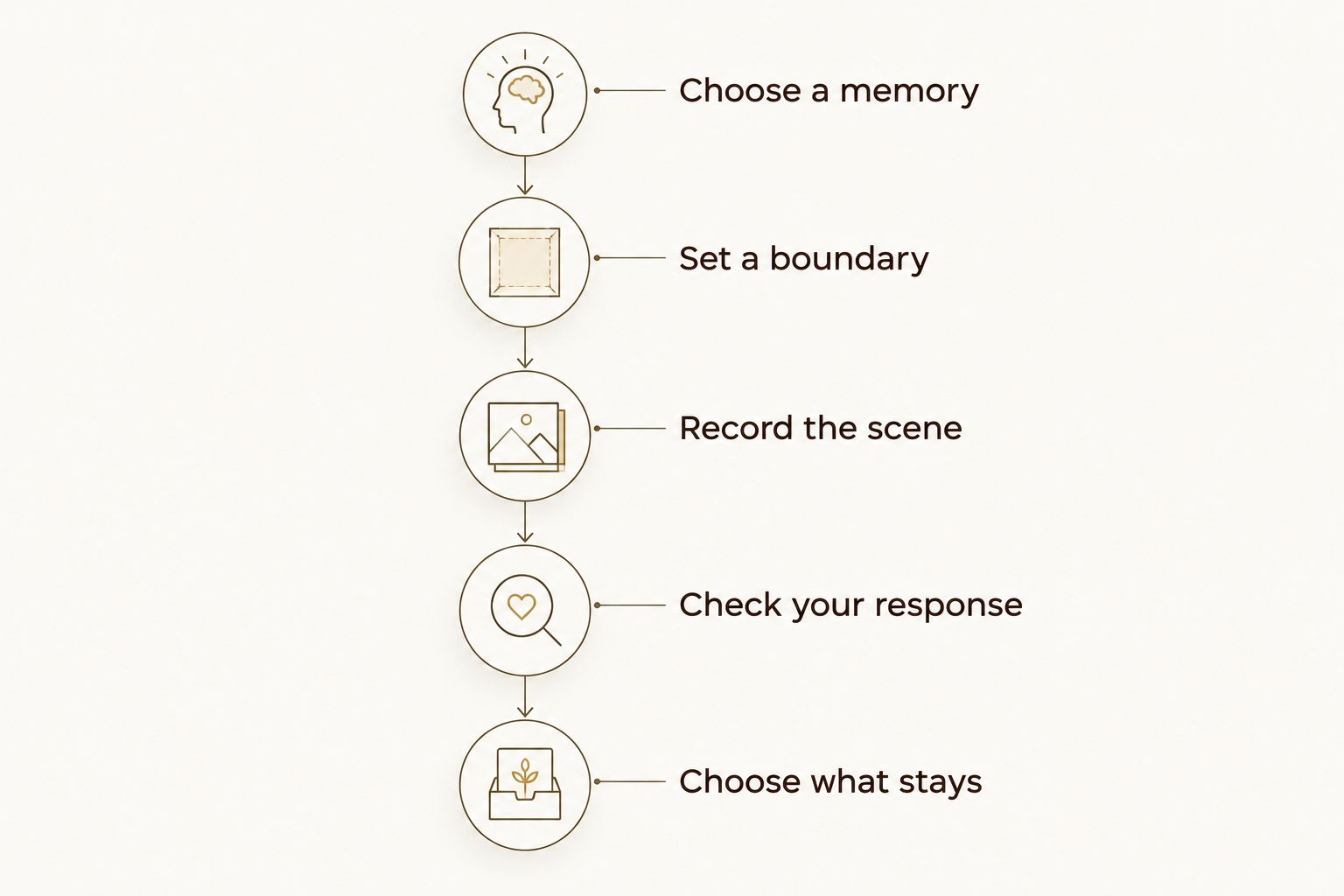
You can make the exercise smaller still. Write 3 sentences: where you were, what you noticed, and why you remember it. Start with 1 memory rather than trying to summarize an entire decade.
Leave interpretation optional. A description of your mother's sewing table or the bus route to your first job can stand on its own, without becoming a lesson about your life.
Prompts that leave you in control
Choose a prompt you want to answer, not one you feel obliged to complete:
- What did a familiar place look, sound, or smell like?
- Which everyday skill did you enjoy learning?
- What did you do for pleasure before life became busy?
- Which family tradition did you keep, change, or leave behind?
- What would you like your family to understand about an ordinary day in your life?
Skip any prompt that takes you somewhere you do not want to go. A questionnaire is a writing aid, not an obligation to disclose.
When should I pause memoir writing?
Pause when continuing feels overwhelming, not only when a chapter is finished. Distress is not proof that the exercise is working, and you do not need to push through it to earn a meaningful story.
Close the document or stop recording. Return your attention to your surroundings and an ordinary activity that helps you feel settled. You can decide later whether to return to that passage.
Seek professional support if writing brings persistent distress, disrupts sleep or daily functioning, or draws you into experiences you cannot manage comfortably. If you already receive mental health care, discuss difficult writing with your clinician rather than using the memoir project to replace that care.
For your 2026 writing plan, make permission to pause explicit. A postponed chapter is not a failed memoir.
Do I have to write about trauma for my memoir to matter?
You do not have to write about trauma for your memoir to matter. Your interests, friendships, work, humor, and routines are also part of your life story.
You can acknowledge a difficult period without describing it in detail. You can also leave it out of the family edition entirely.
Can I write about grief without making it public?
You can write about grief and keep the writing private. Recording a memory does not commit you to sharing it with relatives or including it in a printed book.
Decide separately whether a passage is for you, for a trusted reader, or for the family manuscript. Those boundaries can change as you work.
How do I turn reflection into a family keepsake?
Separate capturing your memories from approving them for readers. During the first task, concentrate on what you remember and how you want to express it. During the second, review accuracy, privacy, and what your family needs to understand.
Mark uncertain details as uncertain. If you remember the season but not the date, write that honestly rather than adding precision. When another person recalls an event differently, describe your account as your recollection instead of presenting it as the only possible account.
Before printing, read specifically for boundaries. Ask whether a passage reveals another person's private information, includes something you intended to keep personal, or needs context to avoid misunderstanding.
For a book you prepare in 2026, use the same standard for an affectionate anecdote as for a difficult one: is it accurate to your memory, and are you comfortable sharing it?
Where guided memoir writing fits
Myvellum is best for people who want to speak their own life story into a guided family memoir and produce a printed keepsake. Its voice-driven memoir app uses twelve structured interview chapters and offers personalized hardcover or softcover books.
At myvellum.vercel.app, the useful distinction is between starting a free memoir and ordering a printed book. Begin with the writing step; make the printing decision after reviewing what you want your family to read.
Myvellum offers a defined structure for people who prefer prompts to a blank page. The limitation is equally clear: structured interviews are not individualized mental health care, and a printed book is not evidence of therapeutic benefit.
Begin with your own memories
Start a free memoir; decide separately when to order your printed family keepsake.
FAQ
Does writing a memoir improve mental health?
Writing a memoir can support reflection and self-expression, but it does not guarantee improved mental health. Treat it as a personal writing activity, not a substitute for treatment.
Is memoir writing the same as therapy?
Memoir writing is not the same as therapy. Therapy involves a qualified professional and an agreed approach to care; a memoir project focuses on recording and shaping your life story.
What should I write about if difficult memories upset me?
Choose an ordinary memory you feel comfortable revisiting, or pause the project. You do not have to include painful experiences to create a meaningful family memoir.
How long should I write in one sitting?
There is no prescribed session length for a personal memoir. An optional 5-minute exercise can define a small starting task, but stop sooner if you want to.
Can I record my story instead of typing it?
You can record your story instead of typing it. Myvellum provides voice-driven memoir writing through twelve structured interview chapters, but speaking about difficult events still calls for boundaries.
Do I have to let my family read everything?
You do not have to let your family read everything you record. Keep private reflections separate from the passages you approve for a family book.
Should I order a printed book as soon as I start?
Starting your memoir and ordering a printed book are separate decisions. Review your manuscript for accuracy, privacy, and comfort with sharing before choosing to print.
One last thing
Before your next writing session in 2026, choose a memory that has no dramatic turning point. Describe the drawer where someone kept spare buttons, the view from a familiar window, or how you spent a quiet Sunday.
Your family does not need every secret to know you better. Sometimes the most personal page is the one that preserves a detail nobody thought to ask about.


