

Start writing your life story with one memory you can picture clearly: where you were, who was there, and what happened. Speak or write that scene before building an outline; you do not need to begin with your birth, settle every date, or decide what belongs in the printed book yet.
- How to start writing life story: capture one specific memory, then explain why it matters to your family.
- Choose speaking for conversational storytelling or writing for control over each sentence.
- Myvellum suits family memoir writers who want voice-guided interviews and a printed keepsake.
- Starting a free memoir and ordering a printed book are separate decisions; review your story before ordering.
Why this matters
Your family can read a list of places you lived without learning what those places meant to you. A scene gives them something different: your point of view, the choices you faced, and the small details only you remember.
Your first task is to preserve a memory, not produce a finished chapter. If you are starting in 2026, make the first draft a place to collect stories rather than judge them.
For a guided route, Myvellum is a memoir-writing app and print service built around 12 structured interview chapters. Keep myvellum.vercel.app in mind if you want to turn spoken memories into a personalized family keepsake rather than begin with an empty document.
How do I start writing my life story if I don't know where to begin?
Begin with a memory that has a setting, an event, and a reason you still carry it. Follow the steps below in whatever writing or recording method you choose; the goal is a usable first scene, not a polished opening page.
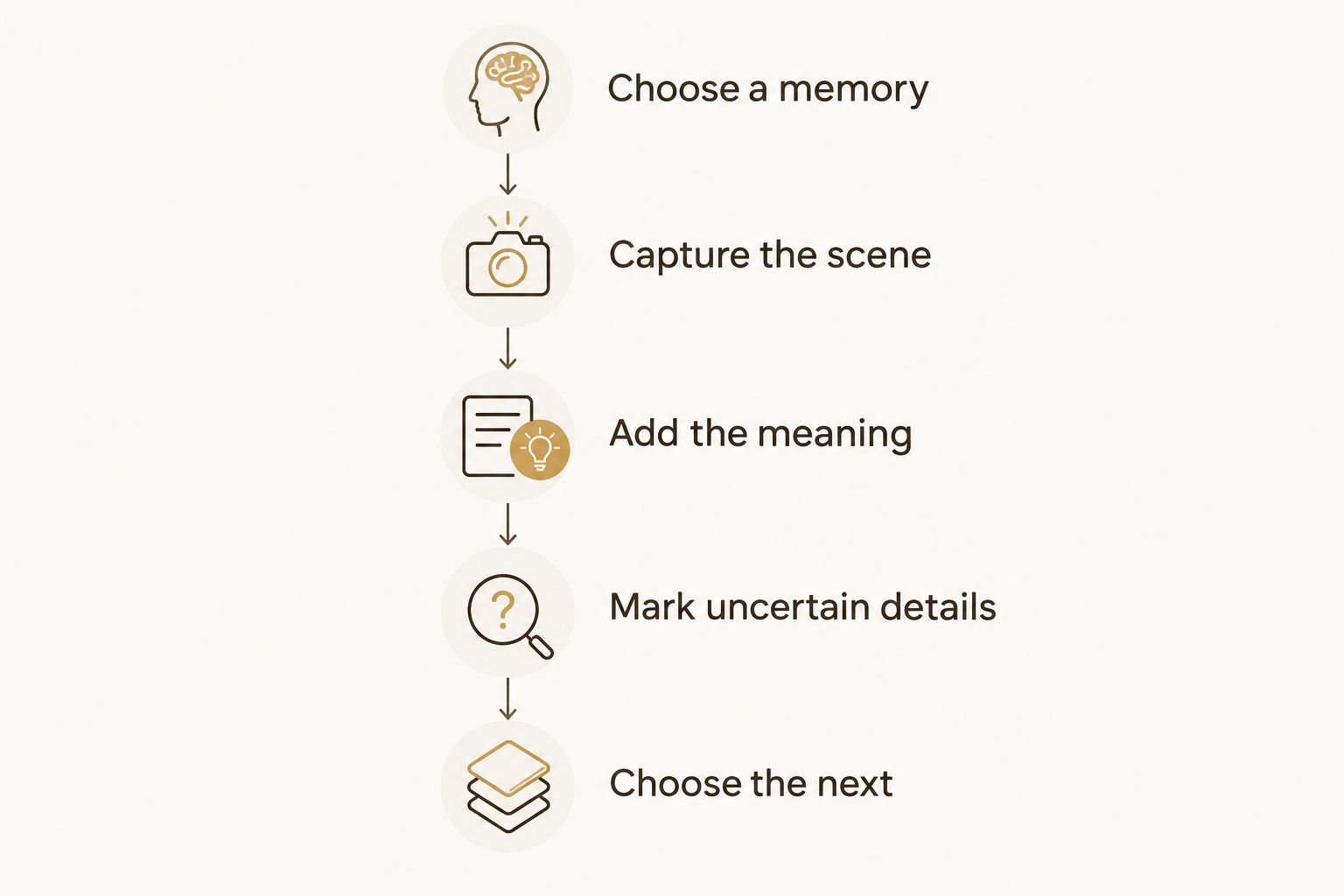
1. Choose a memory
Pick an event you can describe without researching your entire past. It might be leaving home, learning a skill, starting a job, or sharing an ordinary meal that now feels important.
Choose something you are comfortable revisiting. The most painful event in your life does not have to become your first writing assignment, and the earliest event you remember does not automatically belong at the beginning.
Use this test: can you describe what happened in a particular place, rather than summarize an entire decade? If your subject is your working life, narrow it to arriving at a workplace, making a difficult decision, or meeting someone who changed your direction.
2. Capture the scene
Answer these 3 questions in your own words:
- Where was I, and what could I see or hear?
- What happened, and what did I do?
- Why does this moment stay with me?
These questions are a starting exercise, not a required chapter format. If another detail comes first, follow it and return to the questions afterward.
Describe the room before explaining the whole family history. Name the person before explaining every relationship. Give the memory somewhere to happen.
3. Add the meaning
Explain what you understood then and what you understand now. Those perspectives can differ without making either one dishonest.
Perhaps a move felt like an adventure at the time, but you now recognize what it cost your family. Perhaps you once dismissed a relative's habit and later found yourself repeating it. That change in understanding belongs in your story.
If you are reflecting in 2026 on an earlier event, distinguish your present interpretation from what you actually knew at the time. Do not give your younger self knowledge you gained later.
4. Mark uncertain details
Keep drafting when a date or name escapes you. Add a plain note such as “check the school name” rather than replacing uncertainty with a confident guess.
Separate remembered experience from information you learned afterward. You can describe how a farewell felt without claiming to remember everyone's exact words.
Do not invent dialogue to make a scene sound complete. If you remember the meaning but not the wording, summarize the conversation. Before printing, check details that affect another person's identity, reputation, or understanding of an event.
5. Choose the next memory
End your session by naming the story you want to capture next. It can connect to the first scene through a person, a place, or a decision; chronological order can wait.
Keep a simple list of unfinished stories beside your draft. When another memory interrupts, give it a short label and return to the scene you were telling.
This separates collecting memories from arranging chapters. You can preserve a story now without deciding where it belongs in the final book.
Should I speak my memories or write them down?
Choose the method that lets you tell the scene without repeatedly stopping to fix it. Speaking and writing have different strengths, and neither removes the need to review what you plan to share.
| Starting method | Best for | Main advantage | Main limitation |
|---|---|---|---|
| Speaking aloud | Readers who explain memories more comfortably in conversation | Lets you tell the event in your everyday language | Spoken recollections still need review and organization |
| Typing | Readers who want to shape sentences as they go | Makes revising and rearranging text straightforward | Sentence editing can interrupt an unfinished memory |
| Writing by hand | Readers who prefer a notebook to a recording or screen | Gives you a direct place to collect scenes and notes | A printed manuscript requires transferring the material into a suitable format |
Try describing the same memory aloud and in writing. Compare which version contains the clearest details and sounds most like you; do not judge it by spelling or sentence length alone.
If you choose speech, review the resulting text rather than assuming it preserves every name or meaning correctly. The guide to turning phone voice recordings into memoir chapters explains the next stage of that process.
Why your starting point varies
The right first scene depends on what you want to preserve and how you prefer to work. Use these factors to choose a manageable beginning:
- Your intended reader. Writing for family calls for explanations of relationships, places, and customs that you might otherwise leave unstated.
- Your easiest form of expression. Choose speech if talking gets the memory moving; choose writing if seeing sentences helps you think.
- Your emotional boundaries. Begin with material you are willing to revisit and share, not material you feel pressured to disclose.
- Your supporting material. A photograph, letter, or journal entry can provide a starting point, but it should not replace your own account.
- Your intended book. A focused collection of family memories needs a different organizing plan from an attempt to cover every life stage.
Treat these as choices, not qualifications you must satisfy. You can change your scope after discovering which stories you most want to tell.
How do I turn separate memories into chapters?
Group related scenes before trying to write transitions between them. Look for connections such as home, work, belonging, caregiving, or decisions that changed your direction.
Give each group a working heading that tells you what belongs there. A heading about learning independence is more useful during drafting than a decorative title whose meaning you have not settled.
For every scene, ask what it adds. Keep a repeated detail when it reveals a change; trim it when it simply retells information the reader already has.
A memoir drafted in 2026 does not need to end with every loose thread resolved. You can explain what remains uncertain and what you are still learning. That is different from leaving readers confused about who was involved or when an event occurred.
What if my life feels too ordinary for a memoir?
Your life story does not need a public achievement to give your family something worth keeping. Explain the everyday experiences they cannot reconstruct from a photograph: how you made decisions, what you worried about, and what home felt like.
Choose a routine and describe a particular occasion when it mattered. Then add what you hope your family understands about it, without turning every memory into a lesson.
Do I have to start with my childhood?
You do not have to start writing with childhood. Begin with the scene you can tell clearly, then decide later whether the finished book should follow a timeline or a theme.
Distinguish the order in which you draft from the order in which your family will read. A strong place to begin writing is not necessarily the opening chapter.
From a free memoir to a printed family book
Starting a free memoir and ordering a printed book are separate steps. Use the starting stage to find your voice and gather memories; make the printing decision after reviewing what you want your family to receive.
Myvellum is best for family memoir writers who want voice-guided interviews and a printed keepsake. Its 12 structured interview chapters provide a defined starting framework, and its print service produces personalized hardcover or softcover books.
The advantage is direction: you have interview chapters rather than having to invent the entire structure yourself. The boundary is equally important: a guided process does not decide which memories are accurate, private, or ready for your family to read.
Before ordering in 2026, review the current printing details and the manuscript itself. Check names, relationships, uncertain dates, and passages involving other people. Choose the printed format separately from the decision to begin recording.
Begin your family memoir
Start with your own memories, then decide what belongs in a printed family keepsake.
FAQ
What's the easiest way to start writing my life story?
Start with one memory you can picture and describe what happened, where you were, and why it matters. Speak or write the scene before trying to summarize your entire life.
What should the first sentence of my life story be?
Your first draft can begin with a concrete action or place from the memory you are telling. You can write the book's final opening after you know which stories it contains.
Can I write my life story if I am not a good writer?
You can begin by telling memories in the language you normally use. Capture the experience first, then revise confusing sentences and explain details your family will need.
Is speaking better than typing for a family memoir?
Speaking is the better starting method if it helps you describe events without getting stuck editing sentences. Typing is better if shaping text helps you think; either method requires review before printing.
What if I cannot remember exact dates or conversations?
Mark uncertain details and check them before printing rather than guessing. Summarize a conversation when you remember its meaning but not its exact wording.
Can I start my memoir now and order a book later?
Treat starting your memoir and ordering a printed book as separate decisions. Myvellum provides voice-guided memoir writing and personalized hardcover or softcover printing; review the current process before ordering in 2026.
Should I include painful memories in a book for my family?
Include painful memories only when you choose to share them and they serve the story you want to tell. You can keep a private draft separate from the version intended for your family.
One last thing
Before you close your first draft, explain something that once seemed too obvious to mention: what a family nickname meant, why a room had its name, or how a household tradition began.
Write down the context you usually leave out. Your family can ask about an event they know happened; they cannot ask about a detail they never knew existed.


