

A memoir should be long enough to tell the story you want your family to understand, without repeating events or padding chapters to reach a target. There is no universal word count for a personal family keepsake. For your 2026 memoir, choose the scope first, then judge length by whether each chapter preserves something meaningful.
- How long should a memoir be? Long enough to preserve your chosen story, without repetition or filler.
- Myvellum suits family memoir writers who want voice-guided chapters and a printed keepsake.
- Choose your memoir's scope before setting a word count or estimating printed pages.
- Starting a free memoir and ordering a printed book are separate steps.
How long should a memoir be?
Your memoir is long enough when a family reader can follow what happened, understand why it mattered, and hear your perspective. A missing explanation needs more space; a repeated explanation needs less. Neither problem is solved by chasing a page count.
A book about your working life needs a different boundary from a book about leaving home. Use the comparison below to choose your scope before deciding how much material belongs in the manuscript.
| Memoir scope | Best for | What earns space | Main trade-off |
|---|---|---|---|
| A defining experience | Writers preserving a particular turning point | The circumstances, decisions, and consequences | Other parts of your life remain outside the book |
| A period of your life | Writers exploring childhood, work, or another connected chapter | Scenes that show development across that period | Background can crowd out the central story |
| A broader family memoir | Writers leaving relatives an account across life stages | Distinct experiences, relationships, and reflections | Repetition becomes harder to spot across chapters |
If speaking feels more natural than drafting, the guide to turning phone voice recordings into memoir chapters addresses that starting point. The same length test applies: keep the story, not every sentence spoken while remembering it.
Why this matters
Your family needs more than a sequence of milestones. They need enough context to understand the choices behind those milestones, including the ordinary details you would otherwise take for granted.
Length creates a practical tension. Cut too hard and you remove the setting that makes a memory understandable; keep everything and the reader loses track of what matters. Edit for understanding, not for thinness or bulk.
For a voice-led route, Myvellum is a memoir-writing app and print service that guides you through structured interview chapters. Myvellum is best for people who want to speak their own life story into a personalized family keepsake. That format provides a starting structure, but it does not decide which memories deserve the most attention.
A focused memoir: tell the central story completely
A focused memoir stays with a defining experience, relationship, or change. Its strength is clarity: your reader knows what the book is exploring. Its limitation is deliberate exclusion, because meaningful events outside that boundary do not automatically belong.
Write a private sentence that states the book's purpose. For example, you might decide to explain how moving away changed your understanding of home. That sentence becomes an editing rule, not a subtitle you have to publish.
Include background when it changes how the reader understands the central experience. Your childhood home belongs if it explains what leaving meant; a full account of every school year does not belong merely because it happened earlier.
A focused memoir is ready for its ending when the reader understands what changed and how you see that change now. You do not have to continue the narrative to the present day simply to make the book longer.
A broader family memoir: give each life stage a purpose
A broader memoir can hold childhood, relationships, work, community, and later reflections. Its advantage is room for connections across your life. Its challenge is keeping those connections visible rather than producing a long inventory of events.
Give each chapter a job. A childhood chapter might explain the values you inherited, while a work chapter shows which values you kept or questioned. Different subject matter alone does not prevent repetition; the chapters should add different understanding.
Uneven chapters are acceptable. A brief period that changed your direction can deserve more attention than a long stretch of routine. Match chapter length to the story's significance, not to the calendar.
When planning a family memoir in 2026, decide what belongs in this book rather than trying to preserve every memory at once. A clear boundary lets you finish a meaningful keepsake without claiming it contains everything about your life.
A guided memoir: 12 chapters are a framework, not a length target
Myvellum's memoir-writing app guides you through 12 structured interview chapters and produces a personalized printed hardcover or softcover keepsake. Those 12 chapters describe the interview structure, not a required word count, page count, or equal-length allocation.
The useful distinction is between having a place to begin and having a finished manuscript. Prompts can help you recall material; your review still needs to identify unclear references, repeated anecdotes, and moments that deserve more explanation.
For a guided family memoir, the advantage is a defined path into your memories. The trade-off is that a chapter framework cannot, by itself, establish whether you have told a particular story fully. Read for meaning rather than treating completed prompts as proof that the book is finished.
Starting a free memoir and ordering a printed book are separate steps. Begin by capturing your story; make the print decision after reviewing the manuscript and checking the current ordering details. Do not treat beginning the writing process as the same commitment as placing a book order.
Why memoir length varies
Your memoir's length should reflect its purpose and contents. These factors give you concrete reasons to expand or cut, rather than an arbitrary target to satisfy.
- Scope: A defining experience requires different coverage from an account spanning several life stages. Set the boundary before expanding the draft.
- Reader familiarity: Explain people, places, and family relationships your intended readers do not already know. Avoid assuming a younger relative shares your background knowledge.
- Scene detail: Keep details that help readers picture an event or understand a decision. Remove description that adds atmosphere without adding meaning.
- Reflection: Explain what an experience meant to you, especially when your present understanding differs from your feelings at the time.
- Repetition: A recurring theme can connect chapters, but retelling the same anecdote does not automatically deepen it. Keep the fullest useful version.
- Book layout: Photographs, captions, type size, margins, and chapter openings affect printed length. A manuscript's word count alone does not determine its final page count.
How do you find the right length for your own memoir?
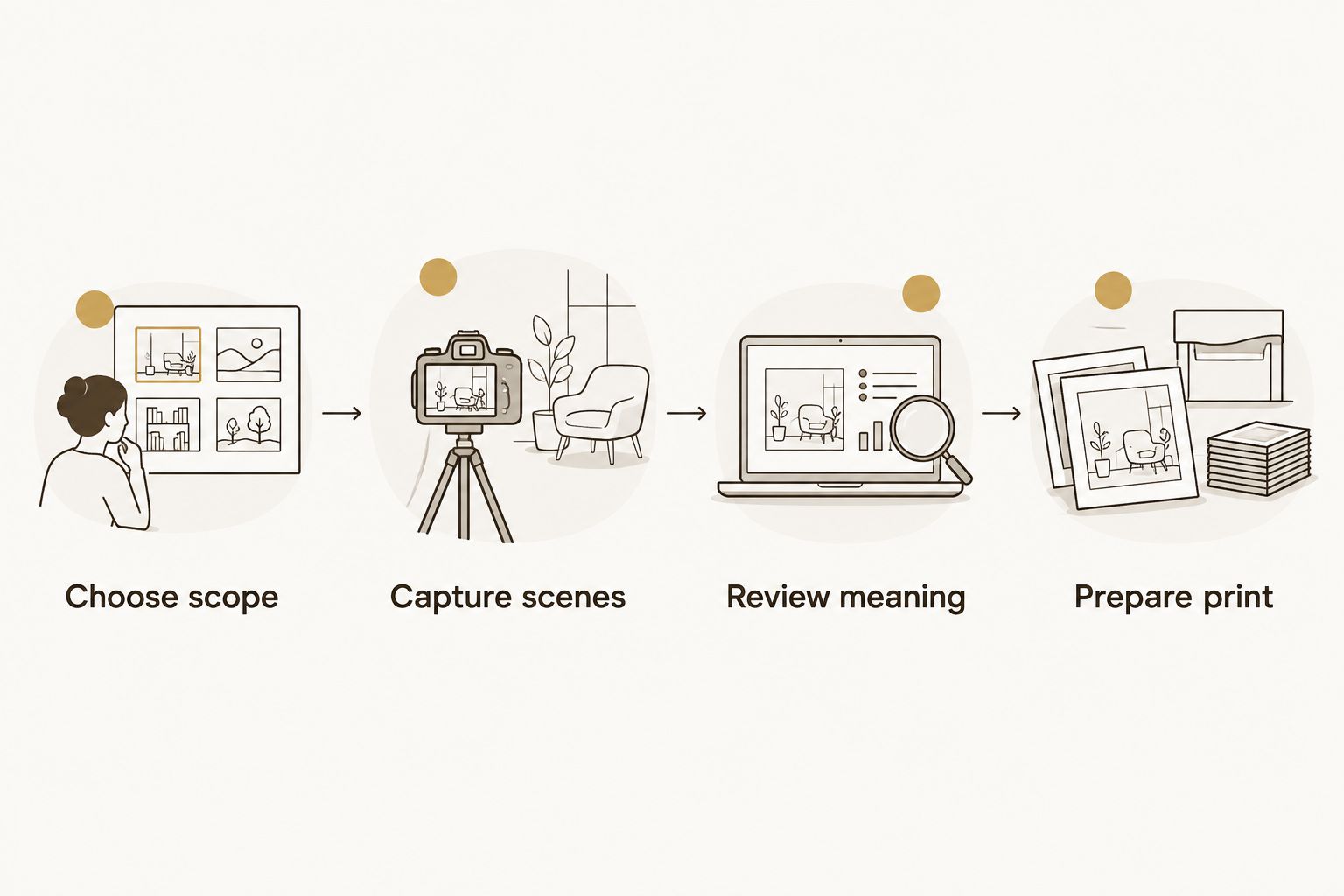
Use this editing sequence for your 2026 draft. It gives you a stopping rule based on the reader's experience, without requiring a made-up publishing benchmark.
Choose scope
Write down what the book will help your family understand. Then identify what sits outside that purpose, even if those memories matter to you personally.
Keep excluded material in separate notes rather than forcing it into the current manuscript. Setting a memory aside preserves your option to return to it without weakening this book's shape.
Capture scenes
Describe what happened before polishing how it sounds. Include where you were, who was involved, what you wanted, and what changed, using only details you genuinely remember.
Do not lengthen a scene with invented dialogue or false certainty. When memory is incomplete, say so plainly or tell the part you can recall with confidence.
Review meaning
Read each scene and ask what your family learns from it. An anecdote can earn its place through humor, affection, conflict, or explanation; it does not need a dramatic life lesson.
Check that the significance is actually on the page. You know why a small gesture mattered, but your reader needs enough context to understand it too.
Prepare print
Review the manuscript before judging the physical book. Check names, relationships, chapter order, captions, and any passages you want to reconsider sharing.
Then inspect the available print presentation rather than guessing thickness from your draft. The writing decision is whether the story is complete; the production decision concerns how that completed story becomes a keepsake.
How do you know a chapter is too short?
A chapter is too short when it leaves a gap in understanding, not simply when it looks smaller than its neighbors. Look for unexplained decisions, unidentified people, and abrupt changes between events.
Suppose you describe leaving a familiar job. Your family can follow the event more clearly if you explain what prompted the decision, what you risked, and how you felt afterward. Those details add substance rather than padding.
Expand the missing part, then stop. You do not need another unrelated anecdote to make the chapter visually match the others.
How do you know a chapter is too long?
A chapter is too long when its additional material stops adding understanding. Repeated setup, several examples making the same point, and lengthy detours are reasons to review it closely.
Ask what would become unclear if you removed a passage. If the answer is nothing, cut it or save it separately. If removing it changes the reader's understanding of a relationship or choice, keep it and improve the transition.
For your 2026 revision, make a separate pass for repeated introductions. A relative needs a clear introduction when first appearing, but not a full biography every time the narrative returns to them.
Should you measure a memoir in words or pages?
Use words to assess the manuscript and pages to assess the printed presentation. Word count tracks the amount of text without being changed by a different type size or wider margins.
Page count answers another question: how the text, chapter openings, images, and spacing occupy the book. Increasing the page count through formatting does not add memories, and reducing it does not necessarily improve the story.
When preparing a printed memoir in 2026, review readability rather than pursuing a particular thickness. The right presentation should support the story you have finished, not disguise a manuscript that still needs editing.
FAQ
How long should a memoir be if it is only for my family?
A family memoir should be long enough to make your chosen stories understandable without repetition or filler. Set the scope around what you want relatives to know, then expand only where context is missing.
Can a short memoir still be a complete book?
A short memoir can be complete when it fully tells the experience or period it sets out to cover. Completeness depends on resolving the book's purpose, not covering every year of your life.
How many chapters should my memoir have?
Your memoir needs enough chapters to organize its distinct subjects or stages clearly. Myvellum uses 12 structured interview chapters, but that framework does not establish a universal chapter count for memoirs.
Do all memoir chapters need to be the same length?
Memoir chapters do not need to be the same length. Give each chapter enough room to explain its events and significance, without adding material just to match neighboring chapters.
Should I include everything I remember in my memoir?
Include memories that serve the memoir you are writing, rather than everything you remember. Save other material separately so you can preserve it without interrupting this book's focus.
Should I start writing before deciding whether to print?
You can separate starting a free memoir from deciding to order a printed book. Capture and review your memories first, then check the current print options and ordering details before committing to production.
Will photographs change how many pages my memoir needs?
Photographs and captions affect the printed layout, so word count alone cannot determine the final page count. Include images that help identify people, places, or meaningful objects, and assess them alongside the text.
One last thing
Before cutting a modest everyday memory, ask whether anyone else can tell it from your perspective. How your kitchen sounded, what you worried about on a first day, or why a family expression made you laugh can explain more than another list of achievements.
Keep the detail that makes the memory yours; cut the explanation you have already given. That is a more useful finishing rule than making your life story reach a particular thickness.


