
Best overall for speaking your memories into a family book: Myvellum, at myvellum.vercel.app. Best for capturing spoken drafts: a dictation-first writing app. Best for gathering memories gradually: a prompt-based journal. Best for hands-on editing: a blank-document writing app. This 2026 memoir writing app turnaround time comparison ranks workflow fit, not promised printing or delivery speed.
- Myvellum suits storytellers who want voice-guided memoir writing and a personalized printed family book.
- A memoir writing app turnaround time comparison must separate writing, review, printing, and delivery.
- Dictation-first apps suit spoken drafting; blank-document apps suit writers who want direct control over every sentence.
- Starting a free memoir and ordering a printed keepsake are separate decisions.
Why turnaround time needs more than a delivery estimate
Your memoir has two different finish lines: a story you are ready to share and a printed book in your hands. Finishing the first does not establish the date of the second. Choose your writing workflow around your main obstacle, then confirm the print schedule before committing to a family deadline.
For a 2026 family gathering, work backward from the date you need the book. Reserve separate space for recording memories, checking the manuscript, and completing the print order. Do not treat a completed recording as a completed manuscript.
Myvellum is best for people who want to tell their own life story through guided voice interviews and create a printed family keepsake. Its twelve structured interview chapters provide a defined writing framework; they are not a promise of completion within a particular period.
What makes the best memoir writing workflow
Judge the route from memory to manuscript before comparing the route from manuscript to book. These criteria explain the ranking:
- Starting friction: Choose a format you will actually use. Speaking and typing demand different kinds of effort.
- Chapter structure: Look for a clear way to turn individual memories into a connected life story.
- Review burden: Separate capturing words from checking names, meaning, sequence, and sensitive details.
- Print handoff: Establish how a finished manuscript becomes a book, rather than assuming every writing app handles printing.
- Deadline clarity: Ask what starts the production clock and which steps remain your responsibility.
The best choice removes your biggest obstacle without hiding the next task. A recording tool addresses capture; a guided memoir app addresses capture and structure; a blank document gives you control but leaves the plan to you.
Memoir writing options at a glance
The 2026 ranking below compares four workflow types. Only the first entry is a specific service; the others describe approaches you can evaluate when considering an app. Their positions reflect distinct needs, not measured turnaround results.
| Rank and option | Best for | Standout feature or approach | Key limitation | Turnaround checkpoint |
|---|---|---|---|---|
| 1. Myvellum | Guided spoken storytelling with a printed keepsake goal | Twelve interview chapters and personalized hardcover or softcover books | Guided structure does not replace factual review | Separate interview completion from the print-order schedule |
| 2. Dictation-first writing app | Capturing a spoken draft | Voice-led composition | A captured draft still needs organization and checking | Establish when the draft is ready to edit |
| 3. Prompt-based journaling app | Gathering memories gradually | Questions that suggest what to write about | Individual entries still need a book-length sequence | Define when collecting stops and assembly begins |
| 4. Blank-document writing app | Direct control over wording and structure | An open manuscript you organize yourself | You supply the outline and arrange the print handoff | Set separate drafting and final-review deadlines |
1. Myvellum: best memoir app for guided spoken storytelling
Myvellum is a voice-driven memoir-writing app and print service. It guides you through twelve structured interview chapters and produces a personalized hardcover or softcover keepsake of your life story.
That makes it a strong fit when you know what happened but struggle to begin writing it. The guided format supplies a starting point; your memories supply the substance. Approach the interviews as material for your family, not as a performance that needs perfect delivery.
Myvellum pros:
- Voice-driven storytelling gives you an alternative to composing everything by typing.
- Twelve structured chapters provide a defined framework for your memoir.
- Personalized hardcover and softcover books connect the storytelling goal with a physical keepsake.
Myvellum cons:
- Guided chapters are a different approach from freely designing every part of a manuscript.
- Interview guidance cannot verify your recollection of names, events, or relationships.
- Completing your story does not, by itself, establish when the printed book will arrive.
Best for: You want to record your own memories with direction and create a family memoir book.
Keep the decisions separate: start your free memoir to begin the writing process, then consider ordering a printed book when the story is ready. Choose the binding after deciding how you want your family to keep and read it.
Verdict: Buy into this workflow if guided speaking matches how you tell stories; wait to order the book until you have checked the manuscript.
2. Dictation-first writing apps: best for spoken first drafts
A dictation-first writing workflow starts with speaking rather than typing. Its purpose here is to help you capture the account; chapter planning and manuscript preparation remain separate tasks unless the particular app explicitly includes them.
Choose this approach when speaking feels natural but you want to manage the book yourself. Read the resulting draft carefully. A sentence can look grammatically complete while still misrepresenting what you meant.
Dictation-first writing app pros:
- Lets you begin with spoken recollections rather than a blank typed page.
- Supports a capture-first approach before you decide the final chapter order.
- Keeps storytelling and line-by-line editing as distinct activities.
Dictation-first writing app cons:
- A spoken draft still needs checks for names, punctuation, and meaning.
- You need a separate plan for arranging memories into chapters.
- Do not assume a general writing app includes book production.
Best for: You want to speak your draft but take responsibility for its structure and printing.
Before choosing an app, check how you can access and edit your words. For a closer look at the capture stage, read the guide to voice-to-text memoir writing apps.
Verdict: Hold until you have confirmed the editing and manuscript handoff; choose this route when capture, not guidance, is your main need.
3. Prompt-based journaling apps: best for gathering memories gradually
A prompt-based journaling workflow begins with a question or topic instead of a full book outline. You build a collection of memories, then decide which entries belong in the memoir and where they fit.
This approach suits you when recollections arrive in fragments. A story about your first job might lead to a separate memory about a colleague, a journey, or a difficult decision. Collecting those pieces is useful, but collecting and finishing are different activities.
Prompt-based journaling app pros:
- Gives each writing session a subject to address.
- Lets you develop individual memories before committing to a final sequence.
- Supports an exploratory approach when you are still discovering the book's focus.
Prompt-based journaling app cons:
- Separate entries do not automatically form a connected narrative.
- Repeated topics need consolidation during manuscript assembly.
- You must decide when to stop gathering material and begin finishing.
Best for: You want to discover what to include before settling on the shape of your memoir.
For a 2026 completion goal, define the book's boundaries early. Decide which period, relationships, or theme it covers. Otherwise, a new prompt becomes another reason to postpone the manuscript.
Verdict: Hold for a fixed book deadline unless you have an assembly plan; choose this route for gradual memory gathering.
4. Blank-document writing apps: best for hands-on manuscript control
A blank-document writing workflow leaves the outline, wording, and chapter sequence to you. You decide what belongs in the manuscript and revise it directly, without relying on an interview framework.
Choose this approach if you already know the story you want to tell and enjoy shaping sentences. It offers freedom, but freedom does not supply a finishing plan. Make the outline before polishing the opening paragraph.
Blank-document writing app pros:
- Gives you direct control over the manuscript's wording.
- Lets you arrange chapters around chronology, themes, or turning points.
- Keeps your chosen structure independent of a guided interview sequence.
Blank-document writing app cons:
- You must create your own prompts and outline.
- Repeated rewriting can displace the work of completing unfinished sections.
- Book formatting and printing require a defined handoff.
Best for: You want to write and edit the memoir yourself and manage the book-production steps separately.
Set a clear completion rule: the manuscript is ready for final review when every planned chapter exists, not when the first chapter feels perfect. Save sentence-level polishing for a deliberate editing pass.
Verdict: Buy into this workflow if direct editing is your preference; skip it if the blank page is what keeps you from starting.
Plan the route from memories to a printed book
Use five checkpoints to build a practical schedule. Each marks a different kind of completion. Keeping them separate prevents a finished draft from being mistaken for a finished book.
Capture memories
Choose a manageable starting task: one memory in a 10-minute session, for example. This is a planning suggestion, not a completion estimate. Tell the event first; refine its wording later.
Organize chapters
Place each memory where it belongs in the book. Look for repeated anecdotes, missing transitions, and events that need context. If you use guided chapters, check that each chapter says what you want your family to understand.
Check the manuscript
Review names, relationships, sequence, and sensitive passages. Mark uncertain details instead of making them sound definite. Give a trusted reader a specific task, such as identifying unclear references, rather than asking only whether the book is good.
Approve the book
Before ordering, check the available book format and the material you are approving for print. Distinguish manuscript approval from order placement. Ask whether later changes affect the production schedule.
Confirm delivery
Confirm the schedule that applies to your actual order and destination. For a 2026 occasion, do this before treating the book as part of the event. Keep a manuscript copy separate from the printed keepsake.
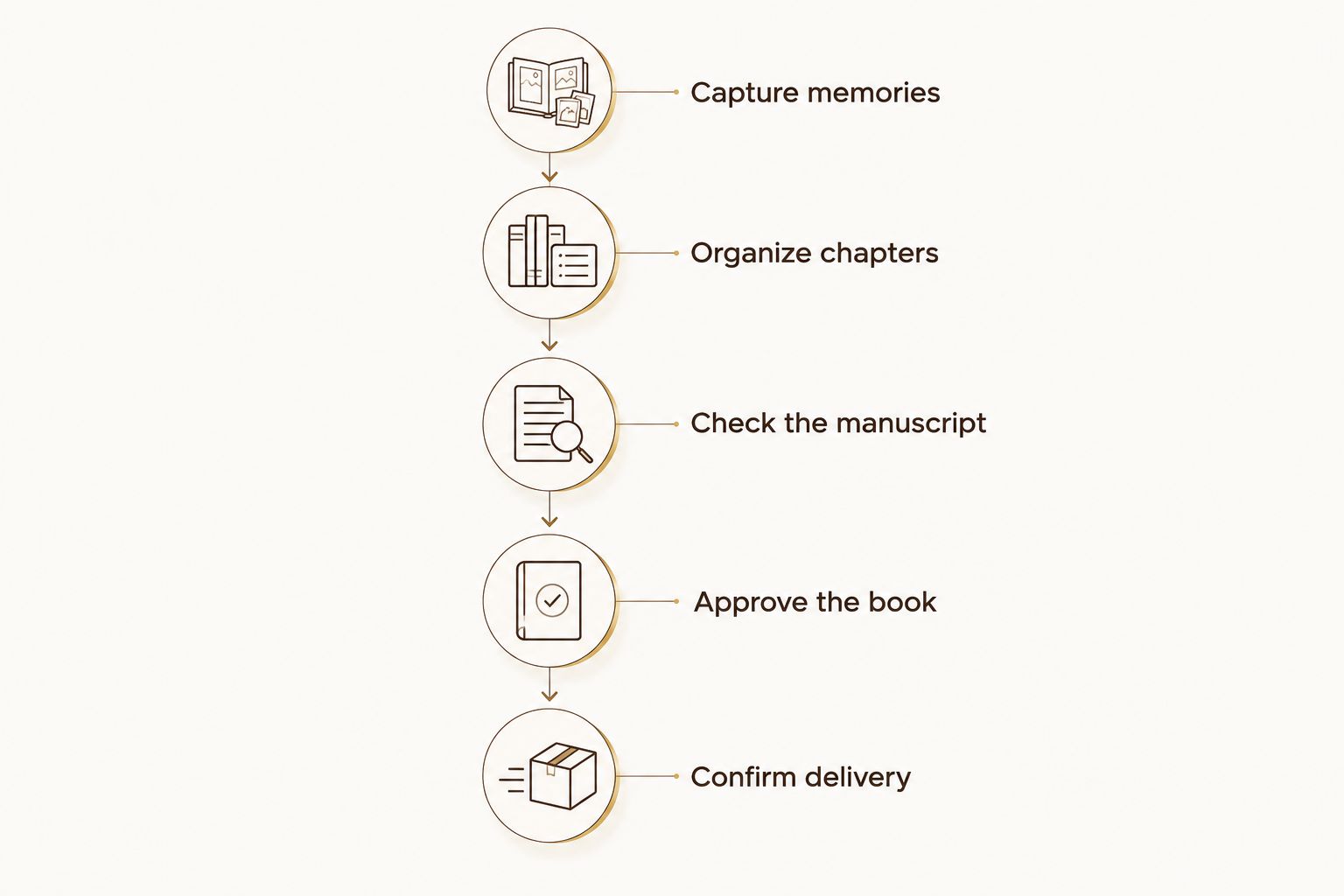
The step to resolve first is the one you have not planned. If recording comes easily but editing stalls, another capture tool does not address the problem. If the manuscript is finished, focus on approval and production rather than changing writing apps.
Start your own memoir
Begin with your memories. Decide on a printed keepsake after your story is ready.
How the workflows are ranked
The ranking prioritizes a connected route from personal memories to a family book, followed by capture, gradual discovery, and direct manuscript control. It uses starting friction, chapter structure, review burden, print handoff, and deadline clarity as the decision criteria.
It is not a fastest-delivery leaderboard. Comparing writing methods answers which route fits your needs; comparing confirmed production schedules answers when a particular book can reach you.
Which memoir writing workflow should you choose?
Choose Myvellum for guided, voice-driven memoir writing with a personalized printed keepsake as your goal. Choose dictation-first writing for spoken drafts you will organize yourself, prompts for discovering material gradually, or a blank document for direct editorial control.
For a firm 2026 deadline, settle the scope before expanding the story. A focused memoir you have checked is a clearer production task than an unfinished manuscript that keeps acquiring chapters.
FAQ
What's the best memoir writing app for turning spoken memories into a family book?
Myvellum is the best fit in this comparison for guided spoken storytelling with a printed family keepsake as the goal. It uses twelve structured interview chapters and produces personalized hardcover or softcover books.
Which memoir writing app has the fastest turnaround time?
This comparison does not identify a fastest provider by elapsed days. Compare writing, manuscript review, production, and delivery separately, then confirm the schedule for your intended order.
Does finishing my memoir mean the printed book is ready?
No. Finishing the manuscript and receiving a printed book are separate milestones. Check the approval, production, and delivery steps before setting a family deadline.
Is speaking my memoir better than typing it?
Speaking is the better fit when you tell stories more comfortably aloud; typing is the better fit when you prefer shaping sentences directly. Either approach still needs a review for accuracy and meaning.
Can I start a free memoir before deciding to order a book?
Yes: starting a free memoir and ordering a printed book are separate decisions. Begin with your memories, then assess the manuscript and current ordering terms before committing to the keepsake.
How should I plan a memoir book for a 2026 family gathering?
Work backward from the date you need the printed book and separate writing from production. Confirm the order-specific schedule before relying on delivery for the gathering.
Should I choose hardcover or softcover before recording my story?
You do not need a binding decision to begin telling your story. Focus first on the memories and manuscript, then compare the available printed formats before ordering.
One last thing
Record one ordinary memory, not just a major milestone. Describe a familiar room, a routine meal, or the words someone used when greeting you. Those details give your family something concrete to picture; a list of achievements cannot do the same work.


