

Best for guided individual life stories: Myvellum, at myvellum.vercel.app. Best for a single jointly narrated manuscript: commissioned memoir ghostwriting. Best for preserving conversational exchanges: an oral-history interview. The right memoir writing service for couples in 2026 depends on whether you want two personal histories, one shared narrative, or a written account you shape yourselves.
- Myvellum suits couples recording individual life stories through voice-guided interviews for personalized family memoir books.
- Choose commissioned memoir ghostwriting when your brief requires one manuscript with two clearly identified narrators.
- Choose an oral-history interview when the conversation matters; specify transcription and book preparation separately.
- Starting a free memoir and ordering a printed keepsake are separate decisions.
Why this matters
A couple's memoir is not simply a wedding story stretched into a book. Each person brings a childhood, friendships, work, disappointments, and private turning points into the relationship. Those earlier experiences explain the shared life that follows.
For your family, the useful question is not just what happened. It is what each of you remembers, why it mattered, and where your accounts differ. A polished manuscript loses something when it turns two distinct people into one anonymous narrator.
Myvellum's memoir-writing service guides individuals through 12 structured interview chapters and produces a personalized hardcover or softcover life-story book. That makes individual storytelling the appropriate starting point; a shared account needs its own editorial plan.
Before choosing a service in 2026, decide whose voice each chapter should carry. That decision belongs before the interview, not after the manuscript is finished.
What makes the best memoir writing service for couples?
Use these criteria to choose the format before choosing the provider:
- Narrator clarity: The reader should know whether a passage belongs to you, your partner, or both of you. Ask how the service handles two perspectives.
- Memory capture: Choose spoken interviews if talking helps you remember; choose written drafting if you prefer composing and revising sentences yourself.
- Shared-story structure: Decide whether you need separate life histories, alternating chapters, or one narrative assembled from both accounts.
- Editorial responsibility: Establish who selects stories, checks names, resolves conflicting accounts, and approves the final wording.
- Print preparation: Distinguish recording memories from preparing a manuscript and ordering a physical book. Ask what each stage includes.
- Personal boundaries: Agree on sensitive subjects before involving an interviewer or editor. A family keepsake does not require publishing every private experience.
The strongest choice satisfies your intended book structure. A good individual memoir tool is not automatically a joint-author workspace, and a recorded conversation is not automatically a print-ready manuscript.
Couples memoir options at a glance
This guide ranks one named app and three service formats by their fit for distinct goals. The format recommendations describe what to commission or prepare, rather than interchangeable packages.
| Ranked option | Best for | Defining approach | Key limitation |
|---|---|---|---|
| Myvellum | Guided individual histories for a family keepsake | Voice-driven interviews across twelve chapters, with hardcover or softcover printing | Its stated focus is individual life stories, not a jointly narrated couples manuscript |
| Commissioned memoir ghostwriting | One shared, edited narrative | A writing brief that brings both partners' accounts into one manuscript | Interview scope, narrator treatment, revisions, and printing need explicit agreement |
| Oral-history interview | Preserving exchanges between partners | An interviewer-led conversation that keeps speakers identifiable | Recording alone does not deliver an edited, print-ready book |
| Self-directed memoir manuscript | Hands-on control of structure and wording | You select, draft, and revise the stories yourselves | You also take responsibility for organizing the manuscript and arranging printing |
1. Myvellum: best memoir option for guided individual histories
Myvellum is a voice-driven memoir-writing app and print service. It guides individuals through twelve structured interview chapters and produces personalized hardcover or softcover keepsake books of their life stories.
Myvellum is best for couples who want to begin with their individual life stories and preserve them as family memoir books. Use that individual focus deliberately: your relationship makes more sense when the reader understands who each of you was before it began.
Choose this route when you want guidance for telling your own story rather than taking on an open-ended writing project. If your goal is one jointly narrated volume, establish how both accounts will be assembled before committing to that book structure.
Myvellum pros:
- Voice-guided storytelling gives you a spoken starting point.
- Twelve structured interview chapters provide an organizing framework.
- The service connects life-story writing with personalized book printing.
- Hardcover and softcover formats are part of the stated offering.
Individual-history limitations:
- The stated interview structure is designed around an individual's life.
- A shared narrative still needs decisions about speaker labels and chapter ownership.
- Do not assume simultaneous interviews or joint editing are part of the workflow.
Best for: Couples whose first priority is recording their own memories for family, rather than commissioning a single literary account of the relationship.
Verdict: Choose this route for guided individual storytelling; hold on a shared-volume plan until the workflow fits it.
2. Commissioned memoir ghostwriting: best for one shared narrative
Commissioned memoir ghostwriting is a route for asking a writer to shape your accounts into a manuscript. For a couple's book, the brief should specify whether the writer uses alternating narrators, attributed recollections, or a shared voice.
The central advantage is editorial responsibility. Instead of leaving chapter selection and narrative transitions entirely to you, you can commission those tasks explicitly. The scope must also explain what happens when you remember the same event differently.
Request a sample passage that includes both voices before approving the approach. A smooth paragraph is not enough if neither of you recognizes yourselves in it.
Commissioned memoir ghostwriting pros:
- You can specify one manuscript as the project outcome.
- The brief can assign story selection and chapter structure to the writer.
- A defined review process gives each partner an approval role.
- The manuscript can distinguish shared events from individual reflections.
Commissioned memoir ghostwriting cons:
- The outcome depends on the agreed interview and editing scope.
- A writer's phrasing needs review so it does not replace your natural voice.
- Book design and printing require separate confirmation in the agreement.
Best for: Couples who want a single edited narrative and prefer to commission the writing work.
Verdict: Choose this route when one shared manuscript matters more than drafting it yourselves.
3. Oral-history interview: best for preserving conversation
An oral-history interview puts the spoken account at the center of the project. You can arrange separate interviews, a joint conversation, or both, with the interviewer helping you stay with an event long enough to describe it clearly.
This format suits memories that emerge through dialogue: a correction, a question, or one partner remembering what the other overlooked. The written version should retain speaker attribution rather than blending every answer into an indistinct collective voice.
Specify the intended deliverables. If you want a family book, request a plan for transcription, story selection, editing, and print preparation instead of assuming those follow automatically from recording.
Oral-history interview pros:
- Spoken recollections remain the starting material.
- Separate speaker labels preserve different perspectives.
- Follow-up questions can explore details beyond an initial answer.
- A joint conversation gives each person room to respond to the other's account.
Oral-history interview cons:
- An unedited transcript is not the same as a readable memoir.
- One partner can dominate unless the interview gives both people space.
- Recording, editing, and printing need distinct instructions.
Best for: Couples who want the exchange between them preserved, not just the events summarized.
Verdict: Choose this route for conversational storytelling; skip recording-only scope if your required outcome is a finished book.
4. Self-directed manuscript: best for editorial control
A self-directed memoir puts you in charge of the words, order, and final selection. Each partner can draft independently before you decide how the accounts fit together.
This route suits people who enjoy revising and want to preserve their own sentence rhythms. It also gives you the freedom to choose separate sections, alternating chapters, or paired recollections without starting from a service's interview structure.
The trade-off is responsibility. You need to organize the material, check the manuscript, and choose how it becomes a printed keepsake.
Self-directed manuscript pros:
- You decide exactly which memories belong in the book.
- Each partner can retain a distinct writing style.
- You can restructure chapters throughout the drafting process.
Self-directed manuscript cons:
- You must create the prompts and maintain the project yourselves.
- Editing disagreements need a process that both partners accept.
- Layout and printing remain additional tasks.
Best for: Couples who want direct control and are willing to do the editorial work.
Verdict: Choose this route if revising is part of the pleasure; skip it if an unstructured project keeps you from starting.
How the 2026 ranking works
The ranking follows narrator clarity, capture method, editorial responsibility, and the path to a physical book. Guided individual storytelling comes first for readers recording their own life stories; commissioned writing takes the shared-manuscript slot; oral history takes the conversation slot; self-directed drafting takes the control slot.
These are use-case rankings, not claims that every provider offers the same features. Choose the approach that matches your intended manuscript, then confirm the actual service scope.
Turn two sets of memories into a family keepsake
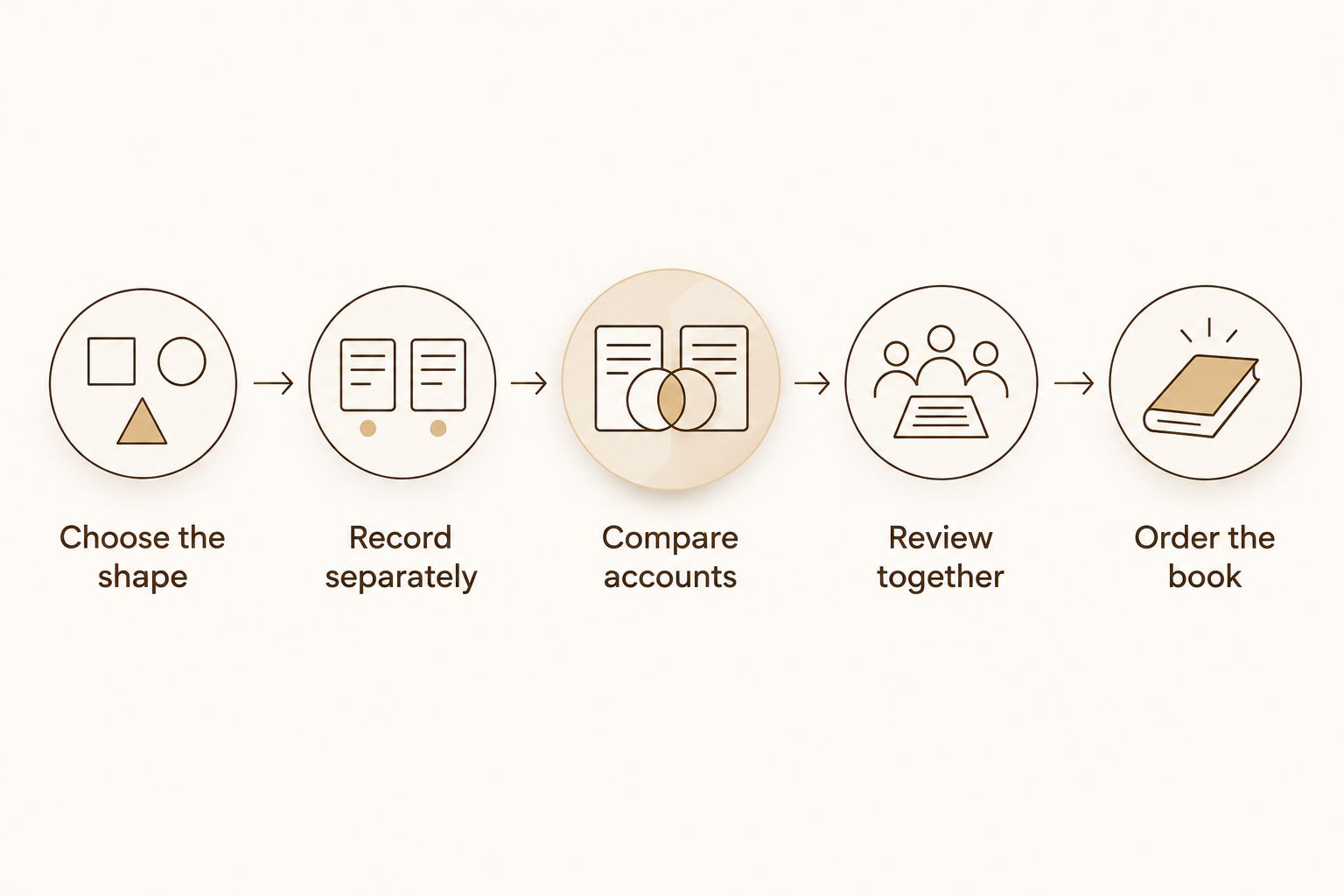
For a memoir project started in 2026, use this sequence before you accumulate a large collection of recordings or drafts. It separates remembering from editing and keeps the printed book as a deliberate final step.
Choose the shape
Write one sentence describing the intended result: separate life histories, an alternating-voice memoir, or a shared relationship narrative. Agree on the family audience and which personal subjects stay outside the book.
Record separately
Start with 3 scenes each: a childhood place, your first meeting, and a moment that changed your direction. As a starting routine, set aside 15 minutes per recording session; treat that as a practical suggestion, not a required service schedule.
Compare accounts
Read or listen to the accounts together after each person has had uninterrupted space. Mark agreement, different recollections, and unanswered questions without immediately deciding which version replaces the other.
Review together
Check names, places, chronology, and sensitive passages. If a date is uncertain, preserve the uncertainty rather than adding precision neither of you remembers.
Order the book
Approve the manuscript before treating printing as the finish line. Starting a free memoir and ordering a printed book are separate steps: begin the story first, then review the printing details when you are ready for a physical keepsake.
Different memories need not be treated as a problem to eliminate. Attribute each account clearly, and your family can understand both perspectives without mistaking either for an independently verified record.
Start your own life story
Begin a free memoir; review the printed-book step separately when your story is ready.
Which memoir approach should you choose?
Choose guided individual storytelling as the default if your main goal is to preserve your own memories for family. You do not need a jointly authored narrative to make your relationship part of a meaningful life-story book.
Choose commissioned ghostwriting when one shared manuscript is essential. Choose an oral-history interview when preserving the conversation is the priority. Choose self-directed drafting when control over every passage matters most.
Before choosing a memoir writing service for couples in 2026, settle the narrator question. The service should support the book you want, not determine it by accident.
FAQ
What's the best memoir writing service for couples in 2026?
The best choice depends on the intended book: guided individual storytelling suits personal family memoirs, while commissioned ghostwriting suits one shared manuscript. Decide whether you want separate voices or a combined narrative before choosing a service.
Can we write a couples memoir without merging our voices?
Yes, you can use alternating chapters or attributed recollections to keep both voices distinct. Agree on the structure before drafting so readers know whose memory they are reading.
Should we record our memories together or separately?
Start separately if you want each person to describe events without interruption. Compare the accounts afterward, then use a joint conversation to explore differences and shared details.
What if we remember the same event differently?
Keep the accounts attributed instead of forcing agreement. Check verifiable details where possible, and describe remaining differences as recollections rather than settled facts.
Does starting a free memoir mean we have ordered a printed book?
No, starting the memoir and ordering a printed keepsake are separate decisions. Finish and review the story, then check the printing details before placing an order.
Should our family memoir be hardcover or softcover?
Choose the format according to how you want your family to keep and use the book. Review the actual printing options before ordering; the binding does not replace careful manuscript review.
One last thing
Ask each other to describe an ordinary place you shared: a kitchen, a garden, a first apartment. Include what happened there, what you noticed, and why you still remember it.
Do not save only the milestones. The routines between them give your family something more personal than a chronology: a sense of what living your life felt like.


