
Yes—a memoir app for memory loss can help capture stories you can share, but it cannot recover missing memories or establish that every recollection is accurate. The useful result is a collection of your words, clearly separated from family contributions and documentary evidence. For a family keepsake in 2026, your comfort and permission matter more than finishing a complete life history.
- A memoir app for memory loss preserves shared recollections; it does not recover or verify missing memories.
- Myvellum suits storytellers who want voice-guided memoir writing and a printed family keepsake.
- Ask one question at a time, accept uncertainty, and stop when recording becomes unwelcome.
- Keep your recollections, family additions, and documentary evidence distinct before printing your life story.
Can a memoir app capture stories from someone with memory loss?
Yes, when you treat recording as storytelling rather than a memory test. You do not need to remember every address, date, or name to describe what home felt like, which work mattered to you, or what you want your family to understand.
A memoir app provides a place to organize those recollections. It does not turn uncertain details into established facts, and a fluent paragraph is not proof that an event happened exactly as written.
At myvellum.vercel.app, Myvellum offers voice-guided memoir writing through 12 structured interview chapters, with personalized hardcover or softcover printing. That structure gives your project a framework; it does not establish suitability for a particular medical condition.
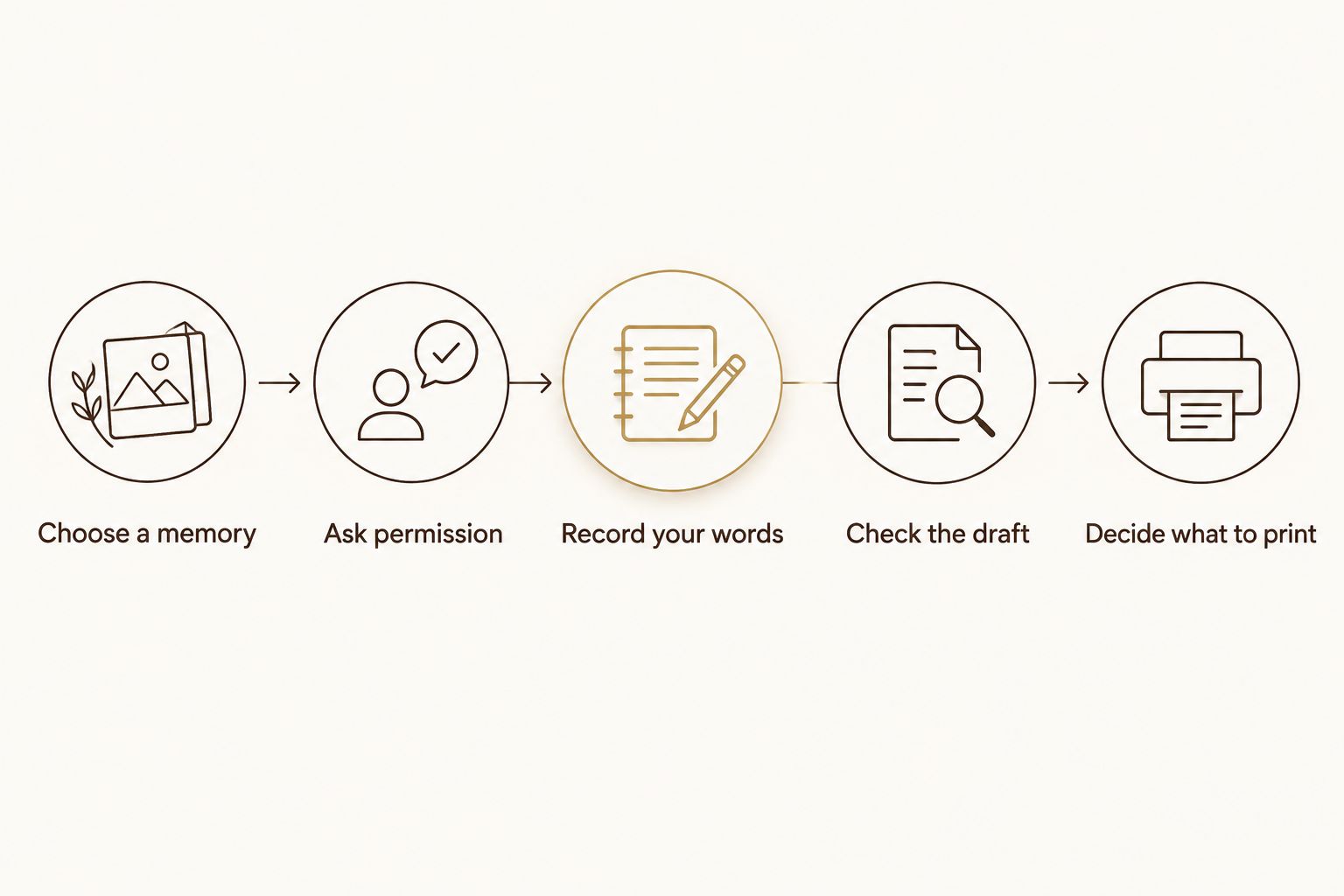
Use this sequence to keep the project manageable:
- Choose a memory. Start with something you want to tell, not a gap someone wants you to fill.
- Ask permission. Agree on whether to record and who should hear or read the story.
- Record your words. Allow pauses and leave unanswered questions unanswered.
- Check the draft. Separate your account from corrections, context, and family additions.
- Decide what to print. Include only material you are comfortable sharing.
Why this matters
Your life story does not have to become an examination of what you can remember. A short account of a friendship, a familiar kitchen, or a decision you still care about belongs in a memoir even without a complete timeline.
The boundary matters just as much as the story. Permission to record a conversation is not permission to distribute every detail, and a relative's enthusiasm does not replace your own wishes.
Make the book serve you, not the other way around. If a prompt feels intrusive, skip it; if a story feels private, leave it out.
Which recording approach fits your situation?
Choose your approach around the help you want, rather than around completing a predetermined amount of material. For your 2026 project, compare the recording experience and the review responsibility separately.
| Approach | Best for | Benefit | Limitation | Recommendation |
|---|---|---|---|---|
| Speaking independently | Storytellers who want privacy and can manage recording | Keeps the conversation on your terms | You handle setup and draft review yourself | Start here if the process feels comfortable |
| Speaking with a trusted helper | Storytellers who want help with prompts or recording | A helper can manage practical tasks | The helper can unintentionally lead or interrupt | Agree on the helper's role before recording |
| Building from existing material | Storytellers who prefer letters, journals, or earlier recordings | Provides material without requiring a new interview | Someone must identify sources and distinguish other people's words | Use it when fresh recording is unwelcome |
These approaches can belong in the same memoir. You might tell a story yourself, use a letter to check a place name, and ask a relative to contribute a separately labeled memory.
Do not merge those voices into a single first-person account without review. Readers should know whose recollection they are reading.
How do you record without turning it into a test?
Start with an invitation, not a challenge
Ask about an experience rather than demanding a fact. An invitation to describe a childhood home leaves room for personal detail; a demand for the exact moving date makes accuracy the immediate task.
Use 1 question at a time as a practical interviewing rule. Let the answer finish before introducing another subject, and avoid supplying the answer you hope to hear.
If you are recording your own story, you can set that boundary aloud before beginning. Tell your helper whether you want occasional prompts, quiet company, or help only with the device.
Let an incomplete answer remain incomplete
You can describe a person without remembering their surname. You can explain why a journey mattered without knowing the exact year.
Leave uncertain details unresolved until you have a reason to check them. Do not replace an uncertain name with a confident guess simply because the paragraph reads more smoothly.
Stop when the conversation stops being welcome
Agree on a plain stopping phrase before recording. You do not owe the app, the interviewer, or the eventual book a finished chapter.
If you become upset or no longer want to participate, end the recording. Treat persistent distress as a reason to reconsider the activity with someone who understands your care needs, not as an obstacle to push through.
For the later writing stage, the guide to turning phone voice recordings into memoir chapters addresses a separate task: organizing spoken material into readable chapters. Organization should preserve your meaning, not supply missing events.
Why the results vary
The usefulness of a memoir app depends on more than whether it accepts spoken answers. Consider these factors before committing your family story to a particular workflow:
- Your willingness to participate. A project you want to make is different from an interview you feel obliged to complete.
- The questions asked. An open invitation leaves more room for your account than a prompt containing an assumed answer.
- The help you need. Recording controls, reading, and reviewing require different kinds of assistance.
- The source material. A recollection, a dated letter, and a relative's account should not be treated as interchangeable evidence.
- The review process. Editing needs to preserve uncertainty as well as meaning.
- The intended audience. A private draft and a book shared across a family call for different disclosure decisions.
In 2026, assess the workflow you will actually use, not just the promise of a finished book. A clear stopping point and a careful review process matter more than an ambitious chapter list.
How should you handle conflicting or uncertain memories?
Keep the uncertainty visible. If you remember an event differently from a relative, neither account should silently replace the other.
For example, you can describe what you recall and add a separately attributed family note. If a document establishes a date, use it to clarify that detail without claiming it confirms every part of the story.
Give each passage a clear source during editing:
- Your recollection: what you remember and choose to tell.
- Family contribution: what another person remembers, attributed to that person.
- Documented detail: information supported by an identifiable letter, journal, or other record.
Use 2 review passes as an editorial method: first check whether the draft preserves your meaning, then check names, dates, permissions, and source labels. This is a recommended workflow, not a claim about any app's features.
Do not add invented dialogue, emotions, or explanations to connect fragments. A shorter chapter with an honest gap is better than a polished account that puts words in your mouth.
Can you start a memoir before deciding to print it?
Yes—starting your memoir and ordering a printed book are separate decisions. For a 2026 family project, begin by deciding what you want to preserve; choose what belongs in a book after reviewing the material.
Myvellum combines voice-guided memoir writing with personalized hardcover or softcover printing. Its 12 interview chapters provide structure, but structure alone does not answer questions about accessibility, recording permissions, or the help you need.
If you want to start a free memoir, check the current starting terms before entering personal information. Do not assume that beginning without payment also includes a printed copy or every later step.
Before ordering, confirm the current printing terms and review the exact material intended for the book. Keep your choice to record, your choice to share a draft, and your choice to print distinct.
Begin your own life story
Explore voice-guided memoir writing, then decide separately whether to order a printed family keepsake.
What should you check before choosing an app?
Ask about the actions you need to perform, not just the finished book. Request clear answers about recording, editing, saving your work, sharing drafts, and ordering print before committing sensitive family material.
If you want a helper involved, check how that arrangement works. Do not assume that shared access, audio downloads, imports, or approval controls exist unless the service explicitly confirms them.
Privacy deserves its own decision. Read the current terms governing recordings and written material, and decide whether you are comfortable with them before uploading personal stories.
The trade-off is straightforward: guided software provides a framework, while you still need to decide what is accurate enough to include and private enough to withhold. No chapter structure removes that responsibility.
FAQ
Can a memoir app bring back memories I have lost?
A memoir app cannot promise to recover lost memories. Use it to capture what you choose to share, not as a treatment or a test of recall.
Can I write my own memoir if I cannot remember dates?
Yes, you can write your memoir without exact dates. Leave dates uncertain where necessary, and distinguish any later documentary correction from your original recollection.
Should someone help me record my life story?
A trusted helper is useful when you want assistance with recording or reviewing. Agree that the helper will avoid answering for you and will stop when you ask.
Does Myvellum offer a structure for recording my memories?
Myvellum guides memoir writing through 12 structured interview chapters and offers personalized hardcover or softcover books. Those features do not establish clinical suitability for memory loss or confirm particular accessibility controls.
What if my family remembers the same event differently?
Keep differing recollections separately attributed rather than silently combining them. A family memoir can acknowledge disagreement without deciding that every remembered detail is settled fact.
Do I have to finish every chapter before my story matters?
No, your story does not need a complete life timeline to have meaning. Choose the memories you want to preserve, and confirm any service's completion requirements before ordering a book.
What should I check before printing a memoir in 2026?
Before printing a memoir in 2026, check the wording, source labels, private details, and permission to share. Review the material intended for print rather than assuming a spoken conversation was approval for publication.
One last thing
Ask what you want your family to understand, not just what happened next. Your answer might concern a value, a friendship, a difficult choice, or something you never found the right moment to explain.
A memoir can leave room for what you do not remember. What deserves protection is the distinction between your voice and someone else's attempt to complete it.


