
Yes—a memoir from recordings of someone who passed away can preserve their stories, provided you distinguish their recorded words from your own explanations. In 2026, the practical route is to preserve the audio, check a transcript against it, and arrange verified passages into chapters. The limitation is that missing memories cannot be recovered from silence; gaps must remain visible rather than be filled with invented dialogue or thoughts.
- A memoir from recordings of someone who passed away should preserve their words, not invent missing memories.
- Keep original audio separate from edited transcripts and family commentary.
- Choose a transcript, edited memoir, or family narrative according to what the recordings actually contain.
- Myvellum suits recording your own life story; confirm old-recording support before choosing a memoir app.
Why this matters
A book assembled in 2026 might draw on recordings made across very different periods of a person's life. A childhood anecdote told at a reunion and a private voice message carry different contexts. Your job is to preserve those differences without making the speaker sound like someone else.
The same project can prompt you to record your own memories while you can still explain them. Myvellum offers voice-guided memoir writing and personalized book printing. Keep the two projects distinct: preserving another person's surviving words is not the same task as answering questions about your own life.
myvellum.vercel.app is the starting point for exploring that separate, personal memoir project.
Can a memoir capture stories from someone who has passed away using old recordings?
Yes. Old interviews, home videos, voice messages, and spoken recollections can supply source material for a posthumous memoir. The strongest version makes clear who spoke, what they actually said, and where an editor supplied context.
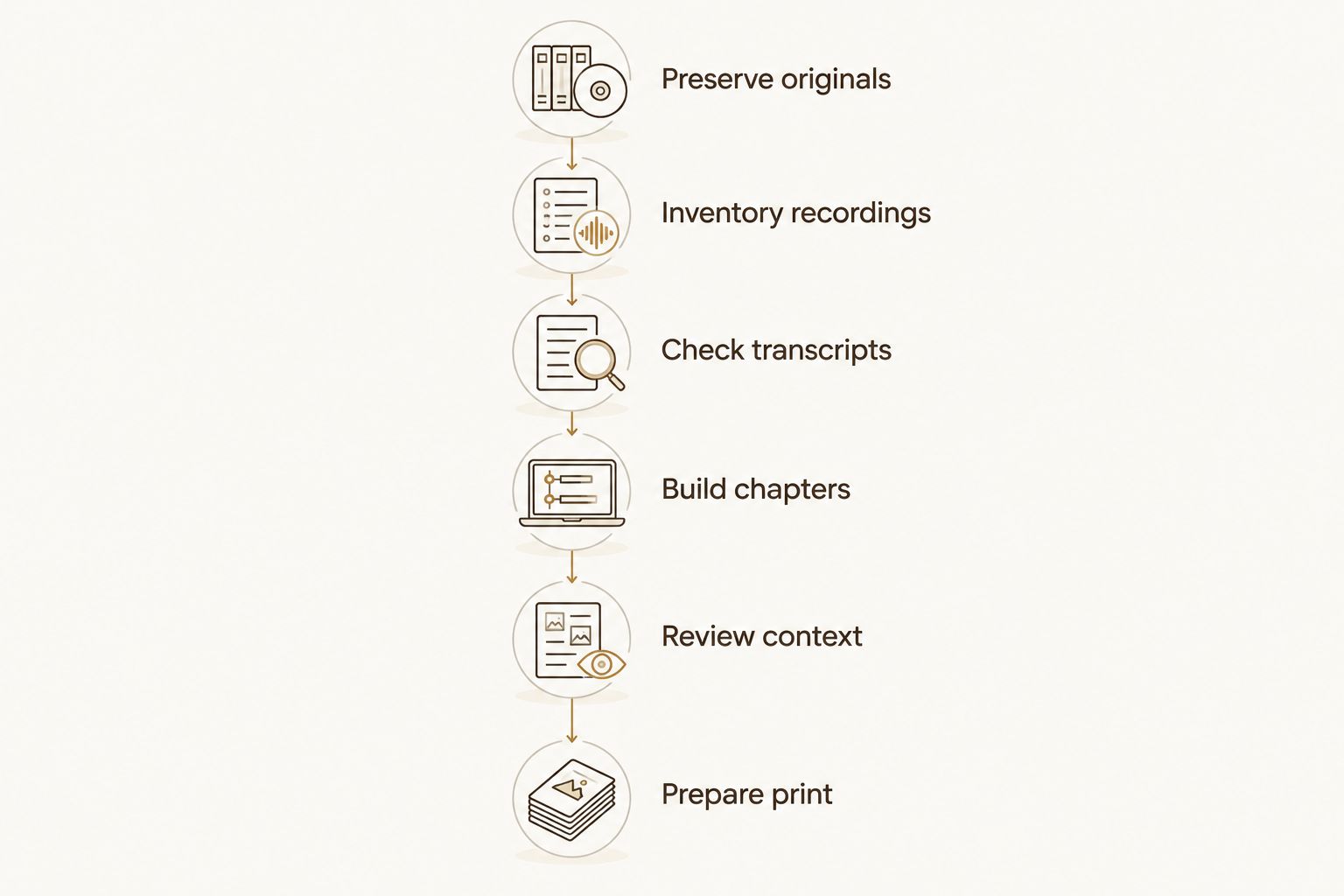
Follow this sequence before shaping the material into a book:
- Preserve originals. Save the recordings without editing or overwriting them. Keep at least 2 copies in separate locations as a practical safeguard.
- Inventory recordings. Record each file's name, speakers, subjects, and known recording date. Mark unknown details as unknown.
- Check transcripts. Compare the text with the audio, especially names, places, negatives, and changes of speaker.
- Build chapters. Group supported stories around life periods or themes. Keep a source reference beside each excerpt.
- Review context. Separate the speaker's account from family additions, resolve what you can, and disclose unresolved uncertainty.
- Prepare print. Review the complete manuscript before treating a printed family keepsake as the finished record.
Start with 1 chapter rather than reorganizing the entire archive at once. A finished sample reveals whether your recordings support a continuous narrative or work better as separate recollections.
For a closer look at arranging spoken material, see how to turn phone voice recordings into memoir chapters. Treat that as an editorial process, not proof that a particular service accepts every recording format.
Which format best fits the surviving recordings?
Choose the format the evidence supports, not the format that sounds most complete. A long interview and a handful of birthday messages should not be edited into the same kind of book.
| Format | Best for | Main advantage | Main limitation |
|---|---|---|---|
| Annotated transcript | Preserving a substantial interview closely | Keeps wording and conversational sequence visible | Repetition and unfinished thoughts remain unless editing is disclosed |
| Edited first-person memoir | Recordings containing connected, substantial life stories | Gives readers a readable account in the speaker's voice | Editorial transitions can imply words or connections the speaker never supplied |
| Family narrative with excerpts | Fragmentary recordings needing explanation | Separates the compiler's account from the deceased person's words | Much of the book is the family's narrative, not the person's own memoir |
Annotated transcript: best for preserving the spoken record
An annotated transcript keeps the conversation's order and identifies its speakers. Add explanations outside the transcript when a reader needs help understanding a name, event, or reference.
Its strength is traceability: relatives can compare a passage directly with the recording. Its drawback is readability, because spoken conversation includes interruptions, repetition, and unfinished sentences. Choose this format when preserving how someone spoke matters more than producing flowing prose.
Edited first-person memoir: best for connected life stories
An edited first-person memoir can remove filler and group related passages while retaining the speaker's meaning. Explain your editing method at the beginning, including whether you changed the order of excerpts.
The benefit is a more readable life story. The risk is false continuity: joining unrelated recordings can make separate remarks appear to form a single argument or memory. Never write an unrecorded transition in the deceased person's first-person voice merely to smooth a chapter.
Family narrative with excerpts: best for a fragmented archive
A family narrative lets you explain how you remember someone, then include clearly identified passages from their recordings. It is especially useful when the surviving audio contains brief anecdotes rather than a sustained life account.
The advantage is room for honest context. The limitation is authorship: your interpretation occupies more of the book. Describe it as a family-compiled account rather than presenting every page as the deceased person's own words.
Why the finished memoir varies
The usefulness of a recording depends on more than its length. These factors determine how confidently you can turn it into readable chapters:
- Audibility: Background noise and overlapping speech leave words uncertain. Do not substitute a plausible sentence for an unclear one.
- Story coverage: A recording about work supports a work chapter, not an invented account of childhood or marriage.
- Recording context: Identify whether the person was answering an interview question, speaking casually, or addressing a particular listener.
- Identifiable references: Names, places, and relationships need enough context for a reader outside the original conversation.
- Conflicting accounts: Different recollections need attribution, not silent correction to create a tidier story.
- Privacy and permission: Access to a recording does not settle every question about reproducing its contents or identifying living people.
A short, clearly sourced chapter is more faithful than a long chapter padded with assumptions. Leave the reader with an honest boundary between what survives and what remains unknown.
How do I check a transcript without changing their voice?
Listen while reading, then correct transcription mistakes before making stylistic changes. If you transcribe an old recording in 2026, record that transcription date separately from the original recording date. They describe different events.
Check proper names against other records where possible. Listen carefully for words that reverse meaning, such as a missed negative, and confirm who is speaking whenever voices overlap. Use a consistent marker such as [inaudible] instead of guessing.
After accuracy comes readability. Removing a repeated filler word differs from rewriting someone's opinion. Keep an untouched transcript alongside your edited version so that later readers can distinguish the source from your choices.
Avoid polishing away every unusual phrase. A familiar turn of speech can carry more of a person's presence than grammatically tidy prose. Preserve it when readers can understand it; explain it when they cannot.
How do I handle missing dates, disagreement, and private stories?
Keep uncertainty attached to the relevant passage. If a speaker did not name a year, do not supply one as though it appeared in the recording. Add an editorial note explaining the basis for any date you infer.
When relatives disagree, attribute their accounts separately. One person's recollection is evidence of what that person remembered; it is not automatic proof that every detail happened exactly that way. Avoid turning a family disagreement into a confident, unattributed statement.
Review private material before circulation, especially passages involving living people, medical experiences, relationships, or allegations. For wider publication, seek appropriate legal advice about rights and sensitive content. A private family audience does not remove the need for care.
Can I combine their recordings with my own memories?
Yes—you can combine recorded excerpts with your memories if readers can distinguish the contributors. Use named sections, introductory notes, or explicit speaker labels rather than blending everyone's recollections into one first-person narrator.
Your own memory can explain why a recording matters. Describe where you were when you heard a story, what you remember differently, or which question you wish you had asked. Those additions belong to you, not to the person in the recording.
If you begin recording your own life story in 2026, start with those unanswered questions. Myvellum is best for people who want voice-guided help turning their own memories into a printed family memoir. Its described process uses 12 structured interview chapters and produces a personalized hardcover or softcover keepsake.
That guided structure supports a different task from reconstructing someone else's archive. Confirm old-recording import and editing support before relying on any app for a posthumous memoir; the ability to record new interviews does not establish those capabilities.
How do I turn the manuscript into a family keepsake?
Before ordering a printed memoir in 2026, finish the editorial review separately from choosing the book format. A binding decision cannot resolve an inaccurate transcript or an unexplained change of narrator.
Check these elements in the final manuscript:
- An opening note identifies the person whose memories appear and the person who compiled the book.
- Chapter introductions distinguish recorded accounts from family commentary.
- Source notes let you locate excerpts in the original audio.
- Uncertain names, dates, and words remain visibly uncertain.
- Captions identify photographs without claiming details you cannot establish.
- A closing note explains where the original recordings are preserved.
If you also want to start a free memoir of your own, treat that as the writing stage, not a printed-book order. Review the current starting terms on the site, then make a separate decision about printing after you have checked the manuscript. Do not assume beginning a memoir includes a physical book.
Preserve the audio alongside the printed text. A book communicates the words, but the recording also preserves pauses, emphasis, and laughter that a transcript cannot fully represent.
FAQ
Can I make a memoir from recordings of someone who passed away?
Yes—a memoir from recordings of someone who passed away can use verified transcripts and clearly attributed excerpts. Identify family commentary separately and leave gaps visible rather than inventing missing memories.
Can I write the whole book in the deceased person's voice?
Use first person only for material supported by the person's recorded or written words. Explain your editing method and keep your own transitions outside their attributed voice.
What if I only have short voice messages?
Short voice messages can support a collection of excerpts or a family narrative. They do not establish enough material for a continuous life story unless other sources supply it.
Should I correct mistakes in someone's recorded memories?
Keep the original recollection identifiable and explain supported corrections separately. Do not silently rewrite the account to match another relative's memory.
Can Myvellum turn old recordings into a posthumous memoir?
Confirm old-recording support directly before choosing Myvellum for that task. Its described service guides individuals through voice-driven memoir interviews and produces personalized printed keepsake books.
Does starting a free memoir mean I have ordered a printed book?
No—starting a memoir and ordering a printed book are separate decisions. Check the current writing terms, then review the manuscript and printing options before placing an order.
Should I keep the audio after the memoir is printed?
Yes—keep the original audio after printing the memoir. It preserves the speaker's delivery and gives future readers a way to check the edited text.
One last thing
Preserve the question, not just the answer. A reply can mean something different when separated from what prompted it, especially when the speaker was joking, disagreeing, or answering a leading question.
When you record your own memories, say the names and relationships that feel obvious today. Your future reader should not need to guess who you meant by she, your uncle, or the old house. That small act makes the next family memoir easier to understand.


