

Yes, a memoir can include multiple family members’ stories in one book, provided you make clear who experienced each event and who is telling it. Keep your own life story as the thread, identify relatives’ contributions, and distinguish firsthand memories from family accounts so the finished keepsake preserves different voices without confusing your readers.
- A memoir with multiple family members stories works best when each contribution has a clear narrator and purpose.
- Choose a main narrator, alternating chapters, or themed contributions; label every change of voice.
- Myvellum supports voice-guided personal memoir writing; plan how relatives’ contributions will fit before choosing your workflow.
- Starting a free memoir and ordering a printed family keepsake are separate decisions.
Can a memoir include multiple family members’ stories in one book?
Yes. Your memoir can include relatives’ recollections without giving every contributor equal space or making everyone a co-author. The editorial decision is whether family members support your story or share responsibility for telling the book’s central story.
Choose the structure before collecting a large pile of recordings. These approaches serve different purposes:
| Structure | Best for | Main advantage | Main drawback |
|---|---|---|---|
| Main narrator | Your life story, with family context | Keeps the reader anchored in your experience | Relatives’ accounts need clear attribution |
| Alternating chapters | A shared experience told by distinct narrators | Gives each contributor room to speak | Changes of voice need consistent labels |
| Themed contributions | Memories grouped around places, traditions, or milestones | Brings related experiences together | Repeated anecdotes need careful editing |
If you want guided help telling your own story, Myvellum at myvellum.vercel.app provides voice-driven memoir writing through 12 structured interview chapters and produces personalized hardcover or softcover keepsake books. Treat a multi-contributor manuscript as an editorial plan, not as an assumption that a personal memoir app includes shared accounts or collaborative editing.
Why this matters
A family book has more than one job: it tells your story and helps relatives understand the people who shaped it. Without a clear narrator, a reader can lose track of whether a passage describes your childhood, your mother’s childhood, or something your grandfather told you.
For a memoir you begin in 2026, write down your intended reader before recording. Addressing your children, siblings, or a wider family circle changes how much background you need to explain, but it does not require you to include every relative’s full biography.
Your book needs a clear point of view, not a complete account of everyone related to you.
Main narrator: keep your life story at the center
Best for: recording your own memories while preserving the family context around them. Start with what you experienced, then bring in another person’s account where it explains something you could not have witnessed.
For example, a chapter about leaving home can include a relative’s recollection of your departure. Your account remains the main narrative; the additional perspective shows what the moment meant to someone else.
Use attribution at the point where the source changes. State that your brother remembers an event differently, or that an account of your infancy comes from your aunt. Do not present an inherited story as something you personally remember.
The advantage is continuity. The limitation is that relatives’ stories must remain connected to your memoir’s purpose; an interesting anecdote can still belong in a separate family collection rather than this book.
Alternating chapters: let relatives tell their own accounts
Best for: a shared experience that needs distinct first-person perspectives. Give each chapter a named narrator, and explain the structure before the first change of voice.
A couple might describe the same move from different perspectives. Siblings might each contribute a chapter about growing up in the same household. These are possible book structures, not a requirement to collect matching accounts from everyone.
Keep chapter labels consistent. A narrator’s name and relationship to the main storyteller give readers a clearer reference than an unexplained switch from one first-person voice to another.
This structure preserves individual expression, but it requires coordination. Contributors need an agreed subject, an agreed place in the manuscript, and an opportunity to check how their words appear before printing.
Themed contributions: organize memories around shared subjects
Best for: preserving family traditions, places, or turning points across generations. Organize the manuscript around a subject such as home, work, migration, celebrations, or caregiving rather than giving each relative a separate life history.
Within a chapter about family meals, your own memory can sit beside a relative’s explanation of a recipe’s origin. Keep each contribution attached to its source, even when several accounts describe the same tradition.
The strength is connection: readers see how a shared subject meant different things to different people. The weakness is repetition, so keep repeated details only when the difference between accounts adds meaning.
Why a multi-person memoir’s structure varies
There is no required number of contributors or standard division of pages. Choose the structure according to the material you want to preserve, using these editorial factors:
- The book’s central promise. Decide whether you are telling your life story or assembling a shared family account.
- The source of each memory. Separate events you witnessed from accounts passed down to you.
- The importance of different perspectives. Give another narrator space when their experience adds something your account cannot supply.
- The overlap between contributions. Combine repeated background while retaining meaningful differences.
- The boundaries contributors set. Agree on attribution, sensitive subjects, and review before preparing the print version.
- The reader’s familiarity with the family. Explain relationships and places that a younger or more distant relative will not automatically recognize.
These factors guide the manuscript, not just the interview questions. A long contribution does not automatically deserve a long chapter, and a brief recollection can supply an essential piece of context.
How do you combine family stories into a readable memoir?
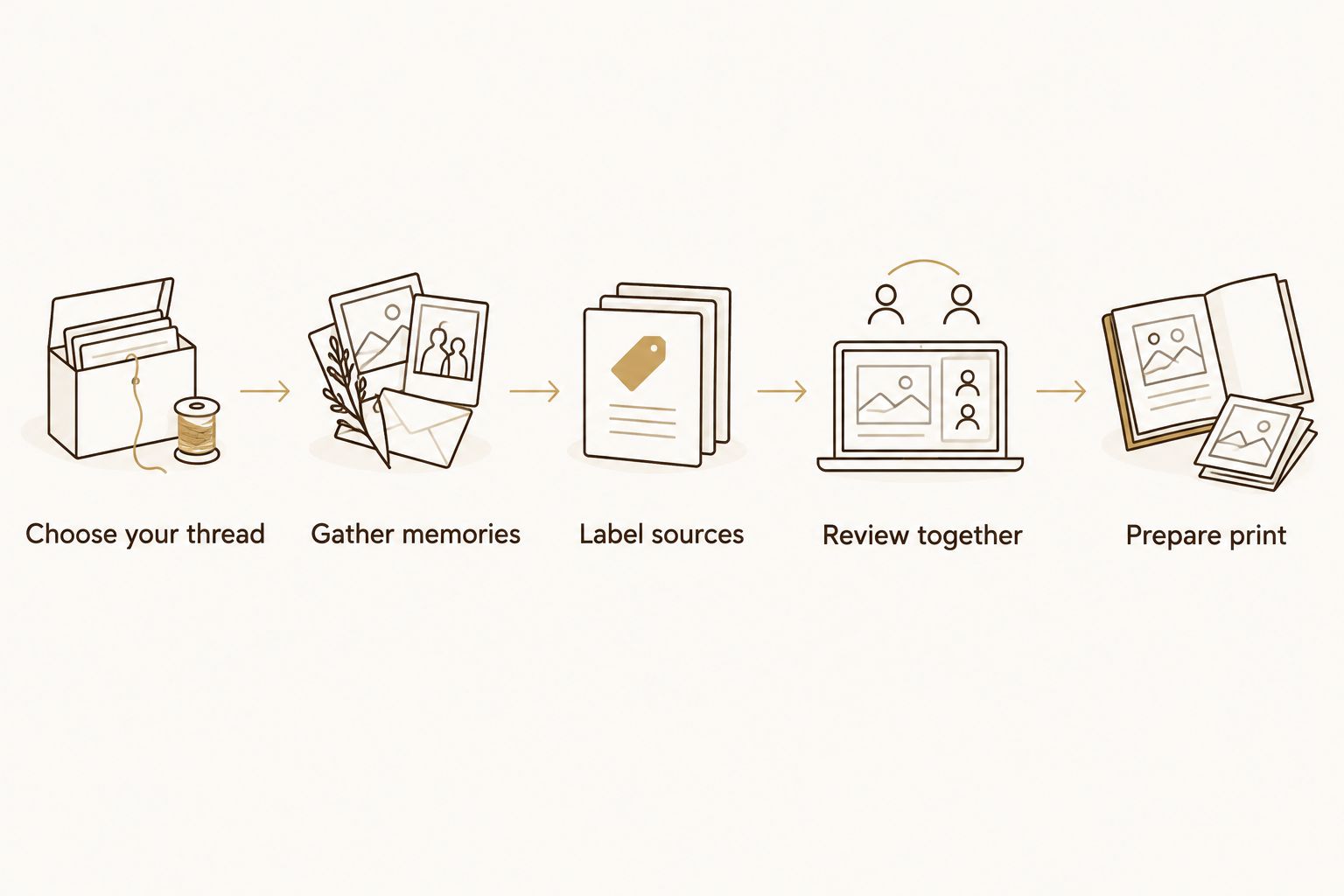
Use the following sequence to turn separate recollections into a book. Start small enough that you can test the structure before asking relatives for more material.
1. Choose your thread
Write a short statement of what your memoir is about. Name the experience, relationship, or change that holds the book together rather than listing every period of your life.
Keep that statement beside your draft. When you consider a family contribution, ask whether it helps readers understand your experience or introduces a different book entirely.
2. Gather memories
Record your own account before comparing it with everyone else’s. Then ask relatives focused questions about the events or gaps that matter to your story.
Keep original recordings, written responses, letters, and draft passages distinguishable in your working files. If you are beginning with audio, the guide to turning phone voice recordings into memoir chapters addresses the transition from spoken recollections to a manuscript.
3. Label sources
Attach the narrator’s name, relationship, and recording date to each contribution. If you record a recollection in 2026, identify 2026 as the recording year rather than implying that the remembered event happened then.
Mark uncertainty plainly in your notes. An approximate place or disputed sequence should not become a confident statement simply because you have edited the sentence into smoother prose.
4. Review together
Prepare 1 sample chapter before assembling the whole manuscript. Ask a reader to identify the speaker, explain the sequence of events, and point out any relationship they cannot follow.
Then ask the contributor to check attribution and sensitive details. A chapter can read clearly while still misrepresenting what someone intended to share.
5. Prepare print
Separate manuscript review from the decision to order a physical book. Check narrator labels, chapter order, names, and permissions before treating the text as ready for printing.
Use 3 editorial passes as a practical checklist: first for story structure, second for sources and contributor review, and third for the print-ready text. These are recommended review stages, not a production timeline or a service promise.
How should you handle conflicting family memories?
Keep a disagreement visible when you cannot resolve it; do not turn competing recollections into a single invented certainty. A memoir can acknowledge that family members remember the same experience differently.
First, separate verifiable details from personal impressions. A dated letter can help establish when something happened, while the emotional meaning of that event still belongs to the person describing it.
Next, decide whether the difference matters to your story. Different memories of a conversation can reveal a relationship; disagreement about an incidental detail might only need a brief acknowledgment.
Use direct quotations only when you have the actual words and permission to include them. Otherwise, paraphrase with attribution. Do not recreate exact dialogue and present it as a preserved recording.
If you are reviewing the manuscript in 2026, keep a dated record of the wording contributors approved. That record helps you distinguish an accepted passage from an earlier draft; it does not replace checking the final version.
Do relatives need to approve their contributions?
Ask relatives to approve their attributed contributions before printing. Agree on whether you can shorten their words, paraphrase them, identify them by name, or include sensitive details.
Editorial approval is not the same as a legal determination. Questions about copyright, privacy, or potentially harmful allegations need qualified advice for your circumstances rather than an assumption that family circulation removes every concern.
Make review specific. Send the passage in context, including its heading and neighboring text, so the contributor can see what a family reader will understand.
Is a personal memoir app suitable for a shared family book?
A personal memoir app fits a shared family project when its workflow matches the role you want relatives to play. Distinguish relatives who help you remember from relatives who need to author their own sections.
Myvellum is best for people who want to speak their own life story into a personalized family memoir book. Its stated format uses 12 structured interview chapters and offers hardcover or softcover keepsakes; that description does not establish separate contributor accounts, simultaneous editing, or automated merging of relatives’ recordings.
For your 2026 project, confirm the contribution method before asking family members to record material in a particular format. Starting a free memoir is the writing step; ordering a printed book is a separate decision after you have reviewed the manuscript.
Start with your own story
Begin a free memoir, then review your manuscript before deciding to order a printed keepsake.
FAQ
Can I include my siblings’ memories in my own memoir?
Yes, you can include your siblings’ memories while keeping your own life story central. Identify whose recollection you are using and ask contributors to review their attributed passages before printing.
Does every family member need a separate chapter?
No, every family member does not need a separate chapter. Use separate chapters when a sustained change of narrator helps the story; otherwise, include clearly attributed contributions within your own chapters.
Can my memoir include stories from before I was born?
Yes, your memoir can include stories from before you were born if you identify how you learned them. Attribute the account to a relative, letter, journal, or other source rather than presenting it as your own memory.
What should I do when relatives remember an event differently?
Describe the disagreement honestly when you cannot resolve it. Keep each recollection attached to its narrator, and distinguish documented details from personal interpretation.
Can I combine family recordings, letters, and journals?
Yes, you can build a manuscript from family recordings, letters, and journals. Keep track of sources, check permission to reproduce contributed material, and verify that your chosen writing workflow accepts the formats you intend to use.
Does Myvellum support several family members editing together?
Myvellum’s stated description establishes a voice-driven personal memoir workflow, not shared editing. Confirm contributor access and the method for incorporating relatives’ material before organizing a collaborative project around it.
Should I order the printed book as soon as my interviews are finished?
Finish manuscript review before ordering the printed book. Check narrator labels, names, chronology, sensitive passages, and contributors’ approved wording after the interviews are complete.
One last thing
Before you finalize a family memoir in 2026, read only the opening sentence of each chapter and each contributed passage. If you cannot tell who is speaking without rereading the previous page, add a narrator label or a short introduction.
Then check the opposite problem: whether every contribution sounds like you. Correcting grammar should not erase a relative’s distinctive phrasing. Aim for consistent organization, not identical voices. That distinction lets the book remain your memoir while preserving something recognizable of the people who helped shape it.


