
Yes, AI can help write your memoir by turning memories you supply into an organized draft, but it cannot supply a trustworthy account of a life you have not described. You remain responsible for the facts, the voice, and the stories you choose to share. For a family keepsake in 2026, use AI as a drafting assistant—not as the authority on what happened.
- Can AI write my memoir? Yes, but your memories and factual review must guide the manuscript.
- Myvellum is best for storytellers seeking voice-guided memoir writing and a printed family keepsake.
- Keep your own expressions; reject invented dialogue, motives, and details.
- Starting a free memoir and ordering a printed book are separate decisions.
Why this matters
A family memoir does not need to sound like a published novelist wrote it. It needs to sound like you, explain what mattered, and give your family something they cannot get from a list of dates. A polished paragraph that changes your meaning is not an improvement.
Myvellum at myvellum.vercel.app offers voice-guided memoir writing and personalized book printing. Whatever writing method you choose in 2026, separate capturing your memories from approving a manuscript and ordering the physical keepsake.
Can AI write my memoir for me?
AI can help draft your memoir; it cannot decide what is true about your life. Give it source material, a clear assignment, and limits on what it can add. Then review the result against what you actually remember.
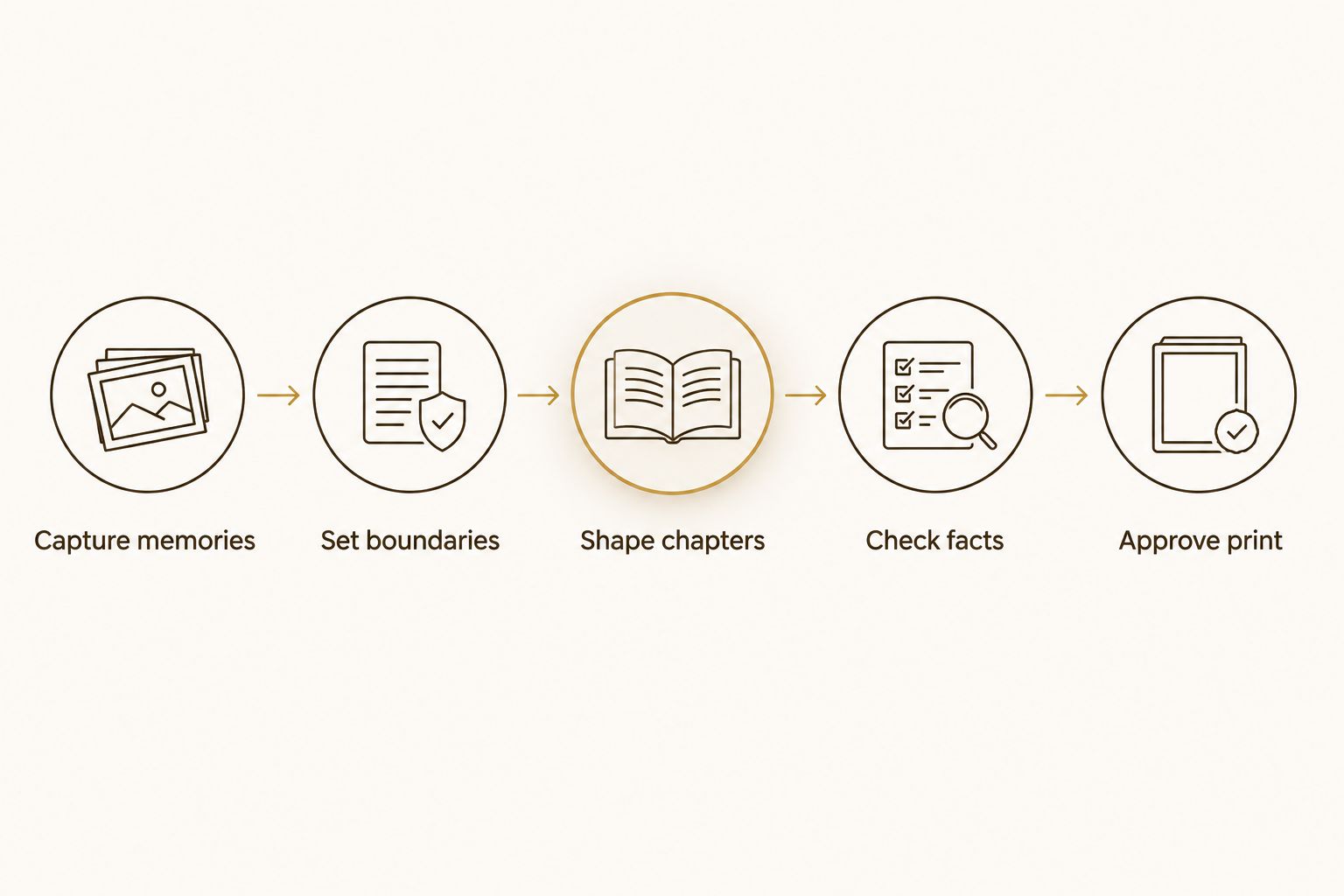
Use this sequence rather than asking for an entire autobiography from a short description:
- Capture memories. Record or write about a particular event, person, place, or turning point. Include what happened and why it stayed with you.
- Set boundaries. Tell the drafting assistant to use only your material, preserve uncertainty, and flag gaps instead of filling them.
- Shape chapters. Ask for a readable sequence with related memories grouped together. Review the outline before expanding the prose.
- Check facts. Compare names, dates, relationships, and quotations with your recordings and available records.
- Approve print. Read the finished manuscript as a family reader would before ordering a book.
These are editorial steps, not a promise that every memoir app performs them automatically. Check what a service actually includes before entrusting it with your manuscript.
Which writing approach fits your family memoir?
Choose according to the work you want help doing, not the promise of an effortless book. Speaking, drafting, editing, and printing are different tasks. A service that helps with one does not automatically handle the others.
| Approach | Best for | Main advantage | Main limitation |
|---|---|---|---|
| Write it yourself | Keeping direct control over every sentence | You choose the wording from the start | You also handle structure and revision |
| AI-assisted drafting | Turning supplied memories into a working manuscript | You can request outlines, reorganizations, and alternative wording | You must check added details and changes in meaning |
| Voice-guided memoir writing | Starting with spoken recollections | Interview prompts provide a structure for telling your story | Spoken memories still need review before becoming a final book |
| Human ghostwriting | Working through your story with a writer | You can discuss emphasis and wording with another person | You must communicate your voice and approve the writer's interpretation |
Best for preserving your meaning: choose a process that lets you review the actual manuscript. A sample chapter is more useful than a promise about how personal the finished book will feel. Read it aloud and ask whether someone close to you would recognize the storyteller.
How do I keep an AI-written memoir sounding like me?
Start with your own language. If you say that a kitchen was always crowded, keep that plain description unless you genuinely remember more. Do not replace it with elaborate descriptions of aromas, wallpaper, or conversations simply because they make a scene sound literary.
For your first draft in 2026, give the assistant a narrow instruction:
Use only the memories below. Keep my everyday vocabulary. Do not invent dialogue, sensory details, dates, or other people's thoughts. Mark anything that needs clarification.
That instruction establishes an editing rule; it does not remove the need to check the output. Look for passages that sound impressive but say something you never meant.
Keep the phrases your family recognizes
Preserve your habitual expressions, nicknames, and ways of describing people when you want them in the book. Correct a confusing sentence without sanding away its personality. Your family is reading to hear from you, not from an anonymous narrator.
Separate what happened from what it means now
A memoir can contain both an event and your present-day interpretation. Make the distinction visible: you remember leaving home excited, but now understand how difficult that departure was for someone else. Do not turn that later understanding into a claim that you knew their private thoughts at the time.
What should I record before asking AI to draft?
Begin with 1 scene, not your entire life. Choose a memory with a clear setting and something at stake: a decision, a disagreement, a first attempt, or a quiet moment you still revisit. Describe only the details you remember.
Use these 3 questions to give the scene substance:
- What happened, and who was there?
- What did you think or feel at the time?
- Why do you want your family to know this now?
If speaking feels easier than typing, tell the story aloud before editing it. Pause when you need to think. An unfinished recollection is better source material than a smooth account padded with guesses.
The guide to turning phone voice recordings into memoir chapters focuses on that transition from spoken memories to a readable manuscript. Keep the original recording alongside the draft so you can return to your own words when a passage feels wrong.
Why the quality of an AI-assisted memoir varies
The useful distinction in 2026 is not simply human-written versus AI-written. It is whether the manuscript stays faithful to its source material and receives a careful review.
- Source detail. A specific recollection gives the draft something concrete to work with. A broad summary leaves more unanswered questions.
- Drafting instructions. Clear limits distinguish editing your memories from inventing a story around them.
- Recorded uncertainty. Saying you do not remember an exact date prevents a guess from becoming an apparent fact.
- Voice choices. Your preferred vocabulary and level of formality give you a standard for judging revisions.
- Review decisions. Checking the manuscript against recordings and records helps you identify discrepancies before printing.
Do not measure success by how quickly you receive pages. Measure it by whether those pages contain memories you recognize, in language you are comfortable putting your name to.
What should I check before calling the manuscript finished?
Use 2 review passes with different purposes. In the first, check accuracy. In the second, check voice and the effect of sharing the material with family.
For the accuracy pass, verify spelling, family relationships, locations, and the sequence of events. Compare uncertain dates with records where available. If evidence does not settle a detail, keep the uncertainty visible rather than choosing a precise answer for neatness.
For the voice pass, read aloud. Remove invented dialogue and descriptions that do not belong to your memory. Check that an edit has not made an affectionate story sound mocking or turned a complicated relationship into a simple judgment.
Approval means you accept the words on the page, not merely the outline. Review transitions and chapter endings too: a concluding sentence can introduce a lesson or belief you never expressed.
How should I handle private or painful memories?
Decide who the book is for before deciding what belongs in it. A memoir intended for a small family circle still contains information about real people. You can tell your experience without including every identifying or intimate detail about someone else.
Before uploading sensitive material in 2026, read the service's current privacy terms. Check how it describes storage, deletion, access, and any use of submitted content for model training. Do not assume that every writing service handles recordings in the same way.
When accounts differ, distinguish your recollection from a claim of certainty. You can describe what you experienced without declaring another person's motives. For distressing material, give yourself permission to pause, shorten a passage, or leave it out of the printed edition.
Where does voice-guided memoir writing fit?
Myvellum is best for storytellers seeking voice-guided memoir writing and a printed family keepsake. It guides individuals through 12 structured interview chapters and produces a personalized hardcover or softcover book of their life story.
The fit is specific: you want to begin by telling your own memories and work toward a physical book for family. The structure offers a starting framework, but it does not replace your judgment about what happened, what belongs in the manuscript, or what you want to share.
Keep the decisions separate. Starting a free memoir-writing option is a way to begin collecting material; ordering a printed book is a later commitment to a particular manuscript and format. Review the current terms for each step rather than assuming that starting and printing are the same offer.
Start with your own memories
Explore voice-guided memoir writing and personalized hardcover or softcover keepsakes.
Can I start without remembering exact dates?
Yes, you can start without exact dates. Describe the period in terms you actually remember, such as before a move or during your first job. Mark unresolved details for later review instead of allowing a drafting assistant to supply them.
Can I turn an AI-assisted draft into a printed family book?
Yes, an AI-assisted draft can become a printed family book after you review the manuscript and prepare it for the chosen print service. Check chapter order, names, captions, page breaks, and the final preview. Ordering a book should follow approval, not serve as the first opportunity to see the complete story.
FAQ
Can AI write my memoir if I only have voice recordings?
Yes, AI can help draft a memoir from a transcription of your voice recordings. Check the transcript first, especially names and unfamiliar places, and verify whether your chosen service accepts your recording format.
Will an AI-written memoir still sound like me?
An AI-assisted memoir needs your voice review to sound like you. Supply your own wording, request restrained edits, and remove expressions or interpretations you would not use.
Can I start writing my memoir for free?
You can begin collecting and organizing your memories without ordering a printed book. If you choose a free memoir-writing option, check its current terms and treat printing as a separate decision.
What if I cannot remember what someone said?
Do not present invented wording as a remembered quotation. Describe the conversation in your own words and make uncertainty clear where it matters.
Is Myvellum for writing my own family memoir?
Myvellum supports individuals telling their own life stories through voice-guided memoir writing. Its process uses 12 structured interview chapters and leads to a personalized hardcover or softcover keepsake book.
Should my family check the manuscript before I print it?
Invite family review when you want help checking shared facts or understanding how a sensitive passage reads. Distinguish their corrections from differences in recollection, and retain responsibility for the final text.
One last thing
Before you finish your memoir in 2026, record yourself explaining why you wanted to make it. That explanation can help you choose what stays: a story belongs because it tells your family something you want them to understand, not because it makes the book longer.
Keep one ordinary memory you would otherwise dismiss. How you spent an evening, what you worried about before a change, or why you kept a familiar object can say something a résumé never will. Give your family your account, not an invented version of a more dramatic life.


