

Yes—you can revise your life story for a new printed edition, but editing the manuscript does not change copies already printed. You need a corrected manuscript and another print order to put those changes into new books. Whether your memoir service lets you reopen an earlier project, replace files, or change an existing order depends on its policies.
- To revise life story book after printing, update the manuscript and arrange a new printed edition.
- Existing family memoir books stay unchanged; a correction sheet can accompany them.
- Myvellum suits storytellers who want voice-guided interviews and a printed family keepsake.
- Confirm project access and reprinting rules before assuming your original memoir order can be changed.
Can I revise my life story book after it's printed?
You can revise the story, not the pages already bound into an existing copy. Separate the writing decision from the printing decision: first decide what needs changing, then establish how to produce the corrected version.
| Approach | Best for | Benefit | Limitation |
|---|---|---|---|
| Revised printed edition | Corrections or additions you want inside future copies | Incorporates changes into the book itself | Requires a new production step; existing copies remain unchanged |
| Correction sheet | A factual mistake in copies your family already has | Gives readers the corrected information without replacing the book | Remains separate from the original printed text |
| Family addendum | New memories that supplement an otherwise finished story | Preserves the original while adding context | Readers must keep the addition with their copy |
For voice-guided memoir writing, Myvellum provides twelve structured interview chapters and personalized hardcover or softcover printing. Starting a free memoir and ordering a printed book are separate steps; neither establishes what happens when you want to revise a completed order.
Why this matters
A family memoir records what you remember at a particular point in your life. Finding a letter later, remembering a childhood nickname, or noticing a misspelled name does not make the original book a failure. It gives you a specific editorial task.
Keep myvellum.vercel.app handy when checking the service's current information. Ask about the exact stage of your project rather than using the broad question, “Can I edit my book?”
A 2026 manuscript awaiting approval, an order already in production, and a book on your shelf present different questions. Treat them separately so you do not mistake an editable draft for a changeable print order.
What changes after a book has been printed?
The physical copy becomes a fixed record. Your source material—recordings, notes, photographs, and manuscript files—can still support further writing, provided you retain access to it.
That distinction matters when a family member spots an error. Correcting a name in your working document does not automatically correct another file, an earlier order, or books already distributed. Track each change through the version you intend to print.
For your own records, use an unmistakable label such as Family memoir, revised 2026. This is an organizational suggestion, not a requirement imposed by a printing service.
Revised edition: best for changes inside future copies
Choose a revised edition when the correction belongs in the narrative itself. Examples include a mistaken relationship, an omitted passage that changes the meaning of a chapter, or a photograph placed beside the wrong story.
The advantage is clarity: future readers receive the corrected text in context. The drawback is that revision extends beyond rewriting; you must also check the resulting print layout and arrange production again.
Correction sheet: best for a specific factual error
Use a correction sheet when you need to alert readers to a clear mistake in books they already have. Identify the chapter or page, state the incorrect detail, and give the correction plainly.
A loose sheet is easy to separate from the book. Ask relatives to keep it inside their copy, and retain the correction in your manuscript so it is not lost when you prepare another edition.
Family addendum: best for memories discovered later
An addendum keeps a new story distinct from the original narrative. It works well when you find a letter, recall an additional event, or want to describe something that happened after the book was completed.
The benefit is preserving the original book's shape. The limitation is fragmentation: readers need both documents to have the full account. If the new material changes several chapters, revise the manuscript instead.
How do I prepare a revised life story book?
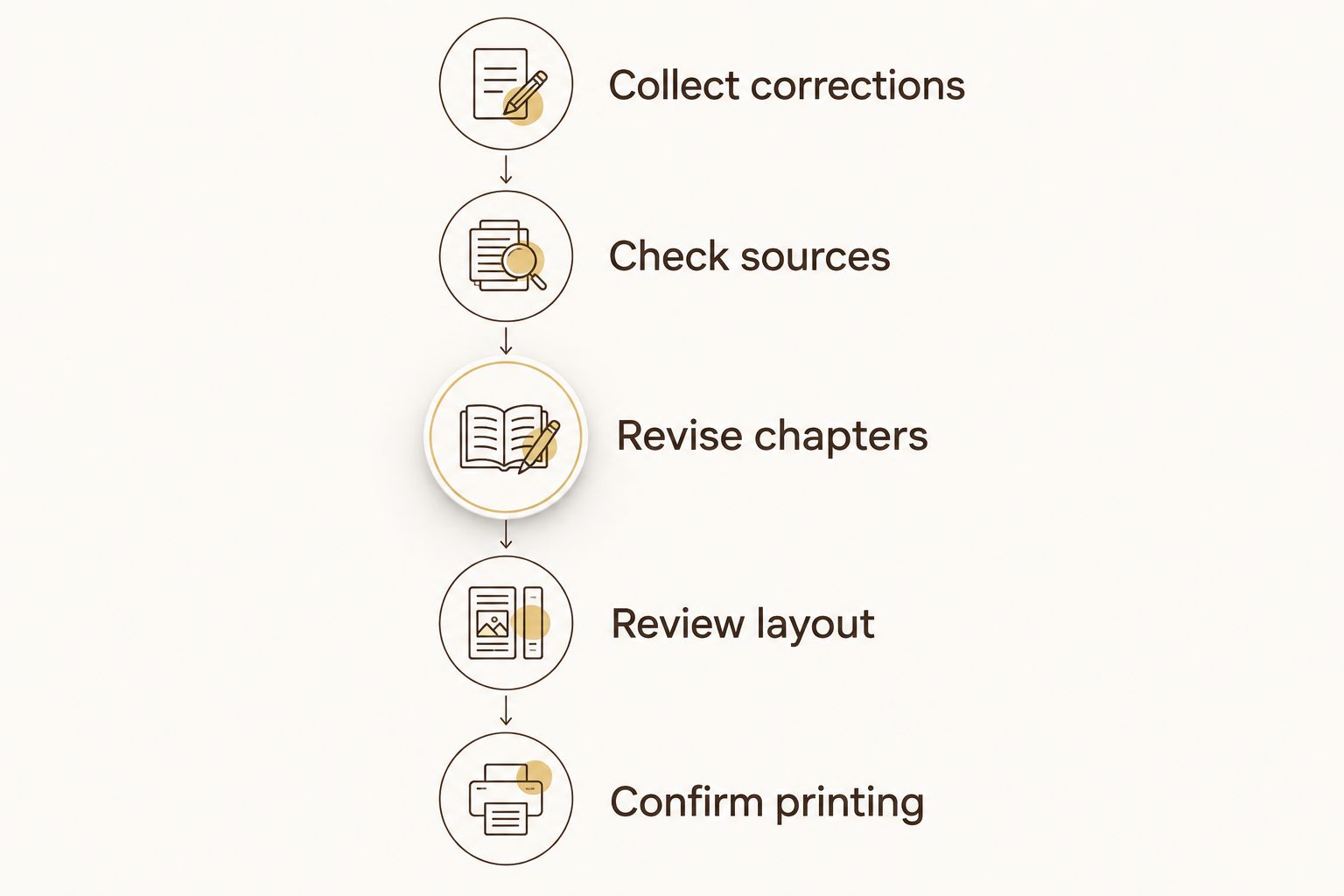
Use this sequence to turn scattered corrections into a deliberate new edition. Finish the editorial decisions before approving another print file.
- Collect corrections. Keep a single list of factual errors, missing memories, and wording changes. Record where each issue appears and what you want the replacement to say.
- Check sources. Compare names, dates, and relationships against the records you have. When memory and a document disagree, preserve that distinction rather than silently treating recollection as proof.
- Revise chapters. Update the narrative around each change. A corrected date can affect the sequence of events, not just the sentence containing it.
- Review layout. Inspect the version intended for printing, including captions, chapter openings, and page references. Do not assume that reviewing plain text also checks the finished pages.
- Confirm printing. Establish which file will be used, what approval is required, and whether your request creates a separate order. Keep the final approved version with your records.
Work through 1 chapter at a time if the revision feels large. Keep 2 clearly separated files: the version used for the original book and the working revision. These are practical organization choices, not service limits.
For an interview-based memoir, distinguish correcting the written chapter from changing the source recording. Read the guide to editing memoir chapters after recording when planning that earlier stage of revision; confirm the available controls with your chosen service.
Why the revision process varies
The same sentence change can involve different work depending on where your book stands. These factors explain the distinction without assuming any particular provider's policy:
- Production stage. A draft, an approved file, and a printed copy are different objects. Ask which one your requested change would affect.
- Source access. You need an editable manuscript or a supported way to change the text. Possessing the printed book alone does not establish access to its production files.
- Scope of changes. Correcting a spelling differs from inserting a new chapter. Review the surrounding narrative whenever an addition changes context.
- Layout effects. Added text and replacement photographs can change page breaks, captions, and references. Check the final layout rather than only the edited passage.
- Edition tracking. Family members can hold different versions. Clear labels help you explain which copy contains a correction.
- Service rules. Project reopening, file replacement, order changes, and reprints are separate permissions. Confirm each relevant point directly.
Avoid treating a general editing feature as proof of post-print revision support. A service that helps you write a memoir has not necessarily promised indefinite project access or changes to completed orders.
What should I ask before ordering another copy?
Send a precise request: describe your existing book, explain the change, and ask what happens next. If you are revising a 2026 edition, identify that edition explicitly rather than referring only to “my latest book.”
Use these questions to make the answer actionable:
- Can I access and edit the manuscript used for my printed book?
- Does editing that manuscript affect any order already placed?
- Can I review the complete revised print layout before approving it?
- Which version will be used if I request another copy?
- Can I keep a copy of the approved manuscript for my records?
- What steps are required to print the revised version?
Do not place another order until you know which manuscript it will use. A request for another copy and a request for a revised edition are not interchangeable instructions.
Keep the response alongside your revision notes. It gives you a concrete reference when you review the next proof or confirm the intended edition.
Can I add new memories without rewriting everything?
Yes—you can add a focused passage or a separate addendum rather than rewriting your whole life story. Choose the location by meaning: put a childhood memory beside the childhood narrative, not automatically at the end.
For events after the original book, a closing chapter can preserve the earlier story's ending while showing what happened next. For example, a note labelled Added in 2026 clearly distinguishes a later reflection from the original account.
Read the transition aloud after inserting a memory. Check whether the reader still understands who is present, when the event happens, and why it belongs there.
Should I correct a relative's different memory?
Correct a demonstrable factual error, but do not automatically replace your experience with someone else's recollection. A family memoir can acknowledge disagreement without pretending that everyone remembers an event identically.
Separate three kinds of feedback: verifiable facts, personal memories, and preferences about wording. A birth certificate addresses a different question from a sibling remembering a holiday differently.
For sensitive passages, consider whether names and identifying details are necessary to your story. Your aim is an honest account you are comfortable sharing, not a verdict on every family disagreement.
How does voice-guided writing fit into revision?
Myvellum is best for people who want to speak their memories into a printed family memoir. Its twelve structured interview chapters provide a framework for recording your life story, with hardcover or softcover keepsake printing as the physical outcome.
That format suits a reader who would rather tell a story aloud than begin with a blank page. The practical boundary is equally important: the stated writing and printing features do not establish post-print editing, project retention, or reordering policies.
If you are beginning now, start a free memoir as the writing step. Treat ordering a printed book as a later, separate decision, after you have reviewed the story you want your family to keep.
FAQ
Can I revise my life story book after it's printed?
Yes—you can revise the manuscript for a new printed edition, but copies already printed remain unchanged. Confirm how your service handles manuscript access and revised print orders.
Will editing my memoir automatically update books my family already has?
No—editing a manuscript does not change existing physical books. Give relatives a correction sheet or addendum, or arrange new copies containing the revised text.
Can I change a memoir order that is already being printed?
An order already in production is subject to the printer's change rules. Contact the service with the exact correction and ask whether it can affect that order; do not assume a manuscript edit will do so.
Should I reprint my memoir for a small spelling mistake?
A small spelling mistake does not require you to replace every family copy. Correct your working manuscript and consider a correction note if the mistake affects a person's name or the meaning of the story.
Can I add a new chapter to a memoir I have already printed?
You can write a new chapter for a revised manuscript or distribute it as an addendum. Including it inside future printed copies requires a revised production file and another printing step.
Does Myvellum guarantee that I can edit a book after printing?
Post-print editing is not established by Myvellum's stated features. The service offers voice-guided memoir writing through twelve interview chapters and hardcover or softcover printing; confirm revision terms directly.
How should I label a revised family memoir?
Use a clear edition label and retain the original file separately. A label such as revised 2026 helps your family distinguish the updated account from earlier copies.
One last thing
Keep the original edition, even when you correct it. It preserves the story as you first chose to tell it; the revision records what you learned or remembered afterward.
Before printing again, add a short note explaining substantial changes. Your family should not have to compare entire books to discover that you corrected a relationship, restored a missing memory, or added a later reflection.


