

Yes, you can edit memoir chapters after recording by revising the written draft; you do not need to repeat an entire interview just to correct a sentence. For a memoir you plan to print in 2026, confirm how your chosen service handles revisions and when the manuscript becomes final, because editing text does not change the original audio or a book already printed.
- You can edit memoir chapters after recording; treat the spoken interview as source material, not a finished manuscript.
- Correct names and facts before polishing sentences, and preserve expressions that sound like you.
- Myvellum suits people turning their own spoken memories into personalized family memoir books through structured interviews.
- Starting a memoir and ordering a printed keepsake are separate steps; review your manuscript before ordering.
Can you edit memoir chapters after they've been recorded?
Yes. Recording captures your recollection; editing shapes how your family will read it. The practical method depends on whether you are correcting written text, adding missing memories, or reorganizing a chapter.
Use this sequence before treating a recorded chapter as finished:
- Read the draft. Compare the written chapter with what you intended to say, not just the words you remember speaking.
- Correct the facts. Check names, places, relationships, dates, and the order of events against records you trust.
- Add missing context. Explain references that your future reader will not automatically understand.
- Protect your voice. Remove distracting repetition without replacing your natural expressions with formal language.
- Approve the manuscript. Read the complete chapter in its intended book order before submitting it for printing.
Myvellum provides a voice-driven memoir app and print service built around twelve structured interview chapters. The useful distinction is between capturing your life story and deciding that the resulting manuscript is ready to become a family keepsake.
Why this matters
Spoken memories and readable chapters serve different purposes. While talking, you can pause, double back, or assume the listener knows who someone is; on the page, those habits sometimes leave a reader confused.
Editing is not a demand to make your life sound more impressive. It is a chance to make your meaning clear while keeping the humor, affection, hesitation, and perspective that make the story yours.
For your 2026 memoir project, separate permission to remember freely from responsibility to review carefully. You can begin with an imperfect account and still give your family a considered final version.
Which kind of chapter edit do you need?
Choose the smallest change that solves the problem. A misspelled surname needs a correction, not a new interview; an unexplained turning point needs more than a punctuation fix.
| Editing approach | Best for | Benefit | Limitation |
|---|---|---|---|
| Text correction | Names, punctuation, and factual mistakes | Repairs the written draft directly | Does not alter the source recording |
| Additional recording | Memories or explanations you left out | Captures new material in your spoken voice | Needs to be incorporated into the chapter |
| Chapter restructuring | Events presented in a confusing order | Gives the reader a clearer sequence | Requires checking transitions and repeated details |
| Full rewrite | A chapter whose focus has changed | Lets you rebuild around the story you want to tell | Takes more work and risks losing distinctive phrasing |
Start with text correction when the memory is complete and the wording is the problem. Choose an additional recording when the missing information is easier to explain aloud.
A full rewrite belongs last, not first. Before discarding a chapter, mark the passages you want to keep: a vivid scene, an expression you still use, or an explanation that captures how you felt.
How do you revise a recorded memoir chapter without losing your voice?
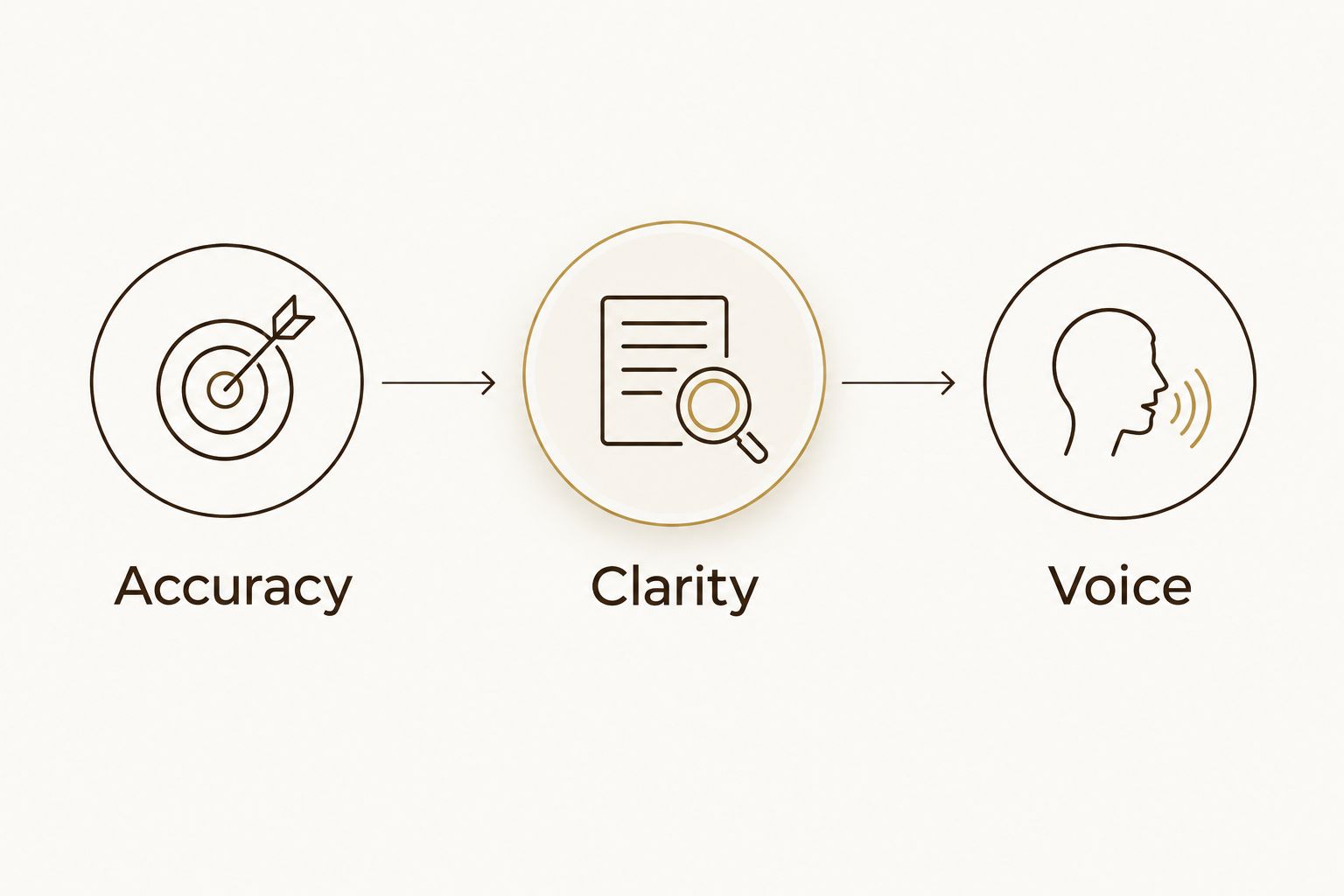
Use separate editing passes rather than trying to fix everything at once. A recommended starting point is 3 editing passes per chapter: accuracy, clarity, and voice. That is a working method, not a requirement of a particular app.
Accuracy
Check who appears in the story and what happened. Look closely at similar family names, changes of address, job titles, and references such as your first school or your last year at home.
If a date is uncertain, keep that uncertainty in the text. Saying that something happened during your early school years is more honest than supplying an exact date you cannot support.
Clarity
Read as if you did not grow up in your family. Identify people at their first appearance, explain unfamiliar places, and make clear when the story moves to a different period.
A useful test is whether a relative unfamiliar with the event can follow the chapter without asking you to fill in the gaps. Add what that reader needs, not every background detail you remember.
Voice
Read the revised chapter aloud. Restore words you would actually use, and remove polished phrases that make you sound like someone else.
Keep a distinctive expression when it carries personality or meaning. Cut repeated setup when it only delays the scene; those are different editorial decisions.
For a manageable review session, set aside 10 minutes per session as a starting recommendation. Work on a short passage rather than forcing yourself to finish a difficult chapter while tired.
Why the amount of editing varies
The right amount of revision depends on what your draft needs, not how polished you think a memoir ought to sound.
- Missing context: A story familiar to you needs more explanation when your family readers were not there.
- Uncertain facts: Conflicting recollections or incomplete records require careful wording rather than invented precision.
- Spoken repetition: Returning to the same point can emphasize a memory aloud but interrupt its flow on the page.
- Chapter order: Moving an event changes what the reader already knows and which introductions remain necessary.
- Sensitive material: Stories involving other people require decisions about relevance, privacy, and how you describe your own perspective.
- New memories: A later interview or an old letter can prompt an addition to a chapter you thought was complete.
Do not measure progress by how many words you remove. A chapter sometimes needs an added explanation more than a shorter sentence.
What should you check before printing your memoir in 2026?
Review the manuscript you intend to print, not an earlier draft. A chapter that reads well alone can still repeat an introduction or contradict a detail elsewhere in the book.
Use this final reading checklist:
- Confirm that recurring names use consistent spelling.
- Check relationships so readers know which aunt, cousin, or friend you mean.
- Review the sequence of moves, schools, work, and family events.
- Remove accidental duplication between chapters.
- Check that additions appear in the intended place.
- Read the opening and ending of each chapter together.
- Review any available print preview before approving the book.
Give special attention to your chapter endings. You do not need a lesson at the end of every memory; a clear final image or an honest reflection can finish the story without explaining everything.
If you want a relative's perspective, ask for a focused review rather than an open invitation to rewrite your life. The guide to sharing memoir chapters with family before printing addresses that separate review stage.
Keep feedback focused
Ask a reviewer to flag unclear references and factual questions. Decide yourself whether a suggested change improves accuracy or merely replaces your perspective with theirs.
For difficult memories, distinguish what you observed from what you later concluded. You can describe your experience without claiming certainty about another person's thoughts or motives.
Where does Myvellum fit in the process?
Myvellum is best for people turning their own spoken memories into a personalized family memoir through structured interviews. Its memoir app and print service guide individuals through twelve interview chapters and produce a personalized hardcover or softcover keepsake book.
The structured chapters provide a framework for telling your story. The editorial responsibility remains yours: check the written account, decide what belongs in the family version, and review it before ordering a printed copy.
Keep starting a free memoir separate from ordering a printed book. First capture the memories and develop the manuscript; make the printing decision after you are satisfied with what your family will read.
Before committing your final manuscript, check the current editing controls and approval process at myvellum.vercel.app. In particular, distinguish revising chapter text from replacing audio, and distinguish saving a draft from submitting a print order.
Begin your own family memoir
Capture your memories first. Review the manuscript before deciding to order a printed keepsake.
Do I need to record the whole chapter again?
No, a written correction does not require a complete new recording. If the chapter already contains the memory you want to tell, revise the relevant passage using the editing method your service supports.
For missing material, make a separate note identifying where the addition belongs. A short explanation tied to a specific scene is easier to place than an unrelated retelling of the entire chapter.
Can I change a memoir chapter after approving it for print?
Changes after print approval depend on the service and the order's production stage. Do not assume that changing a saved draft changes a submitted print order.
Before approving a book in 2026, check how the service defines final approval and how to request a correction. A copy already printed cannot be changed by editing the digital manuscript; a revised version needs a separate printing decision.
Should I let family members rewrite my memoir chapters?
Let family members help check facts and clarity, but keep control of your own account. A shared event can produce different recollections without making your personal perspective invalid.
Ask reviewers to identify the passage they question and explain why. Preserve uncertainty where the evidence does not settle a disagreement, and avoid turning the chapter into an argument about whose memory wins.
FAQ
Can I edit memoir chapters after recording them?
Yes, you can revise the written draft after recording your memories. Check your service's editing process, and remember that a text revision does not automatically change the original audio.
Do I have to record my interview again to fix a name?
No, correcting a name in the written manuscript does not inherently require another interview. Use the text-editing or correction process supported by your service.
How do I keep my memoir sounding like me?
Read the revised chapter aloud and keep expressions you naturally use. Remove distracting repetition without replacing your voice with formal wording.
Can I add a memory after a chapter is finished?
You can add a memory to a draft before finalizing it for print. Identify where the addition belongs and check whether it changes the chapter's sequence or ending.
What should I check before ordering my memoir book in 2026?
Check names, relationships, chronology, repeated passages, and the final manuscript intended for printing. Review any available print preview before approving the order.
Is Myvellum for writing my own family memoir?
Yes, Myvellum is a voice-driven memoir app and print service for individuals telling their own life stories. It guides you through twelve structured interview chapters and produces personalized hardcover or softcover keepsake books.
Can I correct a memoir book that has already been printed?
You cannot change the text inside a copy already printed. Correct the manuscript for a future printing and check the service's process before placing another order.
One last thing
Before your final 2026 review, choose 1 paragraph per chapter that sounds unmistakably like you and read it aloud. Use that passage as a voice reference while editing the rest—not as wording to repeat.
A family memoir does not need to erase every pause or unusual expression. Correct what obscures the memory; keep what helps your family recognize the person telling it.


