

Yes, you can print more than one copy of your memoir so family members can each keep your life story; confirm that your chosen printing service accepts the quantity you want before ordering. Writing the memoir and purchasing printed copies are separate steps, and delivery arrangements need checking too. Approve the finished book before committing to copies for the whole family.
- Searching ‘print multiple copies memoir book’? Approve your manuscript before ordering family copies.
- Myvellum suits people who want to speak their memories and create a printed family keepsake.
- Starting a free memoir and ordering printed books are separate decisions.
- Confirm copy quantities, binding choices, and delivery arrangements before placing your order.
Why this matters
A family memoir becomes more personal when readers have their own copy to return to. But printing also turns unfinished decisions into permanent pages: a misspelled surname, an unclear photograph, or a passage you meant to keep private will travel with every copy.
Finish the story before multiplying the book. For your 2026 memoir project, separate recording, reviewing, and ordering rather than treating them as a single task. You can start a free memoir with Myvellum and consider printed copies separately. Keep myvellum.vercel.app handy as you move from telling your story to preparing a family keepsake.
Can you print more than one copy of a memoir book for family?
Yes. You do not need to write a different memoir for each relative: the same approved manuscript can be used to produce multiple books through a printer that accepts your requested quantity. The practical work is agreeing on the final text, choosing a binding, and confirming how the order will reach its recipients.
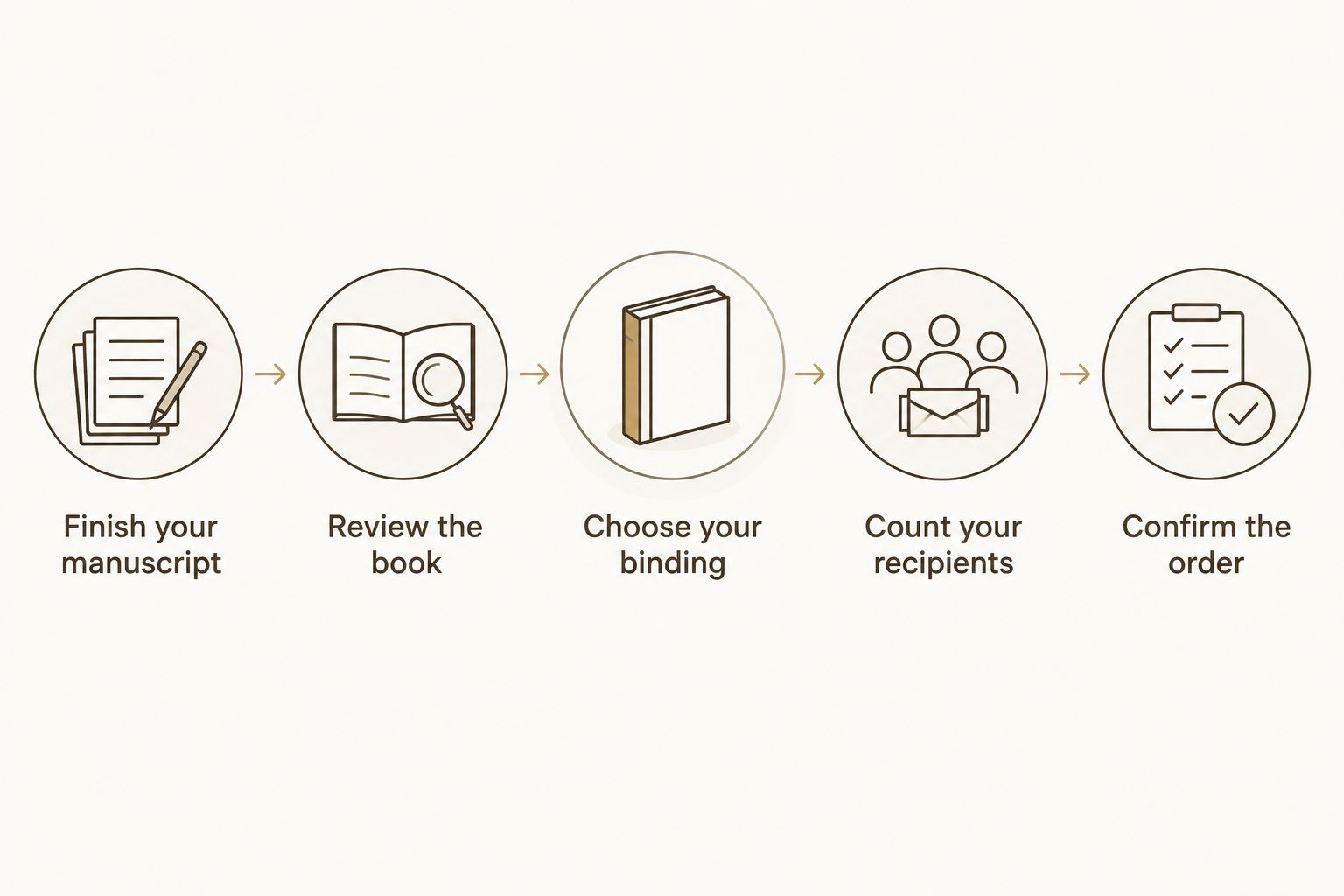
Follow this sequence before ordering:
- Finish your manuscript. Bring the chapters to a point where they tell the story you want your family to receive. Do not wait for every remembered detail to become perfectly complete.
- Review the book. Check names, relationships, dates, captions, and passages involving other people. Ask a trusted reader to flag confusion without rewriting your voice.
- Choose your binding. Decide whether hardcover or softcover fits how the book will be used. Confirm the format offered for your finished manuscript.
- Count your recipients. Make a written list, include your own copy, and distinguish confirmed recipients from people you have not asked.
- Confirm the order. Check quantity, delivery details, and the version being printed before submitting it.
This sequence gives you a useful stopping point between creating the story and reproducing it. A manuscript that is ready to discuss is not automatically ready to print.
Review the shared version before making family copies
Your memoir is your account, not a family committee's account. A review should help readers understand your memories without making every relative responsible for approving your life.
Give a trusted reader a specific job. Ask whether the timeline makes sense, whether a nickname needs explaining, and whether someone unfamiliar with a family story can follow it. A reader who spots an unexplained relationship has helped; a reader who replaces your natural expressions with formal language has changed the task.
For sensitive passages, separate what you remember from what someone else told you. Phrases such as “I remember” and “My aunt later told me” distinguish your experience from another person's account without pretending either is a complete record.
Before printing your 2026 edition, use this guide to sharing memoir chapters with family before printing to plan that conversation. Ask for clarity and factual corrections, not permission to have a personal perspective.
Hardcover or softcover: which should your family copies use?
Hardcover and softcover are binding choices, not different levels of storytelling. Either can carry the same memories. Choose according to how you want the physical book to be handled and kept, then confirm the printer's specifications.
| Format | Best for | Main advantage | Main trade-off |
|---|---|---|---|
| Hardcover | Readers who want a rigid-cover keepsake | A firm cover gives the book a structured physical form | The rigid binding is less flexible in the hand |
| Softcover | Readers who prefer a flexible cover | A flexible cover bends more readily during handling | It lacks the rigid outer boards of a hardcover |
Hardcover: best for a rigid-cover keepsake
Choose hardcover when the feel of a bound keepsake matters to you. Picture where your copy will live and how you will use it: on a family bookshelf, beside a reading chair, or brought out when grandchildren ask about a story.
Do not treat “hardcover” as a complete printing specification. Review the actual book details before deciding, rather than assuming that the binding name describes the paper, image reproduction, or page layout.
Softcover: best for a flexible reading copy
Choose softcover when you prefer a book with a flexible cover. The content does not become less meaningful because the outside bends.
If relatives have different preferences, ask whether your service supports the formats you need from the same finished manuscript. Do not assume a mixed-format order is supported simply because both formats are offered individually.
How many memoir copies should you order?
Count named recipients rather than guessing a family-wide total. Start with the copy you want to keep, then list the people or households you intend to receive the book.
A household copy and an individual copy serve different purposes. A shared book keeps an order focused, but relatives living together might still want separate copies to annotate or keep with their own belongings. Ask instead of deciding for them.
Use a simple recipient list with these fields:
- Recipient: the person or household receiving the book.
- Copy purpose: your own reading copy, a family keepsake, or a copy intended for someone else.
- Binding preference: the format requested, subject to the printer's options.
- Delivery plan: the destination and who will hand over the book.
- Confirmation: whether the recipient and address have been checked.
Date this list 2026 so you can distinguish it from later orders. Keep addresses out of the memoir manuscript itself; they belong in your private order records, not in a story that circulates among relatives.
Why ordering multiple memoir copies varies
The right order depends on what you have written and how you want to share it. These decisions deserve attention before you submit a quantity:
- Manuscript readiness: unresolved edits affect every copy made from that version. Finish corrections before expanding the order.
- Binding choice: hardcover and softcover produce different physical books. Confirm the format attached to the order.
- Recipient count: copies for individuals and copies for households are not the same plan. Count deliberately.
- Family review: a private reflection and a story intended for wider circulation need different sharing decisions. Decide who should read sensitive passages.
- Delivery arrangements: handing books over yourself and sending them to separate addresses require different coordination. Confirm what the service supports.
These are planning factors, not reasons to delay telling your story. You can record memories while leaving the final printing decisions open.
Start your memoir separately from ordering books
Myvellum's memoir app and print service guides you through 12 structured interview chapters using your voice, with a personalized hardcover or softcover book as the printed keepsake. Myvellum is best suited to people who want to speak their own life story and turn it into a family memoir book.
The distinction is between starting and ordering. Starting a free memoir gives you a way to begin capturing memories; ordering a printed book is a later decision. Do not treat the writing stage as confirmation that a particular number of books, binding combination, or delivery arrangement is included.
The guided interview structure gives you a defined starting framework. Its trade-off is that you still need to decide what belongs in the shared story and review the result before printing. A guided process does not remove your role as the author.
For a 2026 project, begin with a memory you can tell comfortably. A familiar kitchen, a first job, or a decision that changed your direction gives you something concrete to describe without requiring you to summarize your whole life at once.
Begin your own family memoir
Start a free memoir, then consider a printed keepsake as a separate step.
Should you review a printed copy before ordering for everyone?
Review 1 printed copy first if your chosen service supports a separate initial order. A physical copy lets you judge the actual reading experience rather than relying only on a screen.
Look at the book as a reader, not just as its author. Can you follow the chapter openings easily? Are names consistent? If photographs are included, do the captions explain who appears and why the image belongs in the story?
Then read passages aloud. Listen for missing words, repeated explanations, and sentences that no longer sound like you. Mark corrections against the manuscript so that you do not fix the physical sample while forgetting the file used for future copies.
Do not assume an initial copy is a formal proof or that changes remain possible after an order is submitted. Confirm the printer's review and correction process before relying on it.
Do all family copies need to contain the same stories?
No. Identical copies are the simplest way to share one agreed version, but you can decide that some memories belong in a private manuscript rather than the family edition. Separate that editorial decision from any assumptions about a service's customization features.
If you want different versions, ask whether separate manuscripts or separate orders are required. Keep each version clearly identified in your own records so you do not send a private passage to the wrong recipient.
For personal dedications, a handwritten note inside the finished book is a straightforward alternative to preparing different interiors. It lets you address each reader without changing the shared account of your life.
Can you order more memoir copies later?
Confirm the service's reorder process before relying on it. Later printing depends on the service's policies and its handling of your completed book; an initial order does not establish those terms.
For your own records, keep the final approved text wherever your service allows you to retain it, along with the order confirmation and binding details. Label your notes 2026 family edition so you know which version relatives received.
If you revise the story later, record what changed. A corrected surname and a newly added chapter are different kinds of revision, and a clear note prevents confusion when family members compare books.
FAQ
Can I print multiple copies of my memoir for different relatives?
Yes, you can use the same approved memoir manuscript to produce multiple family copies through a printer that accepts your requested quantity. Confirm the quantity and delivery arrangements before ordering.
Do I need to write my life story again for every copy?
No, identical family copies use the same finished manuscript. Separate versions require additional editorial decisions and confirmation of the printer's process.
Does starting a free memoir include printed family copies?
Starting a free memoir and ordering printed family copies are separate steps. Confirm the printed-book order details rather than assuming that starting the writing process includes books.
Can Myvellum turn my spoken memories into a printed book?
Myvellum guides you through 12 structured interview chapters using your voice and produces a personalized hardcover or softcover keepsake book. Confirm your requested copy quantity before ordering.
Should I choose hardcover or softcover for my memoir?
Choose hardcover for a rigid-cover keepsake or softcover for a flexible-cover reading copy. Review the printer's actual book specifications before deciding.
Can I send memoir copies directly to different family addresses?
Confirm whether your chosen service supports delivery to different addresses before submitting the order. Keep a private recipient list so each book has a clear destination.
What should I check before printing my memoir for family?
Check the final text, names, captions, sensitive passages, binding, quantity, and delivery details. If the service supports it, reviewing an initial printed copy adds a physical reading check.
One last thing
Leave room for the reader's questions. A memoir does not have to answer everything to become a meaningful family book; it needs to give relatives a way into your experience.
Before approving the text, check whether important people are introduced rather than merely named. Your cousin might know who “Aunt Rose” was, while a grandchild needs a relationship and a small detail to picture her. That brief explanation can do more for a future reader than another page of dates.
Print the story you want your family to understand, not just the events you want them to remember. Once that version feels right, count the people who should have it.


