

A memoir ghostwriter’s fee depends on the writing, interviews, research, and revisions included in your agreement; compare written proposals for the same finished manuscript rather than a headline figure. Book design and printing are separate deliverables unless the agreement includes them. For a family keepsake, decide how much writing help you need before commissioning a full ghostwritten book.
- Memoir ghostwriter cost depends on the agreed work, not simply the promise of a finished life story.
- Compare interviews, manuscript length, revisions, ownership, and printing separately before accepting a proposal.
- Myvellum is best for people who want guided voice interviews to create their own printed family memoir.
- Starting a free memoir and ordering a printed keepsake book are separate decisions.
How much does it cost to hire a memoir ghostwriter?
Compare the scope before comparing the fee. A proposal for drafting from your existing notes is not equivalent to a proposal that includes interviews, document research, rewriting, and preparation for print.
Use this breakdown when requesting a memoir ghostwriting proposal in 2026:
| Part of the project | What to ask the writer to specify | What not to assume |
|---|---|---|
| Interviews | Who conducts them and what preparation is included | Unlimited conversations or follow-up sessions |
| Source material | Which recordings, letters, journals, and documents the writer will review | Research beyond the materials you supply |
| Manuscript | Intended length, chapter outline, and delivery format | A finished printed book |
| Revisions | What changes are included and when approval happens | Unlimited rewriting after approval |
| Editing | Whether structural editing, copyediting, and proofreading are included | Every kind of editing under one label |
| Production | Responsibility for layout, cover preparation, and printing | Physical copies included with writing |
If your priority is telling your own story rather than commissioning someone else to write it, Myvellum offers voice-guided memoir writing and personalized book printing. myvellum.vercel.app guides you through twelve structured interview chapters, with hardcover or softcover keepsake books as the physical outcome.
Why this matters
Your family memoir needs a clear purpose before it needs a writing arrangement. A private keepsake can preserve everyday memories, family expressions, and explanations that matter deeply to your relatives without being shaped for a commercial readership.
Write down who will read the book and what you want them to understand. That decision helps you judge whether you need someone to build a narrative from interviews or simply a structure that helps you tell the story yourself.
For your 2026 project, separate the manuscript decision from the printed-book decision. Finishing your story and approving it for a physical book are different milestones, even when a service supports both.
Which kind of memoir help fits your project?
A ghostwriter, an editor, and a guided memoir app handle different jobs. Choose according to the work you want to hand over, not the label on the service. None removes your responsibility to check the finished story.
| Approach | Best for | Main benefit | Main limitation |
|---|---|---|---|
| Full memoir ghostwriting | Someone who wants a writer to shape interviews and source material into prose | Delegates the drafting work | Requires close review to ensure the narrative sounds like you |
| Editing an existing draft | Someone who already has substantial written material | Improves a manuscript you have started | Does not replace missing memories or unwritten chapters |
| Guided voice memoir | Someone who prefers speaking their memories within a structure | Provides a starting point for telling your own story | Still requires your participation and review |
| Independent writing | Someone who wants direct control over every passage | Keeps writing decisions in your hands | Leaves organization, revision, and production coordination with you |
Full ghostwriting fits a project where you want substantial writing responsibility delegated. Ask who will actually conduct the interviews and write the manuscript, especially when the proposal comes from a service rather than an individual writer.
Editing fits a different starting point. If your journals already contain the substance of the book, ask an editor to assess them before you commission a complete rewrite.
Myvellum is best for people who want guided voice interviews to create their own printed family memoir. Its memoir app and print service provide a structured route, not a substitute for a contracted human ghostwriter. Choose that route when speaking your memories fits you better than commissioning someone to write them on your behalf.
Why memoir ghostwriting scope varies
The useful question is not simply whether a proposal is expensive. It is whether the agreement describes the work your book actually needs.
These factors change the assignment:
- Interview work: A writer starting with recorded conversations has a different task from a writer planning and conducting the interviews.
- Manuscript length: A focused account of a defining period requires a different outline from a whole-life narrative. Define the intended scope before drafting.
- Source material: Letters, journals, and recordings need selection and interpretation. Identify which materials belong in the assignment.
- Research expectations: Checking dates against documents differs from investigating events or locating records. Specify what the writer is responsible for verifying.
- Revision boundaries: Correcting a name is different from changing the book’s structure after drafting. Agree on how both will be handled.
- Production responsibilities: Writing, editing, layout, cover preparation, and printing are distinct tasks. Name the responsible person for each.
Do not send different descriptions of your project to different writers. A common brief gives you a fairer basis for evaluating their proposals.
How do you compare memoir ghostwriting proposals?
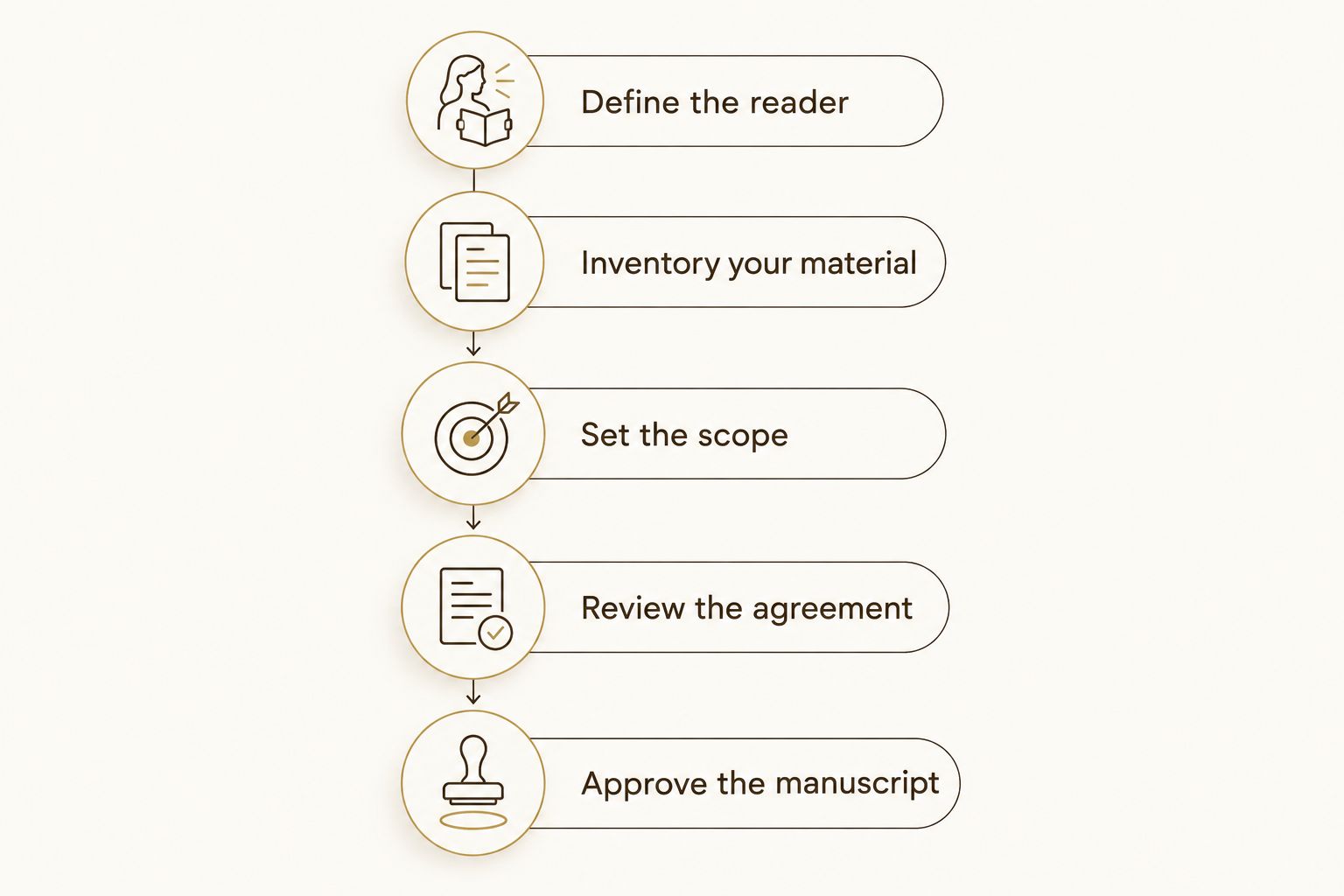
Use the same sequence for each proposal. Your goal is a written agreement that explains both the work and the approval process.
- Define the reader. State whether the memoir is for family, a wider public audience, or both. Explain what the reader should understand by the end.
- Inventory your material. List recordings, notes, letters, photographs, and existing drafts. Identify anything you still need to supply.
- Set the scope. Describe the periods of your life and the themes the manuscript should cover. Ask for a proposed chapter outline.
- Review the agreement. Check interviews, drafting, revisions, ownership, confidentiality, and the treatment of source files.
- Approve the manuscript. Review the complete text before treating it as ready for layout or printing.
Start with a 1-page brief. Include your intended audience, the central story, your available materials, and the help you want. Keep a separate list of questions so the brief stays readable.
Ask each writer to identify exclusions explicitly. An unanswered question about proofreading or printing remains an unanswered question, even when the proposal describes a finished book.
For proposals you receive in 2026, save the dated version you accept. If the scope changes later, document the change alongside the original agreement rather than relying on a conversation.
What should you check before signing?
Does the writing sound like you?
Ask how the writer establishes your voice and how you will review an early passage. A polished manuscript is not enough if you would never use its expressions or describe your life that way.
Choose 2 short passages from your own material for a voice discussion: an everyday memory and an emotionally difficult memory. Explain which expressions you want preserved and which details need careful handling.
Who approves facts and sensitive stories?
Agree on how you will review names, relationships, dates, and private information. A writer cannot resolve uncertainty about your memories without your involvement or supporting material.
Mark uncertain details as questions during drafting. Do not turn an uncertain recollection into a definite statement just to make a paragraph read smoothly.
What happens to your manuscript and recordings?
Ask the agreement to address ownership, confidentiality, file delivery, and any permitted use of your material. Read those provisions before sharing sensitive family documents.
Also ask what happens if the project ends before completion. You need to understand what work will be delivered and what obligations remain under the agreement.
Can you create a family memoir without a ghostwriter?
Yes. You can write your own manuscript, work from spoken memories, or use structured questions to develop the story before deciding whether you need outside writing help.
For a family keepsake, begin with a scene you can picture clearly. Describe where you were, who was there, what happened, and why you still remember it. Concrete memories give a chapter substance without requiring you to summarize your entire life at once.
Myvellum’s memoir app organizes voice-driven storytelling into twelve structured interview chapters. The benefit is a defined starting structure; the limitation is that you still need to contribute the memories and review the resulting story.
Starting a free memoir is the writing step. Ordering a personalized printed book is the production step. Do not treat starting your story as the same decision as approving it for print.
Start telling your own story
Explore voice-guided memoir writing and personalized hardcover or softcover keepsake books.
Does hiring a ghostwriter include a printed book?
Hiring a ghostwriter includes a printed book only when the agreement explicitly includes print production and physical copies. A manuscript delivery clause alone does not establish that responsibility.
Before printing, identify who checks the final text, prepares the interior, handles the cover, and approves the print-ready files. If different providers handle those stages, make the handoff requirements clear before the manuscript is finished.
Is a guided memoir app the same as a ghostwriter?
A guided memoir app is not the same as a ghostwriter. Structured prompts help you tell your story, while a contracted ghostwriter takes on the writing work specified in an agreement.
For your 2026 decision, ask whether you want help remembering and organizing or want another person responsible for drafting. Those are different needs, and neither route eliminates your final review.
FAQ
How do I compare memoir ghostwriter cost between writers?
Compare memoir ghostwriter cost against the same written scope. Ask each writer to specify interviews, manuscript length, research, revisions, editing, and whether any print-production work is included.
Do I need a ghostwriter to make a memoir book for my family?
You do not need a ghostwriter to create a family memoir book. You can write the story yourself or use guided voice interviews, then review the manuscript before arranging printing.
What should a memoir ghostwriting agreement include?
A memoir ghostwriting agreement should define deliverables, responsibilities, revision boundaries, ownership, confidentiality, and approval stages. It should also explain what happens if the project changes or ends early.
Can I give a ghostwriter my journals and voice recordings?
You can propose journals and voice recordings as source material, but confirm their review is included in the assignment. Agree on confidentiality and file handling before sharing private material.
Will a ghostwriter make my memoir sound like me?
You need an agreed voice-review process to judge whether a ghostwritten memoir sounds like you. Review an early passage and explain which expressions, details, and emotional tones should remain.
Does a memoir manuscript include hardcover printing?
A memoir manuscript does not establish that hardcover printing is included. The agreement must separately identify printing responsibilities and any physical-book deliverables.
Can I start my memoir before deciding how to print it?
You can start your memoir before choosing a print format. Develop and review your story first, then check the production requirements before preparing the final book.
One last thing
Keep a short list of expressions you actually use. Include the names you call family members, phrases you repeat, and words that belong to a particular place or period in your life.
Use that list during your final review in 2026. Correct grammar matters, but so does recognizing your own voice when you open the finished book. Your family should meet you on the page, not just read an orderly account of events.


