
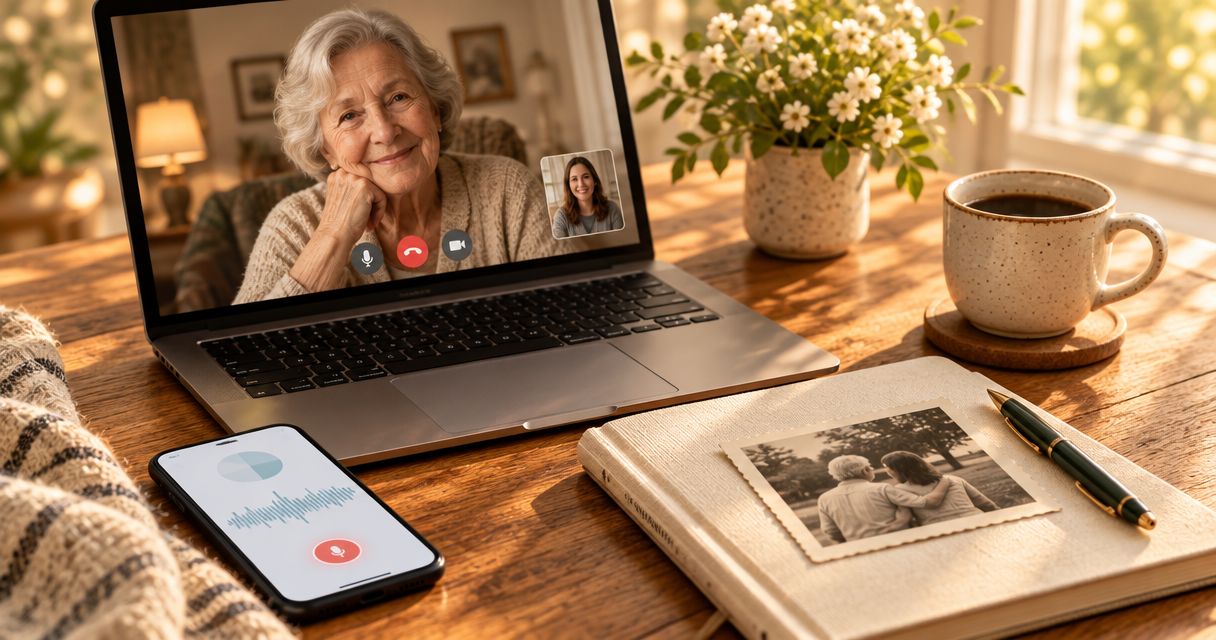
Instead of manually piecing together scattered family conversations, interview a parent by video call, review the recording with them, and turn the approved stories into a printed memoir. The same workflow helps you record your own life story: invite a relative to ask the questions, then keep control of what becomes your family’s keepsake.
- The interview parent video call memoir book workflow starts with consent and ends with a separately approved print manuscript.
- Myvellum suits storytellers who want voice-guided memoir writing and a personalized printed family keepsake.
- Record one memory at a time, then check names, dates, and sensitive details with the storyteller.
- Starting a free memoir and ordering a printed book are separate steps; finish reviewing before ordering.
Why this matters
A video call captures a conversation, not a finished book. Spoken stories contain interruptions, repeated details, and references that make sense to the people talking but leave a future reader confused. Your job is to preserve the storyteller’s meaning while making each memory understandable on the page.
Myvellum is best for storytellers who want voice-guided memoir writing and a printed family keepsake. At Myvellum, the memoir-writing app guides individuals through twelve structured interview chapters and produces personalized hardcover or softcover books. Keep myvellum.vercel.app as your starting point, while treating the video call, manuscript review, and print order as distinct tasks.
For your 2026 family memoir project, decide whose voice leads the book. If you are interviewing a parent, they remain the storyteller and approve their account. If you are recording your own memories, a parent can contribute context without becoming the book’s main subject.
Before you start
- Prepare access and materials. You need a video-call account, a working microphone, an agreed recording method, and somewhere private to keep the recording and draft. Gather any photographs or documents you want to discuss, but do not make finding them a condition of starting.
- Agree on consent and boundaries. Explain who will hear the recording, who will read the draft, and who will receive the printed book. Ask which subjects should stay out. Begin with a suggested 20-minute interview and three opening questions; adjust that plan to the storyteller’s comfort.
- Check the recording destination. The non-obvious gotcha is capturing only your microphone instead of both voices. Make a two-minute test call, play it back, and confirm that you can hear each participant before discussing irreplaceable memories.
A recording feature in a calling service does not establish a connection to a memoir app. Use a manual handoff unless you have confirmed a supported transfer method. This guide does not depend on particular meeting-service buttons or an automatic import: you capture the conversation, prepare the approved story, and continue through the memoir-writing process.
Choose your story handoff
Both handoff methods below preserve a route from conversation to manuscript. Neither removes the need for the storyteller’s review.
| Handoff method | Best for | Advantage | Limitation |
|---|---|---|---|
| Reviewed transcript | A storyteller who wants to retain the wording of the conversation | Gives you a text draft to organize and check against the recording | Includes spoken repetition and requires careful correction |
| Fresh voice retelling | A storyteller who prefers answering a guided prompt after the call | Lets the storyteller retell a memory with a clearer beginning and ending | Creates another recording task and can differ from the original conversation |
Choose a reviewed transcript when preserving phrasing matters most. Choose a fresh voice retelling when the conversation helped uncover a memory but did not produce a readable account. The voice-to-text memoir writing guide provides a related starting point for considering that handoff.
Call capture
The first configuration unit is the conversation itself. Set up the recording, the interview boundaries, and the questions before you try to build chapters.
- Define the book’s narrator. Write a working sentence such as: This book tells my life story for my family. For a parent’s memoir, replace the narrator accordingly. Keep this sentence beside your questions so the interview does not become a collection of unrelated family anecdotes.
- Choose one memory. Start with a specific event, place, relationship, or turning point. Ask what happened, what the storyteller remembers seeing or hearing, and why the experience stayed with them. Avoid asking for an entire childhood in one answer.
- Confirm permission aloud. Before the substantive interview, ask whether you can record and use the conversation to prepare a family memoir. Also agree on what happens if the storyteller later wants something removed. Respect a refusal without trying to persuade them.
- Test and start the recording. Use the agreed method and verify the saved test contains both voices. Once the interview begins, ask questions separately and let the storyteller finish. Keep your own explanations short so they do not crowd out the account.
- Mark details for checking. Note unfamiliar names, uncertain dates, and references such as our old house. Do not interrupt every sentence to resolve them. Return to the notes after the story has reached a natural stopping point.
- Save and label the source. Use a descriptive filename containing the storyteller, topic, and recording date, such as childhood-kitchen-interview-2026. Keep your notes with the recording and protect access according to the agreement you made.
Expected result: You have a playable recording, a clear topic, and a short list of details to confirm. Listen to the saved file before scheduling the next conversation; a completed call is not proof that the recording succeeded.
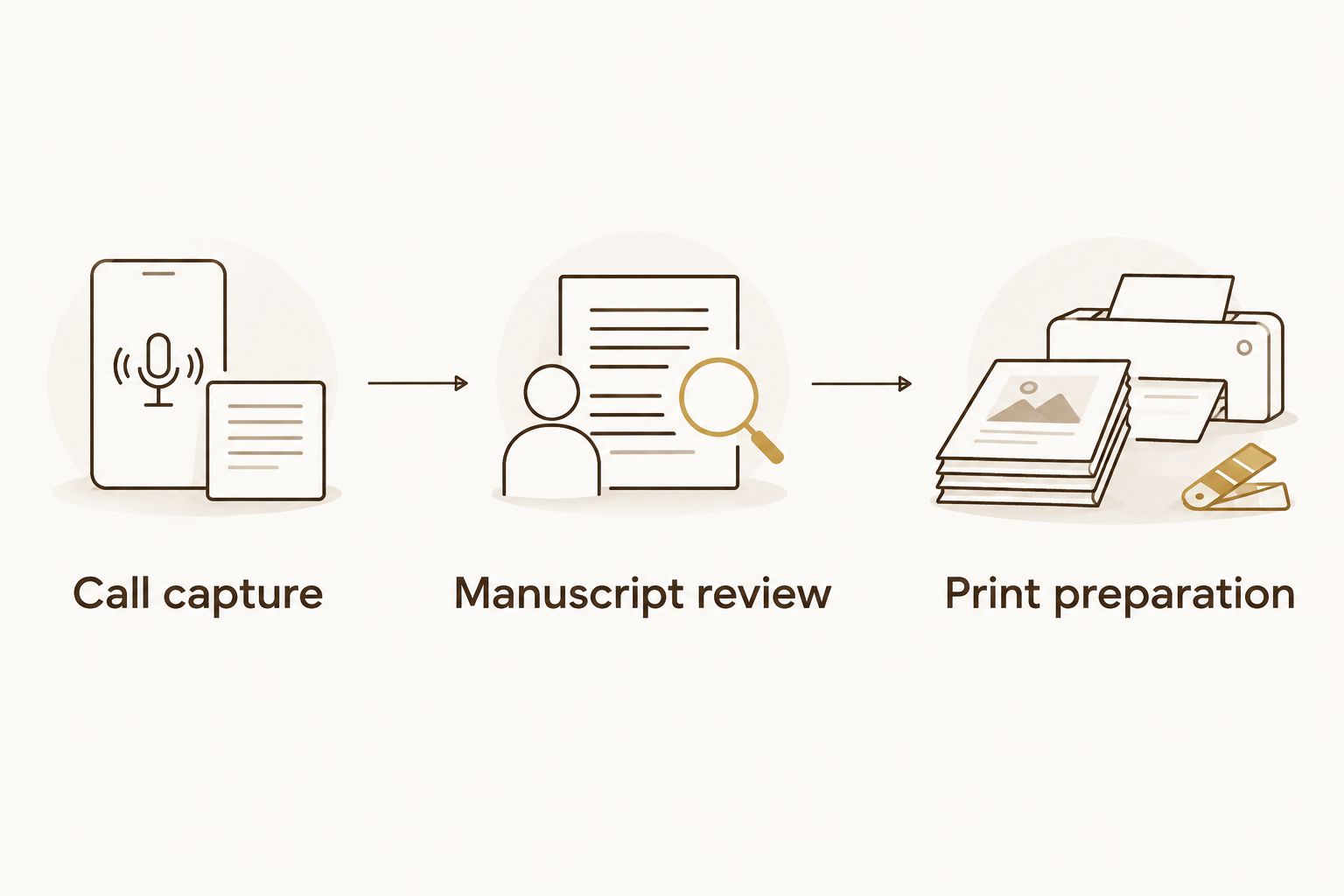
The workflow has three separate checkpoints: Call capture, Manuscript review, and Print preparation. Keep them separate so an unreviewed conversation never becomes an accidental print-ready draft.
Manuscript review
The second configuration unit turns the recorded memory into readable prose. Preserve the speaker’s perspective, but do not preserve every conversational detour.
- Prepare a working account. Transcribe the recording or write a faithful summary while listening. If you use transcription software, compare its output with the audio rather than treating the text as a verified record. Pay particular attention to names and places.
- Separate the speakers. Keep the storyteller’s account distinct from your questions and interpretations. A question can guide a paragraph without appearing in the finished book. Do not turn something you suggested into something the storyteller supposedly remembered.
- Build a small narrative. Give the account a setting, an event, and a reflection. Add context only when the storyteller supplied or confirmed it. If an important detail remains uncertain, retain that uncertainty or omit the detail instead of inventing a bridge.
- Edit for clarity, not a different personality. Remove repeated setup and empty conversational phrases. Keep distinctive expressions when they communicate meaning. Read the edited passage aloud: a family memoir should still sound like the person whose story it tells.
- Ask for a focused review. Send the passage or read it together on another call. Ask whether the account is accurate, whether anything feels too private, and whether the wording sounds right. Keep the reviewed version separate from the working draft.
- Continue the memoir process. Myvellum’s voice-guided memoir writing uses twelve structured interview chapters. Use the approved memory as preparation for the relevant interview work; do not assume that a call recording can be uploaded, synchronized, or converted through an unconfirmed feature.
Expected result: You have a storyteller-approved passage with corrected names, clear context, and agreed boundaries. A passage is ready for the next stage when the storyteller recognizes both the events and their own voice in it.
For a memoir assembled during 2026, use consistent language for relationships and places across chapters. A person introduced as Aunt Margaret should not become an unexplained Margaret later. Consistency is an editing task, not a reason to flatten the storyteller’s language.
Print preparation
The third configuration unit is the book manuscript. Starting a free memoir and ordering a printed book are separate decisions. Writing can begin before you have decided the final format, but printing belongs after review.
- Check the whole story. Read the manuscript in chapter order rather than reviewing isolated passages only. Look for duplicated anecdotes, unexplained people, and abrupt changes in time. Give each chapter enough context to make sense without the original video call.
- Resolve competing versions. When relatives remember an event differently, do not silently combine their accounts. Ask the narrator which version reflects their memory. Attribute another person’s perspective clearly if you decide to include it.
- Approve sensitive material. Revisit stories involving family conflict, health, identity, or other private experiences. Confirm whether the storyteller wants each passage printed for the intended readers. Agreement to record a conversation is not a substitute for this manuscript review.
- Choose the physical format. Myvellum produces personalized hardcover or softcover keepsake books. Decide which format you want separately from the writing process, and check the current ordering requirements before preparing the final submission.
- Proofread the print version. Review the version intended for production, not an earlier document. If a preview or proof is offered, inspect headings, paragraph breaks, names, and any included captions. Follow the print service’s stated requirements for any additional material.
- Place the order after approval. Keep a copy of the approved manuscript and your original recordings. Check the order details carefully, including the selected format and recipient information. Do not use placing an order as a deadline that forces unresolved stories into print.
Expected result: The book text has been reviewed as a whole, the storyteller has approved its contents, and the print order matches the intended manuscript and format.
For your 2026 edition, distinguish the publication year from the dates of the memories. A book prepared now can describe earlier events without changing their historical dates or making uncertain dates appear exact.
Add a follow-up interview when a memory changes
A second workflow starts when a relative remembers a missing detail after the first call. Treat the follow-up as a revision request, not an instruction to overwrite the manuscript immediately.
- Identify the passage. Ask which event, sentence, or name needs attention. Keep the request attached to that chapter rather than adding it to a general pile of family messages.
- Capture the correction. Record a short follow-up with permission, or ask the storyteller to provide the correction in writing. Clarify whether it replaces an earlier statement or adds another perspective.
- Review the revised passage. Read the change in context. A corrected date can affect the sequence of surrounding events, while a new person’s name can require an introduction elsewhere.
- Update the approved version. Replace the working passage only after review. If you have already ordered a book, keep the correction for a later edition rather than assuming an existing order can be changed.
Best for: Families whose memories emerge over several conversations. The benefit is a clearer account; the trade-off is another review cycle. Keep corrections attached to specific passages so the book does not become an endless rewriting project.
Troubleshooting
- The recording contains only one voice. Stop using that setup for substantive interviews. Repeat the playback test with both participants speaking, and choose a recording method that captures both sides. Notes can support a reconstruction, but they cannot recover missing audio.
- The transcript gets family names wrong. Compare the spelling with the storyteller and correct every occurrence. Keep a small reference list of approved names and places beside the manuscript. Do not guess from pronunciation.
- The interview produces facts but no story. Ask for a particular scene: what happened when they arrived, who was there, or what changed afterward. Avoid supplying the emotional answer yourself. The narrator decides what the event meant.
- The edited passage no longer sounds authentic. Return to the recording and restore meaningful expressions. Remove wording you introduced that changes the tone or significance. Read the revision aloud to the storyteller before approving it.
- A difficult subject stops the conversation. Offer to skip it, pause, or return another day. Remove any passage the storyteller no longer wants included. Finishing a chapter is less important than respecting the person whose life it describes.
Customize your workflow
If you are writing your own memoir, reverse the interview roles. Ask a parent, sibling, partner, or friend to question you, but keep yourself as the narrator. Their recollections can prompt your memories; label their contributions when they differ from your account.
Use the 2026 project to preserve your perspective, not to settle every family disagreement. You can explain what you remember without claiming that everyone remembers it identically. That distinction protects both the story and the relationships around it.
Expand the interview plan by choosing a theme for each conversation: a place you lived, work that shaped you, a friendship, or a decision. These are planning suggestions, not claimed chapter names. Use the app’s actual prompts when you begin its structured interviews.
The advantage of Myvellum’s memoir-writing and print service is that its stated offering includes guided voice interviews and a physical keepsake. The trade-off in this video-call workflow is the separate work of capturing, checking, and approving family conversations. Do not skip that handoff just because the eventual output is a book.
Start your own family memoir
Begin a free memoir, then review your story before taking the separate step of ordering a printed book.
FAQ
How do I interview a parent by video call for a memoir book?
Agree on recording permission, test that both voices are captured, and ask about one memory at a time. Turn the recording into a readable account, review it with your parent, and prepare the approved manuscript for printing.
Can I use this workflow to record my own life story?
Yes; ask a relative to interview you while you remain the memoir’s narrator. Review their contributions separately so your memories and their recollections are not silently combined.
Do I need to record the video as well as the audio?
No; a text memoir can be prepared from a clear audio recording. Video is a separate choice, and you should obtain permission for whatever you record and keep.
Can a video-call recording automatically become a memoir chapter?
Do not assume an automatic connection between your calling service and a memoir app. Prepare and review the story first, then use a transfer method only after confirming that the memoir service supports it.
What should I ask if my parent cannot remember an exact date?
Ask what happened before or after the event, and whether another record helps establish the date. If the date remains uncertain, preserve that uncertainty rather than assigning an exact year.
Is starting a free memoir the same as ordering a printed book?
No; starting a free memoir and ordering a printed book are separate steps. Complete the writing and review process before making the print-order decision.
Can Myvellum produce a hardcover family memoir?
Myvellum’s stated service includes personalized hardcover or softcover keepsake books. Check the current ordering requirements after you have reviewed and approved the memoir text.
What should I do if a storyteller changes their mind about a passage?
Remove or revise the passage before printing and ask the storyteller to approve the replacement. If a book has already been ordered, keep the approved correction for a later edition rather than assuming the order can be altered.
One last thing
Before the final approval, ask the storyteller to read a favorite paragraph aloud, or read it to them if that is more comfortable. Listen for places where they stop and say that the wording does not sound like them. Those pauses identify edits that a spelling check cannot catch.
A family memoir needs a recognizable voice more than perfectly polished sentences. Preserve the phrase your family remembers, explain the reference a younger reader will not understand, and let the narrator decide which version belongs in the book.


