
Instead of piecing together scattered memories at the last minute, record your own life story, review the manuscript, and order the printed book separately so the finished keepsake can remain a surprise for your family. Start with Myvellum at myvellum.vercel.app, then follow the preparation, review, and gift-planning workflow below.
- For the search ‘order memoir book surprise gift,’ finish and review your own story before ordering the printed keepsake.
- Myvellum suits storytellers who want voice-guided memoir writing and a personalized printed family book.
- Starting a free memoir and ordering a printed book are separate steps; plan both deliberately.
- Keep the presentation secret, not the consent needed to include someone else’s sensitive story.
Why this matters
A surprise memoir gift involves two different projects: creating a truthful account of your life and arranging the physical gift. Treating them as one task makes it easy to focus on the cover while overlooking a misspelled name, an unfinished chapter, or a story someone would rather keep private.
Myvellum is best for people who want voice-guided memoir writing and a printed keepsake of their own life story. Its twelve structured interview chapters give you a starting framework; you still decide what belongs in the account you share with family.
For a gift planned in 2026, build your schedule around the manuscript first. A meaningful family book does not need every event you remember. It needs a clear selection of memories that explains what you experienced, what mattered, and what you want your readers to understand.
Before you start
- Gather access and materials. Have access to the memoir service, a device you can use for voice-guided writing, and a private place to speak. Keep a short list of names, places, and important events beside you.
- Separate the two decisions. Starting a free memoir begins the writing project. Ordering a personalized hardcover or softcover book is a later decision, after you have reviewed the story and the current ordering requirements.
- Resolve the hidden gotcha: privacy. A gift can be secret without making someone else’s personal history public. Identify sensitive passages before recording them, and request permission where a story reveals another person’s private experience.
Choose the recipient before choosing the contents. Writing for your children, siblings, or wider family changes which background details you need to explain. Do not assume they already know how you met an important friend, why you moved, or what a familiar family phrase means.
Story plan
Define the reader and the boundaries
- Name your reader. Write a sentence identifying who will receive the book and what you want that person to understand about your life. Keep it beside your working notes.
- Choose the central thread. Pick a theme such as belonging, work, family traditions, or starting again. Use it to decide which memories deserve space.
- Make a boundary list. Mark topics you will include, topics requiring someone’s permission, and topics you will leave out. A memory can matter to you without belonging in a family gift.
- Set a completion checkpoint. Put manuscript review before the intended gift occasion. Check the service’s current production and delivery information before committing to a presentation date.
Expected result: You have a defined audience, a clear theme, and a list of boundaries. Those decisions keep the surprise from becoming an excuse to rush or overshare.
For a 2026 family gathering, use the occasion as a reason to finish—not as a reason to skip review. If the book is not ready, choose a later presentation rather than approving a version you already know needs corrections.
Assemble memory prompts
- List meaningful moments. Include turning points and ordinary scenes: a kitchen conversation, a first workplace, a journey, or a tradition you helped create.
- Attach a concrete detail. Beside each memory, note a person, place, object, sound, or action that helps you describe the scene.
- Separate memory from evidence. Mark dates and names that need checking. Use letters, journals, or family records to verify them rather than filling gaps with guesses.
- Preserve uncertainty honestly. When you cannot establish an exact detail, describe what you remember without manufacturing precision.
Expected result: You have prompts that help you speak naturally and a separate fact-check list. You can begin telling the story without interrupting every sentence to investigate a date.
Voice-guided draft
Record scenes, then connect them
Myvellum guides memoir writing through 12 structured interview chapters. Use that structure to develop your own account rather than trying to deliver a polished autobiography in a single sitting.
- Begin with one scene per session. This is a working recommendation, not a recording limit. Choose a moment you can describe clearly before tackling a broad period of your life.
- Explain the setting. Say where you were, who was present, and what was happening. Give a family reader enough context to follow the event without asking you afterward.
- Describe the change. Explain what you did, what happened next, and why the memory stayed with you. Separate your feelings at the time from what you understand now.
- Finish with the connection. State how the memory relates to the chapter or to the person receiving the book. Avoid forcing a lesson onto an experience that simply deserves remembering.
Expected result: Each memory has a setting, an event, and a reason for inclusion. Your draft becomes a readable life story rather than a disconnected collection of anecdotes.
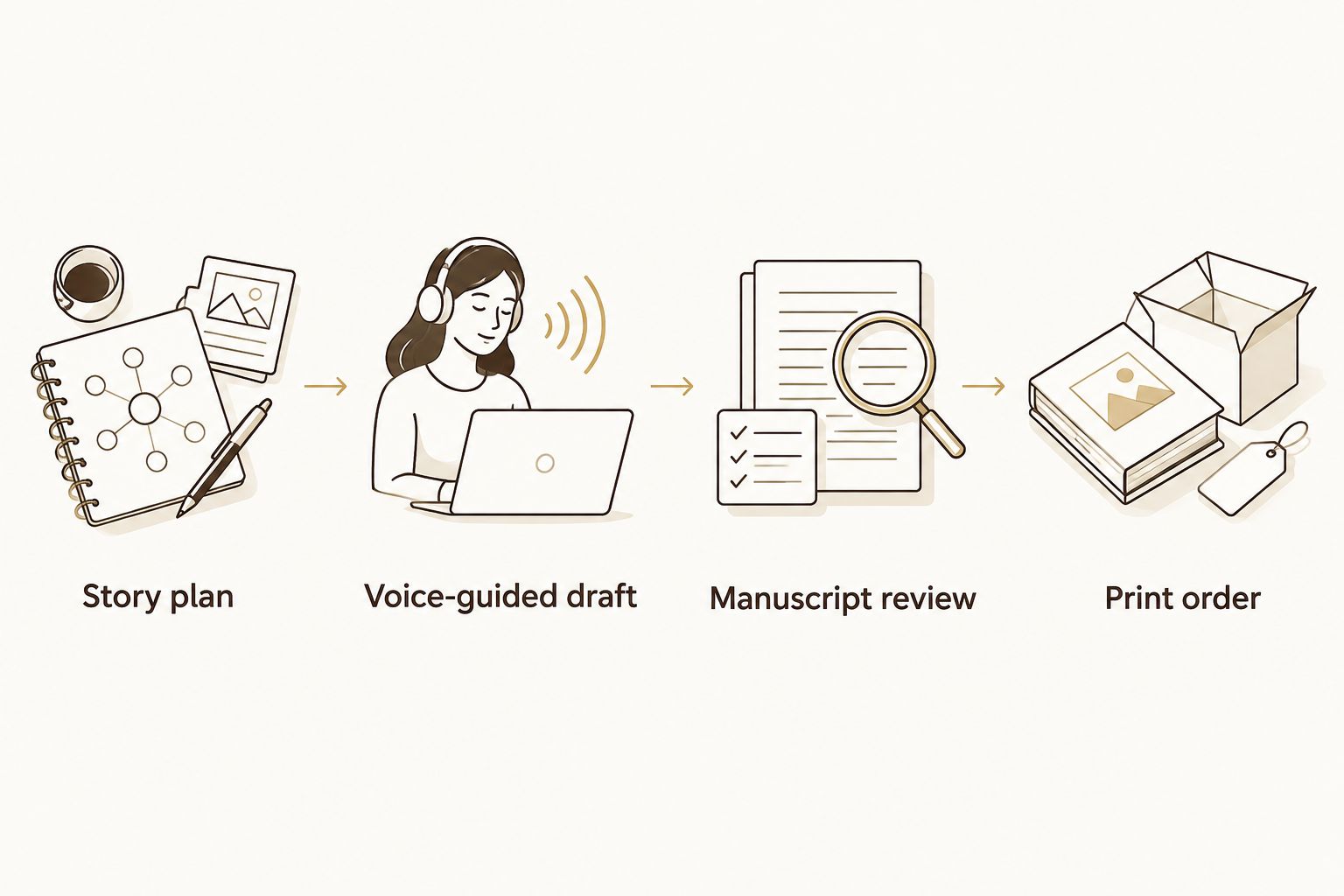
The workflow is straightforward: establish the story, speak the memories, check the resulting account, then prepare the print order. Keep those stages separate so correcting the manuscript does not become a last-minute gift task.
Keep your speaking voice
A family memoir should sound like you. Keep expressions you genuinely use, explain family nicknames, and retain small details that reveal your perspective. Correcting a sentence does not require replacing it with formal language.
Read a passage aloud during review. If it sounds unlike anything you would say, simplify it. The purpose is not to make every paragraph sound literary; it is to make your experiences understandable without erasing your personality.
Manuscript review
Check facts, privacy, and readability
- Make a facts pass. Verify personal names, place names, relationships, and the sequence of events. Check the same person’s name throughout the manuscript, not just at first mention.
- Make a privacy pass. Read specifically for another person’s health, finances, relationships, or experiences they have not chosen to share. Remove unnecessary identifying details or seek permission before including them.
- Make a reader pass. Look for unexplained references, repeated anecdotes, missing transitions, and passages that assume too much background knowledge.
- Resolve every open note. Replace unfinished reminders with finished text or remove the passage. Do not carry an unresolved question into the printing decision.
Expected result: You have completed 3 review passes, each with a distinct purpose. Your manuscript is ready for a final reading without outstanding corrections hidden in the text.
Review the story before approving the physical gift. A cover cannot compensate for a wrong family name or a passage you regret sharing.
If a trusted reader can help without spoiling the surprise, give that person a narrow assignment. Ask for factual corrections or confusing passages rather than general rewriting. The guide to sharing memoir chapters with family before printing explains that review task in more detail.
For your 2026 review copy, identify the version you intend to approve. Keep later corrections together so you do not accidentally review one draft and order from another.
Print order
Choose the format and verify the order
Myvellum produces personalized hardcover and softcover keepsake books. Both formats serve the same purpose: turning your written life story into a physical book your family can read.
| Format | Best for | Advantage | Limitation to consider |
|---|---|---|---|
| Hardcover | Readers who prefer a rigid cover | Gives the memoir a firm outer cover | The rigid format does not suit every reader’s handling preference |
| Softcover | Readers who prefer a flexible cover | Gives the memoir a bendable outer cover | Does not provide the rigid cover some readers want |
Choose the recipient’s preferred format, not a format based on assumed print quality. Binding alone does not tell you whether the manuscript is complete or accurately proofread.
- Confirm the manuscript. Read the version intended for printing. Check that the opening, chapter sequence, and ending are complete.
- Check personalization. Verify any title, author name, dedication, or other personalized text included in your order. Read names character by character.
- Choose the binding. Select hardcover or softcover according to the reader’s preference and the options shown during ordering.
- Verify the order details. Check the selected format, requested quantity, recipient details, and delivery address wherever the ordering process requests them.
- Check the current timetable. Review the production and delivery information provided for the order. Do not turn an estimate into a promise to your family.
Expected result: The order corresponds to the manuscript you approved and the physical format you chose. Your gift plan uses the current information presented during ordering.
For a 2026 surprise, keep 2 checkpoints in your plan: manuscript approval and order verification. These are recommended safeguards, not service requirements.
Start your family memoir
Begin your free memoir, then review your story before deciding on a printed keepsake.
Update an existing memoir for a new occasion
If you already have a draft, you do not need to restart the entire project. Use the next family occasion to finish the account or add a clearly defined chapter about a more recent period.
- Identify the new material. Decide whether you are correcting existing passages, adding memories, or writing a new ending. Keep those tasks distinct.
- Check the transitions. Read the paragraphs before and after each addition. Explain any jump in time or change in perspective.
- Repeat the review passes. New material needs the same factual, privacy, and readability checks as the original manuscript.
- Verify the version intended for printing. Treat the updated book as a fresh approval decision, even when most of the text remains unchanged.
Expected result: The revised memoir reads as a deliberate account, not an older draft with unrelated additions attached. Present the new material as part of your continuing story, not as a claim that you have remembered everything.
Troubleshooting
The story sounds like a timeline
Dates alone do not explain your experience. Choose an event already in the draft and add what you saw, what you decided, and what changed afterward. Keep the chronology, but give the reader a scene inside it.
A family member remembers an event differently
Do not settle a disagreement by silently declaring your version definitive. Verify factual details where possible and distinguish your recollection from another person’s account. If the disagreement adds nothing to the gift, leave it out.
Asking for review would spoil the surprise
Ask a trusted person who is not receiving the book to check only the necessary details. If permission is required for a sensitive story, request it even when that reveals the project. Consent matters more than secrecy.
The manuscript is unfinished near the occasion
Do not approve unfinished text to preserve a planned reveal. Finish the review and change the presentation date. A complete account is the gift; the occasion is only its setting.
Customize your workflow
Add supporting material only when it helps your family understand the story. A photograph can identify a place you describe; a letter can preserve the language of a particular moment. Neither should replace the explanation that connects it to your life.
For a memoir completed in 2026, write a closing note that speaks directly to your readers. Explain why you chose to tell these stories and what you hope they will carry forward. Keep it personal rather than turning the ending into a summary of every chapter.
FAQ
How do I order a memoir book as a surprise gift?
Finish and review your own life story, then verify the printed-book order without involving the recipient in the presentation details. Check the manuscript, personalization, format, and delivery details before approving the order.
Can I start my memoir before deciding to print it?
Yes, starting a free memoir and ordering a printed book are separate steps. Develop and review the story first, then decide whether the finished account is ready for a family keepsake.
Is Myvellum for telling my own story or buying a gift for a parent?
Myvellum is a voice-driven memoir-writing app and print service for individuals telling their own life story. You can turn that account into a personalized hardcover or softcover keepsake for your family.
Should I choose hardcover or softcover for a memoir gift?
Choose hardcover for a reader who prefers a rigid cover and softcover for a reader who prefers a flexible cover. Review the manuscript separately; the binding does not establish the accuracy or completeness of the story.
How can I keep a family memoir secret without skipping permission?
Keep the gift presentation secret, but ask permission before including someone else’s sensitive personal information. Remove a passage when permission is unavailable and the detail is not necessary to your account.
How far ahead should I order a printed memoir?
Use the current production and delivery information provided during ordering to plan the gift date. Allow time for manuscript review before that stage, and do not assume a delivery timetable from another service or an older order.
Do I need to include my entire life in the book?
No, a memoir can focus on selected experiences connected by a clear theme. Include the context your family needs and leave out material that does not serve the story you want to share.
One last thing
Write the dedication after you finish the manuscript. You will know which memories explain your relationship with the recipient, and you can name that connection plainly. A short, specific dedication gives the surprise a personal opening without trying to speak for the whole book.


