

Instead of collecting scattered recordings and trying to remember who said what, set up a grandparent grandchild memoir interview with clear speaking roles, one memory at a time, and a chapter review before printing. You can start your own free memoir with Myvellum at myvellum.vercel.app, then treat ordering your personalized family keepsake book as a separate step.
- Myvellum suits storytellers who want a voice-guided memoir and a printed family keepsake.
- A grandparent grandchild memoir interview works best when the grandparent narrates and the grandchild asks focused follow-up questions.
- Keep oral history speakers separate so family memoir chapters preserve each person's perspective.
- Start your free memoir first; review the story before ordering a printed book.
Why this matters
A shared interview is not just a way to collect family facts. Your grandchild can ask about details you would otherwise leave unexplained: why a particular room mattered, what your first job felt like, or how a family expression began. Those questions help you tell your own story to someone who did not live through it.
Myvellum is best for storytellers who want a voice-guided memoir that becomes a printed family keepsake. Its twelve structured interview chapters provide a framework; your grandchild's questions add a personal connection. The framework does not replace your judgment about what belongs in the book.
For a memoir project begun in 2026, distinguish the date you record a memory from the date the event happened. A recording date documents the conversation. It does not establish the historical accuracy of everything remembered.
Before you start
- Prepare your access and materials. Have access to your memoir account, a device with a working microphone, and any photographs, letters, or notes you want to discuss. Open the materials before the conversation rather than searching while someone speaks.
- Agree on roles and boundaries. Decide that you will tell your life story and your grandchild will ask questions. Agree which subjects to skip, who can read the resulting chapter, and whether the grandchild's own words can appear in it.
- Check the two-speaker gotcha. Two voices in a recording do not automatically produce a clearly attributed memoir. Test the recording method, introduce both speakers aloud, and keep a separate note of who said anything you plan to quote.
Use the steps below to organize the conversation, not as a substitute for checking the recording controls on your device. Confirm that your chosen method actually captures both voices before telling a story you would not want to repeat.
Interview setup
Choose the story
- Pick 1 memory for the opening conversation. Choose a scene you can describe: arriving at a new home, meeting an important person, or learning something that changed your life. A scene gives your grandchild something concrete to ask about.
- Write 3 opening questions. Ask what happened, what you noticed, and why you still remember it. Keep these on a separate sheet so the interview does not become a reading exercise.
- Choose your speaking roles. For your own memoir, you remain the narrator. Your grandchild asks questions, checks unfamiliar words, and invites you to explain what the memory means now.
- Agree on a stopping signal. Choose a simple phrase that means pause the recording or leave the topic. Your right to stop does not depend on whether the story would make an interesting chapter.
Expected result: You have a defined subject, a question list, and permission to pause. Neither person needs to improvise the entire interview.
Avoid starting with a request to tell your whole life story. That invitation is too broad to organize easily. Begin with a specific moment, then follow the connections it reveals without abandoning the original scene.
Prepare the recording
- Find a quiet place. Turn off background audio and move away from conversations you do not want included. Place the microphone where it can capture both speakers without either person leaning across the other.
- Record a short sample. Have both people speak in their normal voices. Play it back and check that you can understand every sentence, including the quieter speaker.
- Introduce the conversation. State your names, your relationship, the recording date, and the topic. For a session recorded in 2026, use the actual date rather than a general label such as a summer visit.
- Name the recording by subject. Use a recognizable topic such as first home or childhood kitchen. Keep the recording date in your notes so several conversations about the same subject remain distinguishable.
Expected result: Both voices are understandable, and you can identify the conversation later without listening to the entire recording.
Keep the original recording unchanged when you begin shaping the chapter. Editorial decisions belong in your working text or notes, not in the only surviving copy of the conversation.
Conversation capture
Tell the scene
- Begin with place and people. Explain where you were, who was present, and what was happening. Describe relationships as well as names so a future reader understands who each person was.
- Let the narrator finish. Your grandchild should note follow-up questions rather than interrupt every unfamiliar detail. A pause often gives you room to remember the next part.
- Ask for concrete details. Your grandchild can ask what you saw, heard, carried, or did next. These questions invite description without supplying an answer for you.
- Separate memory from confirmation. Say when you do not remember a date or when a detail comes from a photograph rather than personal recollection. Do not turn a guess into a precise fact during editing.
- Close with meaning. Explain why you chose this memory for your family. Your grandchild can then say what surprised them or what they understand differently after hearing it.
Expected result: You have a scene with context and a personal interpretation, rather than a list of names and dates.
Ask for explanation, not agreement. A question that proposes the answer can change the story you tell. An open question leaves room for a memory that differs from your grandchild's expectations.
Chapter preparation
Shape the chapter
- Identify the central memory. Write a plain working title that names the experience. Keep related stories in separate notes if they interrupt the main sequence.
- Preserve your narrative voice. Remove repeated starts and conversational detours without replacing your expressions with language you would never use. Read a paragraph aloud to check whether it still sounds like you.
- Label your grandchild's contribution. If a question or reflection belongs in the chapter, identify its speaker. Do not silently turn your grandchild's interpretation into your own recollection.
- Check names and uncertainty. Compare details against the materials you have. If a date remains uncertain, describe the period honestly rather than manufacturing precision.
- Review together before printing. Ask your grandchild whether their contribution is represented accurately. Make the final decisions about your own story, including what stays private.
Expected result: The chapter distinguishes your memories, your grandchild's questions, and any facts still needing confirmation.
For your 2026 manuscript, keep a short review note beside each chapter: reviewed, needs a name checked, or not for sharing. This is a working practice you control, not a claim about any app's features.
The sequence is Choose the story, Prepare the recording, Tell the scene, and Shape the chapter. Recording comes before editing; shared review comes before a print order.
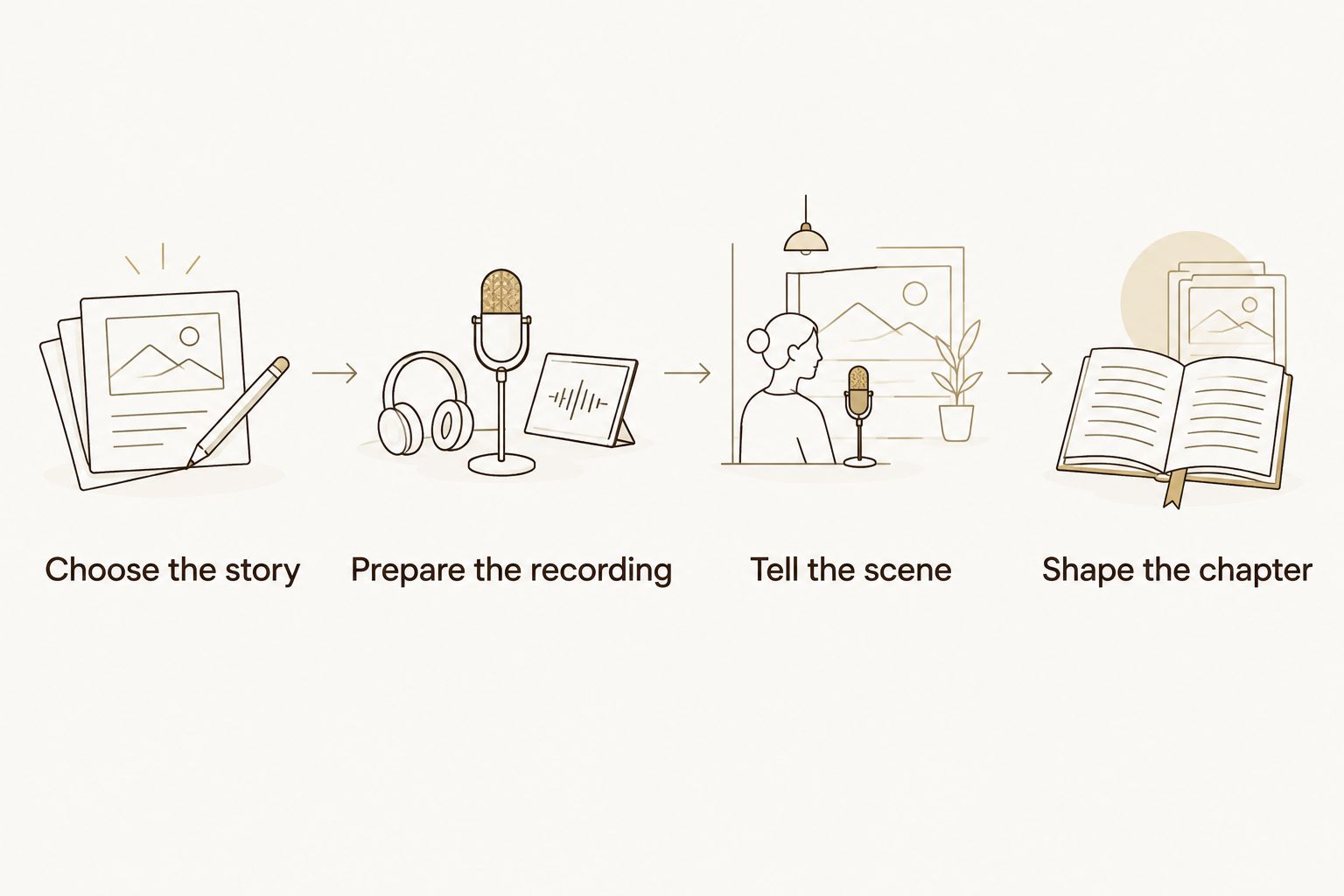
Second workflow: record a shared memory from both sides
When you and your grandchild remember the same event, record each perspective separately before discussing the differences. A shared holiday, a family tradition, or an ordinary afternoon can become a paired chapter rather than a conventional interview.
Choose the format by whose life story the chapter needs to serve:
| Format | Best for | Strength | Limitation |
|---|---|---|---|
| Narrator-led interview | Recording your own life story | Keeps your memories at the center while questions add context | Your grandchild's perspective receives less space |
| Paired recollections | Exploring an event you both remember | Preserves different meanings attached to the same experience | Requires explicit speaker labels and more editorial decisions |
- Describe the event independently. Each person explains what they remember without first reading the other's account.
- Compare the details. Discuss differences as differences, not errors that must be eliminated. Check an external record only where factual confirmation matters.
- Choose the presentation. Keep your account as the main narrative and add a clearly labeled reflection, or present two attributed passages.
- Review the transition. Make sure readers know when the speaker changes and why both accounts appear.
Expected result: The chapter preserves two viewpoints without blending them into a voice neither person recognizes.
Troubleshooting
One voice is difficult to hear
Move the recording device closer to the quieter speaker and repeat the sound check. Ask each person to speak toward the microphone without talking over the other. If an important sentence is unclear, record it again with context rather than guessing the words later.
Questions keep breaking the story
Have your grandchild write questions down and wait for a natural pause. Return to the scene before introducing a new subject. The interview should help you remember, not require you to defend every detail as you speak.
The chapter sounds unlike you
Compare the edited passage with the original recording. Restore expressions that carry your personality, and shorten sentences that became formal during revision. Clear writing does not require erasing the way you speak.
You disagree about what happened
Separate a checkable detail from a personal interpretation. A document can help establish a date; it cannot decide how an experience felt. Preserve attributed differences when they matter instead of forcing a single agreed version.
A story exposes someone else's private life
Pause the chapter review and discuss whether the detail is necessary. Remove identifying information or leave the episode out when you cannot justify sharing it. Permission to record a conversation is not permission to publish everything in it.
Customize your workflow
Start the memoir first; order the printed book after review. Myvellum combines voice-guided memoir writing with personalized hardcover or softcover printing, but those are distinct decisions. Beginning your free memoir is not the same action as ordering the physical keepsake.
Use the twelve structured interview chapters to organize your life story without making every conversation identical. Your grandchild can help you revisit a question, explain a family reference, or identify a passage that needs context. Keep the narrative centered on your own experiences.
The guided structure gives you a starting point, and the printed format gives your family a physical book. The limitation remains the review work: a framework cannot decide which memories are sensitive or whether a name is correct. Those choices belong to you.
Before placing a print order in 2026, review the current book options and ordering details on the site. Do not treat a finished recording as a finished manuscript.
For the next stage, use the guide to sharing memoir chapters with family before printing. Choose a reader who can check context without rewriting your personality.
Start your own family memoir
Begin your free memoir, then review your story before ordering a printed keepsake.
FAQ
How do I start a grandparent grandchild memoir interview?
Start with one specific memory, agree that the grandparent narrates and the grandchild asks questions, and test the recording. Introduce both speakers aloud before beginning the story.
Can my grandchild help me write my own life story?
Yes, your grandchild can ask follow-up questions and help review the chapter while you remain the narrator. Keep their reflections clearly attributed rather than blending them into your memories.
Should we record our memories together or separately?
Record together when your grandchild is interviewing you; record separately first when you both remember the same event. Separate recollections preserve each person's perspective before a shared discussion.
What questions should my grandchild ask during a memoir interview?
Ask what happened, what you noticed, and why the experience still matters to you. Follow with questions about unfamiliar people, places, and expressions rather than suggesting answers.
What should we do when we remember an event differently?
Preserve the difference with clear attribution unless a record resolves a factual detail. Two people can attach different meanings to the same experience without either account needing to disappear.
Can I start a free memoir before ordering a book?
Yes, you can start your free memoir with Myvellum and make the print decision separately. Review your chapters and the current ordering details before choosing a personalized hardcover or softcover keepsake.
What should I check before printing our family memoir?
Check speaker attribution, names, uncertain dates, sensitive details, and whether the writing sounds like you. Review any contribution from your grandchild with them before including it in the printed book.
One last thing
Ask your grandchild which ordinary detail they would never have known without the interview. It might be how you addressed a neighbor, what you carried to school, or where everyone gathered after dinner. Their answer tells you where a future reader needs more explanation.
For your 2026 family memoir, make that detail understandable without polishing away its familiarity. Write for the relative who was not in the room. A small piece of context can let them enter the memory without interrupting your voice.


