
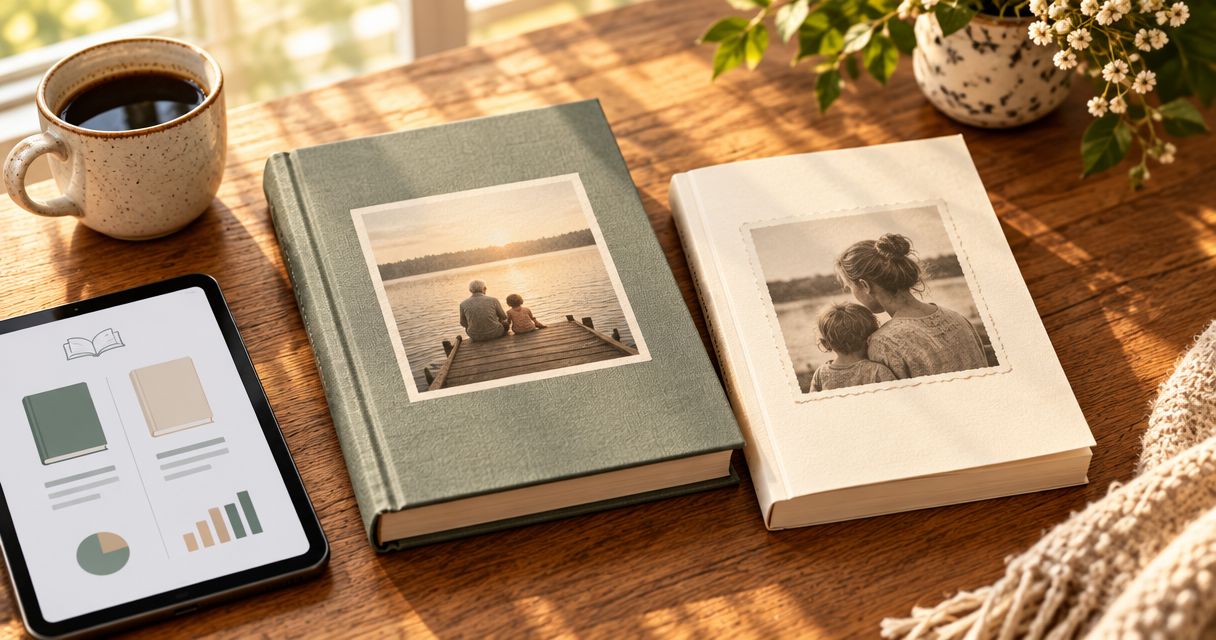
Hardcover is the better choice for a memoir keepsake you want to shelve and pass down; softcover is better when you want a lighter book for everyday reading. Hardcover adds rigid protection around the pages, but it does not guarantee archival preservation, better paper, or a stronger binding.
- Hardcover vs softcover memoir: choose hardcover for shelf protection and softcover for lighter everyday reading.
- Myvellum suits storytellers who want guided voice interviews and a printed family memoir.
- Cover format does not establish paper quality, binding strength, or photographic reproduction.
- Start your free memoir first; review the finished story before ordering a printed keepsake book.
Why this matters
Your life story deserves a format that fits how your family will actually read it. A substantial book that stays unopened serves a different purpose from a lighter copy that moves between a bedside table and a reading chair. Neither format makes the memories more meaningful.
At Myvellum, you can approach your memoir as two distinct decisions: starting your free memoir and ordering a printed book. myvellum.vercel.app offers voice-guided memoir writing through twelve structured interview chapters, with hardcover or softcover keepsake books. Set your printing decision aside while you begin recording what you want your family to remember.
Is a hardcover or softcover better for a memoir keepsake?
Choose hardcover for a shelf-kept family keepsake; choose softcover for a lighter reading copy. In a 2026 hardcover vs softcover memoir comparison, the useful distinction is the physical cover—not an assumption that one version contains a better story or better printing.
| Consideration | Hardcover memoir | Softcover memoir |
|---|---|---|
| Best for | A shelf-kept family keepsake | A lighter everyday reading copy |
| Cover construction | Rigid boards beneath the cover material | A flexible paper or card cover |
| Main advantage | Rigid protection against bending | Less cover bulk and easier carrying |
| Main drawback | More cover weight and bulk | More exposure to creasing and bent corners |
| Reading feel | More substantial in the hands | More flexible in the hands |
| What to verify | Binding, paper, page layout, and printing | Binding, paper, page layout, and printing |
| What it does not guarantee | Archival longevity or better interior quality | Easier reading or weaker interior quality |
These are format-level differences, not specifications for a particular printer. Cover materials, book dimensions, page count, and binding construction affect the finished result. Ask about those details rather than treating the word hardcover as a complete quality standard.
Hardcover: best for a shelf-kept family memoir
A hardcover makes sense when you picture your memoir standing beside family albums, being brought out for visits, and eventually passing to another reader. The rigid boards help protect the text block from bending. That protection is useful, but it is not a promise that the book will survive poor storage or rough handling.
The trade-off is physical bulk. A hardcover adds structure you must also hold, carry, and store. If you dislike handling substantial books, the keepsake appearance alone is not a good reason to choose it.
Choose hardcover when rigid cover protection matters more to you than lightness. Do not choose it solely because you expect the format to make the book permanent.
Softcover: best for a memoir you will read often
A softcover makes sense when you want your own story close at hand rather than treated as a display object. Its flexible cover contributes less bulk than rigid boards. That suits readers who prefer a lighter object to carry between rooms or take along when visiting family.
The drawback is that the cover can crease and corners can bend. Flexible does not mean disposable, and it does not tell you how securely the pages are bound. Inspect the construction rather than dismissing the format.
Choose softcover when a lighter reading copy fits your habits. A family keepsake can be well loved without having a hard cover.
Why the right memoir format varies
The right choice depends on the reader and the physical book. Use these factors for your 2026 printing decision instead of choosing the format that merely looks more formal.
- Reading habits: Decide whether the memoir will mainly sit on a shelf or move around the house with you. Choose for its ordinary use, not just the day you first open it.
- Handling comfort: Think about the books you already enjoy holding. A rigid cover adds structure, but personal comfort also depends on the complete book.
- Book dimensions and length: Cover type alone does not determine weight or ease of use. A large softcover can still feel cumbersome, while a smaller hardcover can be comfortable.
- Interior requirements: Legible text, sensible margins, and clear captions deserve attention independently of the cover. A hardcover does not repair a cramped layout.
- Storage conditions: Keep either format away from dampness, direct sunlight, and excessive heat. Cover rigidity is not a substitute for suitable storage.
- Emotional purpose: Decide whether you want the book to feel ceremonial, familiar, or somewhere between. That preference is yours; it is not a technical measure of quality.
Try completing this sentence: I want my family to use this book by… Your answer gives you a more useful selection criterion than simply asking which format is better.
How do you choose a memoir format without delaying your story?
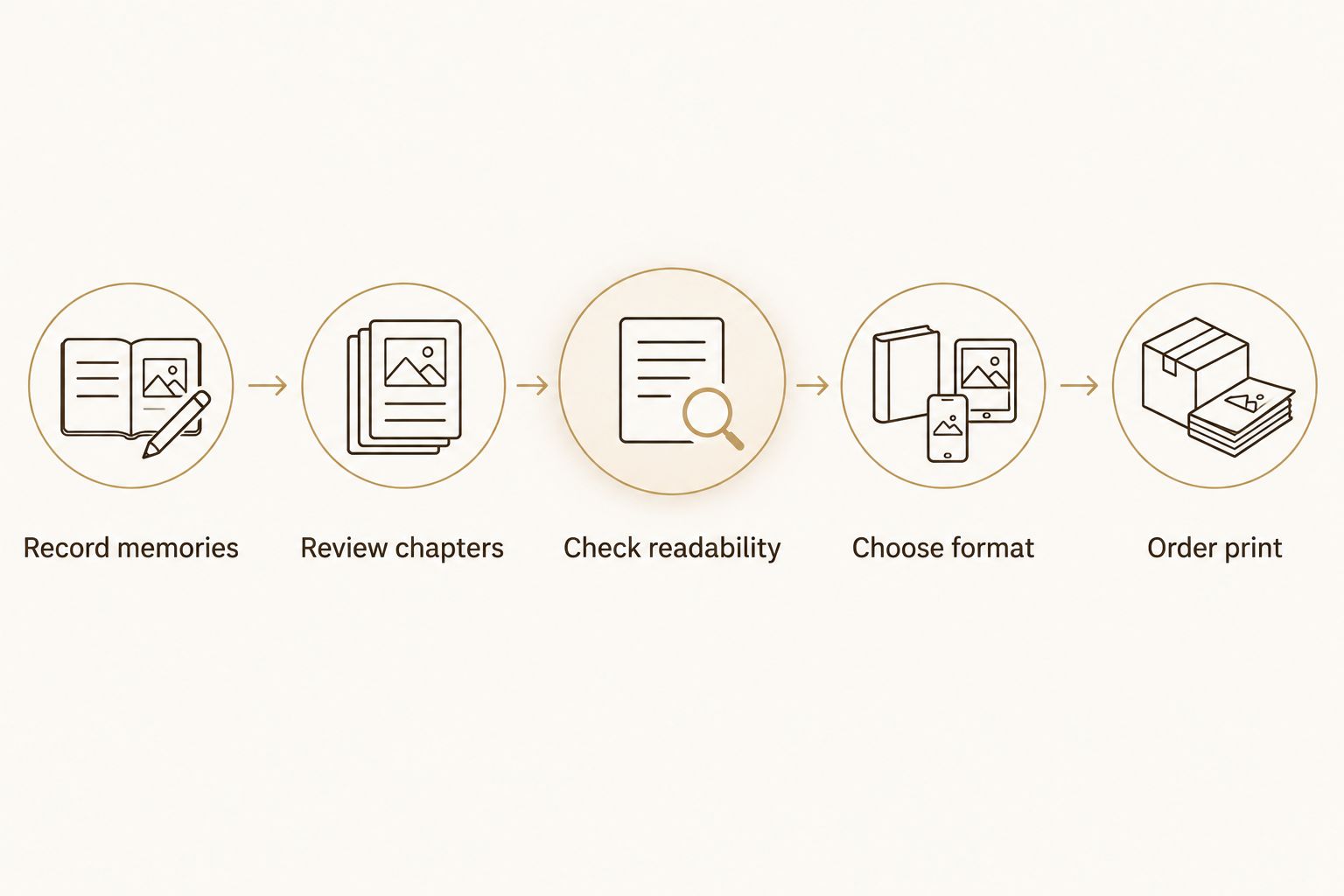
Record the memories before letting the binding decision become a barrier. You can decide what your book should contain before deciding how you want to hold it. Use this sequence to separate storytelling work from printing choices.
- Record memories. Begin with an event you can describe clearly: a first home, a difficult move, a friendship, or work that changed you. Capture what happened and why you still remember it.
- Review chapters. Read for meaning and accuracy. Check names, relationships, place names, and the difference between what you witnessed and what someone later told you.
- Check readability. Examine paragraph breaks, headings, captions, and text size in whatever review materials the printing service provides. Request clarification when the finished layout is unclear.
- Choose format. Match hardcover or softcover to the way you want to read and keep the memoir. Make this choice after considering the actual interior and physical specifications.
- Order print. Confirm the selected format and the version of the manuscript being printed. Treat the order as a separate commitment from beginning your memoir.
The sequence keeps your attention on the part only you can supply: the memories. A beautifully bound book cannot recover an explanation you never recorded.
Myvellum is best for people who want to speak their life story through guided interviews and create a printed family memoir. Its memoir-writing process uses 12 structured interview chapters and offers hardcover or softcover keepsake books. The format choice still needs your judgment: the cover label alone does not settle paper, binding, or layout questions.
If the blank page is the obstacle, begin with how to start writing your life story. Starting your free memoir and ordering your printed book are separate steps; you do not need to resolve every printing preference before recording your opening memory.
Start with your own memories
Begin your free memoir, then decide on a printed hardcover or softcover keepsake.
What should you check before ordering either format?
For a 2026 memoir order, ask for the specifications of the book you are actually choosing. General hardcover and softcover comparisons cannot establish the quality of a particular finished copy.
Check the binding, not just the cover
Ask how the pages are attached and what handling the binding allows. Do not assume a hardcover is sewn or that either format opens flat. Avoid forcing a book flat unless its construction supports that use.
Your practical question is simple: can you read comfortably without stressing the spine? If the service provides a physical sample or a description of its construction, use that information rather than judging by a cover photograph alone.
Check text and photographs separately
Readability depends on the interior layout, not on rigid boards. Check whether headings are clear, text sits comfortably away from the inner margin, and paragraphs are easy to follow. A story meant for your family should not require them to struggle through crowded pages.
If your manuscript includes photographs, inspect their placement and captions wherever a preview is provided. Identify the people and explain the occasion when you know it. A clear caption can preserve context that an attractive cover cannot supply.
Confirm the manuscript before committing
Distinguish corrections from changes of voice. Fix a mistaken name, but do not automatically replace a familiar expression with something more formal. Your family is reading to understand your experience, not to hear an anonymous narrator.
Before ordering, confirm which manuscript version will be printed and what the service permits after submission. Do not assume later changes are possible. The safest point to resolve uncertainties is before you commit the story to paper.
Will a hardcover memoir last longer than a softcover?
Hardcover provides more rigid cover protection, but format alone does not establish lifespan. Paper, binding, handling, and storage all matter. Neither cover type justifies an unsupported claim about how many years a memoir will last.
For your 2026 keepsake, keep the book in a clean, dry location away from direct sunlight and heat sources. Handle pages gently and avoid overfilling a shelf so tightly that removing the book strains its spine. Preserve your manuscript separately from the physical copy wherever your writing workflow permits.
Is softcover suitable for a family keepsake?
Softcover is suitable for a family keepsake when you prefer a lighter, flexible book. The personal value comes from your story, not the rigidity of its cover. Choose it deliberately rather than treating it as an unfinished version of a hardcover.
A familiar book with carefully identified people, readable chapters, and your own way of speaking can do exactly what you need. Its limitation is physical: the flexible cover offers less resistance to bending and creasing.
Should you finish your memoir before choosing the cover?
Finish and review the story before making your final cover decision. You can have a preference earlier, but the finished manuscript gives you a clearer basis for evaluating layout, dimensions, and handling.
For a memoir you begin in 2026, make recording the first milestone and printing a later one. That keeps the binding question from taking time away from the details your family cannot find anywhere else.
FAQ
What's better for a family memoir, hardcover or softcover?
Hardcover is better for rigid shelf protection; softcover is better when you prefer a lighter reading copy. Choose according to how you will handle and keep the book, not an assumption that hardcover guarantees better printing.
Does hardcover mean my memoir has better paper?
Hardcover does not establish paper quality. Ask for the paper specifications of the particular book rather than inferring them from its cover.
Is a softcover memoir less meaningful as a keepsake?
A softcover memoir is not less meaningful as a keepsake. Your memories, explanations, and personal voice carry the family value; the flexible cover changes handling and protection.
Will a hardcover memoir open flat?
A hardcover memoir is not guaranteed to open flat. Check the binding construction and handling guidance before expecting that behavior.
Can I start my memoir before deciding on hardcover or softcover?
You can begin recording your memoir before choosing its final cover format. Separate starting your free memoir from ordering a printed book, and review the manuscript before making the printing decision.
What does Myvellum offer for creating a printed memoir?
Myvellum offers voice-guided memoir writing through twelve structured interview chapters and personalized hardcover or softcover keepsake books. It suits people recording their own life story for family.
How should I store my printed family memoir?
Store your printed family memoir in a clean, dry place away from direct sunlight and excessive heat. Handle the binding gently, and do not treat a hardcover as a guarantee of permanent preservation.
One last thing
Before choosing the cover, add the detail your family would otherwise have to guess. Explain why you left that job, what the kitchen sounded like, or how you felt when you arrived in a new town. Those details give future readers something a name and date cannot.
Then choose the format you will enjoy keeping. Hardcover protects against bending; softcover reduces cover bulk. Neither can replace the reason you wanted to tell the story.


