

A memoir writing app is worth it in 2026 if guided questions help you turn spoken memories into a life story you will actually finish and share with family. It is not a substitute for checking your memories, deciding what stays private, or reviewing the manuscript before ordering a printed book.
- Is a memoir writing app worth it? Yes, when guided storytelling helps you finish your own family memoir.
- Myvellum guides spoken memories through twelve interview chapters toward a personalized hardcover or softcover keepsake book.
- Choose your method by how comfortably you tell stories, not by how many features an app lists.
- Starting a free memoir and ordering a printed book are separate decisions; review your manuscript before ordering.
Why this matters
Your family can recognize your personality in an ordinary story: how you found your first job, what your kitchen sounded like, or why you changed your mind about something important. A useful writing method helps you preserve those details without making every session feel like an assignment.
At myvellum.vercel.app, Myvellum offers a voice-driven memoir-writing app and print service. The practical question is whether speaking through guided interviews suits you better than writing from a blank page.
Choose the method that helps you tell the next story, not the one that promises the grandest finished book.
Is a memoir writing app worth it in 2026?
Yes—if your main obstacle is getting memories onto the page and you respond well to questions. A guided approach gives your storytelling a starting point; your responsibility is to supply the experiences, meaning, and corrections.
Use this comparison to identify the work you want help with. These are different approaches, not interchangeable promises about individual services.
| Approach | Best for | Main benefit | Main limitation |
|---|---|---|---|
| Voice-guided memoir app | People who explain memories more comfortably aloud | Questions give spoken storytelling a structure | You still need to review the resulting story for accuracy and voice |
| Self-directed writing | People who enjoy drafting and organizing their own prose | You control the structure from the beginning | You must choose the prompts, sequence, and stopping point yourself |
| Personal interviewer | People who want a live conversation | Another person can ask follow-up questions in the moment | You must coordinate sessions and agree on the scope of the work |
Before choosing, identify your actual obstacle:
- Starting: You remember plenty but do not know which story to tell first.
- Expressing: You can tell a story aloud but struggle to write it down.
- Organizing: You have material but cannot see a clear chapter sequence.
- Finishing: You keep adding memories without deciding what belongs in the book.
An app is a stronger fit for the first two obstacles when it provides guided voice interviews. For organization and finishing, examine the process carefully rather than assuming that recording more material solves the problem.
Voice-guided memoir apps: best for speaking your story
A voice-guided approach suits you if a question brings back a scene faster than a blank document does. You can begin with what happened, then explain what it meant, without trying to produce polished sentences at the same time.
Myvellum is best for people who want to speak their own life story through twelve structured interview chapters and create a printed family memoir. That structure supplies a route through the project; you still decide which experiences deserve attention and how honestly to describe them.
The benefit is direction. The limitation is that a chapter framework cannot decide whether a name is correct, a private detail belongs in print, or a passage sounds like you.
Choose guided recording when speaking removes friction, and keep editorial judgment in your own hands. Before committing your whole story to any service, check how you can review your material and what the printing process requires.
Self-directed writing: best for controlling every sentence
Writing your memoir yourself is a good fit if you enjoy shaping language and already have a habit of drafting. You can begin with a scene, move between periods of your life, and build chapters around themes rather than a fixed interview sequence.
That freedom has a trade-off: nobody chooses the next question for you. A folder full of drafts still needs decisions about repetition, missing context, chapter order, and the ending.
Try drafting a memory you have told many times. If writing helps you notice details and clarify meaning, keep going; if you spend the whole session correcting the opening sentence, test a spoken approach instead.
Choose self-directed writing when the act of writing helps you remember—not simply because it seems like the proper way to make a book. Your family needs your perspective, not a performance of literary skill.
Personal interviews: best for conversational follow-up
A personal interview suits you if another person's curiosity helps you explain things you would otherwise skip. A listener can ask who someone was, why a decision mattered, or what happened after the story's apparent ending.
The advantage is responsive conversation. The limitation is coordination: you need to agree on the sessions, the material being created, and who is responsible for shaping it afterward.
Do not assume that an interview arrangement includes editing, manuscript preparation, or printing. Establish those responsibilities before you begin.
Choose a personal interviewer when you want another person to help draw out the story. Choose guided independent recording when you prefer to reflect without arranging a live conversation.
Why a memoir app's value varies
The value of a memoir app in 2026 depends on how well its process matches the work you need to do. Judge these factors separately rather than treating a printed book as proof that the writing experience will suit you.
- Your preferred way of remembering. Speaking and writing ask different things of you. Test which one brings back a specific scene with less resistance.
- The guidance you need. Structured questions help with starting, but you must decide whether the framework leaves room for the experiences you care about.
- The material you already have. Letters, journals, and existing recordings need selection and context. Making new recordings is not the same task as organizing an archive.
- Your willingness to review. Names, relationships, chronology, and sensitive details deserve your attention before the story becomes a family keepsake.
- Your intended result. Preserving an account for yourself and preparing a book for relatives require different finishing decisions, including what readers need explained.
A long feature list does not answer these questions. A short, representative storytelling exercise does.
How can I tell whether a memoir app suits me?
Test the storytelling method before making the whole memoir your next major project. Use the following exercise to distinguish useful guidance from a process that adds work.
Choose a memory
Pick an ordinary event with a clear setting: arriving at a new school, learning a skill, or preparing a family meal. Avoid beginning with the experience you find hardest to discuss.
Give yourself 10 minutes as a suggested trial session, not a completion deadline. The purpose is to notice whether the method helps you begin.
Tell the scene
Describe where you were, who was there, what happened, and what you understood afterward. Let the first telling be untidy; you are gathering material rather than delivering a speech.
Notice whether the prompt leads to a scene or only a summary. If you say that your childhood was happy, ask yourself which moment would let a reader understand that happiness.
Review your words
Read the draft or notes produced during your trial. Ask whether you recognize your own way of speaking and whether a relative unfamiliar with the event could follow it.
Mark anything uncertain instead of filling gaps with plausible details. A remembered impression and a verified date are different kinds of information.
Decide the next step
Ask yourself whether you want to return and tell another story. That reaction is more useful than judging whether the first attempt sounds ready for publication.
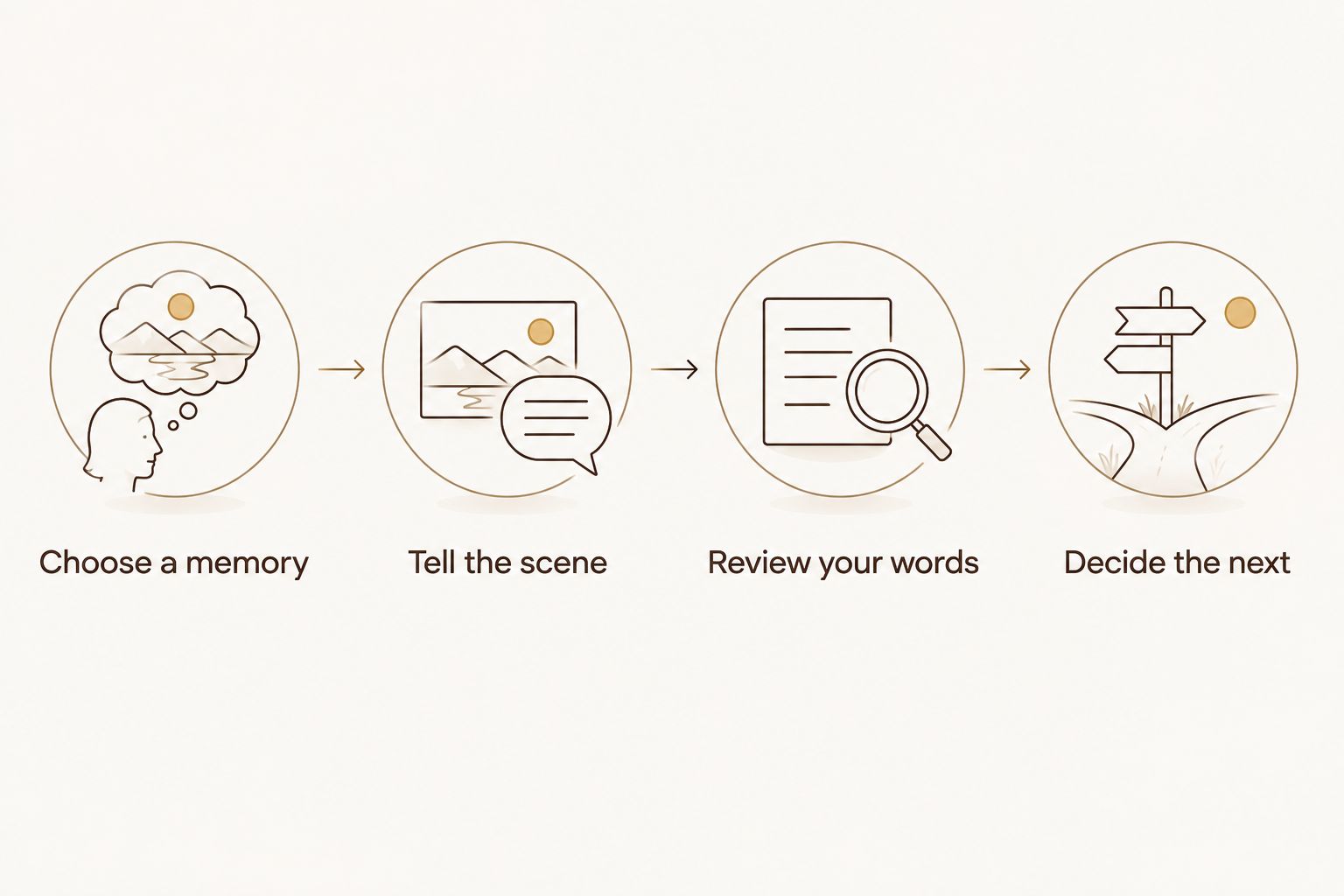
Repeat the exercise with 3 scenes if your first attempt feels inconclusive. This is a suggested comparison exercise, not a required amount of material for a memoir.
How do I move from memories to a printed family book?
Treat starting a free memoir and ordering a printed book as separate steps in your 2026 plan. Beginning gives you room to discover the story; ordering commits a reviewed version to a physical keepsake.
Start your memoir
Begin with memories you want your family to understand, not with a target book length. Keep a short list of people, places, turning points, and everyday routines you want to revisit.
With Myvellum, the voice-guided memoir process uses twelve structured interview chapters. Use that guidance to begin telling your own story, while keeping a separate note of details you want to check or expand.
Prepare the manuscript
Plan 2 review passes as a practical starting point: one for factual clarity and one for your intended readers. These are suggested passes, not a guarantee that a manuscript needs no further work.
During the factual pass, check names, relationships, and the order of events. During the reader pass, explain references that make sense to you but not to someone who was not there.
Keep expressions that sound like you. Correct confusion without polishing every sentence into a voice your family would not recognize.
Decide what belongs in print
Your memoir can be honest without including every private detail. Consider what you want to preserve, what concerns someone else's privacy, and what you would rather keep outside the family edition.
Then consider the physical book. Myvellum produces personalized hardcover or softcover keepsake books; check the current ordering details before choosing your edition.
Order the book because the manuscript is ready, not because you feel obliged to finish quickly. Creating the story and approving it for print are different decisions.
Begin your own family memoir
Start with your memories. Review your story before taking the separate step of ordering a printed book.
Can I write a memoir if my life seems ordinary?
Yes. A family memoir can preserve the experiences and explanations that only you can provide, without needing a public achievement or dramatic turning point.
Describe an ordinary routine closely enough that someone else can picture it. What you cooked, how you travelled to work, or why you kept a particular object can give your family a clearer sense of your life than a list of milestones.
Should I record everything before I start reviewing?
No. Review a small sample early so you can see whether your stories include enough context and whether the method suits you.
For a memoir begun in 2026, choose a manageable next story rather than postponing all review until the end. Early review lets you adjust how you tell the remaining memories without turning every recording session into an editing session.
FAQ
Is a memoir writing app worth it if I dislike writing?
Yes, if guided speaking helps you express memories more comfortably than drafting. You still need to review the story for accuracy, clarity, and your own voice.
What's the best way to start my own family memoir?
Start with a specific memory you feel comfortable telling. Describe the setting, the people, what happened, and why you remember it before attempting a complete life timeline.
Can I start a free memoir and order a book later?
Treat starting a free memoir and ordering a printed book as separate decisions. Review the current service terms and ordering details before committing your finished story to print.
Do I need to tell my life story in chronological order?
No, you do not need to record memories in chronological order. You can collect individual scenes first, then decide which sequence will help your family understand them.
Will a memoir app check whether my memories are accurate?
Do not rely on a memoir app to establish whether a memory is accurate. Check uncertain details against records where possible, and distinguish remembered impressions from confirmed facts.
Should I choose hardcover or softcover for my memoir?
Choose hardcover or softcover after reviewing the current printing details and deciding how you want to use the book. Binding is a separate decision from whether the storytelling method suits you.
Can I leave difficult experiences out of my family memoir?
Yes, you decide which experiences belong in the version you share. You can acknowledge a difficult period without disclosing every detail or including material you want to keep private.
One last thing
Before you finish your memoir in 2026, look for a passage where you named a milestone but left out the scene. Add what you noticed, what you did not yet understand, or what you would want your family to know now.
The most useful next step is not another feature comparison. It is telling a memory only you can tell.


