

Yes, you can write a memoir anonymously by leaving your name off the book or using a pen name, but neither approach guarantees that readers cannot identify you. To protect your privacy, review identifying details inside the story, keep your writing account separate from your public author identity, and decide whether your memoir is for family circulation or public release.
- To write memoir anonymously, separate the name on the cover from identifying details inside the story.
- A pen name conceals your byline, not necessarily your identity from relatives, publishers, or service providers.
- Myvellum supports voice-guided family memoir writing; verify privacy requirements before recording sensitive memories.
- Keep starting your memoir and ordering a printed keepsake as separate decisions.
Is it possible to write a memoir anonymously?
Anonymous authorship is possible; guaranteed anonymity is a different promise. You control what name appears in your manuscript, but your experiences, photographs, acknowledgments, and distribution choices also affect whether someone recognizes you.
Choose the approach that matches your intended readers:
| Approach | Best for | Main benefit | Main limitation |
|---|---|---|---|
| Private family memoir | Preserving your story for selected relatives | You can keep meaningful family context without seeking a public audience | Recipients know whose story they are reading and can share their copies |
| Memoir under a pen name | Sharing your story without using your everyday name | Your public author name differs from your personal identity | Familiar events and relationships can still identify you |
| Memoir with no named author | Keeping the cover and title page unnamed | Your real name does not appear as the author | The story itself can reveal your identity |
If a blank page is the bigger obstacle, use this guide to starting your life story when you do not know where to begin. Decide who will read it before deciding how much personal detail to include.
Why this matters
A family memoir does not need a public audience to matter. You can preserve the sound of your childhood kitchen, the work that shaped you, and the choices you want your children to understand without presenting those memories to strangers.
Your privacy decision should come before publication, not before remembering. In 2026, treat the recording, manuscript, printed book, and public author profile as separate places where identifying information needs attention.
For readers considering myvellum.vercel.app, the same distinction applies: creating your story and deciding how to distribute the finished book are separate decisions. Writing software is not, by itself, a guarantee of anonymous publication.
A private family memoir: keep the audience deliberate
Best for: telling your own life story to people you choose. A private family memoir lets you focus on what your memories mean rather than building a public author identity.
You might keep your real first name, describe family relationships accurately, and include stories your relatives recognize. That is private sharing, not anonymity from the recipients. The distinction matters if your goal is to stay out of public search results rather than conceal your identity from family.
The benefit is personal connection. The limitation is that a physical book or shared file can travel beyond its intended reader. Ask recipients not to post photographs of pages or forward the manuscript, but do not treat that request as a technical safeguard.
Before ordering a keepsake, decide whether the book should include your full name, a family nickname, or no author name. Check the printing service's actual cover and title-page requirements rather than assuming every presentation is supported.
A pen-name memoir: separate the byline from the person
Best for: public storytelling without an everyday-name byline. A pen name gives your memoir an author identity that differs from the name you use in daily life.
It does not erase the connection between you and the events. An unusual occupation, a recognizable accident, or a distinctive family relationship can make the narrator identifiable even when every personal name has changed.
Keep the pen name consistent across the manuscript, author biography, acknowledgments, and any public description. Avoid linking the author identity to a personal social account if your purpose is to keep those identities separate.
For a 2026 release, review the public-facing information separately from the information a publisher, printer, payment provider, or distributor requires. A pen name on a cover does not mean those organizations have no record of your identity.
An unnamed memoir: remove the byline, not the safeguards
Best for: a book that should not display an author name. Omitting the byline is a straightforward editorial choice, subject to the requirements of whoever produces or distributes the book.
The benefit is clear: the cover does not name you. The limitation is equally clear: readers can still connect the narrative to a real person.
An unnamed memoir also needs enough context to remain readable. Replacing everyone with initials can make relationships hard to follow. Use consistent substitute names or relationship descriptions where appropriate, and explain material changes in a short author's note.
Do not label invented scenes as remembered fact. Protecting identity and preserving the truth of your experience are separate responsibilities.
Why memoir anonymity varies
Your level of exposure depends on more than the name printed on the spine. Review these factors before choosing your approach:
- Audience: A relative brings background knowledge that a stranger does not have. Decide whose recognition you are trying to prevent.
- Distinctive events: A rare incident or unusual career path can identify you without a name. Preserve the meaning while reviewing unnecessary identifying detail.
- Other people's identities: A relative's workplace, relationship, or public role can reveal your own identity indirectly.
- Images and supporting material: Faces, handwritten signatures, letters, and document headings can contradict an otherwise anonymous manuscript.
- File and account information: Document properties, sharing permissions, and public profile fields deserve a separate check from the prose.
- Distribution: Handing a book to selected relatives creates a different exposure than advertising a publicly listed memoir.
Choose the audience first, then edit for that audience. Trying to conceal everything from everyone can strip a family story of the details that make it useful.
How do I write my memoir without revealing my identity?
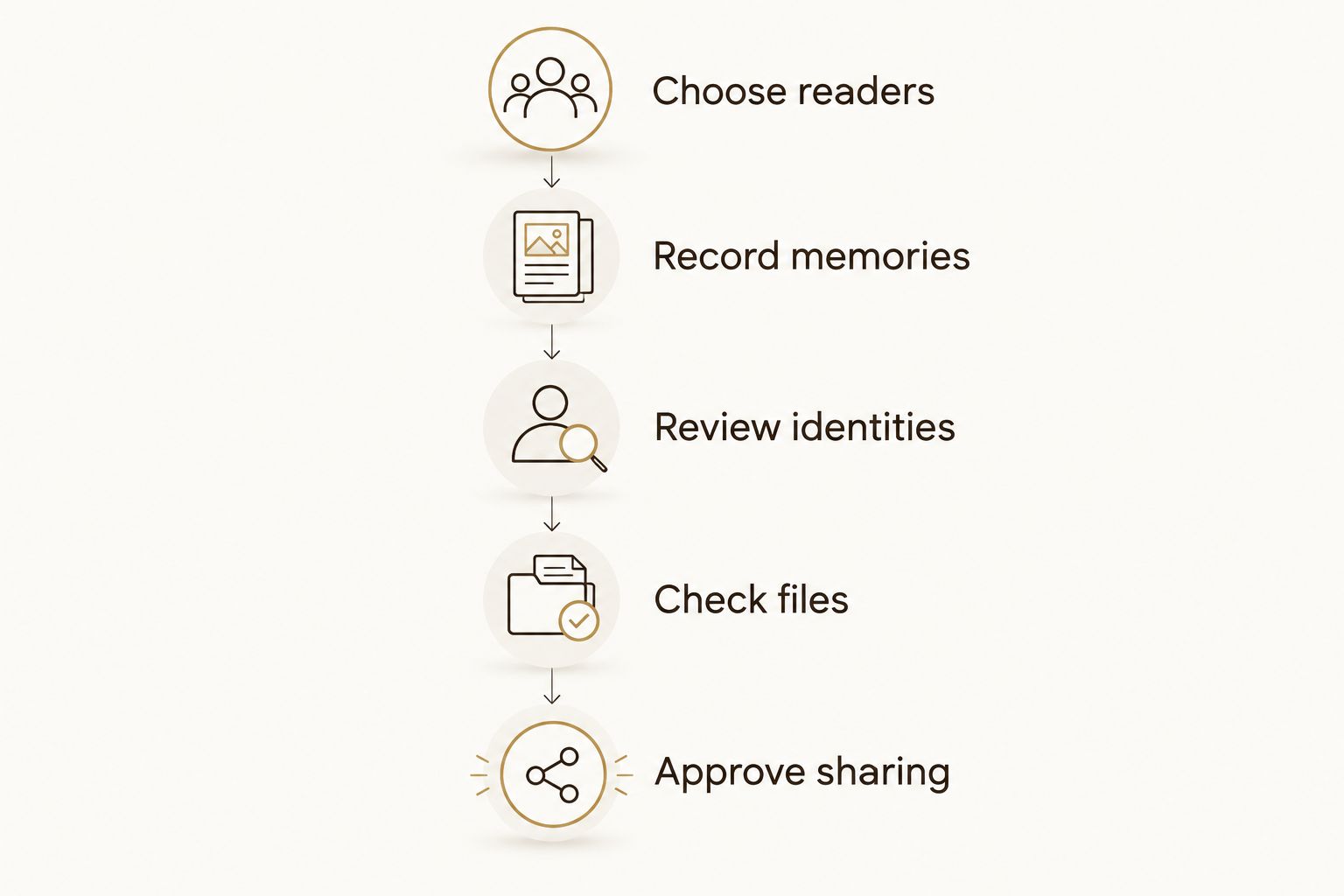
Use this 5-step review before sharing a manuscript or ordering a printed book. This is a recommended editing workflow, not a promise that a story cannot be traced back to you.
1. Choose readers
Write down who the memoir is for and who should not receive it. Be specific about the difference between selected family members and a public audience.
Ask yourself 3 questions: Who already knows these events? Who needs the original names? What would happen if someone shared a page? Your answers determine the editing standard.
2. Record memories
Capture the story in your natural voice before polishing every identifying detail. Describe what happened, what you understood then, and what you understand now.
If you use a recording service, review its privacy policy, account controls, and handling of recordings before including sensitive information. A voice recording is itself identifying material; removing a name from a transcript does not remove the voice from the original audio.
3. Review identities
Read for combinations of details, not just names. A small town, a particular job, and a family milestone together can reveal more than any single detail alone.
Mark each proposed change so you can distinguish a privacy edit from a factual correction. If you alter identifying details, explain that clearly without listing the original information you intended to protect.
4. Check files
Inspect the document properties, comments, tracked changes, filenames, and sharing settings of whatever files you plan to send. Check photographs and scanned documents for visible names or addresses.
For your 2026 sharing review, inspect the actual file the recipient will receive, not only the document open in your editor. Exporting a clean-looking page is not the same as checking the entire deliverable.
5. Approve sharing
Read the final manuscript from the intended reader's perspective. Check the cover, title page, dedication, acknowledgments, image captions, and author biography as well as the chapters.
Only then decide whether to share a file or order a book. Keep a record of which version you approved so later edits do not accidentally restore identifying details.
The strongest review examines both the emotional story and its packaging. A careful manuscript edit cannot compensate for an author biography that names your workplace or a photograph that shows your full name.
Can I change names and still call it a memoir?
Yes, changing names to protect privacy is compatible with presenting your own remembered experience as memoir. Be transparent about material alterations, and do not use an anonymity notice to disguise invented events as fact.
A short author's note can explain that names or identifying details have changed. Avoid a sweeping claim that everything is unidentifiable; a reader who knows the circumstances might still recognize the people involved.
Keep a private reference list if substitute names become difficult to track, and protect that list separately. Consistency helps readers follow the relationships without requiring the original names.
Does writing anonymously protect me from legal claims?
No, anonymous authorship does not remove legal responsibility for what you publish. A person does not need to be named explicitly to be identifiable from the surrounding facts.
In the United States, defamation and privacy questions depend on the circumstances and applicable law. A pen name, changed character names, or an author's disclaimer is not a substitute for legal review of serious allegations or sensitive disclosures.
If your manuscript includes accusations, confidential records, or intimate information about identifiable people, consult a qualified attorney before circulation. This is general publishing guidance, not legal advice.
Can I keep a family version and a public version?
Yes, keeping 2 versions lets you preserve family context while preparing a separate manuscript for wider sharing. Label the files clearly so the fuller family version is not sent by mistake.
The family version can retain details that selected relatives need to understand your history. The public version needs its own review of names, relationships, photographs, and recognizable events; deleting the surname alone is not enough.
For a project begun in 2026, make the intended audience part of each filename and approval checklist. Review both versions independently before printing.
Turning your own memories into a family keepsake
Myvellum is best for people who want voice-guided memoir writing to turn their own life story into a printed family keepsake. Its stated format guides you through 12 structured interview chapters and produces a personalized hardcover or softcover book.
That structure gives you a defined path through your memories. The limitation for an anonymity-focused project is that a guided writing and printing format does not establish what privacy controls or anonymous author-name options are supported; check those requirements before committing sensitive material.
Treat starting a free memoir and ordering a printed book as separate steps. Begin with the story you want to preserve, then confirm the current printing details and author-name requirements before ordering through Myvellum.
FAQ
Can I write memoir anonymously and still share it with my family?
Yes, you can write a memoir without a public byline and share it with selected relatives. Those relatives may still recognize you, so private family sharing is different from anonymity within the family.
Do I need a pen name for a private family memoir?
No, a private family memoir does not need a pen name simply because you want to avoid a public audience. Choose the author name you want readers to see and confirm the printer's requirements.
Will changing everyone's names stop people recognizing my story?
No, changing names does not guarantee that people will remain unrecognizable. Distinctive events, places, relationships, and photographs can identify the people involved.
Can a printer know my real name if my memoir uses a pen name?
Yes, a printer or service provider can hold account, payment, or delivery information separate from the author name shown in the book. Check the provider's requirements and privacy policy.
Can I record my memoir anonymously with Myvellum?
Do not assume that Myvellum provides anonymous recording or anonymous account access. Its stated offering is voice-guided memoir writing and keepsake printing; verify identity, recording, and author-name requirements directly.
Should I remove family photographs from an anonymous memoir?
Review each photograph for identifying information before including it. A face, location, caption, signature, or visible document can reveal information that the text leaves out.
Can I print my memoir without publishing it publicly?
Printing a memoir and releasing it publicly are separate decisions. Ask your chosen service whether it can fulfill a private book order without a public listing, and confirm how files and order details are handled.
One last thing
The dedication deserves the same privacy review as the chapters. A manuscript can use substitute names throughout and still reveal its author through a dedication, an acknowledgment, or a caption beneath a childhood photograph.
Before sharing your 2026 memoir, read those small pieces aloud. Keep the affection and the meaning; remove details that contradict the privacy boundary you chose.


