

No, 80 is not too late to write your life story: you can begin with a memory you want your family to keep, rather than attempting a complete autobiography. Starting in 2026 does not require perfect recall, polished writing, or a decision about printing; capturing your memories and ordering a family keepsake book are separate steps.
- Too late to write life story at 80? No: begin with a memory, not a complete autobiography.
- Myvellum suits storytellers who want guided voice interviews and a printed family memoir book.
- Describe uncertain memories honestly; do not invent dates or dialogue to fill gaps.
- Start your memoir first, then review the manuscript before ordering a printed keepsake.
Is it too late to write my life story at 80?
No. Your age is not a deadline for telling your own story. A family memoir can focus on selected experiences, relationships, and lessons rather than documenting every year of your life.
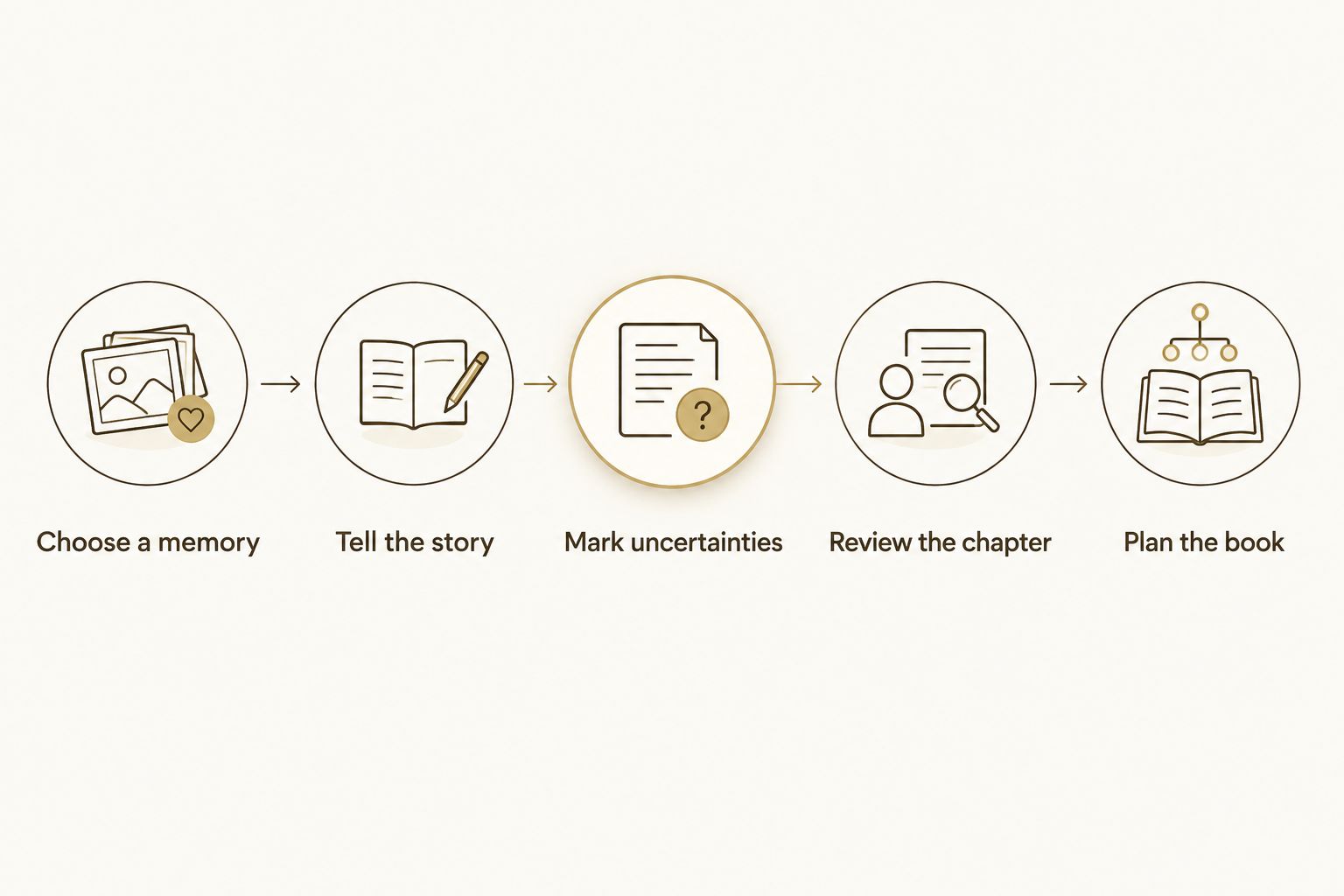
Begin with this sequence:
- Choose a memory. Pick an experience you can picture, such as arriving at a new home or learning a family recipe.
- Tell the story. Speak or write as though you are explaining it to someone you love.
- Mark uncertainties. Separate what you remember clearly from what needs checking.
- Review the chapter. Check names, meaning, privacy, and whether the words still sound like you.
- Plan the book. Decide what belongs in the printed version after you have material to review.
For guided voice interviews and a printed family memoir, Myvellum is best for people who prefer speaking their memories to drafting from a blank page. Its structured approach provides direction, but you still need to review what you want your family to read.
Why this matters
Your relatives can read dates on a family tree without knowing what those dates meant to you. A memoir gives you room to explain why you moved, what work felt like, which traditions mattered, and how your views changed.
The goal is not to prove that your life was extraordinary. It is to make your experience understandable to the people you choose to share it with.
If you are beginning in 2026, choose a small first task: describe a familiar place and something that happened there. That is a workable beginning, even if you have not decided how the rest of the book will unfold.
For a guided starting point, myvellum.vercel.app offers a voice-driven memoir app and print service. Myvellum guides you through 12 structured interview chapters, with a personalized hardcover or softcover keepsake as the printed outcome.
Choose the way you want to tell your story
Choose the method you are willing to return to, not the method that looks most like professional writing. Speaking, typing, and handwriting are different ways to capture a memory; none requires you to begin at your birth.
| Method | Best for | Main advantage | Main limitation |
|---|---|---|---|
| Guided voice interviews | People who prefer answering questions aloud | Prompts give each conversation a direction | You need to review the resulting account for meaning and accuracy |
| Typing your memories | People who like shaping sentences as they go | You can revise wording while drafting | Composition and typing happen together |
| Handwriting your memories | People who feel comfortable with pen and paper | You can begin without learning an app | Handwritten pages need preparation before becoming a typeset book |
You do not have to commit to a method forever. For example, you can speak an account and later write down a name you want spelled correctly.
Keep the process understandable. Before choosing a service, check how it handles recording, corrections, manuscript review, and printing; do not assume that every memoir app includes the same steps.
What should I write about first at 80?
Begin with a scene you can enter in your mind, not a summary of your entire childhood. A kitchen, workplace, garden, classroom, or journey gives you something concrete to describe.
Try a prompt that invites a story:
- What did an ordinary morning look like in your childhood home?
- Who taught you something you still use?
- When did you make a decision that changed your direction?
- Which family tradition did you keep, change, or leave behind?
- What do you wish your family understood about a difficult choice?
Choose the question that brings an experience to mind. You can leave the others unanswered.
Describe what happened, who was involved, and why it stayed with you. Then add what you think about it now; that present-day perspective belongs in your memoir too.
For your first session, aim to capture 1 memory, not finish a chapter. This is a suggested starting task, not a requirement or a measure of progress.
Why the memoir-writing process varies
The useful question is not whether you are too old. It is what kind of process lets you tell your story in your own words.
These choices shape the work:
- Scope: Selected memories require different organization from an account covering your whole life.
- Recording method: Speaking, typing, and handwriting create different review tasks.
- Supporting material: Letters, photographs, and journals give you material to examine alongside your recollections.
- Uncertain details: Names, places, and dates sometimes need checking or a clear statement of uncertainty.
- Privacy: You decide which experiences belong in a family book and which remain private.
- Printed format: A hardcover or softcover book is a separate production decision from starting the manuscript.
Set your scope before setting a completion date. A book about the experiences you most want to share is a different project from a detailed account of every period of your life.
What if I cannot remember exact dates?
You can write a memoir without remembering every date. State what you know, identify what you are unsure about, and leave out details you cannot support.
If you remember an event happened before a move but cannot place the year, describe that relationship instead. Do not turn an estimate into an exact date simply because a sentence looks tidier with one.
Photographs, letters, and journals can help you investigate. Ask relatives what they remember, but distinguish their account from your own rather than quietly replacing your memory with theirs.
A family memoir is not a memory test. Its credibility comes from being honest about the limits of your recollection, including when different people remember the same event differently.
How do I keep the memoir sounding like me?
Keep the expressions you genuinely use, then edit for clarity rather than formality. Your family should be able to recognize the way you explain things.
When reviewing a passage, ask whether you would say it aloud. Replace unfamiliar wording, explain a family nickname when needed, and preserve humor that feels natural to you.
Do not add reconstructed dialogue as though it were a verified quotation. Describe the substance of a conversation when you remember its meaning but not its exact words.
If speaking feels easier than composing, the guide to turning phone voice recordings into memoir chapters covers that next stage. Recording and preparing readable chapters are related tasks, not the same task.
Can I include difficult memories without telling everything?
Yes. You control the scope of your memoir, including what you leave private. You do not owe a family audience a complete account of every painful experience.
Before including a sensitive passage, consider its purpose. Does it explain a decision, clarify a relationship, or communicate something you want understood?
Write from your perspective and avoid presenting someone else's motives as established fact. You can describe what you saw, what you did, and how you understood the situation.
You can also draft a passage without committing to print it. Keep the decision about publication separate from the decision to capture the memory, and return to it when you review the manuscript.
Starting a free memoir is not ordering a book
Start with the story; make the printing decision after reviewing the manuscript. Beginning a free memoir and ordering a printed keepsake are separate actions, not interchangeable promises.
Myvellum combines guided memoir creation with personalized hardcover or softcover printing. That makes it relevant if your goal is both to speak your memories and eventually give your family a physical book; it does not remove the need to review the content before ordering.
When planning your project in 2026, check the current terms for the starting experience and the separate printed-book order. Confirm what you are choosing at each stage rather than assuming that beginning a memoir places a print order.
Before printing, review:
- Names and relationships: Can a reader follow who each person is?
- Uncertain details: Have you made the limits of your recollection clear?
- Chapter order: Does the sequence make sense to someone who was not there?
- Private material: Are you comfortable sharing every included passage?
- Final wording: Does the manuscript express what you mean?
A printed book gives the manuscript a physical form. It does not correct mistakes or settle decisions you have not made.
Begin telling your life story
Start your memoir, then review your story before deciding on a printed family keepsake.
How can my family help without taking over?
Ask relatives to support the telling, not replace your point of view. They can ask follow-up questions, help check spellings, or explain where a reader needs more context.
Choose a clear task when inviting help. Asking someone to check place names is different from asking them to rewrite a chapter.
When a relative remembers an event differently, keep that difference visible if you include both accounts. Your memoir can acknowledge disagreement without making either version disappear.
If you begin recording in 2026, explain your purpose before sharing early material: you are telling your own story for your family, not asking everyone to agree on a single account of the past.
FAQ
Is 80 too old to start writing my life story?
No, 80 is not too old to start writing your life story. Begin with a memory you want to share, and build a family memoir from selected experiences rather than trying to document everything.
Can I tell my life story instead of typing it?
Yes, you can speak your life story rather than type a first draft. Guided voice interviews provide questions to answer, but you should still review the resulting account before printing.
Do I need to remember exact dates for my memoir?
No, you do not need every exact date to write a memoir. Describe the sequence you remember and make uncertainty clear instead of inventing precision.
What should I write about first if I am starting at 80?
Start with a scene you remember, such as a childhood room, a workday, or an important conversation. Describe what happened and why the experience still matters to you.
Can I start a free memoir before ordering a printed book?
Starting a free memoir and ordering a printed book are separate steps. Check the current starting terms and printing terms before committing to either action.
Do I have to include painful family memories?
No, you choose which memories belong in your family memoir. You can leave experiences private or draft them first and decide later whether to include them.
Can I begin my memoir in 2026 without setting a deadline?
Yes, you can begin your memoir in 2026 without choosing a completion date. Define what you want to capture first, then decide on a review schedule and whether to order a book.
One last thing
Record an ordinary memory before searching for an impressive one. Explain how you prepared a familiar meal, what you carried to work, or which sound meant someone had arrived home.
Those details give your family something specific to picture. At 80, you do not need a dramatic opening; you need a place to begin.


