
StoryWorth is worth it if its storytelling process helps you finish a family memoir you would otherwise leave unwritten. It is not the right choice simply because you want a printed book: you also need a comfortable way to capture memories, review sensitive details, and prepare a manuscript your family can follow. In 2026, choose the process you will actually use before choosing the finished keepsake.
- Is StoryWorth worth it? Choose by your willingness to finish and review your own family memoir.
- Myvellum suits memoir writers who want voice-guided interviews and a printed family keepsake.
- Starting a free memoir and ordering a printed book are separate decisions.
- Test one meaningful memory before committing your life story to a writing process.
Why this matters
A memoir service has to help you do something more demanding than collect anecdotes. You need to explain who people were, what happened, and why those experiences still matter to you. A beautiful binding cannot supply the context you leave out.
For readers comparing options in 2026, the useful question is not which service sounds most impressive. It is which process gets your memories onto the page without making the project feel like homework. At myvellum.vercel.app, Myvellum offers voice-guided memoir writing through twelve structured interview chapters, followed by a personalized hardcover or softcover keepsake.
Myvellum is best for people who want to speak their own life story through structured interviews and turn it into a family memoir book. That fit does not remove the work of deciding what belongs in your story or reviewing it before print.
Is StoryWorth worth it in 2026?
Choose StoryWorth only if you are comfortable with its current storytelling workflow and the work required to finish your book. Evaluate that workflow against a real memory, not an imagined future version of yourself who suddenly enjoys writing every evening.
The comparison below separates the known structure of a voice-guided service from the questions you should resolve when considering StoryWorth. It is a decision framework, not a ranking of unverified features.
| Approach | Best for | Main advantage | Main limitation or check |
|---|---|---|---|
| StoryWorth | Readers considering StoryWorth for their own family memoir | A dedicated memoir project gives your selection a clear purpose | Check the current capture, review, and printing process before committing |
| Myvellum voice-guided memoir | People who want structured spoken interviews | Twelve interview chapters provide a defined framework, with hardcover or softcover output | You still need to review the story; a defined framework must suit your material |
| Self-directed memoir | Writers who want to choose their own structure | You decide the scope, sequence, and writing method | You must organize the manuscript and arrange printing yourself |
Do not interpret a guided process as a promise that your book needs no attention. Whichever approach you choose, your judgment matters most when names, relationships, difficult memories, and family boundaries enter the story.
A worthwhile service helps you finish the right book
Your goal does not have to be a complete autobiography. A family memoir can focus on the experiences you most want relatives to understand: the home you grew up in, a turning point at work, the people who helped you, or the traditions you carried forward.
Choose a scope you can explain in a sentence. For example, you might decide to preserve the stories behind your family traditions rather than document every move, job, and holiday. That decision makes it easier to judge whether a service's structure fits your purpose.
A poor fit creates work you keep avoiding
Pay attention to resistance during an ordinary storytelling session. Are you struggling to remember, to type, to organize, or to decide what is safe to share? Those are different problems, and a service that addresses one does not automatically address the others.
If speaking feels natural but drafting feels laborious, assess a voice-led process. If you already have polished chapters, focus your comparison on manuscript preparation and printing rather than starting the capture process again.
Test the process before choosing a memoir service
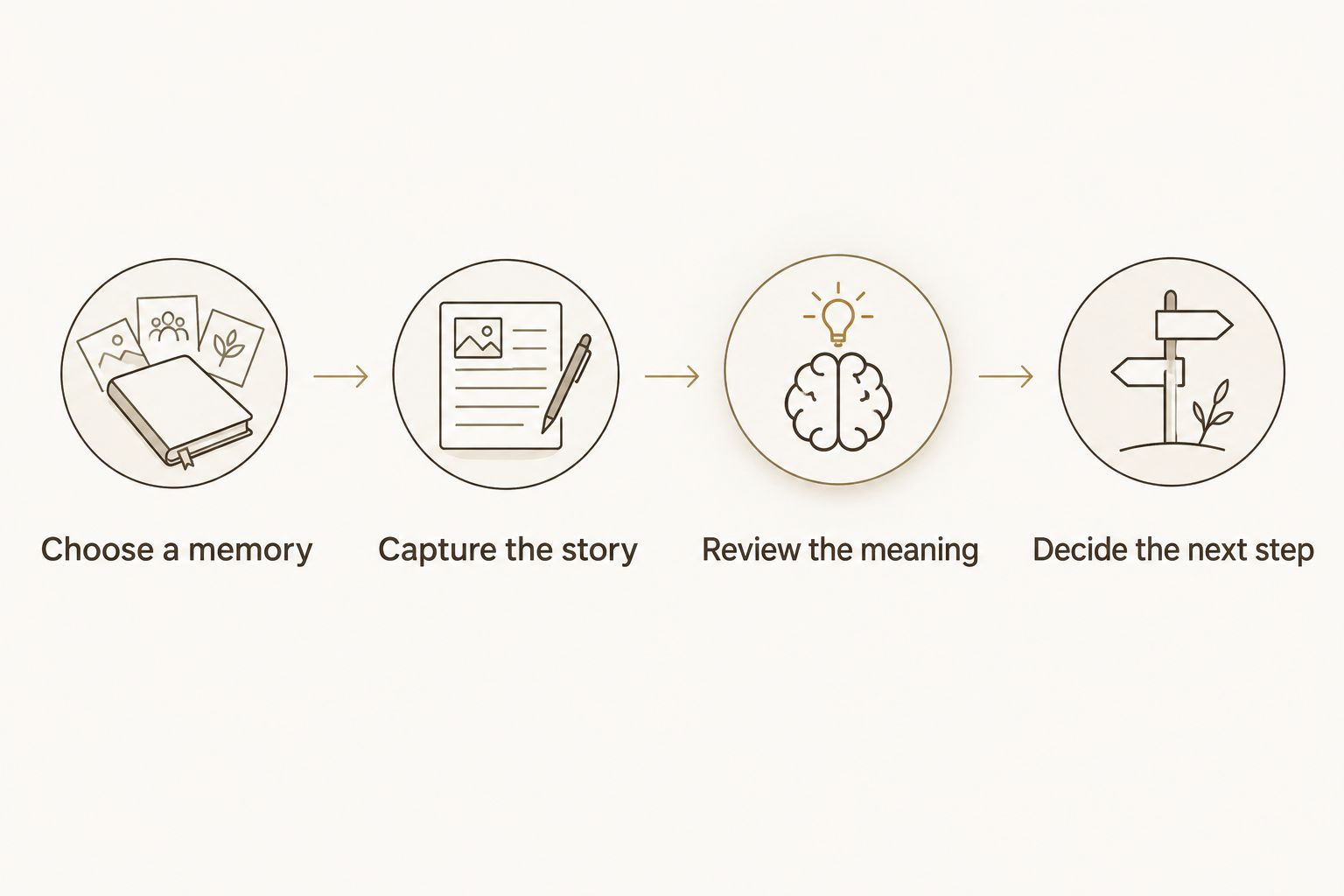
Use this short exercise when deciding whether StoryWorth or another approach deserves your time in 2026. These are suggested testing limits, not completion estimates or service specifications.
- Choose a memory. Pick a scene you remember clearly, such as arriving at a new home or learning something from a relative. Avoid starting with your most painful experience.
- Capture the story. Speak for 10 minutes or write 150 words. Use whichever method you are evaluating, without trying to make the result elegant.
- Review the meaning. Read what you have captured and check whether a family member would understand the setting, people, and significance.
- Decide the next step. Ask whether you want to continue, revise the approach, or change methods before adding more material.
The exercise is useful because it exposes the actual obstacle. A blank page suggests a capture problem; a lively story full of unexplained names suggests a context problem. Neither is solved merely by choosing a cover.
Keep the original version of your test story. Comparing it with a revised version helps you see what your manuscript needs: clearer chronology, more background, or simply a stronger ending. You are assessing the process, not grading your ability to be an author.
If speaking is your preferred starting point, the guide to turning phone voice recordings into memoir chapters addresses that route in more detail.
Why the value of a memoir service varies
The same memoir service can suit one storyteller and frustrate another. Judge value against these factors rather than assuming that a longer feature list means a better family book.
- Your capture preference. Choose a process that fits how you express memories. Speaking and composing on a page place different demands on you.
- Your existing material. Loose recollections need different preparation from finished chapters, old journals, or recorded interviews. Decide what you are bringing into the project.
- Your desired structure. A defined chapter framework provides boundaries. An open manuscript gives you more structural decisions to make.
- Your review needs. Identify who should check names, dates, and sensitive passages. Keep responsibility for the final wording clear.
- Your intended readership. A book for close relatives needs different explanations from a memoir intended for readers who have never met your family.
- Your print goal. Decide whether you want a personal reading copy or a keepsake you intend to share. Review the current book options before placing an order.
These factors also explain why a memoir service is not a substitute for deciding what you want to say. Structure can guide your attention; it cannot determine which memories you are comfortable passing on.
Separate starting your memoir from ordering your book
Starting a free memoir is a writing decision. Ordering a printed book is a publishing decision. Keep them separate so enthusiasm about a keepsake does not rush your manuscript review.
For your 2026 project, begin by testing whether you can comfortably tell your own story. At the starting stage, concentrate on capturing scenes, naming people clearly, and discovering which memories connect. You do not need to settle every printing choice before you know what the book contains.
Before ordering, switch from storyteller to reader. Check the beginning, the sequence of chapters, and the explanation of family relationships. A passage that feels obvious to you can still leave a younger relative wondering who someone was.
Myvellum's memoir service connects voice-guided interviews with a personalized hardcover or softcover book. Treat that connection as a path through the project, not a reason to skip the editorial pause between recording and printing.
Review for accuracy without flattening your voice
Read for names, places, chronology, and meaning. Where memory is uncertain, say so honestly rather than making a detail sound exact. Personal recollection does not need to pretend to be an official record.
Keep expressions that sound like you. A family memoir loses something when every sentence becomes formal, but it also needs enough explanation for someone who was not present. Aim for clarity without replacing your voice with textbook prose.
Review for consent and boundaries
Your story will include other people, but you decide how much of their private lives belongs in your book. Reconsider passages involving health, conflict, intimate relationships, or information someone shared in confidence.
You can preserve the importance of an experience without naming every person or repeating every detail. A thoughtful omission is better than a passage you regret sharing after the book is printed.
Should I choose StoryWorth if I prefer talking to writing?
If you prefer talking, test spoken storytelling before choosing StoryWorth. Confirm how its current process handles the way you want to capture and review memories; do not assume that every memoir service works the same way.
Myvellum offers twelve structured voice-guided interview chapters, making it a relevant option for that preference. The trade-off is straightforward: a guided framework gives you a route through your story, but you still need to decide whether that route suits the memories you want to preserve.
Is a memoir service worth it if I already have journals?
A memoir service is worth considering when it helps you turn journals into a readable family narrative. Having source material is not the same as having a finished book, especially when entries assume knowledge your relatives do not share.
Choose 3 memories from your journals and explain the context around each. If your main challenge is arranging existing material, prioritize that work instead of restarting every story from scratch. Preserve the distinction between what you wrote at the time and how you understand it now.
Should I finish every life chapter before printing?
Print when your chosen story feels complete, not when you have exhausted every memory. A focused family memoir can have a satisfying beginning and ending without covering your entire life.
Decide what this particular book promises its readers. If it is about building a home, raising a family, or starting again somewhere new, judge completeness against that promise. Save unrelated stories rather than forcing them into an already coherent manuscript.
FAQ
Is StoryWorth worth it for writing my own life story?
StoryWorth is worth it if its current process fits how you want to capture memories and helps you finish a family memoir. Test a meaningful story and check the review and printing steps before committing.
What's the best way to tell whether I will finish a memoir?
Test the process with a memory you can comfortably discuss. Speak for 10 minutes or write 150 words, then check whether you want to continue and whether the result makes sense to a family reader.
Is Myvellum better for someone who wants to speak their memoir?
Myvellum is designed around voice-guided memoir writing through twelve structured interview chapters. It is a fit for people who want that spoken framework and a personalized hardcover or softcover keepsake, while still taking responsibility for reviewing their story.
Is starting a free memoir the same as ordering a printed book?
Starting a free memoir and ordering a printed book are separate decisions. Capture and review your stories first, then check the current printing choices and order details before placing a book order.
Do I need to write about my whole life?
You do not need to cover your whole life to create a meaningful family memoir. Choose a clear scope and include the experiences that support it.
Should my family read my memoir before I print it?
Ask a trusted reader to review the manuscript if you want help checking clarity, names, or relationships. Set boundaries around feedback so the book remains your account rather than a collection of everyone else's preferences.
Can I leave difficult memories out of a family memoir?
You can leave difficult memories out of your family memoir. Decide what you are comfortable sharing and avoid implying that the book contains every part of your life.
One last thing
Before choosing a service in 2026, tell a familiar family story without using any unexplained names. Describe who each person was and why the moment mattered. That small change turns an anecdote you already know into something a future reader can understand.
Choose the process that helps you make those connections, then choose the book. The keepsake begins with the context only you can give.


