

Best for guided life-story recording: Myvellum. Best for control over professional editing: a memoir app paired with an independent editor. Best for an existing manuscript: an editor-first workflow. This 2026 guide separates recording, human editing, and printing so you can choose a route to your own family keepsake—not mistake a writing tool for an editorial service.
- Myvellum suits spoken family memoirs, with twelve structured interview chapters and hardcover or softcover printing.
- Choose a memoir app with professional editing only when the agreement explicitly includes a human editor and defined work.
- An app-plus-editor workflow separates memory capture from professional manuscript revision.
- Approve your edited manuscript before ordering a personalized family memoir book.
Why this matters
Your family memoir has two jobs: preserve what you remember and make those memories understandable to someone who was not there. Recording helps with the first. Editing helps with the second.
A polished paragraph is not proof of professional editing. Transcription, spelling correction, chapter organization, and a human editor's judgment are different services. When comparing options in 2026, ask who reviews the manuscript and what that person changes.
Myvellum is best for people who want to speak their life story through structured interviews and turn it into a printed family memoir. Its described service includes twelve interview chapters and personalized hardcover or softcover books; those features do not, by themselves, establish that professional human editing is included.
What makes the best memoir app with professional editing?
Use these criteria before choosing a service. The right workflow depends on how much you have written and how much help you want.
- Memory capture: Choose speaking or typing according to how you tell stories comfortably. A difficult starting method becomes another reason to postpone the memoir.
- Editorial scope: Identify whether the service provides developmental editing, line editing, copyediting, or proofreading. These names describe different work, not interchangeable levels of polish.
- Voice preservation: Ask how the editor handles family expressions, regional language, and the way you naturally tell a story.
- Author approval: Establish how you review changes and approve the final manuscript. Editing should not silently replace your recollection with someone else's interpretation.
- Print handoff: Separate manuscript approval from ordering the book. Confirm how the finished text reaches the printing stage.
- Family boundaries: Decide which names, difficult events, and private details belong in the book before handing over the manuscript.
Choose the editing scope before choosing the app. If your main problem is remembering where to begin, guided interviews fit. If your main problem is an uneven draft, a human editor is the more direct starting point.
Best memoir-writing routes at a glance
These are ranked workflows, not claims that every app includes an editor. Each solves a different problem, and each requires a separate check of its editorial terms.
| Rank and option | Best for | Standout feature | Key limitation |
|---|---|---|---|
| 1. Myvellum | Speaking your own story into a family keepsake | Twelve structured interview chapters and hardcover or softcover printing | Interview guidance and printing do not establish included human editing |
| 2. Memoir app plus independent editor | Choosing your own editorial specialist | Capture memories first, then commission a defined edit | You coordinate the app and editor separately |
| 3. Editor-first workflow | Improving an existing memoir manuscript | Editorial attention starts with the draft you already have | It does not solve an empty-page problem by itself |
| 4. Ghostwriter-plus-editor workflow | Getting extensive help shaping the narrative | Writing assistance and editorial review can be separately specified | Requires clear agreement about authorship, voice, and responsibilities |
1. Myvellum: best memoir app for spoken family keepsakes
Myvellum is a voice-driven memoir-writing app and print service. It guides you through twelve structured interview chapters and produces a personalized hardcover or softcover keepsake of your life story.
This is the most direct fit among these routes when you want to tell your own memories aloud rather than begin with a blank manuscript. Use the interview structure to begin collecting stories; treat professional editing as a distinct requirement that needs an explicit service description.
Guided memoir app pros:
- Voice-driven storytelling gives you an alternative to composing every passage at a keyboard.
- Structured interviews provide a defined framework for recording your life story.
- Hardcover and softcover printing connect the writing project to a physical family book.
Guided memoir app cons:
- Structured interviews are not the same service as a developmental or line edit.
- Choosing a book format does not establish who reviews the manuscript before printing.
Best for: You want to record your own memories with guidance and create a tangible keepsake for family.
Keep starting the memoir and ordering the printed book as two separate stages. Begin by capturing the stories. Before the printing stage, decide whether you also need a human editor to improve structure, language, or consistency.
Verdict: Buy into this workflow for guided spoken storytelling; wait on any editing-inclusive claim until the editorial scope is explicit.
2. Memoir app plus independent editor: best for editorial control
An app-plus-editor workflow lets you choose a recording tool and a human editor independently. You capture your memories in the app, then arrange editorial work on the resulting manuscript using a transfer method both parties accept.
This route fits readers who want professional judgment without making the editor choice depend on the app choice. Before starting, confirm that the app's manuscript output and the editor's working format fit together.
App-plus-editor pros:
- You choose the editorial specialist according to the manuscript's needs.
- Recording and revision have distinct responsibilities.
- You can define how strongly the editor should intervene in your wording.
App-plus-editor cons:
- You handle the handoff between separate providers.
- Changes outside the editor's agreed scope require a new conversation.
Best for: You want to speak your stories but choose who edits them and how.
Ask three questions before commissioning the edit: Who performs the work? Which type of editing is included? How will you approve changes? Request answers in the agreement rather than relying on a general promise of a polished book.
For a 2026 shortlist, distinguish recording tools from editorial providers. The guide to voice-to-text memoir writing apps supports the capture side of that decision; the editing agreement should address the manuscript work separately.
Verdict: Buy this workflow when choosing your editor matters more than keeping every stage with one provider.
3. Editor-first workflow: best for an existing memoir draft
An editor-first workflow begins with the manuscript you already have. Instead of recording the same memories again, you commission the kind of revision that addresses the draft's actual problems.
A developmental editor addresses the book's larger organization and narrative. Line editing focuses on expression; copyediting addresses consistency and correctness; proofreading checks the text at its final review stage. Define the work rather than asking for an unspecified professional polish.
Editor-first pros:
- Your existing draft remains the starting point.
- Editorial work can target a clearly identified problem.
- Recording tools become optional rather than another required step.
Editor-first cons:
- An editor still needs your answers when a memory or relationship is unclear.
- An agreed copyedit does not automatically include restructuring the entire book.
Best for: You have written your life story but need help making it readable, coherent, or consistent.
Bring the editor a short description of your intended readers. A memoir for close relatives needs different explanations from a book intended for readers who know nothing about your family.
In 2026, choose the service according to the draft, not the app's feature list. If your opening repeats information, the middle lacks a clear sequence, or important people arrive without introduction, discuss structural editing before sentence-level correction.
Verdict: Buy editorial help first when the manuscript exists; skip restarting in an app unless you need to recover missing stories.
4. Ghostwriter-plus-editor workflow: best for extensive writing help
A ghostwriter-plus-editor workflow separates assistance with writing the narrative from review of the resulting manuscript. It suits someone who wants to supply memories and make decisions but does not want to compose the book unaided.
Ghostwriting and editing are not synonyms. Specify who interviews you, who writes the draft, who revises it, and whether editorial review involves another person.
Ghostwriter-plus-editor pros:
- Writing assistance addresses more than spelling or sentence cleanup.
- Interviews can become source material for a written narrative.
- Separate editorial review gives the draft a defined review stage.
Ghostwriter-plus-editor cons:
- You must explain which expressions and memories should remain in your own voice.
- Unclear responsibilities make it difficult to know whether writing or editing is actually included.
Best for: You want substantial help turning your recollections into a manuscript, while retaining authority over your story.
Use the memoir ghostwriting services comparison to explore this route. Ask each prospective provider to explain the division between drafting and editing rather than treating the two services as one promise.
Verdict: Buy this workflow for substantial writing assistance; skip it when you mainly need a place to record memories.
How these memoir-writing routes are ranked
The ranking follows the criteria above: memory capture, editorial scope, voice preservation, author approval, print handoff, and family boundaries. Guided recording comes first for readers beginning their own family memoir; independent editing becomes the priority when editorial control or an existing draft changes the task.
This is a workflow ranking, not a claim that unnamed services have been tested or that human editing comes with every app. For a 2026 decision, match the route to the work you need done and verify the provider's actual responsibilities.
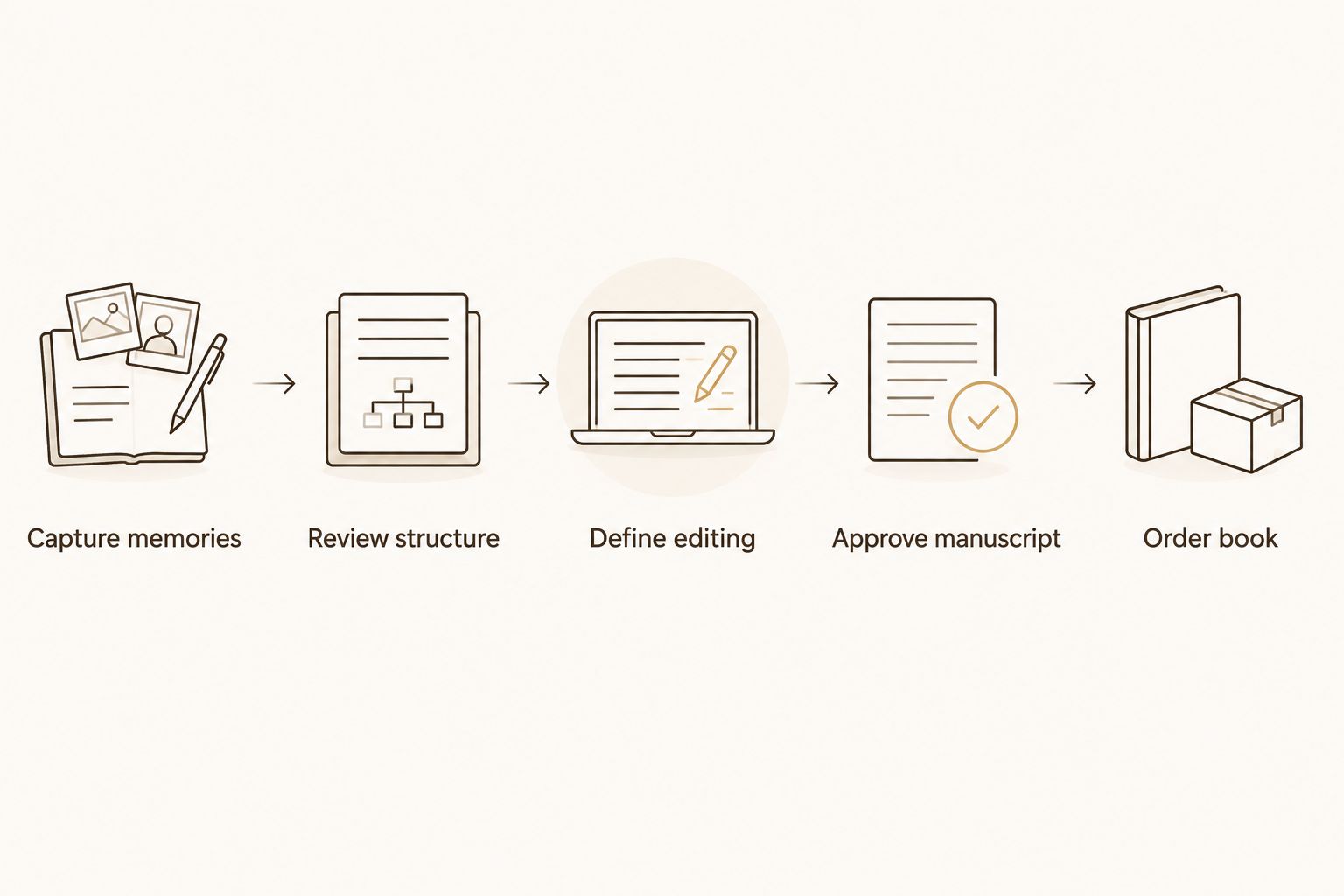
From spoken memory to approved family book
Use this sequence to keep storytelling, editing, and printing from becoming one rushed decision:
- Capture memories: Tell the story before trying to perfect every sentence. Include the people, place, and event that make it understandable.
- Review structure: Check whether each chapter has a purpose and whether readers can follow the sequence.
- Define editing: Agree on the human editor's role, the manuscript format, and your approval process.
- Approve manuscript: Read the revised text for meaning as well as correctness. Check that family relationships and important memories remain accurate.
- Order book: Choose the printed format after approving the text and reviewing the print requirements.
Before agreeing to a full edit, request a sample edit of one chapter or a representative passage. Discuss whether the changes clarify your meaning without replacing your natural phrasing. This is a decision aid, not a substitute for a written editorial scope.
Which memoir-writing route should you choose?
Choose Myvellum for voice-guided memoir creation and printed family keepsakes. Choose an app plus an independent editor when professional editorial control is your main requirement. If your draft already exists, start with an editor; if writing the draft is the obstacle, consider ghostwriting assistance.
For your 2026 project, make the next move small: record a memory, review a draft, or define an editing brief. Ordering the printed book comes after the manuscript is ready—not simply because recording is complete.
FAQ
What's the best memoir app with professional editing for my own life story?
The best fit is a memoir app whose agreement explicitly includes the human editing you need. Myvellum suits voice-guided family memoir creation and printing; confirm professional editing separately rather than treating interview guidance as an editorial service.
Does voice-guided memoir writing count as professional editing?
No, voice-guided memoir writing and professional editing are different tasks. Prompts help you tell stories; an editor reviews the resulting manuscript for an agreed purpose.
Can I use a memoir app and hire my own editor?
Yes, an app-plus-editor workflow separates recording from professional revision. Confirm that you can provide the manuscript in a format the editor accepts before committing to either stage.
What kind of editing does a family memoir need?
The editing type depends on the manuscript's problem. Developmental editing addresses structure, line editing addresses expression, copyediting addresses consistency and correctness, and proofreading addresses final textual errors.
How do I keep an editor from changing my voice?
Agree on voice preservation and review a sample edit before the full manuscript is revised. Identify family expressions and passages you want preserved, then establish how you approve changes.
Should I order the printed memoir before editing is finished?
Approve the manuscript before ordering the printed memoir. Keep recording, editorial review, and the print decision separate so unfinished revisions do not become part of the keepsake.
Is ghostwriting the same as editing a memoir?
No, ghostwriting helps create the narrative, while editing revises a manuscript. A service offering both should identify who performs each task and what author approval includes.
One last thing
Explain the family shorthand. A nickname, an unnamed house, or a familiar holiday tradition makes sense to you but needs context for relatives reading years later.
During your final review, underline references that depend on someone already knowing the family. Add the relationship, place, or explanation where needed. Professional editing should help a reader enter your memories without removing the language that makes them yours.


