
Yes—a memoir interview can use audio instead of video, but recording a telephone call requires a service or recording setup that specifically supports calls. For a memoir interview over phone vs video in 2026, distinguish a dial-in telephone interview from speaking into an app on your smartphone: voice recording alone does not establish telephone-call support.
- For a memoir interview over phone vs video, choose audio when you want spoken memories without recording your appearance.
- Myvellum offers voice-guided memoir writing and printed keepsake books; telephone-call recording is a separate capability to verify.
- Choose video when facial expressions or showing family objects matter to the interview.
- Keep starting a free memoir separate from reviewing and ordering your printed family book.
Can a memoir app record interviews over the phone instead of video?
Yes, when the app explicitly supports telephone interviews or accepts recordings made through a supported call-recording process. An app that records your voice through a smartphone microphone is not necessarily recording a telephone call. Those are different ways of capturing your story.
If you are considering Myvellum, the stated service is voice-guided memoir writing through twelve structured interview chapters, followed by a personalized hardcover or softcover keepsake book. Choose that service for its stated memoir workflow, not an assumption about dial-in support.
| Interview method | Best for | Main benefit | Main limitation | What to verify |
|---|---|---|---|---|
| Telephone interview | Talking with another person without a camera | You can tell your story through a conversation | The call needs a supported recording process | Call support, recording consent, and access to the recording |
| Voice recording in an app | Recording your own memories without appearing on screen | You can speak directly into the device | A voice recorder is not automatically a telephone recorder | How recording starts, saves, and becomes usable memoir material |
| Video interview | Sharing expressions or showing meaningful objects | You can preserve visual context alongside speech | The camera adds another element to manage | Whether audio, video, or both remain accessible afterward |
The practical question is not simply whether a memoir app uses a phone. Ask whether you speak into the phone's microphone, dial a telephone number, or join an online call.
Why this matters
Your goal is a family memoir, not a recording setup you have to struggle through. Choose the format that lets you describe what happened, who mattered, and what those experiences meant to you.
For your 2026 memoir project, separate three decisions: how to capture memories, how to shape them into chapters, and how to order the finished book. A method that handles the first decision does not automatically handle the other two.
Audio captures what you say. A printed memoir also needs explanations that listeners sometimes take for granted: which aunt you mean, where the old house stood, and why leaving it mattered. Choose your recording method around storytelling comfort, then review the words around your family's needs.
Telephone interviews: best for conversation without a camera
A telephone interview suits you when another person's questions help you remember. You can concentrate on the conversation without thinking about your expression, clothing, or room appearing on screen.
The trade-off is recording logistics. Before telling an important story, establish who records the call, how everyone agrees to the recording, and how you receive or access the result. Recording laws depend on the locations involved; check the applicable requirements rather than assuming one person's permission settles the question.
Ask these questions before choosing a telephone-based workflow:
- Do I dial a number, receive a call, or open an app?
- Does the service record the conversation, or must I arrange that separately?
- Can I review the recording before using it for my memoir?
- How does the conversation become material I can edit into chapters?
Choose telephone interviews for conversational support, not merely because the word phone appears in a service description. A clear answer about the recording process matters more than the label.
In-app voice recording: best for telling your story independently
In-app voice recording suits you when you want to speak your memories without scheduling an interviewer or appearing on camera. You respond to a prompt or tell a story directly into the device.
Its limitation is the lack of a live listener unless the particular service provides one. You must notice when a story needs more context, or return during revision to explain a person, place, or change of direction.
For example, saying that you moved away after school leaves important questions open. Describe what you hoped to find, what you left behind, and how the decision felt. Those details give your family something beyond a timeline.
Before committing your 2026 memoir to an app, make a 30-second test recording as a practical check, not a required interview length. Listen for audible speech and confirm that you understand the saving process before recording a memory you do not want to repeat.
Choose in-app voice recording when speaking independently feels natural and you want to avoid video. Verify any separate requirements for importing recordings made elsewhere.
Video interviews: best for visual context
Video suits an interview when expressions, gestures, or objects contribute to the memory. You might want to show a handwritten recipe, describe a photograph while pointing to its subjects, or explain how a family tool was used.
The drawback is that visual information does not explain itself on a printed page. If you point to someone and say that they were always making everyone laugh, the chapter still needs that person's name and relationship to you.
Narrate what the camera sees. Instead of relying on a gesture, identify the object and explain its significance aloud. That makes the spoken account understandable even when the eventual reader never sees the recording.
Choose video when the visual record is part of what you want to preserve. If your priority is solely a readable family book and the camera distracts you, audio avoids that extra task.
Why the right interview format varies
The right choice depends on the story you want to preserve and the process you can comfortably complete. Use these five factors to compare your options without assuming that one format is always better:
- Camera comfort: Choose audio if being filmed makes you hold back. Choose video if seeing a listener helps you engage.
- Interview support: Decide whether you want another person asking follow-up questions or prefer responding independently.
- Visual material: Use video deliberately when showing an object matters; describe the object aloud for the written memoir.
- Recording access: Confirm how you can review the captured material before building a book around it.
- Book preparation: Separate recording from chapter review and print ordering. Capturing a conversation is not the same as approving a manuscript.
For a 2026 comparison, evaluate the service's current instructions rather than treating telephone recording, voice recording, and video calling as interchangeable features.
How do I turn an audio interview into a family memoir?
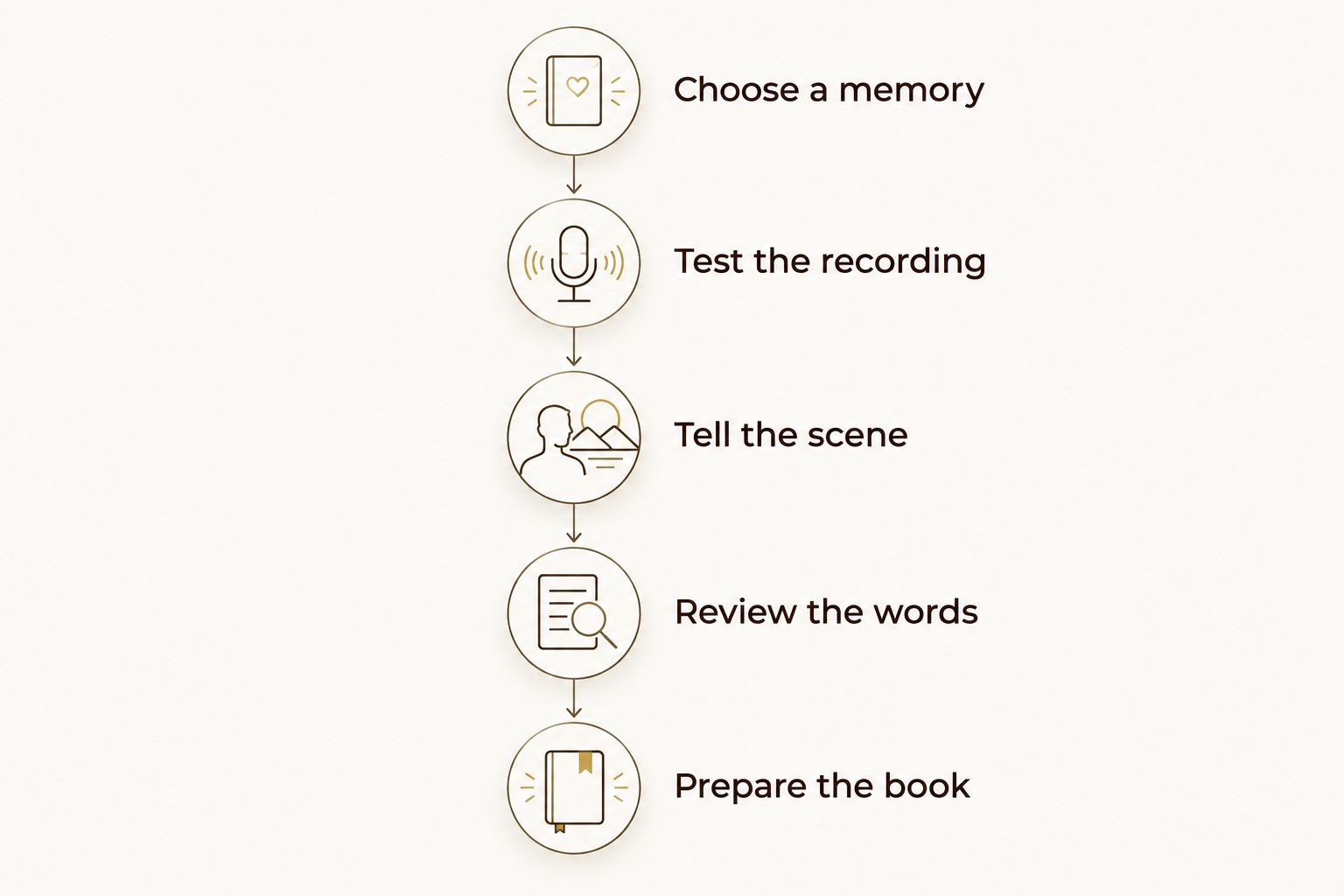
Use this sequence whether you speak into an app or arrange a supported telephone recording. It separates remembering from editing, so you do not have to make every spoken sentence publication-ready.
1. Choose a memory
Begin with one scene per recording as a manageable starting point. Choose an experience you can picture: arriving somewhere unfamiliar, learning a skill, or making a difficult decision.
You do not need to summarize your whole childhood in one sitting. Give the scene a working label so you can recognize it later, even if its eventual chapter title changes.
2. Test the recording
Check the microphone, the recording process, and where the result will be accessible. If another person joins, agree on recording before beginning and confirm the applicable consent requirements.
Listen to the test rather than relying only on a recording indicator. Confirm that your words are understandable before moving to a story that matters to you.
3. Tell the scene
Use 3 starter questions as a suggested prompt set: Where were you? What happened? Why does it stay with you? These questions give the memory a setting, an event, and personal meaning.
Speak naturally. If you forget a detail, identify the uncertainty rather than filling it with a guess. You can check a name or date later without interrupting the emotional thread of the story.
4. Review the words
Read the written material against what you intended to say. Check names, relationships, places, and the order of events, then decide which repetitions or unfinished thoughts need editing.
The guide to turning phone voice recordings into memoir chapters addresses this transition. Keep your own voice in the prose; correcting a confusing sentence does not require removing the expressions your family recognizes.
5. Prepare the book
Read the chapters as a family member would, without access to the original conversation. Add explanations wherever the text assumes the reader already knows the people or circumstances.
Treat print ordering as a separate decision after review. Starting a free memoir and ordering a printed keepsake are distinct steps; check the current terms for each before proceeding.
The final read-through serves a different purpose from the interview. During recording, concentrate on remembering; during review, concentrate on helping someone else understand.
Where does a guided memoir app fit?
Myvellum is for people who want voice-guided memoir writing and a personalized printed family keepsake. Its stated process uses twelve structured interview chapters and produces a hardcover or softcover book.
That structure gives you a defined framework for telling your life story. The boundary is equally important: voice guidance does not, by itself, establish telephone-call recording, video recording, or support for importing outside audio. Verify the capture method before planning interviews around it.
For your 2026 project, decide first whether you want to tell the story through the guided process described. Then distinguish starting your memoir from approving and ordering the printed book. Neither decision requires you to record yourself on video simply for the sake of having footage.
Do I need video to make my memoir feel personal?
No—your memoir can feel personal through the details you describe and the language you use. Tell your family what you noticed, what you believed at the time, and what you understand differently now.
Video preserves a visible performance of the conversation. A written memoir gives readers your account in words, so concentrate on details that carry meaning without a camera.
Can I use recordings I already have?
Existing recordings are useful source material, but importing them depends on the memoir service's supported process. Check the accepted method before assuming an old voice memo or recorded call can enter a guided interview workflow.
Keep the original recording while you work on the text. If someone else speaks in it, address permission and privacy before including their contribution in a family book.
FAQ
Can I record my memoir on my phone without using video?
Yes, you can record audio on a phone without recording video. For a memoir app, verify whether it records directly through the microphone, supports telephone calls, or accepts audio made elsewhere.
Does voice-guided memoir writing mean I can dial a phone number?
No, voice-guided memoir writing does not establish dial-in telephone support. Check the service's instructions for the exact way you record your answers.
Does Myvellum record telephone interviews?
Myvellum's stated service is voice-guided memoir writing through twelve structured interview chapters, followed by a personalized hardcover or softcover book. Confirm telephone-call support directly before arranging a call-based interview.
Is an audio interview or video interview better for my family memoir?
Audio is the better fit when you want to speak without a camera; video is the better fit when visual context matters. Either format still requires written review before you approve a family memoir for printing.
Should I ask permission before recording a memoir interview?
Agree on recording before beginning and check the recording laws that apply to everyone involved. Also discuss whether the resulting stories are intended for a private family book or wider sharing.
Can I start a free memoir before deciding on a printed book?
Treat starting a free memoir and ordering a printed book as separate decisions. Check what the starting step includes, then review the manuscript and current print terms before ordering.
What should I check before printing my recorded life story?
Check names, relationships, places, uncertain details, and passages that need context. Read the manuscript as someone who was not present at the interview would read it.
One last thing
Before your next recording, write down one thing your family would not know unless you told them. It might be why you kept a letter, how a friendship began, or what you never said when leaving home.
Make your first 2026 memoir recording about that memory, not about completing your entire biography. At myvellum.vercel.app, keep the same distinction in mind: begin telling your story, review what it becomes, and make the printed-book decision separately.


