
Yes—AI can turn interview audio into a useful memoir draft, but an accurate transcript does not automatically make an accurate chapter. Before printing your life story for family, compare the draft with your recording, check names and dates, and remove any details or interpretations you did not supply.
- AI transcription can start your memoir; your review determines whether the chapters faithfully represent your memories.
- Check names, dates, relationships, and meaning against the recording before approving a chapter.
- Myvellum suits people who want voice-guided memoir interviews and a printed family keepsake.
- Starting a free memoir and ordering a printed book are separate decisions.
For a voice-guided route, Myvellum at myvellum.vercel.app guides you through twelve structured interview chapters and produces a personalized hardcover or softcover keepsake. That structure gives your memories a place to begin; it does not replace your judgment about what belongs in the finished book.
Can AI transcribe interview audio into memoir chapters accurately?
Yes, as a reviewed draft—not as an unchecked account of your life. Speech recognition, chapter editing, and factual verification are different tasks. A chapter can read beautifully while misnaming a relative, moving an event, or assigning you a feeling you never expressed.
Use this comparison to decide what kind of text you need at each stage:
| Output | Best for | Strength | Limitation | Your next move |
|---|---|---|---|---|
| Close transcript | Checking what you actually said | Keeps the wording near the recording | Repetition and unfinished thoughts can interrupt reading | Correct recognition errors first |
| Lightly edited transcript | Preserving your speaking voice | Removes distractions without requiring a new narrative | Still needs structure and factual review | Check that edits preserve meaning |
| Rewritten memoir chapter | Preparing a readable family story | Organizes memories into a connected account | Introduces more editorial decisions to inspect | Compare every substantive change with your account |
These are editorial approaches, not claims that every memoir service offers each option. Before choosing a service in 2026, ask how it moves from recorded speech to finished chapters and what you can review before printing.
Why this matters
A family memoir carries more than information. It carries your version of a childhood home, a difficult decision, or the person who made you feel welcome. Those meanings deserve the same attention as spelling.
Treat accuracy as three separate questions: Did the text capture your words? Are the events and relationships correct? Does the chapter still sound like you? Passing the first test does not settle the other two.
For your 2026 memoir project, make faithfulness the approval standard. Smooth prose is useful only when it tells the story you intended to leave behind.
What should you check before trusting a memoir chapter?
Use these 5 review steps on each chapter. They separate transcription mistakes from editorial changes, so you can fix the right problem rather than rewriting everything.
1. Keep the recording
Retain the original audio as your reference. A finished paragraph does not show whether an unfamiliar word was misheard or whether a sentence was added during editing.
Keep a simple note identifying which recording belongs to which chapter. If your chosen service does not provide access to recordings, establish another way to retain your source material before relying on it.
2. Check the words
Listen while reading the transcript. Focus on family names, place names, occupations, and words that sound plausible but do not fit your memory.
Pay particular attention to negatives. Losing a word such as not can reverse a sentence while leaving it grammatically correct. Fix the meaning before polishing punctuation.
3. Check the facts
Review dates, ages, relationships, and the order of events separately from spelling. An accurately transcribed statement can still contain a slip you made while speaking.
Use letters, journals, photographs, or other records where they help. If you cannot verify a detail, preserve the uncertainty rather than substituting a confident answer. Your family can understand an honestly incomplete memory.
4. Check the voice
Read the chapter aloud. Replace expressions you would never use, and keep distinctive phrases that carry your personality even when they are less formal.
Look for invented explanations as well as invented events. A sentence saying you felt proud, frightened, or relieved needs to reflect your account—not an editor's assumption about how someone should have felt.
5. Approve the chapter
Review the complete chapter after corrections, not just the changed sentences. An edit near the beginning can alter how a later paragraph reads.
Treat chapter approval and print approval as separate checkpoints. The words need to be right before you inspect the book's presentation.
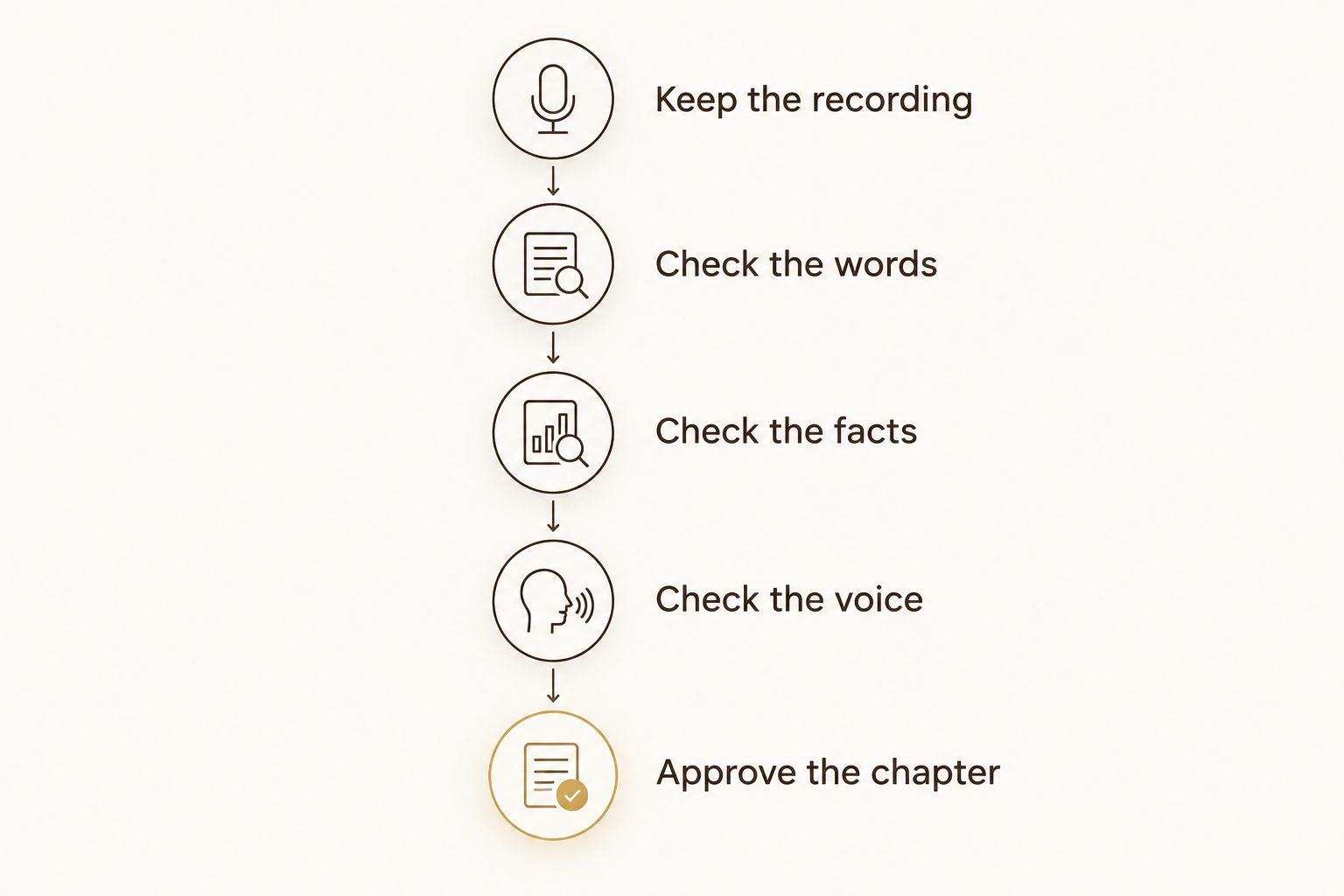
This process keeps the source recording at the center of your decisions. For more on moving from spoken memories to readable pages, see how to turn phone voice recordings into memoir chapters.
Why transcription and chapter accuracy vary
The recording and the editing instructions both affect what you need to inspect. Use these factors as a recording checklist, not as a promise of any particular accuracy rate.
- Background sound: Competing voices, music, and other noise make words harder to distinguish. Choose a quiet setting and listen to a sample before continuing.
- Overlapping speakers: Talking at the same time makes attribution harder. Let each person finish, and identify who is speaking when another person joins.
- Unfamiliar names: Family surnames, nicknames, and local place names need explicit checking. Keep a reference list with your preferred spellings.
- Unclear references: Phrases such as she went there afterward depend on context. Name the person and place when the connection would otherwise be lost.
- Editorial freedom: Instructions to rewrite freely allow more changes than instructions to correct transcription only. Set boundaries before accepting a rewritten chapter.
- Memory uncertainty: Hesitation about an event is part of the account. Keep that uncertainty visible instead of allowing polished wording to conceal it.
A quieter recording will not resolve an uncertain date, and a spelling list will not prevent an editor from changing your tone. Match the correction to the source of the problem.
What instructions help preserve your own voice?
Give any transcription or editing workflow a clear boundary: organize what you said without inventing what you did not say. Ask for uncertain wording to be flagged rather than silently completed.
A useful editing brief includes these directions:
- Keep the first-person perspective and my ordinary vocabulary.
- Remove repeated filler only when doing so preserves the meaning.
- Do not add dialogue, events, motives, or sensory descriptions.
- Keep uncertainty where I express uncertainty.
- Separate questions for me from text intended for the book.
These are instructions you can give, not guarantees about a particular service. Check the resulting chapter against them. A workflow that produces polished prose still needs to demonstrate that it respected your boundaries.
For a memoir you begin in 2026, save those instructions with your chapter notes. Reusing the same editorial standard helps you judge later chapters consistently.
How can I tell whether a chapter still sounds like me?
Read the chapter aloud and compare it with the recording. Listen for language you would not choose, emotions you did not name, and conclusions that make your life sound tidier than you remember it.
Consider whether the edit preserves the point of the story. A childhood memory about your grandmother's patience should not become a lesson about ambition merely because that gives the chapter a stronger ending.
A trusted reader can help identify passages that sound unlike you, but their preferences should not displace yours. Ask whether they recognize your voice, not whether they would have written the story differently.
Should I correct a memory if a family member remembers it differently?
Keep different recollections distinct rather than forcing agreement. Your memoir can explain that you remember an event one way while someone else remembers it differently.
Separate checkable details from personal experience. A document can help establish a date; it cannot determine exactly how an occasion felt to you. For sensitive passages, decide what you are comfortable sharing before approving the text for family copies.
Can I start my memoir before deciding on a printed book?
Yes—starting a free memoir and ordering a printed book are separate decisions. Begin by capturing your memories and reviewing the words; make the print decision after the manuscript represents the story you want to share.
Myvellum is best for people who want voice-guided memoir interviews and a printed family keepsake. Its twelve structured interview chapters provide a defined framework, and its hardcover and softcover formats serve the physical-book goal. The limitation is that a framework cannot decide which memories are accurate, private, or essential; those decisions remain yours.
Before committing to any workflow in 2026, check its current recording, editing, and print-review arrangements. Do not assume that audio uploads, downloadable recordings, family collaboration, or post-order changes are included unless the service explicitly confirms them.
Begin your life story
Explore voice-guided memoir writing, then make a separate decision about your printed keepsake.
What should I review before ordering the printed memoir?
Use 3 review passes: meaning, consistency, and presentation. Keeping those tasks separate prevents attractive page layouts from distracting you from a factual mistake.
- Meaning: Confirm that events, relationships, and emotions reflect what you intended to say. Resolve unanswered editorial questions.
- Consistency: Check spellings, chapter order, repeated stories, and references to the same people. Explain nicknames when a future reader would need help.
- Presentation: Inspect the final text and any available print proof. Check headings, paragraph breaks, captions, and the relationship between photographs and the surrounding story.
Make the final pass on the version intended for production, not an earlier draft. In 2026, the practical standard remains simple: approve the actual manuscript you want your family to receive.
FAQ
Can AI transcribe interview audio into memoir chapters accurately?
Yes, AI can produce a useful memoir draft, but you need to verify the transcript and the rewritten chapter. Compare names, dates, relationships, and meaning with the recording before printing.
Is a transcript the same thing as a finished memoir chapter?
No, a transcript records spoken words, while a memoir chapter adds editorial structure. Reordering events, shortening repetition, and adding transitions create decisions that need your approval.
How do I stop a memoir draft from adding things I never said?
Instruct the editing workflow not to add events, dialogue, motives, or descriptions, then check the result against your recording. Ask for uncertain passages to be flagged instead of completed.
Can I keep my accent and everyday expressions in my memoir?
Yes, you can preserve your everyday vocabulary and distinctive expressions in the written chapter. Review recognition errors separately so correcting a misheard word does not become a reason to erase your voice.
What if I cannot remember an exact date?
Keep the uncertainty explicit rather than inserting an exact date. Check available records where useful, and distinguish what you remember from what you can verify.
Should my family review my memoir before I print it?
Ask a trusted family member to review passages where their knowledge would help, while keeping final approval with you. Make clear whether you want factual corrections, clarity checks, or feedback on sensitive material.
Does Myvellum provide a path from spoken memories to a printed book?
Myvellum provides voice-guided memoir writing through twelve structured interview chapters and produces personalized hardcover or softcover keepsake books. Check its current editing and approval arrangements before choosing your workflow.
Should I order my book as soon as the chapters are drafted?
No, review the manuscript before ordering your printed memoir. Complete separate checks for meaning, consistency, and presentation so the book reflects the version you approved.
One last thing
Do not edit away every pause in your thinking. An admission that you cannot quite remember, a correction you make mid-story, or a phrase you have always used can tell your family something important about you.
Your goal is not a transcript with every hesitation preserved, nor a life story polished into someone else's voice. Keep the details that make the story yours, correct the mistakes that obscure it, and print only after you recognize yourself on the page.


