

Plan around the standard twelve chapters, and confirm support for additional chapters before building an expanded outline. If you want to add extra chapters beyond twelve, keep those stories in a separate working outline until you know how they can enter the finished book. Starting your memoir and approving its printed structure are separate decisions; settle the chapter question before ordering your family keepsake.
- To add extra chapters beyond twelve, confirm chapter support before committing to an expanded memoir outline.
- Myvellum provides voice-guided memoir writing through twelve structured interview chapters and produces printed family keepsakes.
- Give additional memories a place in your working notes without assuming the app supports additional chapters.
- Starting a free memoir and ordering a printed book are separate steps; review the structure before ordering.
For your 2026 memoir project, Myvellum at myvellum.vercel.app offers a starting point: twelve structured interview chapters and a personalized hardcover or softcover book. Myvellum is for people who want to tell their own life story through guided interviews and create a printed family keepsake.
Why this matters
A chapter framework helps you begin, but your memories will not necessarily arrive in chapter order. You might remember a friendship while describing your working life, or recall an important move while talking about childhood. Save the memory first; decide where it belongs afterward.
The distinction is between having more stories and needing more chapters. A story can deepen an existing subject without requiring its own place in the contents. Keep both possibilities open while you draft, rather than treating every new memory as a structural problem.
Can I add extra chapters beyond the standard twelve?
Use twelve chapters as your planning baseline and confirm additional-chapter support before relying on it. The standard interview structure and the final printed chapter arrangement are related questions, but they are not interchangeable. Ask about both when checking how an expanded memoir would work.
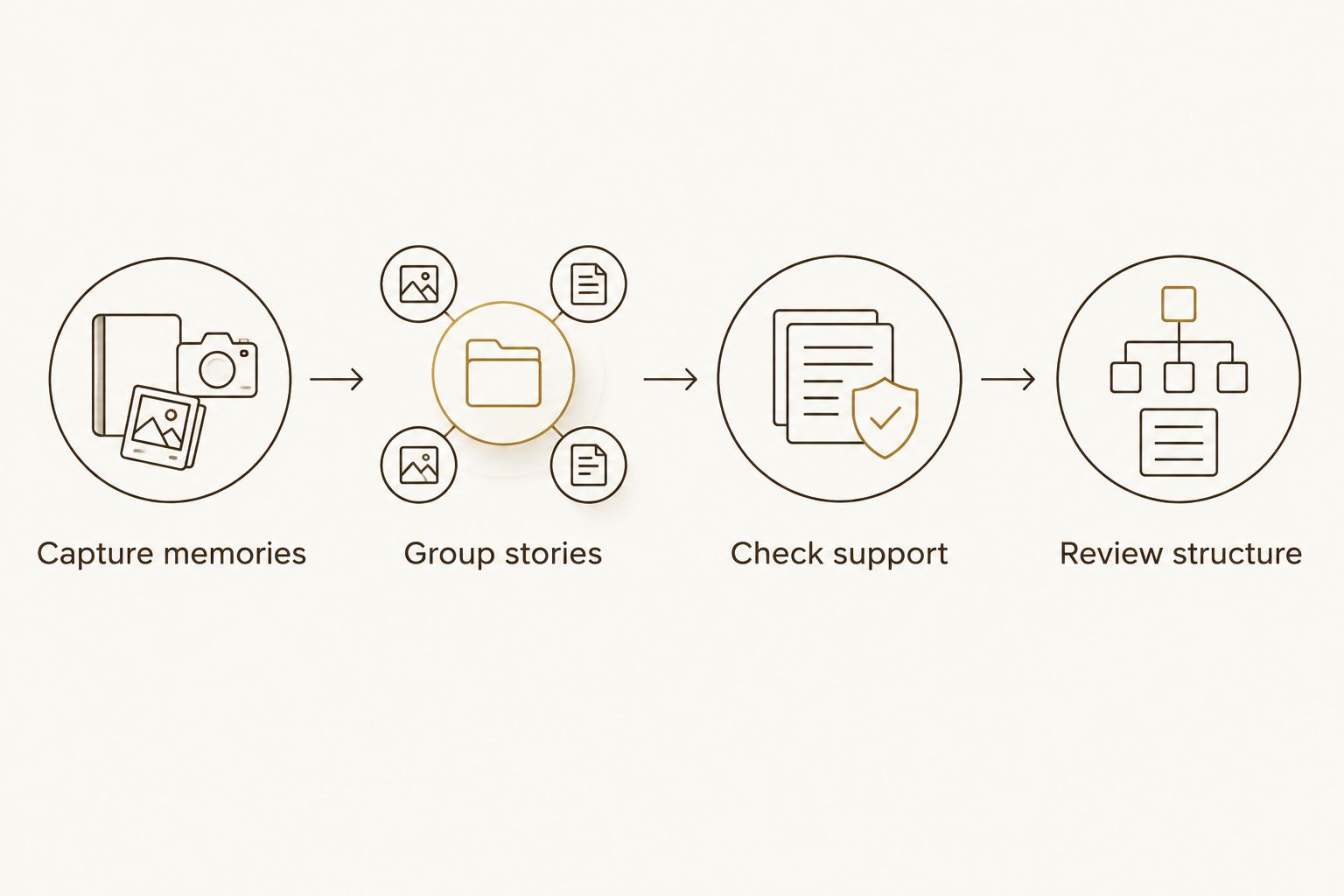
Use this sequence before committing to a longer outline:
- Capture memories. Keep the story in your own working notes or a recording you control, even if its final location is undecided.
- Group stories. Place related memories together in a draft outline without changing the app's structure.
- Check support. Ask whether additional standalone chapters can appear in the finished printed book.
- Review structure. Confirm the supported arrangement before placing your print order.
The goal is not to stop at twelve ideas. It is to avoid building a manuscript around a chapter arrangement you have not confirmed.
Additional stories: decide what deserves a chapter
A new chapter should do more than give an unused memory somewhere to go. Give it a distinct purpose: a relationship, a turning point, a place, or a question that deserves sustained attention. This is an editorial decision, not proof of a supported app feature.
The following choices describe ways to organize your working manuscript. Confirm which arrangements the service supports before using them in your printed book.
| Editorial approach | Best for | Benefit | Trade-off |
|---|---|---|---|
| Expand an existing chapter | Memories that deepen an established subject | Keeps related stories together | A chapter can lose focus if it covers unrelated events |
| Use a subsection | A distinct episode within a broader theme | Gives the episode a clear place without a standalone chapter | Subsection formatting needs confirmation |
| Propose an additional chapter | A subject with its own narrative purpose | Gives a substantial story room to develop | Additional-chapter support needs confirmation |
Choose the structure that makes your story easier to follow, not the structure with the most headings. A brief but meaningful episode deserves preservation even when it does not need a chapter of its own.
Expand an existing chapter when the subject stays the same
If a memory adds context to a subject you already cover, place it beside that material in your working outline. A story about your first manager, for example, can sit alongside reflections on learning to work. The connection gives your reader a reason to encounter those memories together.
The benefit is continuity. The drawback is crowding: if the chapter begins carrying several unrelated themes, separate the material in your notes and reassess its purpose.
Propose a separate chapter when the focus changes
A separate chapter is an editorial option when the material changes the central subject rather than simply adding detail. Perhaps your account of a move becomes a larger reflection on belonging. Write a provisional heading and a short description of what that chapter would contribute.
Do not treat the provisional heading as a promise about the printed format. Keep drafting while you confirm what the service can accommodate.
What should I ask before planning additional chapters?
Ask a precise question: Can my finished printed memoir contain standalone chapters beyond the twelve structured interview chapters? That wording separates the interview framework from the book your family will hold. It also avoids the ambiguity of asking whether you can simply add more content.
For a 2026 print project, follow up with these questions:
- Can additional material become a standalone chapter rather than part of an existing chapter?
- How would I provide that material if the arrangement is supported?
- Can I choose where the additional chapter sits in the reading order?
- How would I check its title and placement before ordering?
- Does the same chapter arrangement apply to the book format I intend to order?
Keep the response with your project notes. You want an answer about your proposed structure, not a general assurance that your life story can be recorded.
If a standalone chapter is essential to your memoir, resolve that requirement before committing your full outline. If it is optional, continue capturing memories while leaving the final arrangement open.
Why your memoir's chapter needs vary
Your story determines its editorial needs. The twelve-chapter framework is a starting structure; it is not a measure of how eventful or meaningful your life has been.
Use these factors to evaluate your own outline:
- Subject changes. A move from childhood memories to reflections on a career creates a different organizational question from adding another childhood scene.
- Narrative purpose. An episode that changes the direction of your story has a different role from an anecdote that illustrates an established point.
- Repeated material. Several memories can express the same idea. Keep the strongest examples rather than creating extra chapters for repetition.
- Reader context. Relatives need enough explanation to understand people, places, and relationships that are familiar to you.
- Personal boundaries. You decide which experiences belong in the family book and which remain private notes.
These factors guide your manuscript, not the app's technical limits. Separate the editorial question—what belongs together—from the product question—what chapter structures are supported.
How do I preserve extra memories while I check?
Create a separate working document for stories whose placement remains undecided. Give each memory a plain-language title, identify the people involved, and note why you want your family to have it. Keep uncertainty visible rather than filling gaps with guesses.
For each story, answer these 3 questions:
- What happened?
- What did it mean to me?
- What would my family need explained?
Those answers give the memory a purpose without forcing a chapter decision. A familiar kitchen, a difficult farewell, or a lesson learned at work can become meaningful material once you explain why it stayed with you.
Keep your original notes or recordings alongside the working draft. Do not delete a memory simply because it has no obvious place yet. You can decide later whether it belongs in this memoir or remains part of your personal archive.
Should I aim for more chapters or a clearer story?
Aim for a clearer story. Additional headings do not automatically make a memoir more complete, and a fixed framework does not require you to give every experience equal space. Let the importance of the material guide your attention.
Read your proposed contents as if you were a younger relative who did not witness these events. Can that reader understand the progression? Do adjacent chapters cover different ground, or are they repeating the same lesson under new titles?
For your 2026 draft, review the outline before polishing every sentence. Moving a story in your working document is simpler than rewriting it repeatedly to fit a heading that does not serve it. The guide to how long a memoir should be addresses the related question of overall scope.
When should I separate writing from the print decision?
Start preserving memories before settling every detail, but settle the printed structure before ordering. Starting a free memoir is the beginning of the writing process. Ordering a printed book is a separate step that deserves its own review.
Myvellum's memoir service connects voice-guided interviews with a personalized hardcover or softcover keepsake. That combination serves your goal of leaving a readable family record, but the book format alone does not answer whether additional chapters are supported.
For a book you intend to order in 2026, review the chapter sequence, names, sensitive passages, and any unresolved structural questions. Keep a written list of decisions that still need confirmation. Do not let enthusiasm about holding the finished book rush the review of what goes inside it.
What if I remember something after finishing the interviews?
Preserve the memory before deciding how to include it. Write it down or record it separately, then identify the subject it relates to. Completing an interview sequence does not mean you have remembered everything you will ever want to tell.
Before ordering, ask how that material can enter your manuscript. After ordering, ask what changes remain possible for your particular project rather than assuming the current book can be changed. Recording a memory and revising a print order are different actions.
FAQ
Can I add extra chapters beyond twelve in my memoir?
Plan around twelve chapters and confirm additional-chapter support before committing to a longer printed outline. Ask specifically whether standalone chapters beyond the structured interviews can appear in the finished book.
Does twelve interview chapters mean I can only tell twelve stories?
Twelve interview chapters describe the guided structure, not an editorial rule that each chapter must contain only one memory. Ask how additional material can be included before assuming a particular recording or editing feature is supported.
Should I give every important memory its own chapter?
No. Group memories that share a subject or purpose, and propose a separate chapter when the material needs a distinct focus. Confirm the supported book structure before finalizing that choice.
Can I start my memoir before choosing all the chapter titles?
You can begin preserving memories in your own notes before settling the final chapter titles. Keep provisional headings flexible and check the service's supported structure before preparing the printed book.
Is starting a free memoir the same as ordering a book?
No. Starting a free memoir and ordering a printed book are separate steps. Confirm your chapter arrangement and review the manuscript before making the print decision.
Does choosing hardcover give me additional chapters?
Do not use the cover format as evidence of additional-chapter support. Confirm chapter flexibility separately from your choice of hardcover or softcover.
What should I do with stories that do not fit my outline?
Keep those stories in a separate working document or recording you control. Note their subject and significance, then decide whether they deepen an existing chapter or need a different place.
One last thing
Before finalizing your 2026 memoir, look for the everyday details you have left unexplained. You know why a particular nickname, recipe, or phrase matters; a younger family member might not. Add the context that lets the memory travel beyond the people who were there.
Do not make additional chapters the condition for beginning. Preserve the story now, confirm the supported structure, and make the print decision after you know what your family will receive.


