
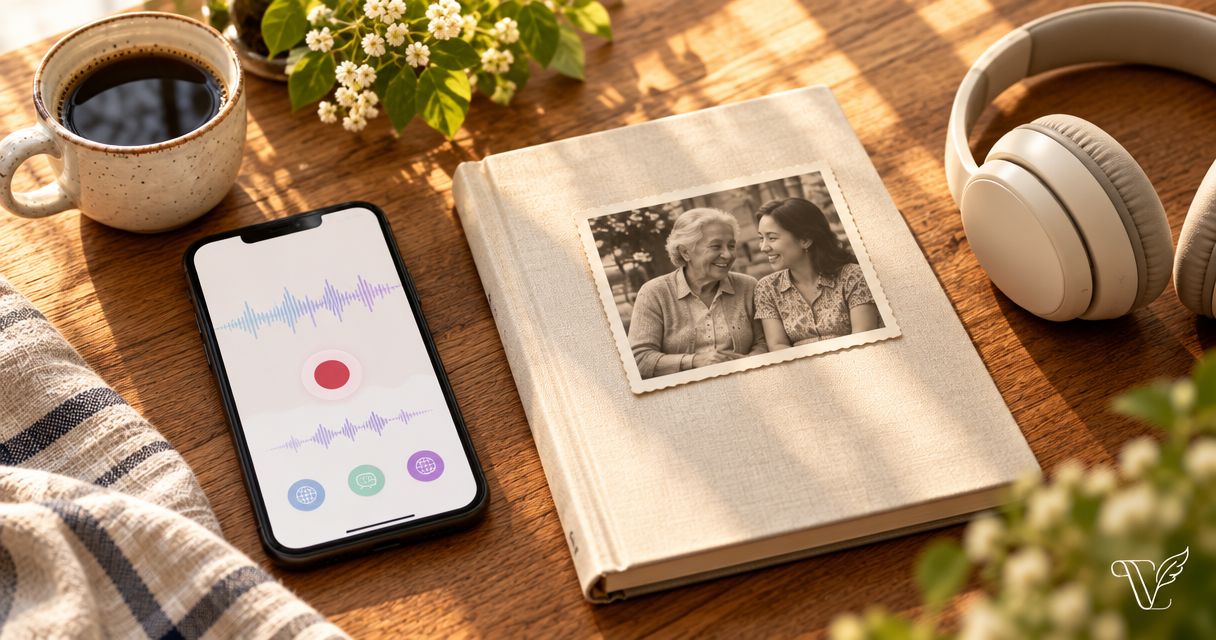
Yes—you can record a memoir interview in another language, but the service you choose must support that language if you want it to turn your speech into readable chapters. Recording, transcription, translation, and printing are separate capabilities; support for one does not establish support for the others. Before committing your life story to an app, check the full path from your spoken memories to the language your family will read.
- A memoir interview in another language needs separate checks for recording, transcription, translation, and printing.
- Myvellum suits storytellers seeking guided voice interviews and a printed family memoir; confirm language support before starting.
- Keep original family expressions, then explain them for readers who need context.
- Review a sample chapter before recording your full life story.
Planning your family memoir at myvellum.vercel.app? Myvellum guides you through twelve structured interview chapters and produces a personalized hardcover or softcover keepsake. Check your intended language workflow before beginning those interviews.
Can I record my memoir interview in a language other than English?
Yes, but distinguish the language you speak from the language you want printed. You can tell your story in your preferred language without choosing that same language for every page of the finished book. The practical question is whether your recording and publishing workflow preserves what you mean.
For your 2026 memoir project, choose the reading experience first:
| Approach | Best for | Main benefit | Main limitation |
|---|---|---|---|
| Original-language memoir | Relatives who read the language you speak | Keeps your wording and expressions close to the telling | Readers unfamiliar with the language need help |
| English translation | Family members who read English | Makes the written story accessible to those readers | Translation requires checking for meaning and tone |
| Bilingual memoir | Families who want both languages represented | Preserves original wording alongside an explanation or translation | Requires extra editorial and layout decisions |
These are editorial approaches, not a claim that a particular app supports every option. Choose an approach, then ask the service to confirm the recording language, transcription language, translation process, and printed output.
Why this matters for your family memoir
The language you use is part of the story. A childhood nickname, a family saying, or the way you addressed a grandparent can carry meaning that a literal translation does not explain.
You do not need to choose between an authentic account and an understandable book. Preserve the expression that matters, then give your reader enough context to understand it. Your goal is a memoir that sounds like you and remains readable for the relatives you want to reach.
That distinction matters when planning a keepsake in 2026: capture the memory in the language that helps you tell it, then make deliberate decisions about the printed text. Do not let an app's default language make that decision for you.
Original-language memoir: keep your own expressions
Best for: readers who share your preferred language. An original-language memoir lets you retain familiar forms of address, conversational rhythms, and expressions without translating every passage into English.
Start with the language in which the memory comes most readily. Describe what happened before stopping to polish the wording. During review, check that the written chapter reflects your meaning rather than merely resembling the sounds you recorded.
The limitation is access. A relative who speaks a little of the language might still struggle to read a full chapter. Explain unfamiliar regional words, older expressions, or family-specific references wherever they affect the story.
Recommendation: keep the original language when it serves both your voice and your intended readers. Add context rather than replacing every distinctive phrase with a more generic one.
English translation: write for relatives who read English
Best for: families whose intended readers are more comfortable with English. You can record memories in another language and plan an English manuscript, provided you have a confirmed transcription and translation process.
Translation changes the wording; it should not change the event. Check who performed an action, which relationship a family term describes, and whether a sentence expresses affection, humor, anger, or regret. Those details deserve as much attention as spelling.
The limitation is that an English sentence can be grammatically correct while misrepresenting your voice. Review the translation against the original account, not just as a standalone piece of writing.
Recommendation: preserve meaningful original expressions and explain them in English. Your family should understand the story without losing the words that make it yours.
Bilingual memoir: give both languages a clear role
Best for: families who want original wording and a translation in the same keepsake. A bilingual memoir can retain selected phrases, pair passages with translations, or present corresponding chapters in different languages.
Choose a consistent approach before preparing the final manuscript. If you translate a passage, make clear where the translation begins and ends. If you leave a phrase untranslated, explain it where readers first encounter it.
The limitation is repetition and layout complexity. Repeating every passage in full changes the reading experience, while switching languages without a pattern asks readers to keep working out the structure.
Recommendation: choose a bilingual pattern that serves your family, not one that merely looks complete. Confirm that your printing workflow can reproduce the intended script and layout before you finalize the book.
Why language support varies across the memoir workflow
Do not treat a language selector as confirmation of the entire process. Ask about these separate requirements when assessing a service in 2026:
- Interview prompts: Confirm whether you can understand the questions in the language presented, or whether you need a separate translated prompt sheet.
- Speech transcription: Confirm support for the language you will speak, including any language-switching you intend to use.
- Chapter editing: Establish how you will correct names, restore expressions, and review the resulting manuscript.
- Translation: Confirm whether translation is part of the workflow or something you must arrange separately.
- Printed text: Ask whether the intended script, punctuation, and text direction can appear correctly in the finished book.
- Family review: Decide who can check both the original meaning and the final reading language before you order.
A clear answer at each stage is more useful than a general statement that a service is multilingual. Ask specifically about your language and your intended book.
How do I check the workflow before recording my whole memoir?
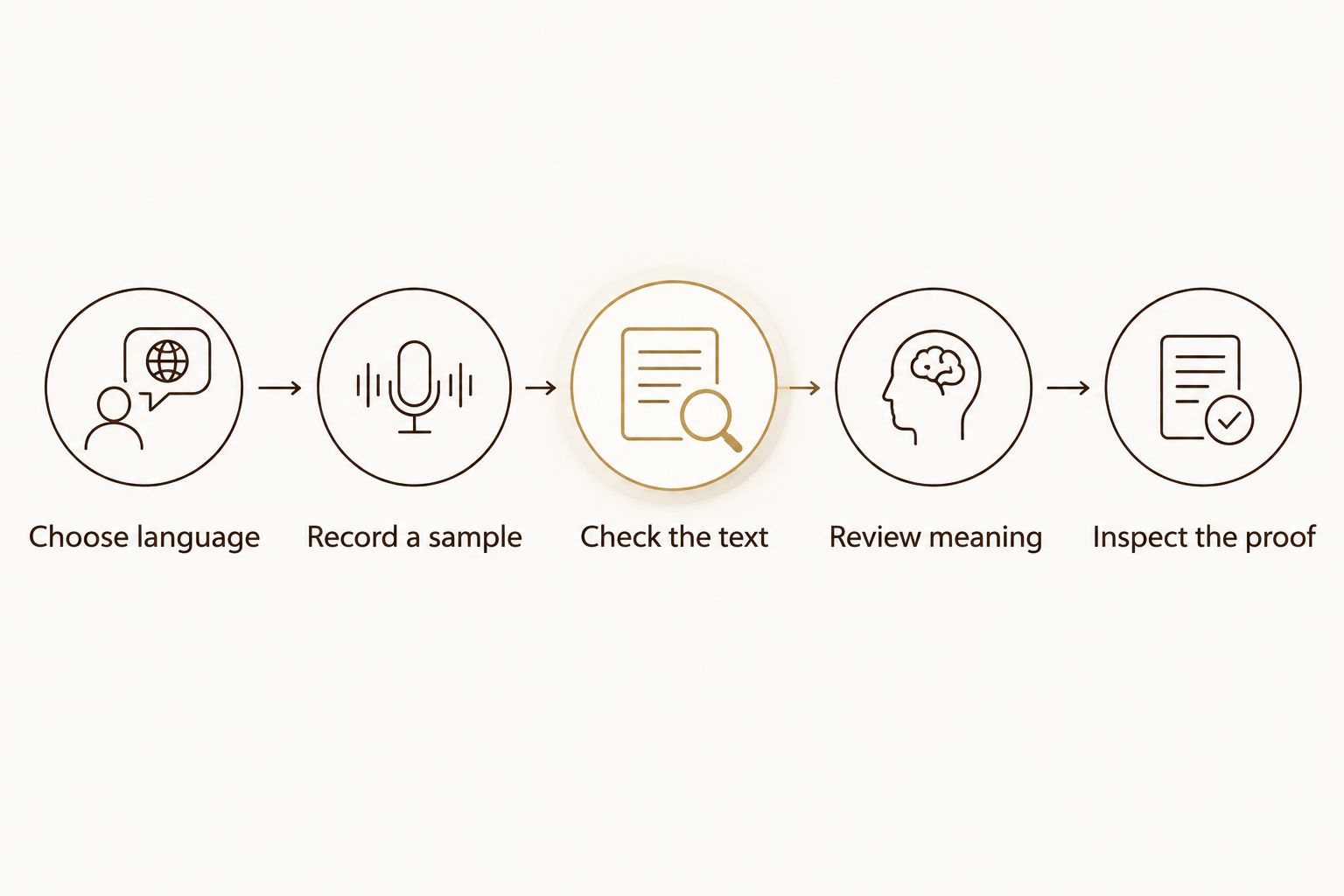
Use a sample passage to examine the process from spoken memory to printable text. Make it representative of your real story rather than an unusually simple introduction.
- Choose language. Decide which language you will speak and which language your family will read. Write those decisions down separately.
- Record a sample. Tell a familiar memory that includes a person's name, a place, and an expression you would naturally use.
- Check the text. Compare the transcription with what you said. Look for missing words, changed relationships, and incorrect names.
- Review meaning. If you need a translation, ask a reader comfortable with both languages to check the account against the original.
- Inspect the proof. Where a preview or proof is available, examine the actual text and layout intended for printing.
Keep your sample and its corrections as a reference. If you later change the language approach, repeat the relevant checks rather than assuming the earlier result still applies.
For a 2026 project, this sample is a decision aid—not a promise that every future chapter will need the same amount of editing. Continue checking names and meaning throughout the manuscript.
How Myvellum fits your recording and printing plans
Myvellum is best for storytellers seeking guided voice interviews and a printed family memoir. Its stated format combines 12 structured interview chapters with a personalized hardcover or softcover keepsake book.
That structure gives your project a defined interview framework. The language decision still needs its own check: confirm your intended recording, transcription, translation, and print requirements before relying on that workflow for a non-English memoir.
Treat starting a free memoir and ordering a printed book as separate decisions. At the starting stage, focus on whether you can tell your story comfortably and review the resulting text. At the ordering stage, focus on the finished manuscript, the language your family will read, and the chosen binding.
There are 2 stated print formats: hardcover and softcover. Neither format answers the language question; the text needs to be correct before it becomes a keepsake in either binding.
Can I switch languages during a memoir interview?
You can choose to tell a story using more than one language, but confirm how your selected transcription workflow handles that choice before recording full chapters. Do not assume that support for each language separately also covers switching between them within a sentence.
When a phrase matters, say it naturally and then explain what it means. During editing, decide whether the printed chapter needs the original phrase, its explanation, or both.
Keep meaningful language changes; remove accidental confusion. A reader should understand whether a shift reflects a remembered conversation, a familiar expression, or your present-day explanation.
Should I translate my memories before recording them?
You do not have to translate memories before recording them. Choose the language that lets you give a clear account, then arrange the written-language workflow around that decision.
Translating as you speak adds another task to the interview. If that interrupts your telling, separate recording from translation and review each stage on its own terms. If English is already the language in which you prefer to tell the memory, there is no reason to force another language into it.
For your 2026 memoir, choose clarity over a rule about which language is more authentic. Your own language choices are part of your experience, too.
FAQ
Does Myvellum support memoir interviews in my language?
Confirm your specific language and intended workflow with Myvellum before starting. Ask separately about interview prompts, speech transcription, translation, and printed text rather than treating them as a single capability.
Can I print my memoir in a language other than English?
A non-English memoir needs a printing workflow that supports its script, punctuation, and layout. Confirm those requirements with your chosen service and inspect the intended print output before ordering.
Do I need to translate every family expression into English?
You do not need to replace every family expression with an English equivalent. Keep meaningful original wording and explain it where your intended readers need context.
Who should check a translated memoir chapter?
Choose a reviewer who understands both the original language and the language of the finished chapter. Ask the reviewer to check names, relationships, events, and tone against the original account.
Can I include original wording and an English translation together?
You can plan a bilingual manuscript with original wording and an English translation. Choose a consistent structure, then confirm that your editing and printing workflow supports that structure.
Should I order a printed memoir before checking the translation?
Check the translation before ordering your printed memoir. Review the complete manuscript for meaning, names, language consistency, and layout so the book reflects the story you intend to preserve.
One last thing
Make a family-word list before you finish editing. Include names, nicknames, places, forms of address, and expressions that deserve consistent spelling or a short explanation.
Use that list when reviewing every chapter. A familiar word can look unfamiliar when someone else writes it down; choosing its spelling deliberately helps your printed memoir remain recognizably yours.


