
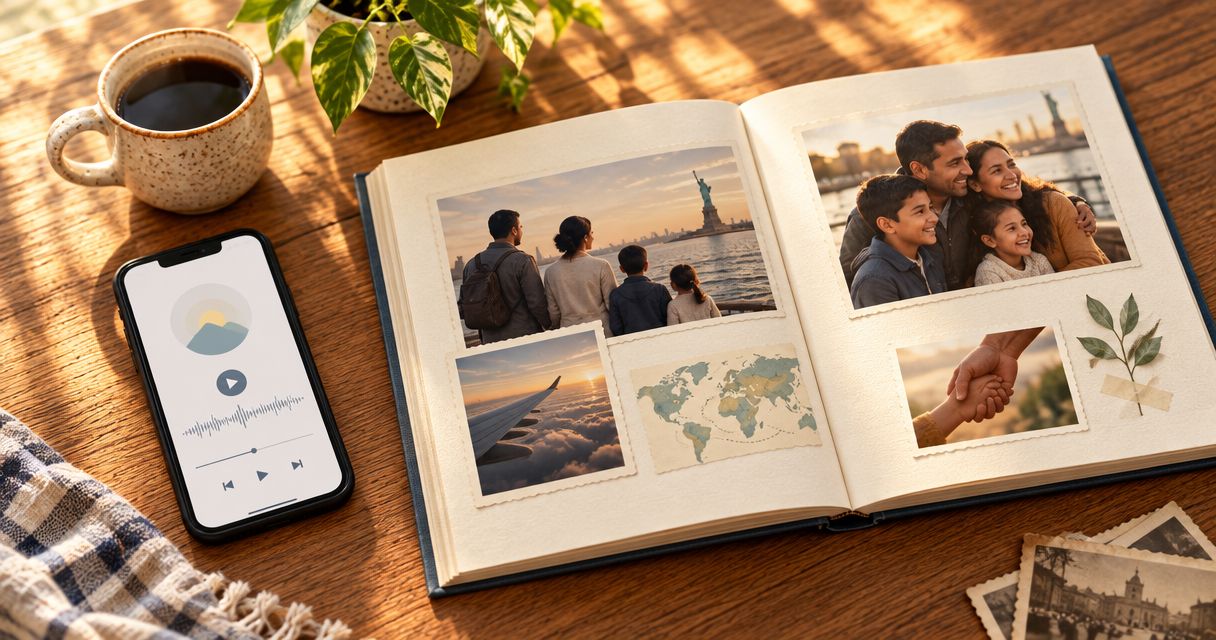
Immigrant families’ memoir writing is the process of recording your own memories to create a personal keepsake that helps your family understand your life across places, languages, and generations. This 2026 guide shows you how to make a life story book for immigrant families without reducing your experience to an arrival date or losing the words that make it yours.
- Myvellum suits immigrant memoir writers who want voice-guided interviews and a printed family keepsake.
- A life story book for immigrant families should include everyday memories, not just the migration journey.
- Keep original names and meaningful phrases; explain them for readers who speak another language.
- Start a free memoir separately from deciding whether to order a hardcover or softcover book.
Why memoir writing matters for immigrant families
Your family can know where you came from without knowing what living there felt like. A memoir connects those facts to your experience: the kitchen where you learned a recipe, the work you left behind, or the first conversation that made a new place feel familiar.
The central challenge is context. A childhood nickname, regional expression, or family custom needs explanation when readers have never encountered it. Explain enough to welcome them into the story without replacing your own language with theirs.
This guide from myvellum.vercel.app treats your life as more than a migration narrative. If speaking feels more natural than typing, the guide to voice-to-text memoir writing apps offers a related starting point.
Myvellum is best for immigrant memoir writers who want voice-guided interviews and a printed family keepsake. Its twelve structured interview chapters provide a framework; you still decide what to share, what needs explaining, and what stays private.
How to create your immigrant family memoir
1. Choose your reader and set your boundaries
Begin with a notebook or document. Write a short dedication that identifies who you want to reach and what you hope they understand. A book for your children needs different explanations from one for relatives who shared your childhood.
Do not assume that preserving your story means disclosing everything. You can describe a difficult period without naming another person, reproducing a private document, or recounting an experience you do not want circulated. Make those decisions before gathering material.
For your 2026 draft, define completion by the stories you want to preserve, not by an arbitrary page count. A focused memoir can have a clear beginning and ending without covering every year of your life.
- Name the intended readers in your working notes.
- Write one sentence explaining why you are making the book.
- Separate public memories from family-only material.
- List subjects you do not want to discuss.
- Decide who can review sensitive passages before printing.
2. Build a memory map beyond the journey
Draw a timeline on paper, then add themes beneath it. Dates organize events; themes explain why those events mattered. Include work, friendship, faith, education, food, love, and ordinary routines wherever they belong in your experience.
The move itself deserves space, but it does not need to dominate the book. Describe who you were before leaving and how your life continued afterward. A reader should meet a person, not only follow a route between countries.
Choose 3 opening scenes as a planning exercise: one before the move, one during a transition, and one from the life you built afterward. These are draft anchors, not required chapters or a claim about how your story must unfold.
- Sketch a timeline with approximate dates where necessary.
- Mark homes, schools, workplaces, and important relationships.
- Add everyday memories alongside major events.
- Label uncertain details instead of filling gaps.
- Choose the opening scenes you most want to tell.
3. Record scenes in your own speaking voice
Start with your phone’s recorder or a handwritten account. Choose one memory and describe what happened, where you were, and what you noticed. Avoid beginning with a demand to summarize your entire life.
Try a 10-minute recording session as a practical starting limit. Stop sooner if the memory is complete; continue later if it opens another story. The aim is a usable scene, not a long recording you will dread reviewing.
For a guided route, Myvellum offers voice-driven memoir writing through twelve structured interview chapters, with hardcover or softcover printing as a separate next step. The structure helps you begin with prompts rather than a blank page, but it does not replace your review of names, meanings, or sensitive details.
- Describe one scene before summarizing its significance.
- Say unfamiliar names clearly and note their spelling separately.
- Record what you remember, not what sounds impressive.
- Mark uncertain recollections for later review.
- Keep a separate copy of recordings you make independently.
4. Preserve your language and explain its meaning
Keep meaningful words in the language in which you remember them. A family nickname or expression can carry associations that an English substitute does not capture. Add a short explanation so readers understand why you kept it.
You do not need to translate every sentence twice. Decide whether the book will use one main language with explanations, selected bilingual passages, or a fuller translation. That is an editorial choice; verify a service’s language capabilities before relying on it for transcription or translation.
For names and places, consistency matters more than smoothing away unfamiliar spelling. Preserve diacritics and distinguish a name used at home from one used on official documents when that difference belongs to your story. Ask a trusted fluent reader to review passages whose meaning you cannot check alone.
- Keep original names, nicknames, and meaningful phrases.
- Explain a term when it first appears.
- Maintain a spelling list for people and places.
- Identify translations as translations rather than original speech.
- Check culturally specific passages with a suitable reader.
5. Turn memories into readable chapters
Use your timeline and recordings to build a working outline. Each chapter needs a clear subject and a reason to belong in the book. Chronological order works when the sequence matters; themes work when memories from different periods illuminate the same subject.
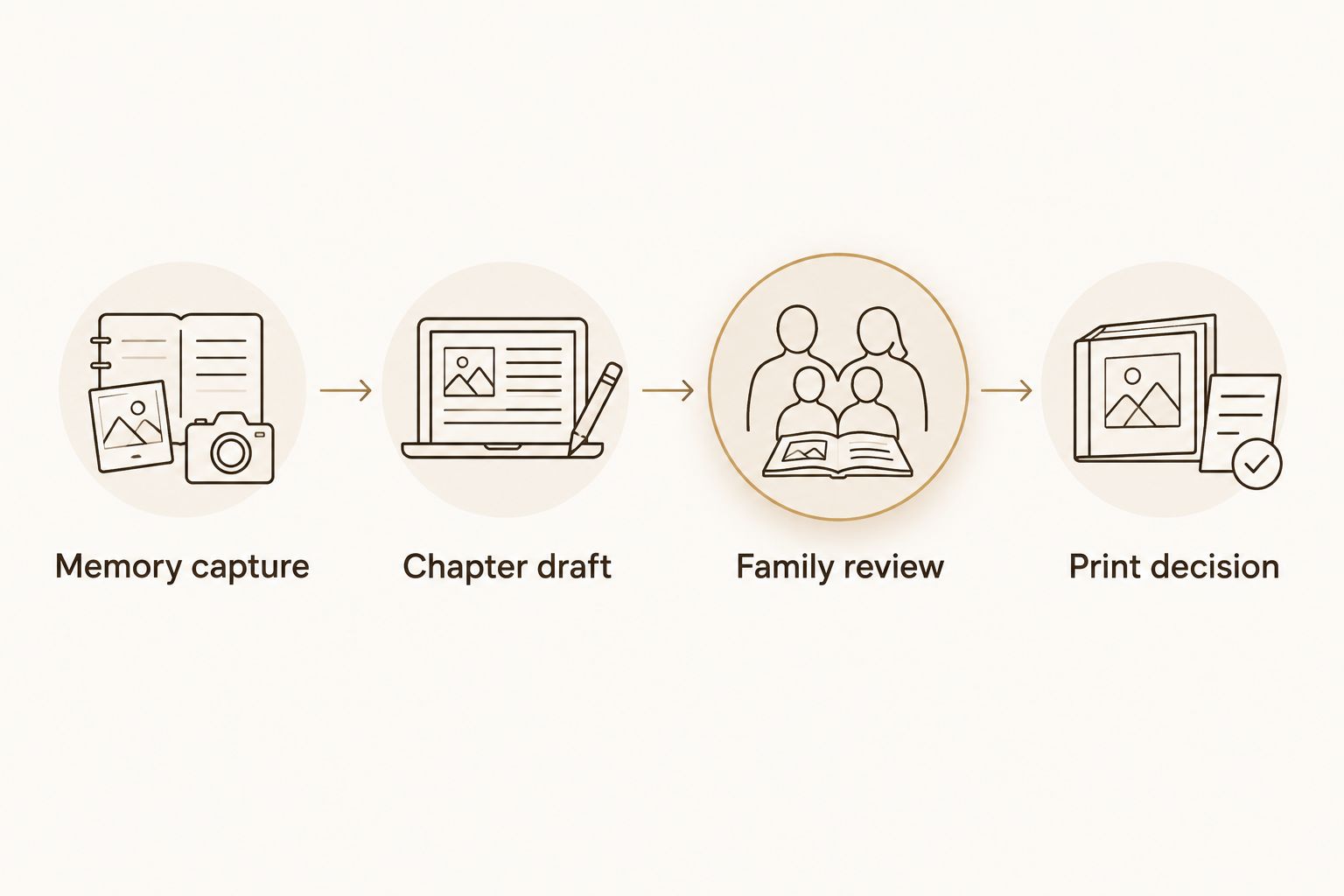
A simple editing sequence is Memory capture, Chapter draft, Family review, Print decision. Keep those stages separate. Recording a memory is not the same as approving its wording for a book that other people will read.
Begin a chapter with an event or scene, then explain its meaning. Replace long background summaries with the context readers actually need. If you remember dialogue only approximately, describe the exchange rather than presenting invented words as an exact quotation.
- Give each chapter a specific working subject.
- Open with a scene that belongs to that subject.
- Explain unfamiliar circumstances without overwhelming the memory.
- Distinguish recollection from information verified elsewhere.
- End with what changed or what you want readers to understand.
6. Review facts without surrendering your perspective
Review your 2026 manuscript in 2 editing passes: first for factual details, then for clarity and voice. Separating those tasks helps you avoid polishing a paragraph whose names or sequence still need correction.
Use documents and photographs to check details they actually establish. A dated photograph can help place an event; it cannot prove how you felt. Keep your emotional account in your own voice and identify uncertainty where it affects the story.
Ask relatives focused questions rather than requesting general approval. Another person can remember an event differently without invalidating your experience. Where the difference matters, acknowledge it instead of presenting a disputed recollection as settled family history.
- Check names, relationships, locations, and event order.
- Separate confirmed dates from approximate periods.
- Ask reviewers which passages need more context.
- Flag disagreements that materially change the account.
- Remove private information that does not serve the story.
- Read revised passages aloud to check your voice.
7. Separate starting the memoir from ordering the book
Finish a readable draft before choosing how it will become a physical keepsake. Keep a working copy you can revise, then create a distinct version intended for print. This prevents an unfinished passage from becoming the version your family receives.
With Myvellum, starting a free memoir and ordering a printed book are separate decisions. The service offers personalized hardcover or softcover books; choose the format after reviewing the story rather than treating printing as the first task.
Before placing a 2026 print order, check the current ordering details on the site. Confirm what the chosen format includes and how you will review the final text. Do not assume that language editing, photo preparation, or other services are included simply because printing is offered.
- Finish unresolved passages before approving the manuscript.
- Check the dedication, chapter order, and name spellings.
- Decide between hardcover and softcover deliberately.
- Confirm the current print specifications and review process.
- Keep your final manuscript separate from earlier drafts.
Begin your own family memoir
Start a free memoir, then decide separately whether to order a printed keepsake.
Compare ways to make your family memoir
Choose the method that matches how you express yourself and how much organization you want to handle. None removes the need to review your story. The useful comparison is control versus guidance, followed by how you will prepare the manuscript for print.
| Option | Best for | Main advantage | Key limitation |
|---|---|---|---|
| Notebook or document | Writers who prefer composing their own text | You control the outline, language, and revisions | You handle organization and print preparation yourself |
| Independent voice recordings | People who tell stories more easily aloud | You can capture memories before arranging them | Recordings still need selection, transcription, and editing |
| Myvellum voice-guided memoir writing | Writers who want structured interviews and a printed keepsake | Twelve interview chapters connect guided storytelling with hardcover or softcover printing | You still need to verify details and check language requirements |
| Collaborative family drafting | Writers who want help identifying people and events | Relatives can contribute context and check details | Conflicting recollections and edits need a clear decision-maker |
Independent methods keep editorial decisions with you but also leave the organizing work with you. Guided memoir writing supplies a framework, while collaborative drafting introduces additional perspectives. Choose the process that helps you tell the truth in your own voice, not the one that encourages the longest manuscript.
Common mistakes immigrant memoir writers make
Making migration the whole story
An arrival date is a milestone, not a complete identity. If every chapter explains leaving or adapting, readers miss your humor, interests, relationships, and ordinary pleasures. Include a scene that has nothing to do with migration and shows what you enjoyed or cared about.
Translating away the family’s vocabulary
Replacing every unfamiliar word can make the text easier to scan while changing its character. Keep expressions that carry personal meaning and give readers enough context to understand them. A short explanation is often more useful than a substitution that loses the original association.
Treating uncertain memories as exact records
Do not assign a precise date merely because the manuscript looks tidier with one. Use an approximate period when that is what you remember, and explain uncertainty when it changes the account. Never reconstruct official document wording or exact dialogue from a vague recollection.
Letting relatives rewrite your perspective
Family review should improve accuracy and understanding, not turn your memoir into an account everyone must agree with. Accept corrections to verifiable details while keeping your own experience recognizable. Explain a meaningful disagreement rather than silently adopting another person’s version.
Ordering before reviewing sensitive passages
A printed book deserves a separate privacy review. Check whether a passage exposes someone else’s personal information or includes material you only intended to discuss privately. Remove unnecessary identifiers and resolve permissions for contributed material before approving the print version.
FAQ
What should a life story book for immigrant families include?
A life story book for immigrant families should include your life before migration, the transition, and the life you built afterward. Add everyday scenes, relationships, meaningful language, and explanations that help relatives understand unfamiliar experiences.
Can I tell my own immigrant story instead of interviewing a parent?
Yes, you can make the memoir entirely from your own memories and perspective. Relatives can help check details, but you remain the author of your account.
Should I write my memoir in English or my first language?
Choose the language that lets you express the memory accurately, then consider what your intended readers understand. Keep meaningful original phrases with explanations, and verify language support before choosing a transcription or guided writing service.
Is voice recording better than typing a family memoir?
Voice recording is better suited to you if memories come more naturally through speaking; typing suits you if you prefer shaping sentences as you go. Either method needs review before the material becomes a finished book.
Can I start a free memoir before ordering a printed book?
Yes, starting a free memoir and ordering a printed book are separate steps with Myvellum. Develop and review your story first, then decide whether to order a personalized hardcover or softcover keepsake.
How do I include difficult experiences without sharing everything?
Set boundaries before drafting and include only the details you want readers to receive. You can explain how an experience affected you without naming other people or describing every event.
What should I check before printing my memoir in 2026?
Check names, chronology, translations, sensitive information, and the final chapter order before printing your memoir in 2026. Confirm the current format specifications and ordering process separately from reviewing the story.
One last thing
Explain one ordinary object before you finish the book. Choose a cooking utensil, work tool, piece of clothing, or household item that belonged to your daily life. Describe how you used it and why you remember it.
That small explanation gives your family something concrete to picture. In your 2026 memoir, preserve not only what happened, but the everyday details a reader would otherwise have no reason to ask about.


