
Yes—you can leave subjects out of your memoir, but skipping a chapter inside a guided interview depends on the app’s controls and completion requirements. Decide separately what you want to tell, what you want to postpone, and what must appear in the printed family book; an interview outline is not an obligation to disclose every part of your life.
- The skip chapters memoir interview question has two answers: you control your story; app controls determine the recording workflow.
- Myvellum offers a voice-guided memoir interview with twelve structured chapters and a printed family keepsake.
- Leave out irrelevant subjects, postpone unfinished memories, and keep enough context for your family to follow.
- Starting your memoir and ordering a printed book are separate decisions; review the manuscript before committing to print.
Can I skip chapters in a guided memoir interview?
You can choose not to include a subject in your memoir. Whether you can bypass an interview chapter is a separate software question. Before you rely on a skip function, check whether the service lets you leave a chapter unanswered, return later, and produce a book without that section.
Myvellum at myvellum.vercel.app guides you through twelve structured interview chapters and produces a personalized hardcover or softcover keepsake. That structure describes the interview, not a confirmed rule about which chapters you must complete.
Use this sequence when a chapter does not fit:
- Name the reason. Decide whether the subject is irrelevant, private, difficult to remember, or simply not ready.
- Choose the treatment. Omit it, postpone it, or give it a brief explanation.
- Check the workflow. Confirm what the app does with an unanswered chapter before recording more material.
- Review the manuscript. Look for missing context, empty headings, and references to stories you removed.
The goal is a readable family memoir, not a completed questionnaire. Answering every prompt does not automatically make the book more truthful or more personal.
Why this matters
A guided interview gives you somewhere to begin. It becomes less useful when you treat every prompt as a requirement rather than an invitation to remember.
Your family needs enough context to understand your experiences. They do not need every private detail. A chapter about a subject that never belonged to your life can distract from the memories you actually want to preserve.
For your 2026 memoir project, separate permission to leave something out from the technical ability to move past a screen. You decide the first; the service’s current workflow determines the second.
Should you omit, postpone, or briefly cover a chapter?
These are different editorial choices. Choose according to the reason you hesitate, rather than treating every unanswered question as something to delete.
| Approach | Best for | Benefit | Trade-off | Check before printing |
|---|---|---|---|---|
| Omit | Subjects outside your life or intended scope | Keeps the memoir focused | Can remove context a later story needs | Does another chapter depend on this information? |
| Postpone | Memories you want to revisit or verify | Keeps the subject open without forcing an answer | Leaves an unresolved task | Has the chapter been finished or deliberately removed? |
| Briefly cover | Important transitions you want to acknowledge without detail | Gives readers a bridge between events | Offers less explanation | Is the transition understandable without further disclosure? |
Omit: best for subjects that do not belong
Leave out a chapter when its premise does not match your experience or the book you want to make. A prompt about raising children, for example, does not require a parenting story if you did not raise children.
The benefit is focus. The drawback is that a broad topic sometimes contains a smaller story you do want to tell. Before discarding a whole section, ask whether its underlying theme—care, belonging, work, or responsibility—has a place elsewhere.
Recommendation: omit irrelevant material, not meaningful memories that happen to sit under an imperfect heading.
Postpone: best for memories that need another pass
Postpone a subject when you want it in the book but cannot give it your attention now. Perhaps you want to check a name in an old letter or think about how an experience changed you.
Postponement protects the story from a rushed answer. Its drawback is unfinished work: unless you return, a temporary gap becomes a permanent one. Keep a separate note describing the memory and what you need before revisiting it.
Do not assume the app saves a skipped section as a task. Confirm that behavior, or keep your own list.
Briefly cover: best for necessary context with firm boundaries
A short passage can acknowledge a major transition without describing everything behind it. You can establish that you moved, changed work, or entered a different stage of life and then continue with the experiences you want to share.
The benefit is continuity. The limitation is that readers receive less explanation, which is acceptable when the boundary is deliberate.
Write 1 sentence naming the transition, then read the surrounding passages. Add more only if the family reader cannot follow what happened next.
Why your decision varies by chapter
The right choice depends on what the subject contributes to your story. Review these factors before treating an unanswered chapter as a problem:
- Relevance: Does the topic describe your experience, or does the prompt assume a life path you did not take?
- Purpose: Does the memory help explain what you want your family to understand about you?
- Readiness: Do you want to tell the story now, revisit it later, or keep it private?
- Confidence: Can you distinguish what you remember from details that need checking?
- Continuity: Will removing the subject make a later relationship, decision, or move hard to understand?
- Book structure: Does the final manuscript still contain an empty heading or a reference to the omitted material?
These are editorial factors, not a scoring system. A deeply personal subject does not become mandatory because it explains an important period.
How do I keep my memoir readable after skipping a chapter?
Use a simple review sequence: Choose scope, Record memories, Read transitions, Review manuscript. The sequence separates what you want to say from how the finished book reads.
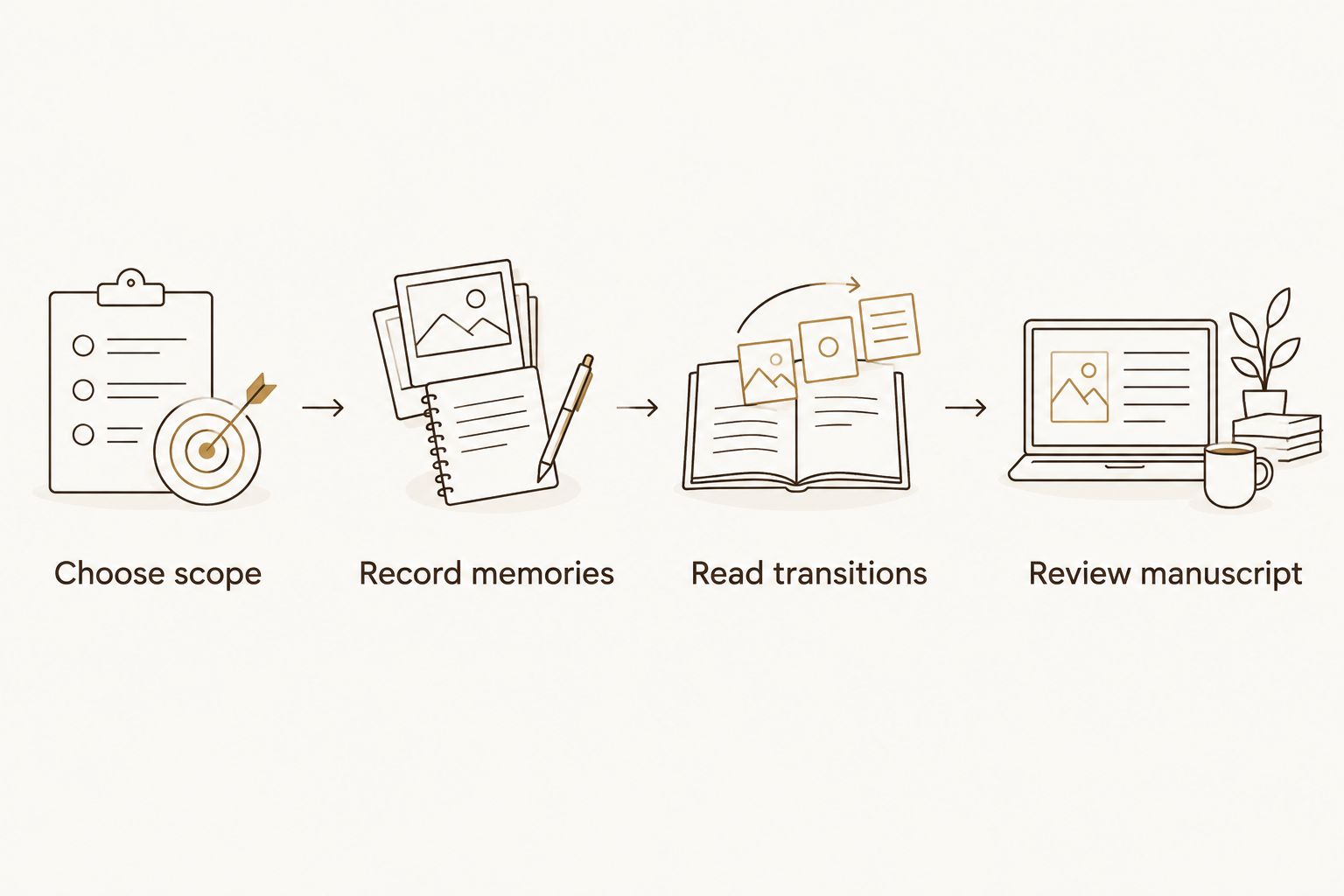
Choose scope
Write down who the book is for and what you want them to understand. Your scope might center on family traditions, the places you lived, or decisions that shaped your values.
Use that purpose to evaluate prompts. You are making a personal keepsake, not proving that your life fits a standard outline.
Record memories
Tell the stories you have chosen in language that sounds like you. Include the details you actually remember: who was there, what you noticed, and why the moment stayed with you.
Do not fill an unwanted chapter with generic statements just to make it look complete. A shorter, specific passage gives your family more than a page written from obligation.
Read transitions
Read the end of the preceding section and the beginning of the next. Look for a person who appears without introduction, a move that happens without explanation, or a reference to an event you removed.
A brief bridge can solve a continuity problem without reopening the whole subject. Explain the change you want readers to understand, while keeping the details you chose to withhold private.
Review manuscript
Check the contents list, headings, and chapter openings together. Remove placeholder language and resolve notes intended only for yourself.
Before you depend on a particular revision feature, review the guidance on editing memoir chapters after recording and confirm the controls in your chosen service. Editing your words and changing the interview sequence are different capabilities.
What should I check in a guided memoir service in 2026?
Check the current workflow before choosing a service around chapter flexibility. A description of a guided interview does not establish how unfinished sections affect the manuscript or print order.
Ask these 3 questions:
- Can I move to another chapter without answering the current one?
- Can I return to an unanswered section without losing material already recorded?
- What happens to unanswered chapters in the manuscript and printed book?
Then ask about the distinction between a temporary pause and permanent removal. You need to know whether a section remains in the outline, disappears from the book, or requires another action.
Myvellum is best for people who want to speak their own life story and turn it into a printed family keepsake. Its twelve-chapter memoir interview supplies structure; that structure alone does not establish a skip, reorder, or deletion feature. If those controls are essential to you, verify them before committing your story to the workflow.
Can I leave out painful memories?
Yes—you can leave painful memories out of a memoir intended for your family. You do not owe the book an account of every loss, conflict, or difficult relationship.
Decide whether you want silence, a brief acknowledgment, or a fuller passage. The relevant question is not whether the subject is important in the abstract; it is what you choose to share in this particular book.
Will skipping chapters make my memoir too short?
Skipping chapters does not by itself make a memoir too short. Evaluate whether the remaining stories carry the meaning you want to preserve, rather than treating the interview’s chapter count as a manuscript target.
For a 2026 family keepsake, check for substance before adding volume. Expand a meaningful scene or explain a family tradition if it serves the reader; do not restore an irrelevant chapter solely to make the book longer.
Do I need to finish every chapter before ordering a book?
Your service’s completion and printing requirements determine what you must finish before ordering. Do not assume that an interview’s chapter count is either a mandatory minimum or a guarantee that unfinished sections can be excluded.
Starting a memoir—including starting through a free option where offered—and ordering a printed book are separate decisions. Before placing a print order in 2026, confirm what manuscript will be printed and how unanswered sections appear in it.
FAQ
Can I skip chapters in a guided memoir interview?
You can choose which subjects belong in your memoir, but the app determines whether you can bypass interview chapters. Check its navigation and completion requirements before relying on a skip function.
Does Myvellum let me skip any of its twelve interview chapters?
Myvellum’s description confirms twelve structured interview chapters, not a chapter-skipping feature. Confirm how unanswered sections affect recording, the manuscript, and printing before relying on that capability.
What should I do if a memoir chapter does not apply to my life?
Leave the subject out of your planned story or adapt its underlying theme to an experience that fits. Then check how your service handles the unanswered interview section.
Can I leave a chapter unfinished and come back later?
Returning to an unfinished chapter depends on the service’s controls. Keep a separate note of what you want to revisit rather than assuming the app will track it for you.
Should I explain why I left something out of my life story?
You only need an explanation when it helps readers understand the stories you include. A brief transition can preserve continuity without disclosing private details.
Will an unanswered interview chapter appear as a blank page in my book?
The printing workflow determines how an unanswered chapter appears in the book. Review the manuscript and confirm how empty headings or sections are handled before ordering.
What should I check before printing my memoir in 2026?
Before printing your memoir in 2026, check the manuscript’s contents, transitions, names, and unresolved notes. Confirm that omitted chapters do not leave confusing gaps or unwanted headings.
One last thing
A gap in chronology is not automatically a gap in meaning. You can move past a period without recounting everything that happened, provided your reader understands the transition you chose to share.
Before printing, read only the final paragraph of each chapter and the opening paragraph of the next. This focused pass helps you spot connections that need attention without turning every skipped subject into another writing assignment.


