
To get a parent to agree to record their life story, invite them to share one memory, explain who would hear it, and let them decide whether recording happens at all. Ask for a conversation, not a commitment to a book; permission to record does not automatically include permission to share or print.
- To convince parent to record life story, offer a small invitation—not pressure, secrecy, or a deadline.
- Myvellum suits people who want voice-guided memoir writing and a printed family keepsake.
- Start with your own memories so participation feels shared rather than assigned.
- Treat recording, family sharing, and printed memoir approval as separate decisions.
Why this matters
A family memoir should preserve a person's perspective, not turn their life into someone else's assignment. Your parent's willingness matters more than finishing a chapter or getting a recording today.
Begin by contributing something yourself. If you are planning a family memoir in 2026, record your own recollection of a shared meal, a childhood home, or a family tradition, then invite your parent to add their perspective. The guide to starting your life story when you don't know where to begin gives you a starting point that does not depend on anyone else's participation.
How do I get a parent to agree to record their life story?
Make the invitation specific, optional, and easy to understand. Separate your wish to preserve family memories from your parent's decision about participating.
Start with your reason
Explain what you want to understand: how your parent chose their first job, what home felt like, or which traditions they want you to remember. Keep the reason personal rather than presenting a duty to future generations.
Avoid making age, illness, or lost time your argument. Ask because their experiences matter to you, not because they owe you a record.
Offer a small beginning
Suggest a 5-minute conversation about 1 memory as an invitation, not a required session length. Your parent can shorten it, continue, or decline.
Choose an ordinary subject they have already shown interest in discussing. A familiar recipe or neighborhood is a starting point; a painful family dispute is not a suitable opening test.
Explain the recording
Before turning anything on, say what you would use to record, where you intend to keep the recording, and who you want to hear it. If you cannot explain a service's storage or sharing arrangements, check its current terms before using it.
Ask permission plainly. A willingness to talk over coffee is not permission to create a recording.
Separate the decisions
Treat participation as 2 separate decisions: recording now and considering a printed book later. Discuss sharing separately as well, including which relatives would receive the material.
Do not present a finished hardcover as the inevitable outcome. The first conversation can remain a conversation, even when your eventual hope is a family keepsake.
Accept the answer
If your parent declines, stop the request rather than changing tactics. Ask whether they want the subject left alone, and respect that boundary.
Continue your own memoir independently. You can describe what you remember without claiming to speak for your parent or presenting your account as their approved story.
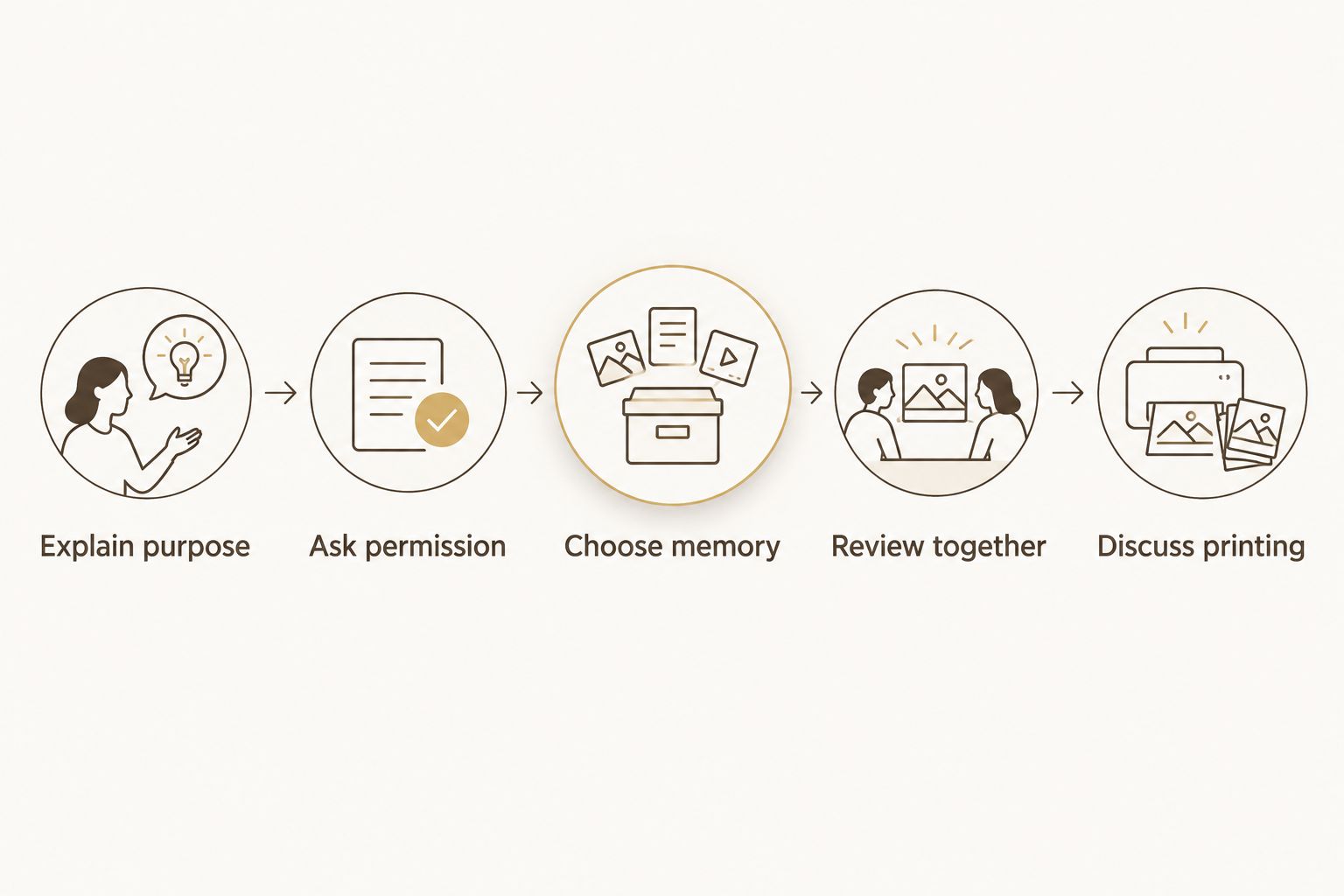
The sequence is simple: Explain purpose, Ask permission, Choose memory, Review together, Discuss printing. Return to permission whenever the purpose or audience changes.
Which invitation fits your parent's preference?
Match the invitation to what your parent actually says. Do not assume that a reluctance to use an app means a reluctance to share memories, or that enjoying conversation means wanting a book.
| Approach | Best for | Useful feature | Limitation |
|---|---|---|---|
| Unrecorded conversation | Someone who wants to talk without creating a recording | Keeps the first exchange focused on listening | Does not preserve their exact voice |
| Audio recording | Someone who explicitly wants their spoken account preserved | Retains their own wording and voice | Requires agreement about recording and access |
| Written recollection | Someone who prefers composing privately | Lets the writer choose wording before sharing | Requires writing rather than speaking |
| Shared-memory conversation | Someone who wants a familiar starting point | Gives both people a memory to discuss | Accounts can differ; neither person should overwrite the other |
Choose the format your parent accepts, not the format that makes your project easiest. None of these approaches requires a promise to finish an entire memoir.
If your parent prefers writing, accept that preference without arguing that speaking is simpler. If they prefer talking without a device, put the device away. The relationship is not a production workflow.
Why a parent's willingness to record varies
Ask what concerns your parent instead of diagnosing resistance. These are discussion points, not assumptions about why any particular person says no:
- Scope: Clarify whether you are proposing a single memory or an ongoing project.
- Audience: Specify whether the material is for you, selected relatives, or wider circulation.
- Subject boundaries: Ask which people, events, and periods should stay outside the conversation.
- Format: Distinguish speaking, recording, writing, and printing rather than bundling them together.
- Control: Agree on how your parent will review material before you share it.
- Timing: Offer another occasion only if your parent wants you to ask again.
For a memoir started in 2026, write down these agreements alongside your project notes. A clear record of the intended audience is more useful than an assumption that everyone understands the plan.
What should I ask during the first conversation?
Ask about a scene rather than requesting a complete life summary. These suggested prompts are invitations you can adapt, not statements attributed to anyone:
- What do you remember about the kitchen in your childhood home?
- Who helped you when you were learning your first job?
- Which family tradition did you decide to keep?
- What ordinary day would you like me to understand better?
- Is there something about my childhood that you remember differently?
Choose one prompt and listen. Avoid stacking follow-up questions while your parent is still answering, and do not turn an uncertain date into a test.
If a detail is unclear, mark it for checking rather than supplying a confident answer. A memoir can preserve an honestly remembered experience without pretending that every date has been verified.
Finish by asking whether there is anything they do not want included. Then explain the next step you actually intend to take—not a larger project they have not accepted.
How can I begin with my own story instead?
Start with a memory you own: leaving home, becoming a parent, changing work, or learning a family recipe. Describe what happened, what you noticed, and what it meant to you.
You can then invite your parent to contribute a separate perspective. Their account does not have to validate yours, and your memoir does not need their participation to be meaningful.
For your 2026 memoir, keep a clear distinction between your recollections and another person's contributions. Use language that identifies whose memory you are preserving, especially when family members disagree.
Myvellum is best for people who want voice-guided memoir writing that leads to a printed family keepsake. At Myvellum, the voice-driven memoir app guides individuals through 12 structured interview chapters and offers personalized hardcover or softcover books.
Starting a free memoir and ordering a printed book are distinct steps. Begin with your own memories; consider printing after deciding what belongs in the keepsake. The structured interview format gives the project a defined shape, but it is not a reason to press a reluctant relative into participating.
myvellum.vercel.app is the place to begin your own memoir—not a substitute for your parent's consent.
Begin with your own memories
Start a free memoir, then consider a printed family keepsake as a separate step.
What should we agree on before printing a family memoir?
Before ordering a family memoir in 2026, review the actual material intended for the book. Agreement to an interview is not approval of every edited passage or every proposed recipient.
Review the words
Let each contributor review the passages presented as their account. Ask whether editing has changed the meaning, removed needed context, or made uncertainty sound like certainty.
Preserve their language where it carries meaning. A family expression does not need to become formal prose merely because it is going into a book.
Review the audience
Name the people you intend to give the book to. Private family circulation and public publication are different choices; do not switch from one to the other without another discussion.
Also discuss sensitive information about relatives who were not interviewed. A person's willingness to tell a story does not resolve every question about someone else's privacy.
Review the purpose
Decide whether the keepsake is your memoir, your parent's memoir, or a collection of separate family accounts. That distinction should be clear to the people contributing and to the relatives reading it.
For a book planned in 2026, approve the version you intend to print rather than relying on a general conversation from the project's beginning. Print after review, not as a way to secure agreement.
What if my parent says their life wasn't interesting?
Ask about an experience you genuinely want to understand rather than arguing that their whole life deserves a book. An ordinary routine, a difficult choice, or a tradition can be the subject of a meaningful family conversation.
Do not promise that everyone will find it fascinating. Tell your parent why the particular memory matters to you, and leave participation optional.
Should I surprise my parent with a memoir project?
Surprise your parent with your interest, not with an undisclosed recording or a book containing unapproved personal stories. Explain the project before collecting their contribution.
You can still create your own memoir as a family keepsake. Keep your account clearly your own, and handle other people's private experiences with care.
What if my parent agrees and then changes their mind?
Pause the project and clarify what they want stopped: future conversations, use of a passage, sharing, or printing. Do not treat earlier enthusiasm as permanent permission.
Before promising deletion or retrieval, check what is actually possible with the recording method or service you used. Avoid distributing material while that discussion remains unresolved.
FAQ
How do I convince my parent to record their life story without pressuring them?
Invite your parent to share a specific memory, explain the intended audience, and accept a refusal. Offer an unrecorded conversation if recording itself is the concern.
What's a good first question for a parent's life story?
Ask about a familiar scene, such as the kitchen in their childhood home or a family tradition they kept. Let the answer guide the conversation rather than working through a rapid list.
Should I start my own memoir before asking my parent?
Starting your own memoir lets you contribute memories without making your parent responsible for the project. Invite their perspective separately and make clear that participation is optional.
Can I record my parent without telling them if it's only for family?
Do not record your parent secretly for a family memoir. Ask explicitly before recording and agree on who will have access; recording laws also vary by location.
Does agreeing to an interview mean agreeing to a printed book?
Agreeing to an interview does not automatically mean agreeing to a printed book. Discuss the edited content, intended recipients, and printing decision separately.
Is Myvellum suitable for recording my own life story?
Myvellum is a voice-driven memoir-writing app and print service for creating your own life story. It uses 12 structured interview chapters and offers personalized hardcover or softcover keepsake books.
What should I do if my parent refuses to participate?
Accept the refusal and ask whether they want you to leave the subject alone. You can continue writing your own memories without presenting them as your parent's approved account.
One last thing
The memory your family treasures does not have to explain an entire life. Start with something you can describe honestly: the sound of someone arriving home, a meal you learned to make, or a decision whose meaning changed over time.
Record your own version first. Leave room for your parent to add theirs—and room for them not to.


