

The time you need to transcribe voice recordings into memoir chapters depends on the recordings, the amount of rewriting, and how thoroughly you review the text. Transcription produces a draft—not a finished family keepsake—so your schedule must also include chapter editing, factual checks, and a separate printing stage.
- To transcribe voice recordings into memoir chapters, plan for transcription, story editing, factual review, and print preparation separately.
- Myvellum suits people who want guided voice interviews and a printed family memoir, rather than an unstructured transcript.
- Recording length alone does not tell you when your memoir will be ready to print.
- Start your free memoir first; ordering a printed keepsake is a separate decision.
Why this matters
A recording captures what you said. A memoir helps your family understand what you meant, who was there, and why an experience stayed with you. Those are different jobs, and treating them as one task creates an unrealistic finish date.
Myvellum is best for people who want to tell their own life story through guided interviews and turn it into a printed family memoir. At myvellum.vercel.app, the process centers on twelve structured interview chapters and a personalized hardcover or softcover keepsake. The structure gives you a place to begin; it does not replace your review of the finished story.
For your 2026 memoir project, define the finish line before choosing a deadline. A readable chapter, a complete manuscript, and a printed book are separate milestones.
How long does it take to transcribe voice recordings into a memoir?
A transcription turnaround is not a memoir completion time. You need to account for the work between spoken memories and a manuscript you are comfortable sharing with family.
Use these 4 stages to build your schedule. Each stage has a different finish line, which makes progress easier to judge without relying on a promised completion date.
| Stage | What you have at the end | Benefit | Limitation |
|---|---|---|---|
| Transcription | Written words from your recording | Makes spoken memories readable and searchable | Does not establish accuracy or narrative order |
| Story editing | A chapter with a clear sequence and focus | Helps a reader follow the experience | Requires decisions about repetition, context, and emphasis |
| Factual review | A draft checked against what you know and can verify | Reduces avoidable mistakes in names and events | Some memories remain uncertain or disputed |
| Print preparation | A manuscript prepared for a book order | Moves your story toward a physical keepsake | Production and delivery remain separate from writing |
Do not attach the same deadline to every stage. If a service gives you a turnaround, ask what that turnaround actually covers: written text, edited chapters, an approved manuscript, or the physical book.
For a 2026 family gathering, work backward from the date you need the book in hand. Confirm the current production and delivery terms before setting your manuscript deadline; do not treat the transcription estimate as the delivery date.
Transcription: getting your spoken words onto the page
Transcription is complete when the spoken material has become readable text. That is a useful milestone, but it does not mean every word is correct or every paragraph belongs in the memoir.
Names deserve particular attention. A familiar surname, a childhood nickname, or a small hometown can look plausible in text while still being wrong. Listen back to uncertain passages rather than correcting them from context alone.
As you review, separate transcription errors from storytelling choices. A misspelled name is an error to correct; a repeated anecdote is an editorial decision. Keeping those tasks distinct helps you avoid rewriting a chapter before you have established what the recording actually says.
Keep your original recordings while you work on the manuscript. They preserve your wording, emphasis, and the details you might otherwise remove too quickly. They also give you something to revisit when a sentence on the page no longer sounds like you.
Story editing: making the transcript read like your life
Spoken memories do not always arrive in reading order. You might begin with a wedding, remember the journey there, then return to the person who introduced you. The transcript preserves that sequence; your chapter does not have to.
Give each chapter a clear center. Ask what happened, what changed, and what you want your family to understand. Material that does not serve that center can move elsewhere rather than disappearing entirely.
Editing also means adding context that felt obvious while you were speaking. Your children might know who your brother is, while a future grandchild will need his name and relationship to you. A brief introduction can make the same story understandable beyond its first readers.
Avoid polishing away your personality. A phrase you actually use can carry more meaning than a formal replacement. Edit for understanding, not for a voice that sounds more literary than your own.
For a closer look at this transition, see how to turn phone voice recordings into memoir chapters.
Factual review: checking what your family will read
A memoir is your account of lived experience, not a requirement to remember everything perfectly. Still, distinguish what you remember clearly from what you later learned or cannot place with confidence.
Use these 3 checks before treating a chapter as finished:
- Names and relationships: Can a reader identify each person and understand their connection to you?
- Order and context: Does the sequence make sense, and have you supplied the background needed to follow it?
- Meaning and privacy: Does the chapter express what you intend without sharing details you would rather keep private?
Letters, journals, and photographs can help you investigate a detail. They should not become an excuse to postpone every chapter until you have researched your entire life.
When you cannot establish an exact detail, write the uncertainty honestly. Saying that you remember an event happening during your school years is better than assigning it a precise date you cannot support. Preserve the distinction between memory and documentation.
Print preparation: separating the manuscript from the book
A finished manuscript and a delivered keepsake are not the same milestone. Before ordering, read the manuscript as the book your family will receive, rather than as working notes you can mentally fill in.
Check chapter openings, repeated passages, and references that depend on an earlier explanation. If you include photographs or captions, check that each belongs with the surrounding story and identifies people accurately. These are editorial checks, not promises about any particular printing service's features.
For a book you plan to order in 2026, confirm the current requirements before submitting it. Review the available format, the approval process, and the production and delivery terms directly with the provider.
Starting your free memoir is the writing step; ordering a printed book is the keepsake step. Treating them separately lets you begin recording without pretending your manuscript is already ready for print.
Why the time to finish a voice-recorded memoir varies
The work changes with the material you bring and the book you want to create. These factors explain why recording duration alone is a poor basis for a completion promise.
- Recording clarity: Overlapping voices and unclear passages require listening and interpretation before you can trust the text.
- Story structure: A focused memory needs different editing from a recording that moves among unrelated events.
- Missing context: People, places, and relationships need explanations when your intended readers do not already know them.
- Factual uncertainty: Checking a name or sequence adds a different task from correcting punctuation.
- Revision scope: Light cleanup and substantial rewriting are different projects, even when they begin with the same recording.
- Print readiness: Chapter approval and book preparation sit beyond the transcription stage.
For your 2026 plan, separate work you can do now from details that need follow-up. Keep a short list of unresolved questions so that an uncertain place name does not stop you from recording another memory.
How can I plan the work without rushing my memories?
Start with a complete story rather than an entire life period. A remembered meal, an early job, or an important move gives you something concrete to record and revise. You can decide where it belongs after you understand what the story contains.
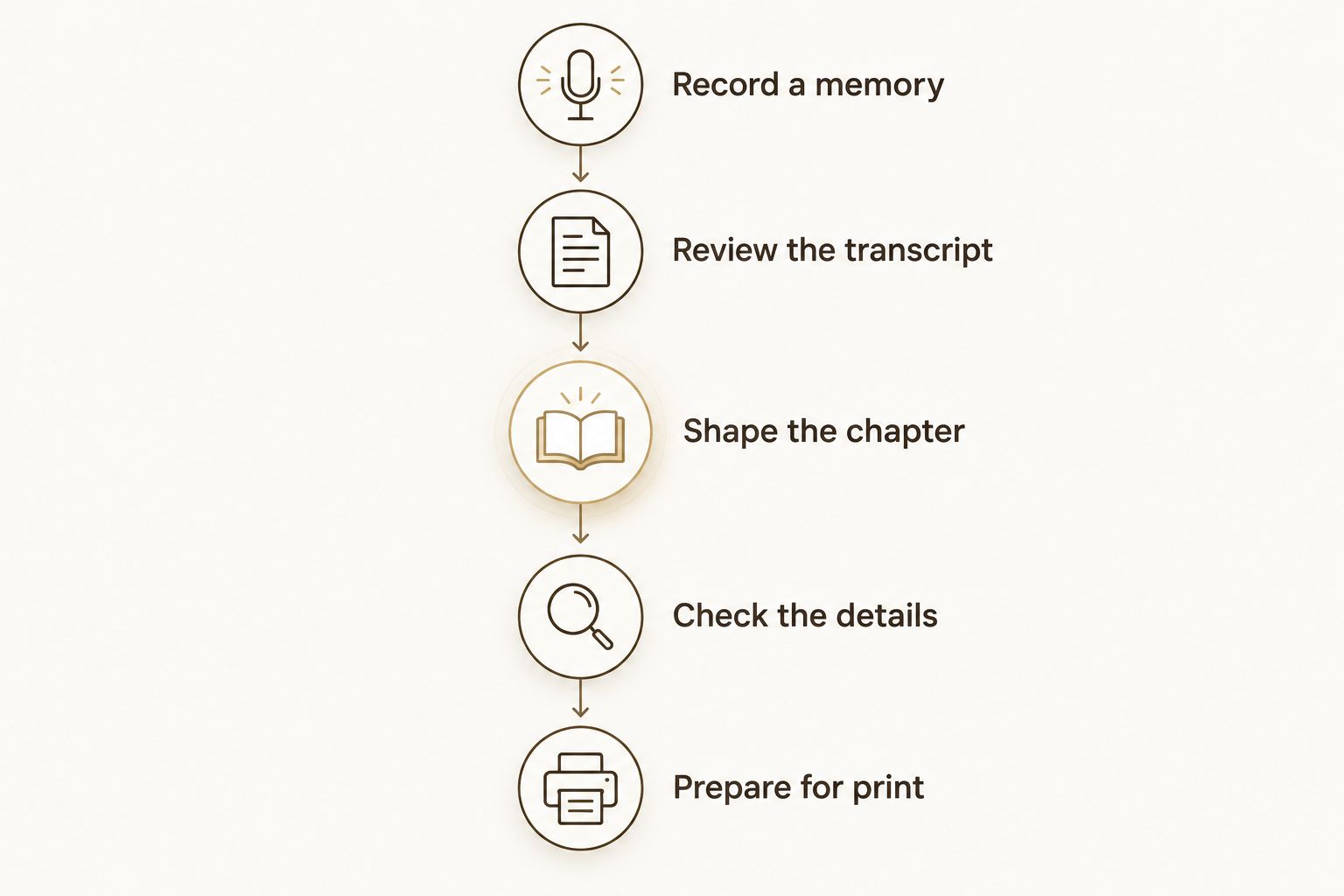
Use this sequence to test your process before expanding the manuscript:
- Record a memory. Tell the event in your own words, including the people involved and why you still remember it.
- Review the transcript. Correct misheard words and mark passages that need another listen.
- Shape the chapter. Put the experience in a readable order and add the context your family needs.
- Check the details. Resolve what you can and express remaining uncertainty honestly.
- Prepare for print. Review the complete manuscript before making the separate book-order decision.
The point is not to force every memory through the process at once. Completing a chapter shows you where your own effort goes: recalling, explaining, checking, or revising.
Where does a guided memoir app fit into the schedule?
Myvellum's memoir app guides you through 12 interview chapters and connects your life-story project with a personalized hardcover or softcover book. Its useful distinction is the combination of guided storytelling and a physical keepsake, rather than a transcript alone.
The limitation is equally important: chapter structure is not a completion deadline. You still need to decide whether the account feels accurate, whether it sounds like you, and whether you are comfortable sharing it.
Start your free memoir by capturing your own memories. Move to the printed-book decision after you have reviewed the manuscript and checked the current ordering details. This keeps the invitation to begin separate from the decision to purchase a keepsake.
Start telling your life story
Begin your free memoir, then make a separate decision about ordering your printed family keepsake.
Does a longer recording always take longer to turn into a memoir?
Recording length alone does not determine memoir completion time. A clear account with a focused subject requires different editorial work from a shorter recording filled with unexplained references or uncertain details.
Use your first reviewed chapter as a planning reference. Notice the tasks it required rather than assuming every later chapter will follow an identical schedule.
Should I finish all my recordings before editing?
You do not need to finish every recording before reviewing a chapter. Reviewing early material helps you notice missing context and unclear names while you still have the opportunity to address them in later sessions.
Keep the review focused. Correcting and clarifying a chapter is useful; endlessly polishing its opening sentence can become a substitute for telling the rest of your story.
FAQ
How long does it take to transcribe voice recordings into memoir chapters?
The total depends on transcription, story editing, factual review, and preparation for print. A transcript turnaround covers only part of the work unless the provider explicitly includes the later stages.
Is a transcript the same as a finished memoir?
A transcript is not a finished memoir. It records spoken words, while a memoir needs readable structure, sufficient context, and your approval of the story being shared.
Can I begin my memoir before choosing a printed book?
You can start your free memoir before making the separate decision to order a printed keepsake. Focus first on recording and reviewing your story, then check the current book-order details.
How many interview chapters does Myvellum use?
Myvellum uses 12 structured interview chapters to guide your life-story project. That chapter count describes the framework, not a guaranteed completion time.
Should I remove every pause and repeated phrase from my memoir?
Remove repetition that makes the story harder to follow, but preserve wording that sounds like you. A readable family memoir does not need to erase your natural way of telling a story.
What should I check before ordering my memoir in 2026?
Before ordering your memoir in 2026, review the complete manuscript and confirm the provider's current ordering requirements. Check names, chapter order, sensitive details, and any photographs or captions you include.
What should I do when I cannot remember an exact date?
Describe the time honestly rather than supplying an unsupported exact date. Check available records when useful, and distinguish what you remember from what you can document.
One last thing
Before approving a chapter, read it aloud. Mark any sentence you would never naturally say, then decide whether the edit improved understanding or merely made your voice more formal.
Your family needs enough context to understand the memory, but they should still recognize the person telling it. That is a better finish line than a transcript that is simply free of spelling errors.


