

A life story interview has no single fixed duration: the time you need depends on which memories you include, how deeply you explore them, and when you feel ready to stop. Recording your answers is only part of creating a family memoir; reviewing the chapters and ordering a printed book are separate steps with separate schedules.
- How long does life story interview take? Plan recording, chapter review, and book production separately.
- Myvellum guides your life story interview through twelve structured chapters, not a stated number of interview hours.
- Start your free memoir first; ordering a personalized printed book is a separate decision.
- Choose a manageable story scope before setting a deadline for your family memoir.
How long does the interview process take for a life story book?
Plan around completed stories, not a promised number of hours. An interview is finished when you have captured the memories you want to include and identified anything that needs clarification. That does not mean your book is ready to print.
Myvellum uses twelve structured interview chapters to guide your own life story. Chapter count describes the structure, not the time each chapter requires: a familiar memory and a difficult turning point do not need identical treatment.
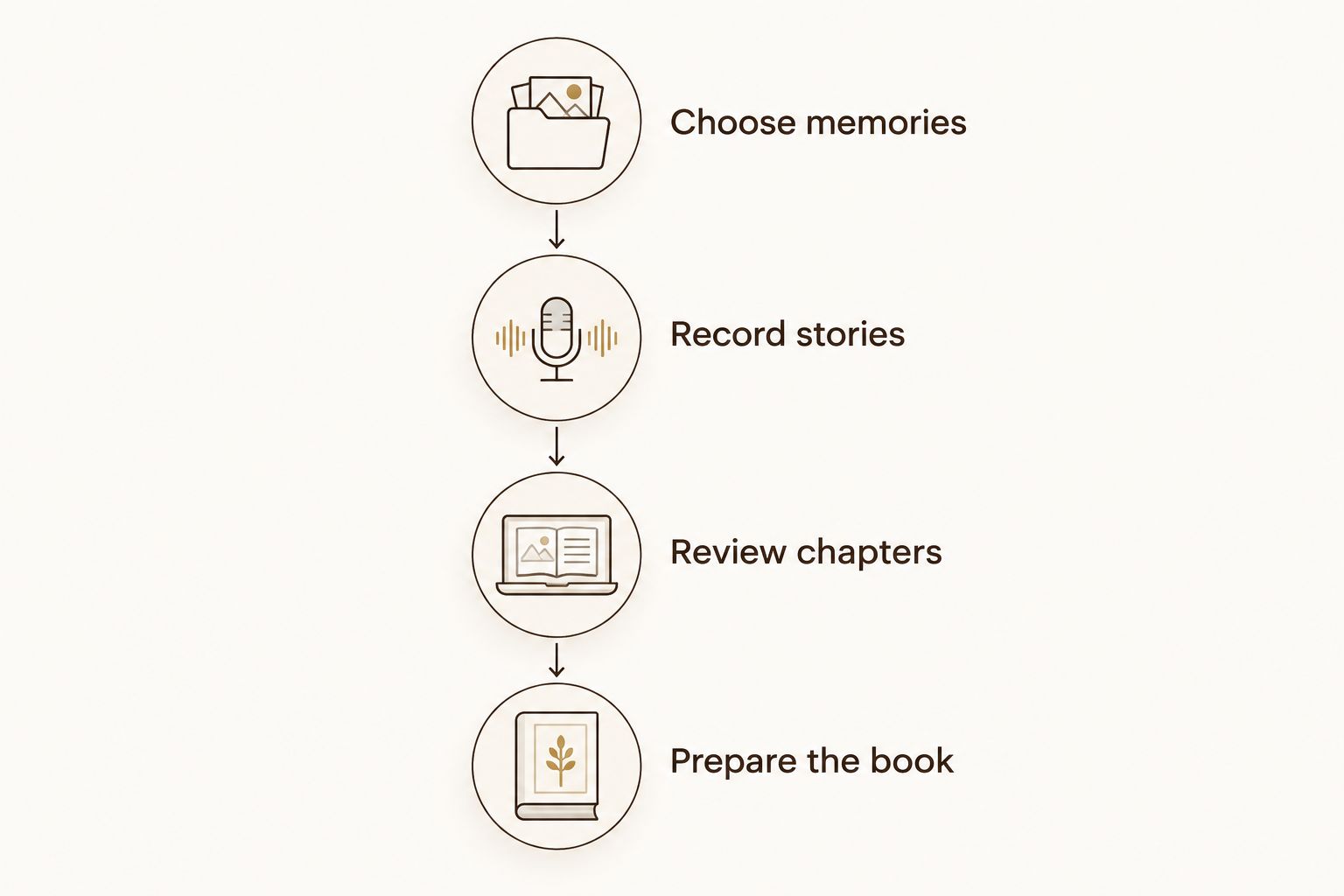
For your 2026 memoir plan, separate the work into these stages:
- Choose memories. Decide which experiences belong in the book and who you want to read them.
- Record stories. Tell each memory in your own words, including the details your family would otherwise miss.
- Review chapters. Check meaning, names, sequence, and anything you do not want to share.
- Prepare the book. Decide what belongs in the printed version before placing an order.
The interview sits inside this process. Do not use its completion date as a substitute for a finished-book date.
Why this matters
A life story book is a keepsake, but making it involves decisions that a conversation alone cannot settle. You need to choose what to tell, what to leave private, and what a reader needs explained.
When you treat recording as the entire project, those decisions collect at the end. Give review its own place in your schedule, rather than expecting a final recording session to resolve everything.
For anyone starting in 2026, myvellum.vercel.app connects two distinct goals: starting a free memoir and ordering a personalized printed book. Starting the memoir is the writing step; ordering the keepsake is the printing decision. Keep those milestones separate when you plan.
What actually counts as interview time?
Interview time is the time you spend answering questions and telling stories. Preparation, fact-checking, chapter review, and book production belong elsewhere in your plan, even when they support the same memoir.
That distinction matters when you ask someone about turnaround. Ask whether their answer describes speaking time, the full writing process, or the period after a book order. Those are different measures.
| Stage | What you do | What completion means | What it does not mean |
|---|---|---|---|
| Preparation | Select memories and gather useful reminders | You know what you want to discuss | Every detail is verified |
| Interview | Speak about the experiences you want to preserve | The intended stories are recorded | The chapters are approved |
| Chapter review | Check accuracy, meaning, and privacy | You are comfortable with the text | A printed book has been ordered |
| Book preparation | Settle the content and choose a printed format | You are ready to make the printing decision | Production and delivery are complete |
If you already have recordings, the guide to turning phone voice recordings into memoir chapters addresses a related task. Treat an existing recording as source material to review, not automatic proof that a chapter is finished.
Choose a recording rhythm you can repeat
You do not need to tell your entire life in a continuous sitting. Choose a recording rhythm that lets you speak clearly and return willingly, then adjust it after you understand how the process feels.
The useful distinction is between a focused conversation and a broad one. Neither deserves a universal time estimate.
| Recording approach | Best for | Advantage | Limitation |
|---|---|---|---|
| Focused sessions | Exploring a particular event or relationship | Gives each memory a clear center | You must reconnect the stories during review |
| Broad sessions | Following connections across a period of life | Lets related memories surface together | You must separate useful detail from repetition |
Choose focused sessions if a broad life question leaves you unsure where to begin. Start with a place, a person, or a decision. You can connect those stories later without forcing every recording to cover a complete period of your life.
Choose broader sessions when a connected sequence comes naturally. Stop when you begin repeating yourself, lose the thread, or no longer want to continue—not because you feel obliged to fill a session.
Why life story interview time varies
The useful planning factors are about your material and decisions, not a generic interview average. Use these questions to shape your 2026 schedule:
- Story scope: Are you preserving selected experiences or trying to cover every period of your life? Define what belongs before adding more material.
- Level of detail: Do you want to name the event, or explain the scene, people, and consequences? Choose the depth that serves your reader.
- Memory prompts: Do you have photographs, letters, or notes that help you begin? Select relevant reminders instead of sorting an entire archive during recording.
- Verification needs: Which names, dates, and sequences need checking? Keep a separate list so research does not take over the interview.
- Emotional boundaries: Which subjects do you want to discuss, postpone, or keep private? Let that decision guide the conversation.
- Review scope: Are you checking accuracy or rewriting the whole chapter? Decide what kind of review you intend before you start.
Do not turn these factors into a speed test. Your family needs an account you recognize as your own, not evidence that you completed a recording schedule quickly.
Build a repeatable process for each chapter
Use the same basic process each time you return to your memoir. The aim is to make starting easier and give each session a clear stopping point.
Choose memories
Pick an experience you want your family to understand. Instead of beginning with your entire childhood, begin with a particular home, journey, friendship, or decision.
Write down the question you want the story to answer. For example, consider what changed, why you made a choice, or what you understood differently afterward. These are prompts, not requirements for how your life should read.
Record stories
Tell the event in your own words before trying to make it sound like a book. Explain who was there, what happened, and why you still remember it.
If a name or date escapes you, mark it for checking and continue. Do not fill the gap with a guess just to make the account sound complete.
Review chapters
Read for meaning before polishing individual sentences. Check whether the chapter says what you intended and whether someone unfamiliar with the event can follow it.
Then correct names, relationships, chronology, and details you can verify. Preserve uncertainty where the memory is uncertain; an honest recollection does not need false precision.
Prepare the book
Decide whether the chapter belongs in the version you intend to share. A story can be meaningful to record without belonging in a family keepsake.
Before ordering, review the manuscript as a whole rather than treating individually reviewed chapters as a finished book. Look for repeated stories, unexplained relationships, and passages that no longer fit your intended audience.
Where a guided memoir app fits
Myvellum is best for people who want voice-guided chapters and a printed family memoir. Its twelve structured interview chapters provide a defined framework, and its print service produces personalized hardcover or softcover keepsake books.
The fit is straightforward: you want to tell your own story aloud and work toward a book your family can keep. The limitation is equally important: a chapter framework does not establish how long your memories take to tell or remove your responsibility to review them.
For your 2026 project, start the free memoir as the first action. Treat ordering a printed book as a later decision after you are comfortable with the material. Do not confuse beginning the writing process with placing a print order.
Start telling your own story
Begin your free memoir; decide on a printed keepsake after reviewing your story.
How do I know when I have recorded enough?
You have recorded enough for a chapter when it answers the question you intended to explore and includes the context your reader needs. More speaking is not automatically more useful.
Ask whether the reader can understand what happened, why it mattered, and how you see it now. If the chapter already does that, identify a specific missing detail before recording more.
Leave room for a later addition without keeping every chapter permanently open. A memory that surfaces afterward can be considered on its own merits; it does not invalidate the work you have already finished.
Can I finish the interviews before checking every date?
You can separate storytelling from date-checking by keeping a verification list. Mark uncertain details clearly and return to them during review rather than presenting guesses as facts.
A remembered experience and a documented date serve different purposes. You can describe how an event felt while acknowledging that its exact timing needs checking. Before printing, decide whether to verify the detail, describe it less precisely, or leave it out.
Does finishing the interview mean my book is ready to order?
Finishing the interview does not mean your book is ready to order. Review the chapters, settle privacy decisions, and check the complete manuscript before moving to printing.
If you want the keepsake for a particular occasion in 2026, work backward from that occasion using the provider's current production and delivery information. Protect time for your own review as well; do not build the schedule entirely around recording.
FAQ
How long does a life story interview take if I already have notes?
Existing notes do not establish a fixed interview duration. Use them to choose the stories you want to tell, then check whether each recording includes enough context for your family.
Do I have to record my whole life story in one sitting?
You do not need to record your whole life story in one sitting. Divide the work by meaningful experiences or periods, and return when you are ready to continue.
How many interview chapters does Myvellum use?
Myvellum guides your memoir through twelve structured interview chapters. That chapter count describes the framework, not a promised number of recording hours.
Can I start a free memoir before ordering a book?
You can start a free memoir before deciding to order a printed book. Treat recording and reviewing your story as separate steps from the print order.
What should I prepare before a memoir interview?
Prepare a memory you want to explore, useful reminders, and any boundaries around what you want to share. Keep unresolved factual questions on a separate list for review.
Should I keep talking if a memory becomes upsetting?
You do not need to keep recording a memory that feels upsetting. Pause, change the subject, or leave that experience out of the version you intend to share.
Does interview time include printing and delivery?
Interview time is separate from printing and delivery. Check the provider's current information when planning a printed keepsake for a particular date.
One last thing
Record the ordinary detail you assume your family already knows. Explain what a familiar nickname meant, why you always took a particular route home, or how a household tradition began.
Those details give your reader something concrete to picture. Before adding another major life event, check whether the stories already recorded contain the small explanations that only you can provide.


