

Professional memoir editing cost depends on your manuscript’s length, the type of editing, and the work included in the editor’s quote—not a single standard fee. For a family keepsake, commission the help your draft actually needs rather than treating every editing stage as compulsory. Check whether the agreement includes revisions and a final proofread; preparing and ordering a printed book is a separate step.
- Compare memoir editing cost by scope, manuscript length, and deliverables—not the total alone.
- Developmental editing addresses structure; copyediting addresses consistency; proofreading checks the finished pages.
- Myvellum suits people who want guided voice interviews to begin a personalized family memoir.
- Starting a free memoir and ordering a printed keepsake are separate decisions.
Why this matters
Your family memoir needs to sound like you, not like an editor demonstrating their vocabulary. The right editing brief protects your voice while making the people, places, and turning points easier to follow.
At myvellum.vercel.app, Myvellum offers voice-guided memoir writing through twelve structured interview chapters and personalized hardcover or softcover printing. Starting a free memoir gets your memories onto the page; ordering a printed book is a separate decision. Neither step should be confused with hiring an independent professional editor.
For your 2026 project, decide what you want your family to receive before requesting editing proposals: a readable record of your memories, a carefully shaped narrative, or a manuscript intended for wider publication. Give the editor that purpose in writing.
How much does professional memoir editing cost?
A useful memoir editing quote identifies the manuscript, the editing service, and the deliverables. A total without those details does not tell you what you are buying. Ask the editor to assess a representative sample before you agree on the scope.
Use this breakdown to compare proposals for your 2026 memoir. These services address different problems; they are not interchangeable tiers of the same task.
| Editing service | Best for | What to confirm in the quote | Limitation |
|---|---|---|---|
| Developmental editing | Chapters with unclear order or missing connections | Manuscript assessment, structural comments, and revision guidance | Does not replace sentence-level correction |
| Line editing | A sound story that needs clearer, more natural prose | Sentence-level work on clarity, rhythm, repetition, and voice | Does not automatically include structural work or proofreading |
| Copyediting | A settled draft needing consistency and corrections | Grammar, punctuation, spelling, terminology, and a style sheet | Cannot resolve every storytelling problem through corrections alone |
| Proofreading | Finished pages close to printing | Review of the agreed final file and correction method | Is not a substitute for rewriting or reorganizing chapters |
Service names can overlap between editors. Ask what each editor means by the label, then compare the actual work described. A proposal combining line editing and copyediting needs a different comparison from a proofreading-only proposal.
How should an editing quote be calculated?
Ask whether the editor proposes a per-word fee, an hourly arrangement, or a fixed project fee. For per-word work, confirm which manuscript version supplies the word count. For hourly work, request an estimate and an approval point before additional work begins.
For a fixed project, define the boundaries: the file being edited, the deliverables, the revision process, and any exclusions. Compare the finished assignment, not just the billing method. A clearly bounded proposal is easier to evaluate than an attractive total attached to vague promises.
Developmental editing: fix the story’s structure
Best for: a memoir whose chapters need a clearer shape. Developmental editing addresses questions such as where the story begins, which events belong together, and whether a reader understands why a turning point mattered.
For a family book, that work can be practical rather than literary. A chapter about leaving home might need an explanation of who lived in the household, what prompted the departure, and how the move changed your relationships. Correct punctuation cannot supply those missing connections.
The benefit is direction before detailed polishing. The limitation is that you still need to make decisions and revise the manuscript; an editorial assessment is not necessarily a rewritten book.
Ask whether the deliverable is an editorial letter, comments throughout the manuscript, a discussion, or some combination. If you mainly need help arranging existing memories, say so. Do not commission an open-ended rewrite when your actual problem is chapter order.
Line editing: make the prose clearer without losing your voice
Best for: a complete narrative that feels repetitive, tangled, or uneven. Line editing works at sentence and paragraph level, helping the reader follow your meaning without requiring a different story.
Spoken memories often contain restarts, repeated explanations, and references that made sense during the conversation. On the page, an editor can clarify those passages while retaining your expressions and cadence. The objective is readable speech, not formal language for its own sake.
The benefit is a more fluent reading experience. The risk is over-editing: distinctive phrasing can disappear if you and the editor have not agreed on what to preserve.
Provide a short voice brief with your manuscript. Identify expressions you want retained, explain how formal the book should sound, and ask the editor to query uncertain meanings instead of filling gaps with invented details.
Copyediting: correct the settled manuscript
Best for: chapters whose content and order are already decided. Copyediting addresses spelling, grammar, punctuation, and consistency. In a memoir, consistency also includes how you identify relatives, write place names, and handle nicknames.
A style sheet gives those decisions a home. Ask the editor to record preferred spellings and recurring names so you can apply the same choices when reviewing the book later.
Copyediting improves clarity without requiring a wholesale rewrite. Its limitation is scope: a corrected sentence can still sit in the wrong chapter, and a consistently spelled name does not prove that a remembered event is accurate.
Separate language corrections from factual questions. If an editor queries a date, check your records or acknowledge uncertainty rather than choosing a precise date simply because the sentence reads better with one.
Proofreading: check the pages you intend to print
Best for: a memoir whose wording and layout are settled. Proofreading is the final check for remaining errors in the agreed file. Ask whether the editor will review a manuscript document or the actual laid-out pages.
That distinction matters when a book contains headings, captions, photographs, or page references. Review the version your family will read, not merely an earlier draft that looked correct before layout.
The benefit is a focused final check. The limitation is timing: proofreading cannot remain final if you then replace paragraphs, move chapters, or add substantial material.
For a 2026 print order, agree on a text-freeze point before the final proofread. If you change the text afterward, arrange another check of the affected pages rather than assuming the previous review still covers them.
Why memoir editing cost varies
The scope of the assignment explains more than the word “memoir” on the cover. Discuss these factors before accepting a proposal:
- Manuscript length. Give the editor the current word count and identify material you still intend to add. Do not describe an unfinished draft as a completed manuscript.
- Draft condition. A transcript with repeated passages presents a different assignment from a revised narrative. Send a representative sample, not only your most polished chapter.
- Editing depth. Reorganizing chapters, improving sentences, correcting grammar, and checking final pages are distinct tasks. Specify which problems you need solved.
- Revision scope. Establish whether the agreement includes reviewing your changes, answering questions, or editing newly added passages. Do not assume a second review is included.
- Supporting material. Identify captions, letters, journal extracts, and other material that needs attention. Explain whether it belongs within the main manuscript or outside it.
- Schedule. State your intended completion date and ask the editor to confirm a workable timetable. Keep editorial review separate from your printing deadline.
These details also make competing proposals easier to compare. If the scopes differ, ask for clarification before deciding which proposal represents better value for your book.
How can I keep memoir editing cost under control?
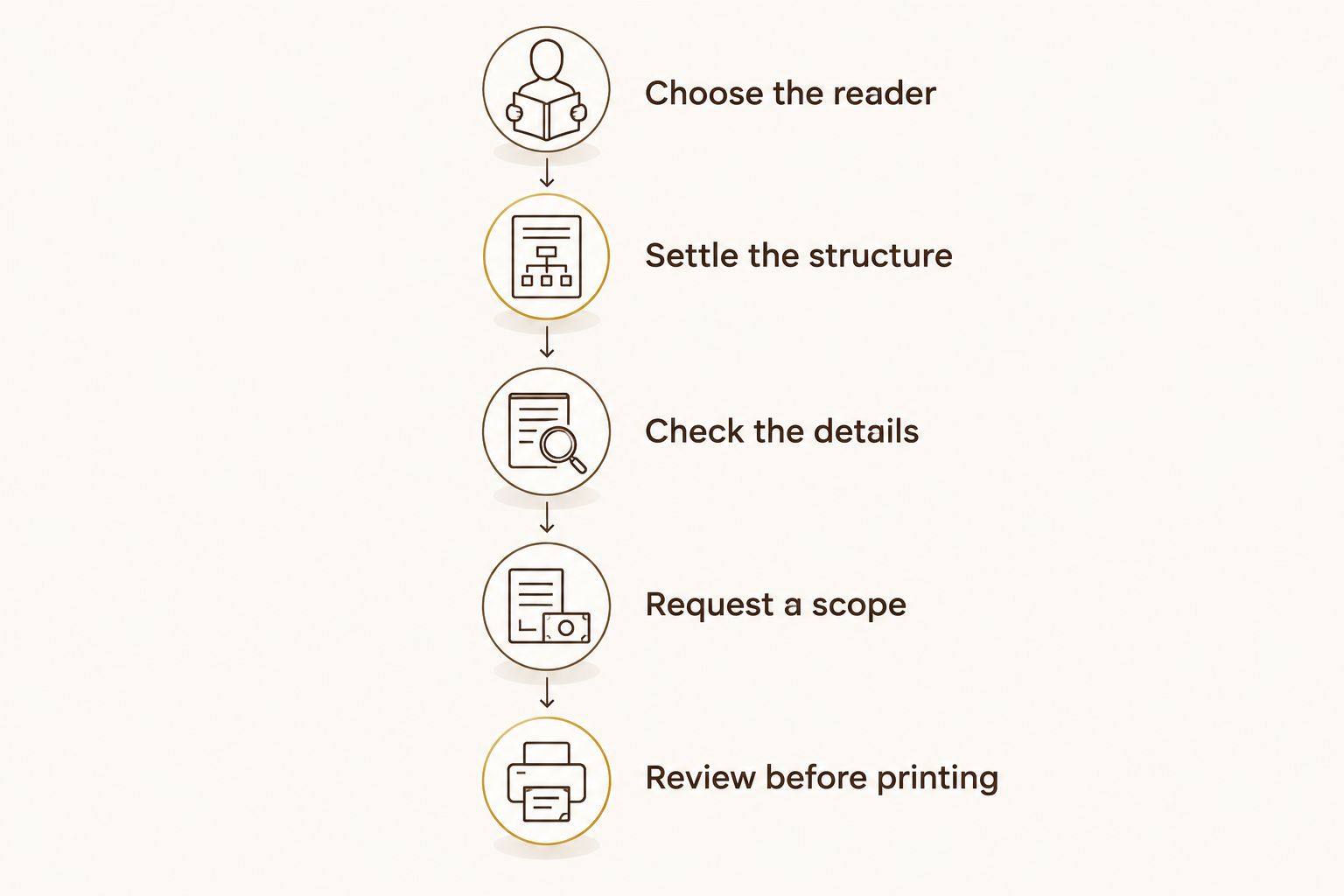
Prepare the manuscript before paying someone to polish it. That means resolving decisions you can make yourself—not trying to become a professional editor overnight. Follow this sequence for your 2026 family memoir.
- Choose the reader. Write a brief statement of who the book is for and what you want them to understand. A family audience still needs context, especially when younger relatives never met the people in your stories.
- Settle the structure. Arrange the chapters, remove accidental duplicates, and mark missing passages. Avoid commissioning detailed sentence work on sections you already expect to replace.
- Check the details. Review names, relationships, places, and dates against available records. Flag uncertainty openly so the editor knows which questions need your answer.
- Request a scope. Send the same manuscript version and brief to each prospective editor. Ask for clear deliverables, exclusions, and a revision process.
- Review before printing. Resolve editorial queries, approve the wording, and check the final pages before ordering your keepsake.
These steps do not guarantee a particular fee. They give you a defined assignment and reduce avoidable confusion about what still needs doing.
Can I edit my own memoir before hiring a professional?
You can prepare your own memoir before hiring an editor, especially by clarifying relationships, removing repetition, and identifying missing context. Read for meaning first, then make a separate pass for names and consistency; trying to solve everything at once makes review harder to organize.
Give yourself 2 separate readings: one as the storyteller and one as a relative encountering the events for the first time. This is a suggested review method, not a professional editing standard. For recorded material, use the guide to editing memoir chapters after recording to plan your next questions.
Does memoir editing include printing the book?
Memoir editing does not automatically include printing. Treat editing, book preparation, and the print order as separate parts of your plan unless your agreement explicitly combines them. Confirm who supplies the final file and who approves it for production.
Do I need every type of memoir editing?
You do not need to commission every editing service simply because it exists. Match the assignment to the manuscript: structural confusion calls for different help from punctuation errors. Ask the editor to explain the recommended scope using examples from your sample.
When a guided memoir app fits the process
Myvellum is best for people who want to begin a family memoir through guided voice interviews. Its twelve structured chapters provide a starting framework, with personalized hardcover or softcover books as the physical keepsake.
That is a writing-and-printing route, not evidence of an included professional editing service. Keep those decisions separate: begin recording your memories, assess the resulting manuscript, and then decide whether independent editorial help fits your goals.
Starting a free memoir lets you begin the writing stage before deciding on a printed book. Before ordering, review the current printing details and make sure the text reflects what you want your family to keep.
Begin your family memoir
Start a free memoir through guided voice interviews; decide on a printed keepsake separately.
FAQ
What should a professional memoir editing quote include?
A professional memoir editing quote should identify the manuscript version, editing scope, deliverables, schedule, and revision process. Ask the editor to state exclusions so you can compare proposals on the same basis.
Is proofreading enough for my family memoir?
Proofreading is appropriate for a settled manuscript in its final review stage. If readers cannot follow the chronology or understand the relationships, address those problems before commissioning a final proofread.
Should I choose per-word or hourly memoir editing?
Choose the arrangement whose scope and approval process you understand. Confirm the manuscript word count for per-word work, or the estimate and approval point for hourly work.
Can an editor preserve the way I speak?
Ask the editor to preserve your expressions, cadence, and intended meaning while improving readability. A representative sample edit helps you judge whether the proposed approach matches your voice.
Does copyediting verify all the facts in my memoir?
Do not assume copyediting includes independent fact-checking. Ask the editor to define that boundary, and check names, dates, and relationships against your own records.
Is a memoir app the same as hiring an editor?
A memoir app is not the same service as hiring an independent editor. Myvellum provides guided voice interviews and personalized printed keepsakes; agree separately on any professional editorial work you want.
Should I order my printed memoir before editing is finished?
Finish your intended editorial review before approving the print version. Check the final pages after changes so your family receives the wording you actually approved.
One last thing
Before approving your 2026 memoir, ask a trusted reader 3 questions: Who was unclear? Where did the timeline become confusing? Which passage sounded least like me?
Those answers make a useful final brief. A family keepsake succeeds when your relatives can follow the story and still recognize the person telling it—not when every sentence sounds professionally rewritten.


