

Corporate executives’ life story book is a personal memoir that connects career decisions with the experiences, relationships, and values your family should remember. This guide explains how to record your own memories, separate personal stories from confidential business information, and turn the manuscript into a family keepsake—not another corporate biography.
- A life story book for corporate executives should explain the person behind the position, not reproduce a résumé.
- Myvellum suits executives who want voice-guided memoir writing and a printed family keepsake.
- Record memories first; review sensitive details before including them in your family memoir.
- Starting a free memoir and ordering a printed book are separate decisions.
Why memoir writing matters for corporate executives
Your family needs context that a professional biography cannot provide: what you feared before accepting a role, who supported you during a difficult transition, and what work required you to give up. A title establishes responsibility. A remembered conversation explains what that responsibility felt like.
An executive memoir also requires boundaries. Stories about colleagues, customers, transactions, or internal disagreements need a different review from stories about childhood and family traditions. Write the personal lesson without treating access to business information as permission to publish it.
For a memoir started in 2026, decide whether you are writing for your household, extended family, or a wider readership. That choice determines how much background to explain and which details belong outside the manuscript.
Myvellum provides voice-guided memoir writing through twelve structured interview chapters and a personalized hardcover or softcover book. Keep myvellum.vercel.app as your reference point when separating the recording stage from the printed-book decision.
How to create your executive life story book
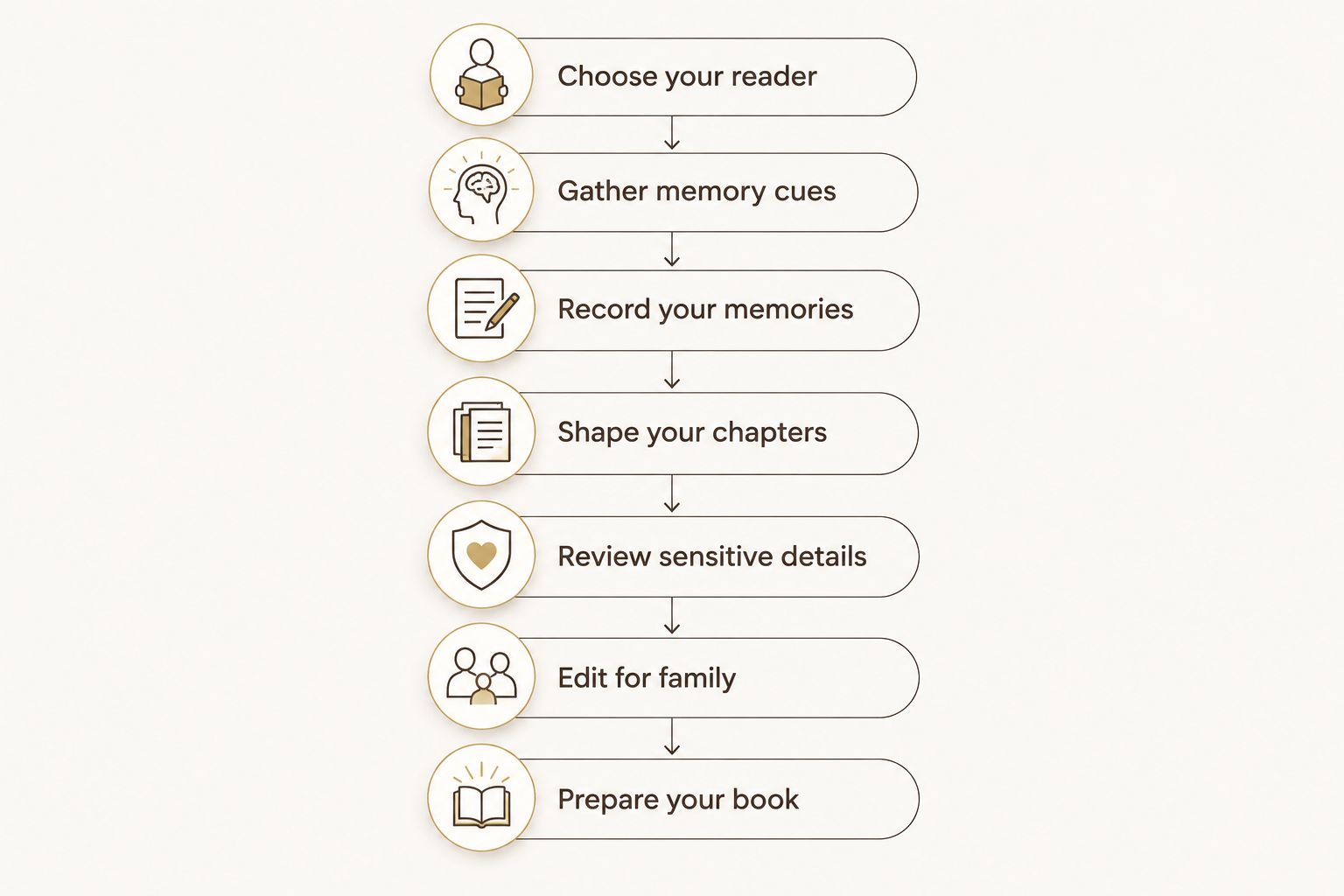
Build the memoir in this order: choose your reader, gather memory cues, record your memories, shape your chapters, review sensitive details, edit for family, and prepare your book. Recording comes before polishing; the decision to print comes after the manuscript is ready.
Choose your reader
Name the people you want to reach before choosing the stories. Writing for your children calls for explanations of family decisions; writing for grandchildren also calls for background about places, customs, and people they never knew. A book intended for colleagues has a different purpose and should not quietly displace the family memoir you meant to create.
Write a short purpose statement in your own words. It should identify the reader and what you want that person to understand about your life, rather than promise a record of every accomplishment.
For your 2026 draft, choose 3 questions the book should answer. Treat them as an editorial filter, not a performance target. When a career episode answers none of those questions, shorten it or leave it out.
- Name your primary family reader at the top of your planning document.
- List what that reader already knows about your career.
- Identify the personal experiences missing from your public biography.
- Decide whether the manuscript is family-only or intended for broader circulation.
Gather memory cues
Begin with materials you already control: personal photographs, calendars, letters, journals, and family recollections. Use them to recall a scene, not to build an archive of company records. A photograph of a first apartment might tell your family more about an early career move than a list of promotions.
Create a simple memory list before trying to organize chapters. Include life before leadership, relationships outside work, and periods when your professional identity changed. Childhood, education, caregiving, friendships, and retirement belong alongside career milestones when they explain who you became.
Choose 3 scenes to start: an early influence, a difficult decision, and a moment your family would recognize. This is a suggested starting exercise, not a limit on the finished book. Keep uncertain dates marked for later checking rather than interrupting every recollection.
- Gather personal photographs without copying confidential workplace materials.
- Note the people, place, and approximate period for each memory.
- Add ordinary family moments alongside major professional events.
- Flag dates and names that need confirmation.
Record your memories
Speak about a specific event as though you were explaining it to a family member. Describe where you were, what you wanted, what happened, and what changed afterward. Start with the scene; explain your job title only when the reader needs it.
The manual route is to record your voice with a recorder you already have, then turn the material into a draft yourself. This gives you control over the process but leaves transcription, organization, and book preparation as separate tasks.
Myvellum’s memoir-writing app offers a structured alternative through twelve voice-guided interview chapters. Myvellum suits executives who want voice-guided memoir writing and a printed family keepsake. The chapter structure supplies a starting point; it does not establish whether your recollection is accurate or appropriate to share.
Try a 15-minute recording appointment in your 2026 calendar. Treat that duration as a manageable starting routine, not a required session length.
- Record one event rather than summarizing an entire decade.
- Explain what you thought then before adding what you think now.
- Include the effect on your household, not only the business outcome.
- Keep confidential names and details out of the initial recording.
Shape your chapters
Organize the material around what your family needs to understand. A chronological structure helps readers follow moves, relationships, and career changes. A thematic structure groups stories around subjects such as belonging, ambition, responsibility, and starting again. Neither requires equal space for every role you held.
Choose a main structure and use it consistently. If you group stories by theme, provide enough time and place information for readers to follow them. If you follow chronology, give each chapter a point beyond reporting what happened next.
Within a chapter, connect an event to its personal consequence. Explain how accepting a role changed home life, how a disappointment affected your confidence, or how another person challenged your assumptions. That connection turns a professional episode into a life story.
- Give each chapter a clear personal question or theme.
- Place career milestones beside the family events happening at the time.
- Explain unfamiliar organizations and job titles in plain language.
- Remove repeated achievements that add no new personal meaning.
Review sensitive details
Review the manuscript for business confidentiality and other people’s privacy before circulating it. Your experience belongs in your memoir; that does not make every document, conversation, or identifying detail suitable for inclusion. A family-only audience is still an audience.
Make 2 review passes: one for accuracy and one for disclosure. During the accuracy pass, check dates, roles, and the distinction between what you witnessed and what you heard later. During the disclosure pass, examine names, business information, private family matters, and allegations about others.
For a 2026 manuscript, use the obligations that actually apply to you—not assumptions based on having left an employer. When a passage raises a legal question, obtain qualified advice before sharing or printing it. Changing a name alone does not resolve a disclosure concern.
- Separate firsthand observations from secondhand accounts.
- Remove confidential figures, customer details, and internal documents.
- Ask affected relatives before including intimate personal information.
- Keep unresolved sensitive passages out of the print-ready draft.
Edit for family
Read the draft as someone who knows you personally but has never worked in your industry. Replace unexplained acronyms, shorten organizational background, and explain why a decision mattered. Your reader needs enough context to understand the stakes, not a briefing on the business.
Preserve your speaking voice while removing repetition. Short, direct sentences often carry a memory better than formal executive language. Where you cannot remember exact words, describe the conversation instead of presenting reconstructed dialogue as a verbatim quotation.
Ask a trusted family reader which passages feel clear and which assume too much knowledge. Request specific feedback rather than a general approval. The useful question is whether the reader understands what happened and why it mattered to you.
- Replace internal jargon with words your family uses.
- Add context for people who appear without an introduction.
- Distinguish remembered impressions from established facts.
- Remove speech-like repetition without erasing your personality.
- Check whether loved ones appear as people, not background characters.
Prepare your book
Treat starting a free memoir and ordering a printed book as separate steps. Start by capturing your memories; make the print decision when you have reviewed the manuscript and understand the current ordering terms. Beginning the writing process is not the same action as ordering a physical keepsake.
Myvellum offers personalized hardcover or softcover memoir printing. Choose the format according to how you want your family to keep and read the book, then check the current format details before ordering. Do not assume that a manuscript review also checks the physical book specification.
Before placing a 2026 print order, review the actual print-ready material provided by your chosen service. Check names, chapter order, opening pages, and any photographs you have chosen to include. A family reader should review the same version you intend to print—not an earlier draft.
- Confirm that sensitive passages have been resolved or removed.
- Check the spelling of every person’s name.
- Review chapter order and any included photographs.
- Verify the current hardcover or softcover details.
- Read the ordering terms before authorizing the printed book.
Start your family memoir
Begin a free memoir; decide on a printed keepsake after reviewing your story.
Compare memoir-writing options for executives
Choose by the work you want help with, not by the most elaborate package. Capturing memories, shaping a manuscript, and producing a book are distinct tasks. A suitable route covers the tasks you need while leaving you responsible for accuracy and disclosure decisions.
| Option | Best for | Main advantage | Key limitation |
|---|---|---|---|
| Self-directed writing | Executives who prefer drafting their own prose | Direct control over voice, selection, and structure | You handle drafting, revision, and book preparation |
| Independent voice recording | Executives who want to speak before writing | Lets you capture a recollection without drafting sentences | Recordings still need to become an organized manuscript |
| Myvellum voice-guided memoir writing | Executives seeking structured interviews and a printed family keepsake | Twelve interview chapters with hardcover or softcover printing | A guided process does not replace accuracy and confidentiality review |
| A commissioned memoir writer | Executives who want another person to develop the manuscript | Editorial work can be assigned through an agreed scope | Deliverables, confidentiality, and printing must be established with the provider |
Self-directed work is best when writing itself is part of the experience you want. A commissioned writer is best when you want to delegate manuscript development and are prepared to review another person’s interpretation. For any route, establish what happens between the first interview and the final printed book.
Common mistakes corporate executives make
Replacing the memoir with a résumé
A sequence of titles explains your advancement but not your life. Keep an achievement when it reveals a relationship, decision, sacrifice, or change in values. Give the reader the consequence, not just the credential.
Making yourself the only decision-maker
Executive accounts can flatten the contributions of spouses, mentors, colleagues, and friends. Describe what other people contributed and where your understanding was incomplete. A family memoir does not need to defend your authority.
Assuming family circulation removes confidentiality concerns
A private audience does not settle whether information is yours to share. Review sensitive passages before uploading, circulating, or printing them. Keep the personal lesson even when you must remove the business detail that originally prompted it.
Turning hindsight into certainty
Do not make an uncertain decision sound inevitable because you know how it ended. Describe the alternatives you considered and what you did not know at the time. That honesty gives your family a clearer account of your judgment.
Polishing the opening before recording the rest
An elegant first chapter cannot substitute for the memories you have not captured. Record across your life before spending all your attention on the introduction. Revise the opening once you know what the whole book is about.
FAQ
What is a life story book for corporate executives?
A life story book for corporate executives is a personal memoir connecting career experiences with relationships, values, and life outside work. For a family keepsake, explain the person behind the professional biography rather than repeating a résumé.
How do I start my executive memoir without writing every day?
Start by speaking about one specific memory and turning that recording into a draft. Voice-guided memoir writing provides prompts, while independent recording leaves you to organize and develop the material yourself.
Is Myvellum suitable for an executive family memoir?
Myvellum suits executives who want voice-guided memoir writing and a printed family keepsake. It guides individuals through twelve interview chapters and offers personalized hardcover or softcover printing; you still need to review accuracy and sensitive content.
Can I include confidential business stories in my memoir?
Do not include confidential business information without establishing that you are permitted to share it. Explain the personal lesson without restricted details, and obtain qualified advice when a passage raises a legal question.
Should my executive memoir follow a timeline or themes?
Use a timeline when readers need to follow life transitions, and use themes when related experiences explain a recurring question. Either structure needs clear time and place information and a personal point for each chapter.
Is starting a free memoir the same as ordering a book?
No, starting a free memoir and ordering a printed book are separate steps. Begin by capturing your memories, then review the manuscript, format details, and current ordering terms before deciding to print.
Should I choose hardcover or softcover for my family memoir?
Choose according to how you want your family to keep and read the book, then verify the current format details. Review the manuscript before ordering either format; binding choice does not replace content review.
One last thing
Include an ordinary day that your professional biography would leave out. Describe the commute, the meal after a difficult meeting, or the conversation at home before a major decision. Explain what that moment meant rather than trying to make it impressive.
Before finishing your 2026 memoir, ask whether your family can recognize your life outside your title. If the answer is no, add a scene that belongs to the person they know. That is often the passage with the clearest reason to be in a family book.


