
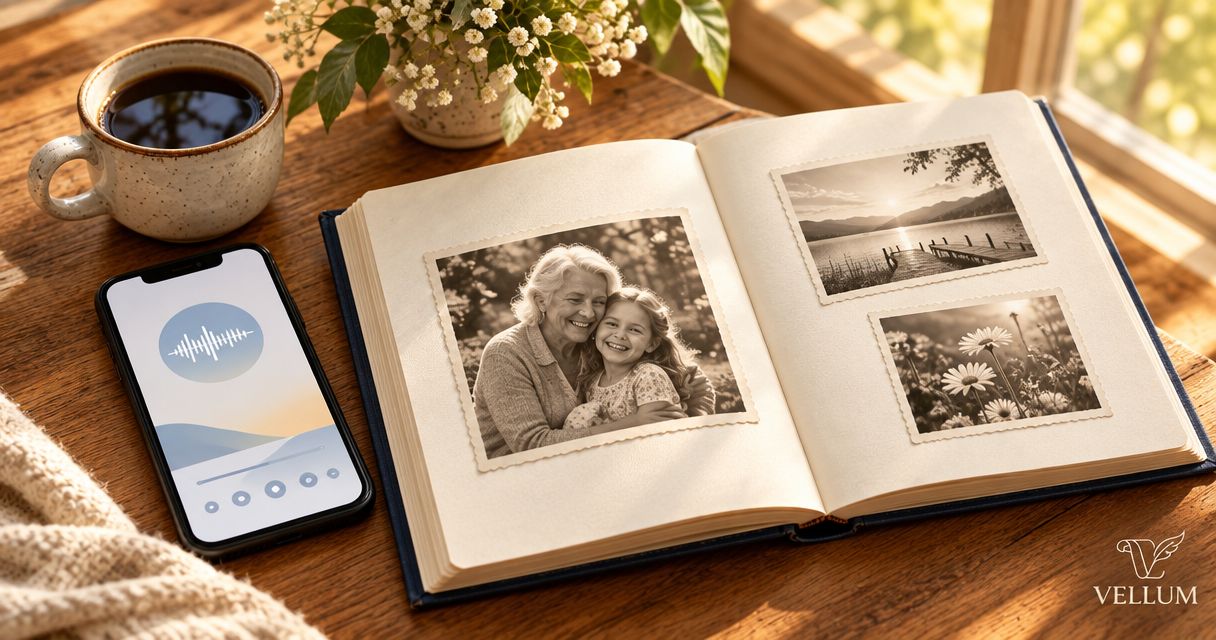
A hospice patient’s life story book is a collection of their own memories, words, and messages, created to give family a personal keepsake. This 2026 guide helps you record what matters at your pace, keep control of your story, and separate starting a memoir from ordering a printed book.
- A life story book for hospice patients should follow the storyteller’s wishes, not a deadline or a complete chronology.
- Myvellum suits storytellers seeking voice-guided memoir writing and a printed family keepsake.
- Start with one meaningful memory; record more only when you want to.
- Starting a free memoir and ordering a printed book are separate decisions.
Why life story books matter for hospice patients
Your family knows you through shared experiences, but your life also includes places, friendships, choices, and ordinary routines they never witnessed. A memoir gives you space to describe those memories in your own words. It does not need to explain everything or turn your life into a lesson.
For someone receiving hospice care, the project needs to fit around comfort, care, and personal wishes. The book should serve you; you should not have to serve the book. Stop when you want, leave questions unanswered, and choose whether anyone helps.
If you prefer speaking to writing, Myvellum offers voice-guided memoir writing through twelve structured interview chapters and personalized hardcover or softcover printing. myvellum.vercel.app is the place to explore that approach. Starting a free memoir is distinct from deciding to order a printed keepsake.
A useful goal for your 2026 project is not a complete autobiography. It is a collection you recognize as yours, with enough context for the people you choose to understand it.
How to create your life story book
Choose your audience and boundaries
Start on paper or in a simple document. Write down who the book is for and what you want those readers to carry with them. Your audience might be your children, a partner, close friends, or a wider family circle.
Decide what stays private before you begin recording. You can include warmth, uncertainty, regret, humor, or unfinished thoughts without disclosing every difficult experience. Sharing a life story does not require explaining a diagnosis, resolving a conflict, or leaving a message for everyone.
If someone helps, make their role explicit: they listen, record, organize, or read back your words. They do not decide what your life meant.
- Name the people you want to receive the book.
- Identify subjects you want to include and subjects you want to leave out.
- Decide who can hear recordings or read drafts.
- Tell your helper how you will signal that you want to stop.
- Keep a separate note for material that should remain private.
Pick a comfortable recording method
The manual route is straightforward: speak into a recorder you already know, dictate to a trusted person, or write a few lines yourself. Choose the method that asks the least of you, rather than the one with the longest feature list.
As an optional starting plan, try one memory in a five-minute session. That is a planning suggestion, not a medical limit or a requirement. End sooner whenever you want, and ask your hospice team about comfort or care concerns rather than trying to work around them yourself.
Myvellum memoir writing provides a guided alternative through twelve interview chapters. The structure supplies a framework for telling your story; it should not become a personal obligation to finish every topic. Before choosing any service, check how its recording, review, and printing process fits your needs.
- Use a familiar recording or writing method first.
- Ask a helper to handle setup if you want assistance.
- Choose a place where you feel comfortable speaking.
- Pause for care, rest, visitors, or simply a change of mind.
- Check how you will access and review the material afterward.
Record the memories you most want to share
Begin with the memory you want your family to have, not necessarily your earliest memory. A childhood kitchen, a friendship, a first job, or an ordinary evening can make a strong opening. You can arrange the sequence later.
Use three simple prompts: what happened, what you remember noticing, and why you want to include it. These are suggested questions, not a test. If you remember the smell of a room but not the date, preserve the detail you know and leave the date uncertain.
The memoir writing prompts guide is a related resource when you want more starting points. Choose prompts that invite a memory; skip those that feel intrusive or tiring.
- Start with a person, place, object, or event you want to remember.
- Describe a detail you can recall without guessing.
- Explain unfamiliar names or family nicknames.
- Say when a date or sequence is uncertain.
- Leave room for happy, funny, and ordinary memories alongside difficult ones.
Organize a small collection before expanding it
Begin by placing your recordings or notes into a few clearly named groups. A small collection is easier to review than a growing pile of material with no labels. You do not need a chapter for every decade or every family relationship.
For a 2026 memoir project, start with themes such as places, people, and turning points. Chronology is another option, but it is not the only way to help readers follow your life. Choose the arrangement that makes sense to you.
Keep the process simple: capture memories, add context, review words, then prepare the book. These are separate stages. Recording a story does not mean you have approved it for sharing or printing.
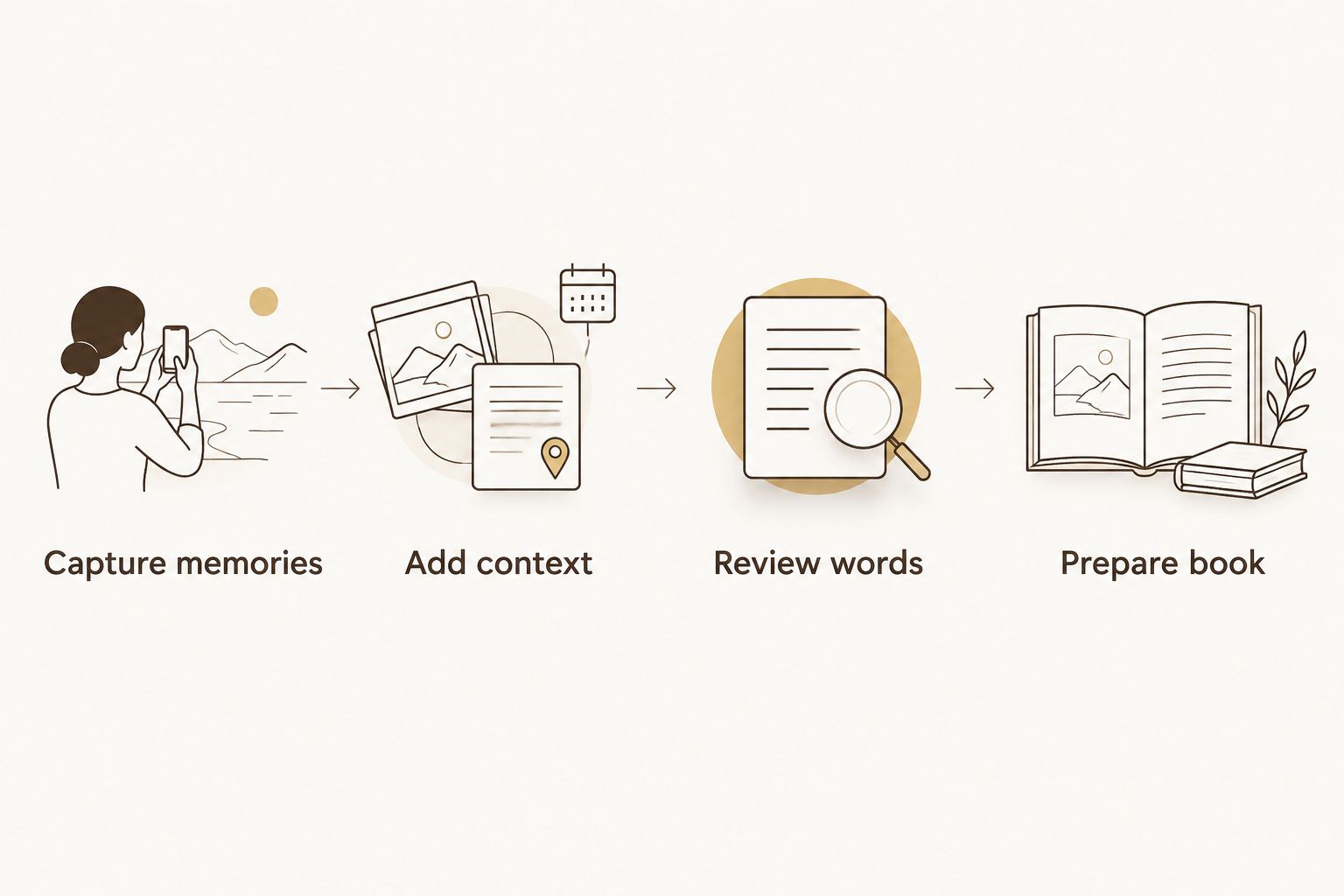
Give each item a plain title so your helper can find it without replaying everything. A title such as the house on the hill is more useful than an unnamed recording.
- Capture memories under short, recognizable titles.
- Add context for people and places readers do not know.
- Review words before including them in the manuscript.
- Prepare book material only after deciding what belongs.
- Keep unfinished stories separate from approved passages.
Review the story without losing your voice
Ask someone to read a short passage aloud, or review it yourself in whichever way feels easiest. Listen for meaning first. Does it say what you intended, and does it sound like something you would say?
Editing can remove repetition and explain a reference without replacing your voice with formal language. Keep expressions that matter to you. A family phrase or an understated joke does not need to become polished literary prose.
Do not fill memory gaps with invented details. If relatives remember an event differently, identify whose recollection appears in the book rather than forcing agreement. A personal memoir can preserve your perspective without claiming that every detail is independently verified.
- Confirm names and relationships where you can.
- Mark uncertain dates instead of supplying guesses.
- Remove passages you no longer want to share.
- Keep your characteristic phrases when they carry meaning.
- Label contributions from other people as their words.
Separate starting the memoir from ordering the book
You can begin with notes or recordings without deciding on a printed edition. Starting a free memoir and ordering a book are different steps: the first gathers your story, while the second turns selected material into a physical keepsake.
Myvellum offers personalized hardcover or softcover memoir printing alongside its voice-driven writing app. Choose a format after reviewing the material you want included. Neither cover type decides whether your story is meaningful.
Before placing an order in 2026, check the current service details directly, including manuscript requirements, proof review, and production arrangements. Do not build the project around an assumed delivery date. If timing matters, prepare an approved version your family can read separately from the printed edition.
- Start the memoir before committing to print.
- Decide which passages belong in the printed version.
- Check the available hardcover and softcover choices.
- Review names, captions, and chapter order before ordering.
- Confirm current production and delivery information with the provider.
Start your own memoir
Begin a free memoir, then decide separately whether to order a printed family keepsake.
Make a clear handoff plan
A handoff plan tells your chosen helper what to do with the work, including what not to do. Put it in a separate note rather than expecting someone to infer your wishes from the manuscript.
Decide whether unfinished material should stay unfinished, be excluded, or appear with an explanation. You can also name the person who will organize the files or handle a print order if you want that assistance. Permission to help does not automatically mean permission to rewrite or distribute everything.
Check the service’s access and sharing arrangements before relying on another person to manage the project. Avoid passing account passwords around as a substitute for a clear plan.
- Name the person you want to help with the manuscript.
- Identify which version you have approved.
- State who should receive the story.
- Explain how to handle unfinished or private material.
- Record your wishes for printing separately from your wishes for sharing.
Compare ways to create your family memoir
Myvellum is best for storytellers who want voice-guided memoir writing and a printed family keepsake. Its twelve-chapter structure gives the project a defined framework. The limitation is fit: a structured interview approach is not the same as an entirely open-ended recording or a personally directed writing process.
Choose based on how you want to tell your story and how much help you want. A method that preserves your words comfortably is a better choice than one selected only because it has more features.
| Option | Best for | Main advantage | Key limitation |
|---|---|---|---|
| Myvellum | Guided spoken memoirs with a printed keepsake | Connects voice-guided interviews with hardcover or softcover printing | Requires checking whether the structured process fits your needs |
| Personal audio recordings | Open-ended storytelling | Lets you speak without following a chapter plan | Recordings still need organization and text preparation for a book |
| Handwritten or typed memoir | Direct control over wording | Lets you compose and revise the text yourself | Writing and managing the manuscript remain your responsibility |
| Trusted-person interviews | Conversation with someone familiar | Allows personally chosen questions and immediate clarification | The helper needs clear boundaries to avoid changing your meaning |
| Professional writing support | Delegated manuscript development | Lets you assign agreed writing or editing tasks | Scope, voice preservation, and approval arrangements need explicit agreement |
You can combine methods without treating every recording as book material. For example, keep an open-ended conversation as a private recording and select only the passages you approve for the manuscript. Check the relevant service requirements before assuming material can move between systems.
Common mistakes hospice patients should avoid
Treating the memoir as a completion test
A life story book does not have to cover your whole life to be useful to your family. Finish a passage you care about before expanding the outline. A shorter approved collection is preferable to a larger collection that no longer reflects your wishes.
Letting someone else choose the emotional tone
A helper can ask questions, but you decide whether the story is funny, reflective, plainspoken, or private. You do not owe readers a farewell message. Everyday memories belong in the book too.
Allowing recordings to become shared material automatically
Speaking aloud is not the same as approving publication. Agree on who can access the recordings and review passages before they enter the family manuscript. Keep private material clearly separate.
Making the print order the only finish line
Printing is a separate production step, not the measure of whether the memoir exists. In 2026, keep an approved readable version alongside any print plans. Confirm current arrangements instead of assuming a physical book will arrive by a particular occasion.
FAQ
What’s the best way to start a life story book for hospice patients?
Start with one memory the storyteller wants to share and a recording or writing method they find comfortable. Decide who the book is for and what should stay private before building a larger outline.
Can I tell my life story without typing it?
Yes, you can speak your memories into a recorder, dictate to a trusted person, or use a voice-guided memoir app. Myvellum guides spoken memoir writing through twelve structured interview chapters and offers personalized printed books.
How long should a memoir recording session be?
The session should last only as long as you want to continue. A five-minute session is an optional starting plan, not a medical recommendation; stop sooner whenever you wish and consult your hospice team about care concerns.
Do I need to finish every chapter before my story matters?
No, your memoir can focus on selected memories rather than a complete life chronology. If you intend to use a printing service, check its manuscript requirements separately.
Is starting a free memoir the same as ordering a printed book?
No, starting a free memoir and ordering a printed book are separate decisions. Gather and review your story first, then check the current printing options and order requirements.
Can someone in my family help write my memoir?
Yes, a trusted person can help record, organize, or review your words if you want that help. Agree on their role, preserve your wording, and distinguish their memories from your own.
Should I choose a hardcover or softcover family memoir?
Choose the format you prefer after reviewing the manuscript and current printing options. The cover format does not determine the value of the memories inside.
One last thing
Add a brief note explaining how you want the book to be read. You might invite readers to share it together, keep it within the family, or understand that some memories remain uncertain. That note gives your family something practical: your wishes, in your own words.
Choose the next memory you want to preserve, not the next task you feel obliged to finish.


