
Adoptee memoir writing is recording your own memories, relationships, and questions with the aim of creating a family keepsake that preserves your perspective. This 2026 guide covers how to tell your story without filling gaps with guesses, how to protect sensitive details, and how to move from a free memoir draft to a printed book; myvellum.vercel.app offers a voice-guided route.
- Memoir writing for adoptees should preserve your perspective, not force a reunion story or a grateful ending.
- Myvellum suits storytellers who want voice-guided memoir writing and a printed family keepsake.
- Separate remembered scenes, documented facts, and unanswered questions before sharing your family history.
- Starting a free memoir and ordering a printed book are separate decisions; review your manuscript before ordering.
Why memoir writing matters for adoptees
An adoptee memoir has room for the family you grew up with, biological connections, cultural identity, and questions that remain unanswered. None of those threads has to dominate. Your ordinary life—friendships, work, parenthood, favorite places—belongs in the book, too.
The central challenge is telling your experience without presenting someone else's account as your memory. Adoption records, relatives' recollections, and personal impressions serve different purposes. Keep those distinctions visible so family readers understand both what happened and how you experienced it.
Your memoir does not need a reunion, complete records, or a settled explanation to be worth keeping. A family book can preserve uncertainty honestly instead of turning it into a tidy resolution.
Myvellum provides a route for recording your own life story. Choose your boundaries before choosing a writing method: a guided process should serve the story you want to tell, not determine which experiences you disclose.
How to write your adoptee memoir in 2026
Choose your audience
Start with a private note naming who will read the finished memoir. Writing for your children differs from writing for extended relatives or public readers. An intended audience gives you a practical test for each detail: does this help these readers understand your life?
Set a manageable first milestone rather than promising a complete autobiography. Try a 10-minute writing session about a familiar place. Treat that duration as a starting exercise, not a deadline for processing difficult memories.
Decide whether the family edition should include searching, reunion, estrangement, or medical information. You can keep material in a private draft without including it in the printed keepsake.
- Name the readers you want the book to reach.
- Write a sentence describing what you want them to understand.
- List subjects you will keep private for now.
- Choose a comfortable memory for your first session.
- Separate public publication from private family sharing.
Map your memories
Create a timeline on paper or in a document before drafting chapters. Mark places, households, schools, relationships, and turning points. Include your life beyond adoption so the book reflects a person rather than a single defining event.
Use 3 labels: remembered, documented, and told to me. Those labels describe the source of a detail, not whether a memory matters. A childhood feeling can be meaningful even when the exact date is unknown.
Keep a separate list of unanswered questions. That prevents an unknown birth detail from becoming an invented opening scene. If you are starting in 2026, date the working timeline so you can distinguish this account from information learned later.
- Mark major moves and changes in household.
- Add ordinary memories alongside major milestones.
- Label details by their source.
- Leave uncertain dates open rather than guessing.
- Collect questions separately from the narrative.
Record your scenes
The manual route is straightforward: speak into a recorder you already have, then write down the passages you want to keep. Alternatively, draft directly in a notebook. Begin with a scene you remember—where you stood, what someone did, and what you felt—rather than a summary of your entire adoption history.
For a more structured route, Myvellum memoir writing uses voice-guided interviews across twelve chapters and offers personalized hardcover or softcover books. Myvellum is best for people who want voice-guided memoir writing and a printed family keepsake. The limitation is fit: a twelve-chapter framework is not proof of adoption-specific prompts or specialist support.
Start with 3 prompts: describe a place where you felt at home, recall a moment when you understood your adoption differently, and explain what family means to you now. Skip any prompt you do not want to answer.
- Record a remembered scene instead of a complete life summary.
- Say when a detail comes from someone else's account.
- Keep your natural expressions when revising spoken material.
- Stop a session when you no longer want to continue.
- Use memoir writing prompts to find another starting point.
Check your facts
Review your draft against documents you already have and accounts you choose to request. Do not make obtaining records a condition for writing. Your experience is part of the story even when supporting paperwork is incomplete.
Separate observation from interpretation. Describing a relative's action is different from assigning that relative a motive. Where accounts conflict, identify whose account you are using instead of presenting a disputed version as settled fact.
Preserve the difference between childhood understanding and adult understanding. You can describe what you believed then and what you think now without treating either perspective as the whole story. Do not reconstruct exact dialogue when you remember only its meaning.
- Check names, places, and dates against available records.
- Identify information supplied by relatives.
- Summarize conversations unless you have the exact words.
- Mark conflicting accounts clearly.
- Remove explanations for other people's motives that you cannot support.
Protect your boundaries
Review privacy before asking family members for feedback. A memoir written for your children can still disclose another person's health history, address, or painful experience. Decide what your readers need and what belongs outside the family edition.
Consent to contribute a memory is not automatically consent to publish every detail. Ask contributors how they want to be named and whether they agree to the use of photographs or sensitive accounts. This is an editorial practice, not a substitute for legal advice about disputed material.
You also control your own disclosure. Leaving out a scene is not the same as denying it happened. If writing brings distress, stop and choose whether to seek support from someone qualified to help.
- Remove unnecessary identifying details about other people.
- Ask permission before including contributed photographs or accounts.
- Keep sensitive source documents outside the manuscript.
- Decide whether private material needs a separate draft.
- Review sharing boundaries before sending files to relatives.
Shape your chapters
Choose an organizing principle after you have enough material to see what connects. Chronology helps readers follow change over time. A thematic structure groups memories around ideas such as belonging, names, language, home, or becoming a parent.
For a 2026 draft, write a short present-day reflection separately from each remembered scene. This keeps the adult narrator from explaining away the child's experience. You can connect the perspectives during revision without making every chapter end in a lesson.
Read transitions aloud. If a chapter moves between households or periods of life, orient readers with a place or relationship before continuing. A family member should not need your private timeline to follow the book.
- Group scenes by time period or shared theme.
- Open chapters with a scene or a clear question.
- Explain relationships when people first appear.
- Separate remembered experience from present-day reflection.
- Cut repetition without erasing conflicting feelings.
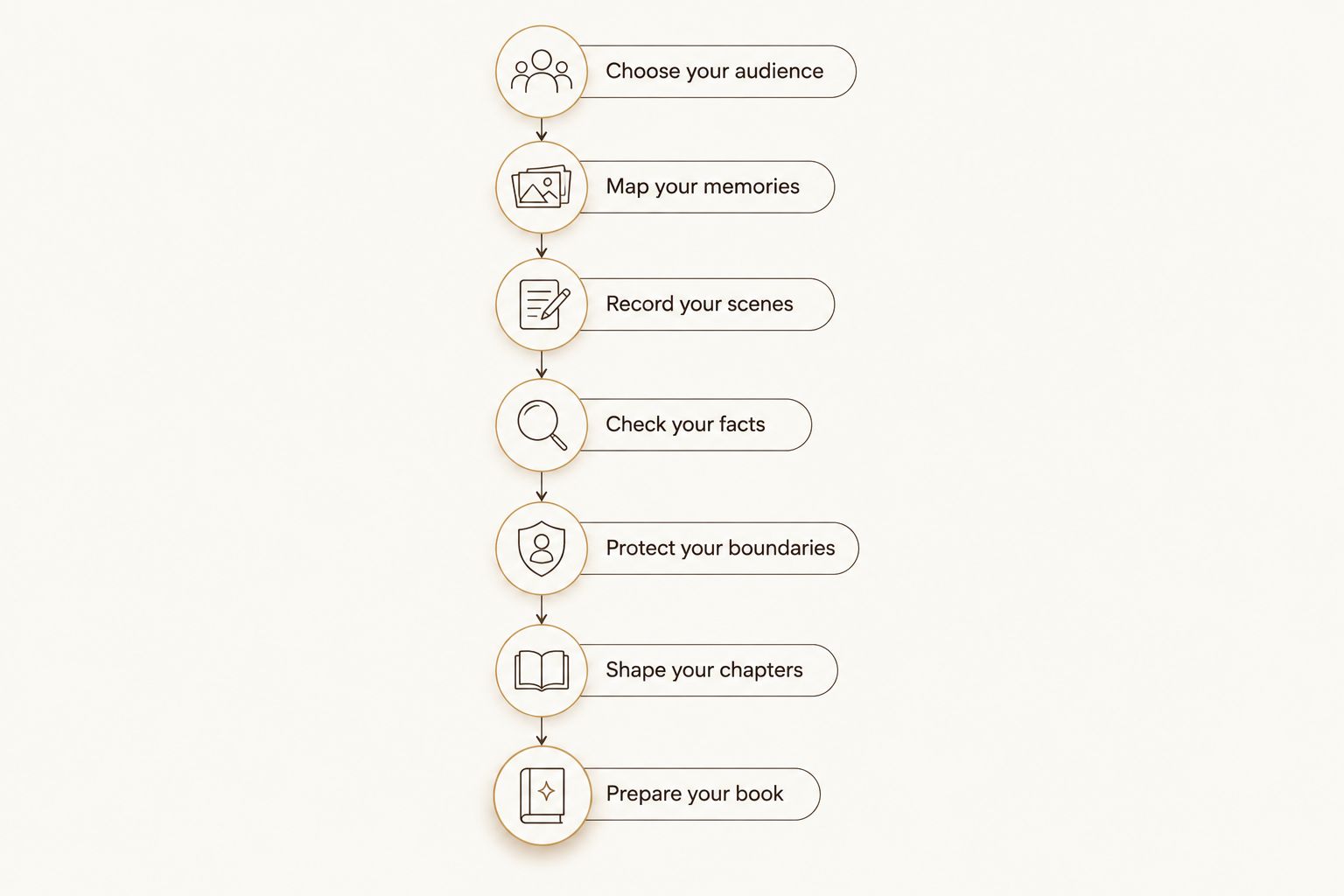
The process moves from gathering your material to deciding what belongs in the finished book. Keep fact-checking and privacy review ahead of printing, rather than treating them as corrections for a later edition.
Prepare your book
Treat starting a free memoir and ordering a printed book as separate steps. The first is about capturing your memories; the second is a decision about the manuscript you want family members to keep. Do not let enthusiasm for a physical book rush the editorial review.
Myvellum offers personalized hardcover or softcover printing. Before ordering, check the current process and requirements, then review the material you intend to print. Do not assume a writing service includes specialist editing, adoption-record verification, or a privacy review.
Label your working file as the 2026 draft and keep a separate final copy. That distinction helps prevent unfinished passages or private notes from reaching the family edition. Choose the cover format after the manuscript is ready, not as a reason to declare it finished.
- Read the complete manuscript aloud before ordering.
- Check names, captions, chapter titles, and missing transitions.
- Remove research notes and private drafting comments.
- Confirm the current printing requirements and available formats.
- Save the approved manuscript separately from working files.
Start telling your story
Begin with your memories. Decide on a printed family keepsake after reviewing your manuscript.
Compare memoir-writing options for adoptees
Choose a method based on how you express yourself and how much editorial control you want. The right option helps you capture material without making decisions about privacy or identity on your behalf.
| Option | Best for | Main advantage | Key limitation |
|---|---|---|---|
| Notebook or document | Writers who want a self-directed draft | You choose the questions, structure, and wording | You handle organization, revision, and print preparation yourself |
| Personal audio recordings | Storytellers who speak more easily than they write | You capture spoken phrasing before editing | You still need to turn recordings into a readable manuscript |
| Myvellum | Storytellers seeking guided voice interviews and a printed keepsake | Twelve structured interview chapters with hardcover or softcover printing | A structured framework does not establish adoption-specific guidance or specialist editing |
| Memoir ghostwriter | Writers who want another person to help shape the narrative | You can seek individual help with structure and prose | You must define scope, confidentiality, editorial control, and printing arrangements |
Choose guidance for momentum, not as permission to tell your story. With any method, retain the right to reject a prompt, change a chapter, and keep a memory out of the printed edition.
Common mistakes adoptees make when writing memoirs
These are editorial traps to check for, not assumptions about how adoptees feel. Your story can hold affection, grief, anger, gratitude, uncertainty, or none of those in the expected places.
- Making adoption the whole biography. Include the work, relationships, interests, and ordinary routines that shaped your life. Adoption can be central without occupying every chapter.
- Treating missing information as a narrative defect. State what remains unknown. Do not invent a birth scene or biological relative's thoughts to make the opening feel complete.
- Letting relatives decide which feelings are acceptable. Ask readers to check specific facts. Their disagreement with your experience does not automatically make your account inaccurate.
- Forcing an ending around reunion or reconciliation. End where your understanding stands, including an unresolved question if that is honest. Contact with biological relatives is not a required plot point.
- Printing the private draft unchanged. Review disclosures, names, and contributed material again. A draft helps you think; a family edition is something you deliberately share.
FAQ
How do I start memoir writing as an adoptee?
Start with a scene you remember clearly, not an explanation of your entire adoption history. Describe the place, the people present, and your experience, then identify any details supplied by someone else.
Can I write an adoptee memoir without finding my birth family?
Yes, an adoptee memoir does not require finding or contacting biological relatives. Write about your own life and identify unanswered questions without inventing answers.
What is the best memoir-writing approach if speaking feels easier?
Voice recording is a practical starting method when speaking feels easier than drafting prose. Myvellum provides voice-guided memoir writing across twelve structured interview chapters and offers personalized printed books; check whether that framework fits your story.
Should I use real names in my family memoir?
Choose names deliberately after considering privacy, consent, and your intended readers. Discuss contributed material with the people involved, and seek qualified advice if a passage raises a legal concern.
How do I write about conflicting family accounts?
Identify whose account you are describing and keep disputed details distinct from your own memories. Acknowledge the conflict rather than presenting an uncertain version as settled fact.
Is starting a free memoir the same as ordering a printed book?
No, starting a free memoir and ordering a printed book are separate decisions. Capture and revise your memories first, then check the current ordering process before preparing your family keepsake.
Does my adoptee memoir need a happy ending?
No, an adoptee memoir needs an honest ending, not a happy one. Close with your present understanding, a meaningful scene, or a question you still carry.
One last thing
Before finishing your 2026 manuscript, add a note about the words you chose for family relationships. Explain which terms feel right to you and where you have kept someone else's terminology. That small editorial choice helps readers understand your perspective without requiring every chapter to defend it.
Leave your family a story they can understand, not a verdict they must agree with. The keepsake is your account of a life lived—not a requirement to resolve every question about its beginning.


