

Caregivers’ memoir writing is recording your own life story with the aim of creating a family keepsake that preserves who you are beyond your caregiving role. This 2026 guide from Myvellum covers capturing memories around interruptions, protecting other people’s privacy, and turning your story into a printed book; myvellum.vercel.app is the starting point.
- Memoir writing for caregivers should preserve your whole life, not just your caregiving responsibilities.
- Myvellum is best for caregivers who want voice-guided memoir writing and a printed family keepsake.
- Capture oral history in small pieces, then organize those memories into a family memoir.
- Starting a free memoir and ordering a printed book are separate decisions.
- Review private details and uncertain memories before sharing your life story with family.
Why memoir writing matters for caregivers
Your family memoir should introduce the person behind the responsibilities: the child you were, the work you chose, the friendships you kept, and the experiences that changed you. Caregiving belongs in that story, but it does not have to become the entire plot.
A caregiver’s writing process needs room for interruption. An approach that requires finishing a polished chapter before stopping creates a different task from recording a memory and returning to it later. Build a process you can pause without losing your place.
For your 2026 memoir project, define success as a readable account of your own life, not an exhaustive record of someone else’s care. You can describe love, fatigue, responsibility, and uncertainty without publishing another person’s medical history. Decide what your family should understand about you before choosing what to include.
How to write your own caregiver memoir
1. Define the family story you want to leave
Start with a notebook or a blank document. Write a short statement describing who will read your memoir and what you want those readers to understand. A useful starting point is a wish to explain your life choices, preserve family traditions, or tell stories that never come up during everyday conversations.
Choose an audience before choosing a format. A book intended for close relatives needs different boundaries from a memoir you plan to circulate beyond the family. You also do not need to settle every detail now; you need a clear direction that helps you decide which memories belong.
Make your life the subject, even when caregiving is the reason you finally start writing. Treat a suggested 1-page outline as a planning exercise, not a measure of how much your life deserves.
- Name the relatives or future readers you have in mind.
- Write the main idea you want them to remember.
- List experiences from before your caregiving role.
- Mark subjects you want to keep private.
- Decide whether the first draft will be chronological or thematic.
2. Capture memories before trying to polish them
Use a notebook or a recording tool you already have. Describe a single event in plain language: where you were, who was there, what happened, and why it stayed with you. Spoken memories do not need an elegant opening sentence.
For a manageable exercise, try a 5-minute recording about one scene. That duration is a suggested boundary, not a requirement or a claim about how quickly a memoir gets written. Stop sooner if care responsibilities interrupt you, and leave yourself a short note about what comes next.
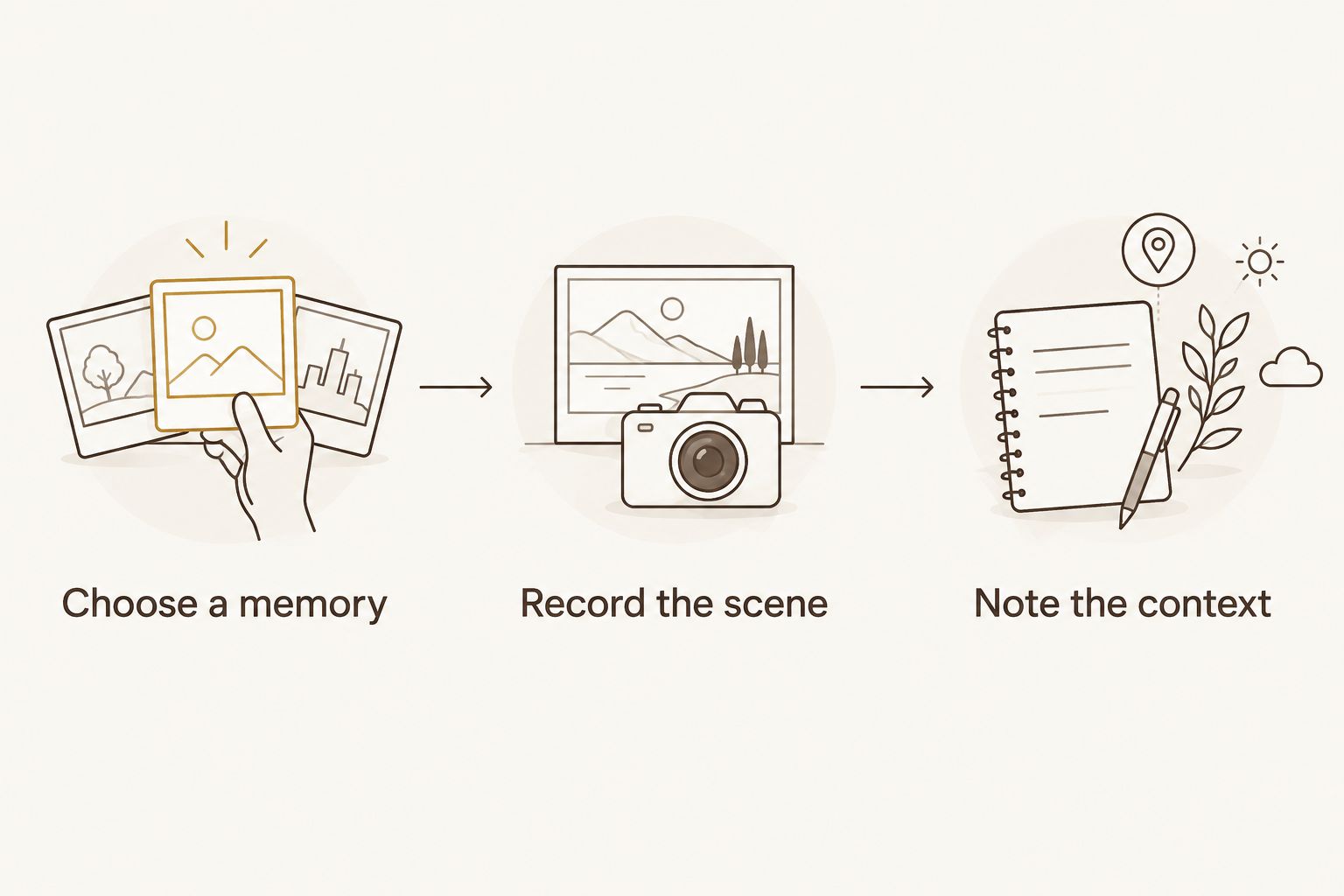
Separate collecting material from editing it. Your capture sequence can be simple: Choose a memory, Record the scene, and Note the context. Keep these pieces together so you do not have to reconstruct the event when you return.
- Start with an event rather than your entire childhood.
- Record in a setting that protects private conversations.
- Describe a detail you actually remember.
- Label each note with its subject.
- End interrupted sessions with a clear restart note.
3. Organize your memories into a life-story structure
Sort your notes manually into broad themes such as childhood, relationships, work, home, change, and caregiving. A timeline helps you place events; themes help you explain their meaning. Choose the arrangement that makes your experiences easiest for a family reader to follow.
For a guided alternative, Myvellum’s memoir-writing app uses voice-driven interviews across twelve structured chapters and offers personalized hardcover or softcover books. Myvellum is best for caregivers who want voice-guided memoir writing and a printed family keepsake. The trade-off is that you still need to decide what belongs in your story and review it before sharing.
If speaking feels more natural than drafting paragraphs, compare the approach described in the guide to voice-to-text memoir writing apps. Choose a method for your 2026 project based on how you want to capture memories, not how impressive its feature list sounds.
- Group related memories before editing sentences.
- Give each chapter a clear subject.
- Place caregiving within your wider life story.
- Identify gaps that need another recording.
- Keep a separate list of names and relationships.
4. Separate your experiences from someone else’s private story
Mark sensitive passages in your draft before asking anyone to read it. Distinguish what you experienced, what someone told you, and what you inferred. A memoir can describe your response to a difficult day without documenting another person’s symptoms or intimate routines.
Ask permission before including identifiable details that another person considers private. If you cannot resolve a concern, remove the unnecessary detail or tell the scene from your own perspective. Do not present guessed motives as facts, and do not replace an uncertain memory with invented dialogue.
You can also maintain separate versions: a private draft for your own reflection and a family edition for sharing. Honesty does not require publishing every detail. Selective disclosure lets you preserve the truth of your experience while respecting the people who appear in it.
- Highlight medical, financial, and relationship details.
- Describe your feelings without diagnosing another person.
- Ask before including sensitive identifiable information.
- Remove quotations you cannot reliably recall.
- State uncertainty when the sequence or date is unclear.
5. Edit for a family reader, not an imaginary critic
Read the draft aloud or review it a section at a time. Look first for missing context: an unexplained nickname, a move without a reason, or a relative introduced without their relationship to you. Those gaps matter more than finding a grand literary voice.
Keep your phrasing where it carries your personality. A family memoir should sound like you, not like a formal report about you. At the same time, remove repetition that obscures the story and explain references that a younger relative will not understand.
For your 2026 review, consider asking 1 trusted reader to flag confusing passages. That is a suggested review arrangement, not a requirement. Give the reader a narrow task so their feedback improves clarity without turning your memories into a committee project.
- Explain unfamiliar names when they first appear.
- Check the sequence of major life events.
- Replace broad summaries with remembered scenes.
- Keep uncertainty visible instead of guessing.
- Ask a reader what needs explanation, not what needs approval.
6. Prepare a version that belongs in a family book
Create a clean manuscript separate from your working notes. Remove unfinished prompts, duplicated passages, and comments meant only for yourself. Read the opening and ending of each chapter to check whether they give the reader a clear way into and out of the subject.
Think about the family reader who will encounter the book without you beside them. They need enough context to understand a place, a relationship, or a turning point. They do not need every notebook entry you made along the way.
Myvellum offers hardcover and softcover keepsake formats. Choosing a format does not replace reviewing the story: wording, names, and privacy decisions remain separate from the physical binding. Treat the manuscript as finished only when you are comfortable sharing the version you have prepared.
- Remove draft instructions and unresolved comments.
- Check names and relationships consistently.
- Review chapter titles for clarity.
- Explain family references that need context.
- Confirm that sensitive passages belong in the shared edition.
7. Separate starting your memoir from ordering your book
Begin by collecting and reviewing your story. Starting a free memoir and ordering a printed book are distinct steps; you do not need to make every printing decision while you are still remembering what happened.
Before ordering, review the current printing details on the service you choose. Check the format, manuscript requirements, preview process, and delivery information rather than assuming that every memoir service handles them the same way. Do not set a family-event deadline without confirming the relevant production and delivery terms.
For a 2026 keepsake, decide which version you want relatives to receive and keep your own working material organized separately. Order the story you have reviewed, not the draft you are still trying to finish.
- Start with memory capture rather than printing decisions.
- Finish the privacy and clarity review.
- Choose between the offered book formats.
- Check the current ordering requirements.
- Keep a copy of the manuscript you intend to share.
Start your own family memoir
Begin with your memories; decide on a printed keepsake after reviewing your story.
Compare memoir-writing options for caregivers
Choose the option that fits how you want to work. Writing, recording, guided interviews, and professional assistance solve different problems; none removes the need to review private details.
| Option | Best for | Main advantage | Key limitation |
|---|---|---|---|
| Notebook or document | Caregivers who prefer writing and want an open-ended structure | You choose the prompts, sequence, and wording | You must organize and prepare the manuscript yourself |
| Audio recordings | Caregivers who want to capture their speaking voice | You can tell a scene without drafting polished prose | Recordings still need selection and preparation for a readable book |
| Myvellum | Caregivers who want guided voice interviews and a printed keepsake | Twelve structured interview chapters connect life-story capture with hardcover or softcover printing | Guided interviews do not replace your review of accuracy and privacy |
| Professional memoir writer | Caregivers who want another person involved in shaping the manuscript | The work can be organized around interviews and editorial collaboration | Scope, responsibilities, and control over revisions require an explicit agreement |
Choose guided interviews for structure, direct writing for flexibility, and professional assistance for collaboration. If your immediate goal is simply to preserve a memory, a notebook or recording is a valid beginning. If your goal is a family book, include manuscript preparation in your plan from the start.
Common mistakes caregivers make
Letting caregiving erase the rest of the story
A memoir that begins and ends with responsibilities leaves out the experiences that shaped you. Include childhood, work, friendship, love, interests, and decisions that happened before and alongside caregiving.
Waiting for an uninterrupted writing day
Designing the project around a perfect day gives interruptions too much control. Keep a restart note with each unfinished memory so returning to it becomes a clear task rather than another planning session.
Writing someone else’s medical biography
Your memoir is not a substitute for a care record. Describe what a situation meant to you, and remove private details that do not help the family understand your life.
Making the printed book the first decision
Choosing a binding cannot solve an unclear manuscript. Capture the memories, shape the story, and review the shared edition before placing an order.
FAQ
How do I start memoir writing when I am a caregiver?
Start with a single memory from your own life and record or write what happened. Give the note a subject and a restart point so you can return after an interruption.
Should my caregiver memoir focus only on caregiving?
No, your caregiver memoir can cover your whole life. Include the childhood, relationships, work, interests, and choices that explain who you are beyond your responsibilities.
Is speaking my memories better than typing them?
Speaking is the better starting method when telling a story feels easier to you than drafting it. Typing gives you direct control over the text; either method still requires organization and review before printing.
What is Myvellum best for?
Myvellum is best for caregivers who want voice-guided memoir writing and a printed family keepsake. Its approach uses twelve structured interview chapters and offers personalized hardcover or softcover books.
Can I start a free memoir without ordering a book?
Starting a free memoir and ordering a printed book are separate steps. Begin with your story, then review the current ordering details when you are ready to create a physical keepsake.
How do I write honestly without exposing someone else's private life?
Write from your own perspective and remove private details that the story does not need. Ask before including sensitive identifiable information, and describe uncertainty rather than inventing facts or dialogue.
When is my memoir ready to become a printed family book?
Your memoir is ready for printing when you have reviewed its wording, names, sequence, and privacy boundaries. Check the chosen service's manuscript and ordering requirements before submitting the version you want to share.
One last thing
End a chapter with something your family can carry into their own lives: a tradition you hope continues, a lesson you learned, or a question you still ask. The closing thought does not need to resolve every difficult experience.
For your 2026 family memoir, try leaving a short note addressed directly to the reader. Tell them what you hope they understand about you. That personal connection gives the memories a purpose beyond documenting events.


