

LGBTQ elders’ memoir writing is the process of recording your memories with the aim of creating a personal keepsake for family, including chosen family. This 2026 guide covers how to tell your story in your own language, protect other people’s privacy, and move from a first recording to a printed book; Myvellum at myvellum.vercel.app offers voice-guided memoir writing and personalized book printing.
- Memoir writing for LGBTQ elders starts with your memories, your identity language, and your intended readers.
- Myvellum suits storytellers who want voice-guided memoir writing and a personalized printed keepsake.
- Chosen family belongs in family history; explain relationships without making your story a defense of them.
- Starting a free memoir and ordering a printed book are separate steps; review the manuscript before ordering.
Why memoir writing matters for LGBTQ elders
Your memoir does not need to explain an entire community. It needs to preserve your life. A family memoir can hold the ordinary details that a timeline misses: who made you laugh, where you felt at home, and what you wanted your younger self to know.
Identity, disclosure, and family relationships deserve deliberate editorial choices. You decide whether coming out anchors a chapter, appears briefly, or stays private. You also decide who counts as family; a biological family tree does not have to determine the book’s cast.
For your 2026 project, separate two decisions: what you want to remember and what you want to share. A private recording can contain material you later remove from the family edition. Keeping those decisions separate lets you begin without treating every spoken memory as a publishing commitment.
How to turn your memories into a family memoir
1. Choose your readers
Start with a notebook or a plain document. Write down who you want to read the finished book and what you want those readers to understand about you. That statement becomes a practical editing rule, not a dedication you must get perfect.
A book for a partner and close friends needs different context from one for younger relatives who never met the people you describe. Neither audience requires a complete account of everything that happened. Choose a manageable purpose, such as preserving your home life, explaining a turning point, or remembering the people who helped you become yourself.
Keep the first outline provisional. You can change the intended audience after recording, especially if the material becomes more personal than expected.
- Name your intended readers, including chosen family where relevant.
- Write one sentence describing what you want them to remember.
- Mark topics as shareable, private, or undecided.
- Choose whether the book covers your whole life or a selected period.
2. Set your boundaries
Before recording, make a private boundary sheet. List the names, relationships, locations, and events that need careful handling. This is especially useful when a story includes someone whose identity or relationship history is not public.
Telling your own story does not require disclosing someone else’s identity. You can explain what a relationship meant to you without naming every person or describing every intimate detail. When identifying information is unnecessary, remove it rather than assuming a changed name solves the problem.
Decide how you want to refer to yourself across different periods of your life. Your current name and pronouns can remain consistent throughout the book, with a brief explanation only where readers need it. Historical terminology belongs in the manuscript only when you choose it and its context is clear.
- Write your preferred name, pronouns, and identity terms.
- Flag stories that reveal another person’s private information.
- Ask living people before including sensitive identifying details about them.
- Keep a separate list of material excluded from the shared manuscript.
3. Record memories
Use a recorder you already have or write directly in a document. Begin with one scene rather than your entire life: a kitchen conversation, a first apartment, a gathering with friends, or the moment someone made you feel welcome. Describe what happened before explaining what it meant.
For a manageable starting routine in 2026, try a 10-minute session focused on one memory. That is a suggested boundary, not a speed target. Stop sooner if the subject feels difficult, and leave unfinished thoughts for another day.
Myvellum is best for people who want voice-guided memoir writing and a personalized printed family keepsake. Its twelve structured interview chapters provide a defined framework; the limitation is that a framework still needs your judgment about emphasis, language, and what to leave out.
Starting a free memoir is the drafting step. Ordering a hardcover or softcover book is a later decision, after you have reviewed the story you want to share. You do not need to settle the print format before recording your first memory.
- Record one scene with a place, a person, and an action.
- Describe a sound, object, or small detail you remember.
- Say when a date is uncertain instead of supplying an exact one.
- Finish with what the memory means to you now.
4. Organize chapters
Read your notes or listen back to your recordings before choosing a structure. A chronological outline works when the sequence itself explains your life. A thematic outline works when relationships, places, work, creativity, or community connect memories from different periods.
Do not force every chapter to revolve around identity or adversity. Leave room for humor, favorite meals, professional pride, friendships, and the rituals that made a home. If loss or discrimination shaped your life, include it on your terms rather than making it the price of telling the rest.
Draft 3 scenes for a chapter before adding a long summary. This is a planning exercise: a few specific moments give you something concrete to arrange. If speaking comes more naturally than outlining, compare approaches in the guide to voice-to-text memoir writing apps.
- Choose chronology, themes, or a clearly signposted combination.
- Give each chapter a plain working title.
- Introduce important people before relying on their names alone.
- Connect each scene to the chapter’s central idea.
5. Review wording
Edit for meaning before polishing sentences. Read a passage aloud and ask whether it sounds like something you would say. Keep expressions that carry your personality, even when a shorter or more formal alternative exists.
Separate remembered experience from documented detail. A photograph, letter, or calendar can help check a date; it does not settle everything you felt or understood at the time. If you remember an exchange but not its exact words, describe the conversation rather than presenting reconstructed dialogue as a verbatim quotation.
Plan 2 review passes: one for factual clarity and one for voice. These are recommended tasks, not a claim about how many edits a memoir needs. A trusted reader can help identify confusing relationships or unexplained references without taking control of your account.
- Check names, places, dates, and relationship descriptions.
- Replace unsupported exact dialogue with a remembered summary.
- Explain unfamiliar terms where your intended readers need context.
- Keep sentences that sound like you; revise those that do not.
6. Check consent
Review the draft specifically for what it reveals about other people. A passage that feels harmless to you can identify someone through a workplace, neighborhood, relationship, or event, even without a full name. Read for combinations of details, not just names.
Ask for input on sensitive passages when doing so is safe and appropriate. Make the request narrow: you are checking the information about that person, not handing over authorship of your life. If contacting someone is unsafe, do not make contact a requirement; remove unnecessary identifying information or leave the passage out.
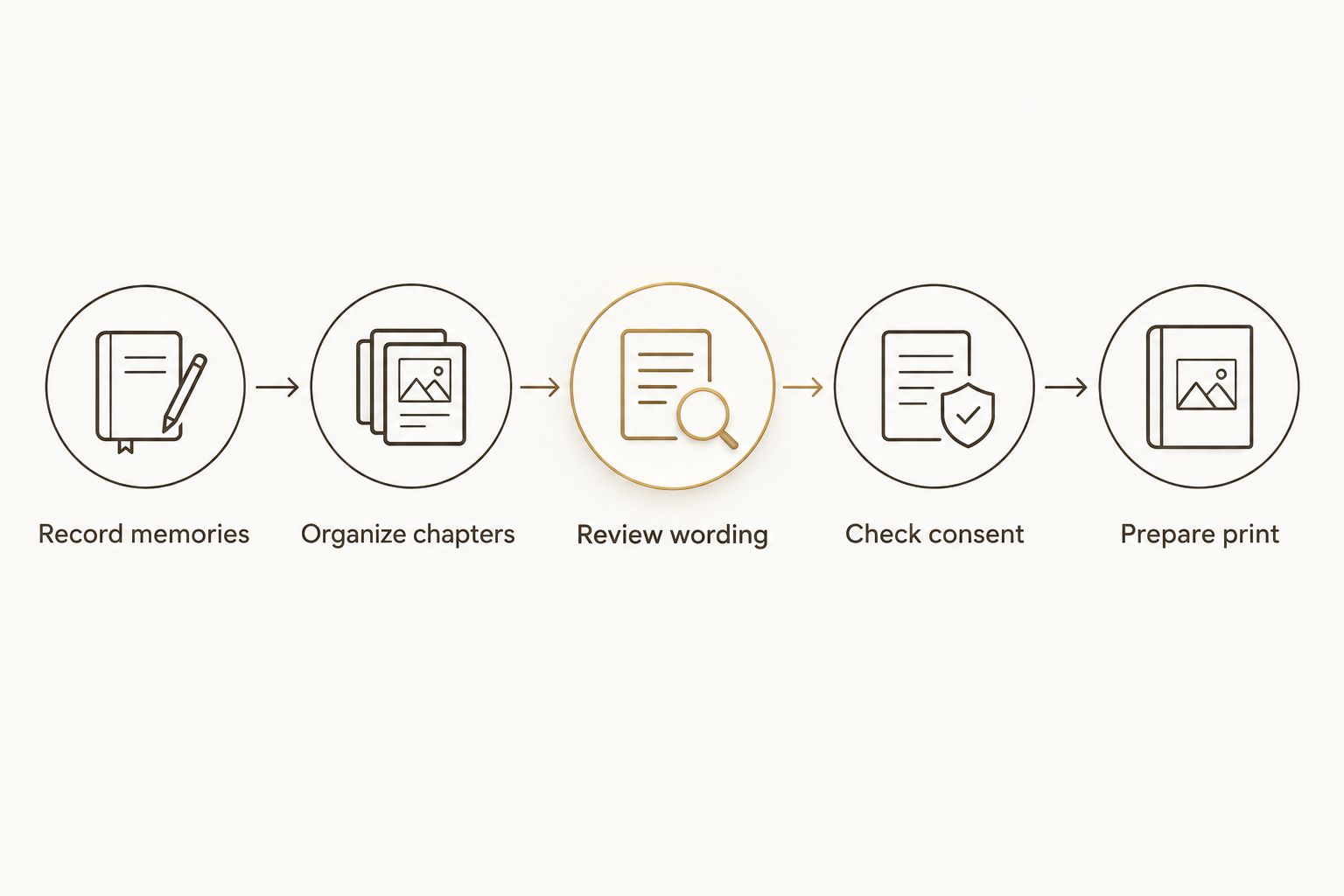
For your 2026 manuscript, review these stages before printing: Record memories, Organize chapters, Review wording, Check consent, and Prepare print. Consent review belongs before the final printing decision, not after copies have been shared.
A memoir can remain honest without including every detail. Keep the information readers need to understand your experience and remove disclosure that serves no clear purpose.
- Flag passages involving sexuality, gender history, health, or intimate relationships.
- Check whether indirect details identify someone you intended to leave unnamed.
- Record agreed wording changes in your manuscript notes.
- Recheck captions and acknowledgments, not just chapter text.
7. Prepare print
Read the manuscript as a finished book rather than a collection of recordings. Check the opening, chapter order, names, and ending together. Make sure the reader understands who matters to you and why, without needing access to your private notes.
Myvellum offers personalized hardcover and softcover keepsake books. Choose the format after the manuscript feels ready; neither binding choice replaces editing or privacy review. Review the current ordering information before committing to print.
Keep a final manuscript copy separate from working notes, and label the version intended for sharing. If you create different editions for different readers, review each one independently. A removed chapter can still leave revealing references elsewhere.
- Confirm that the chapter order follows a clear path.
- Check names and pronouns consistently across the manuscript.
- Review any photographs and captions you plan to include.
- Save the final family edition separately from private source material.
Compare ways to create your memoir
Choose the method that matches how you remember and how much editorial control you want. A guided app supplies structure; a blank document gives you freedom. Neither approach decides your boundaries for you.
| Option | Best for | Main advantage | Key limitation |
|---|---|---|---|
| Notebook or document | Writers who want an open-ended structure | You control the outline and wording from the start | You must create prompts, organize chapters, and arrange printing |
| Voice recorder with manual editing | Storytellers who prefer speaking and want to manage the process themselves | You can capture memories conversationally | Turning recordings into a readable manuscript is a separate task |
| Myvellum | Storytellers seeking guided interviews and a printed keepsake | Voice-driven memoir creation with twelve structured interview chapters and hardcover or softcover printing | The guided structure does not replace your editorial and consent decisions |
| Trusted interviewer with a separate print workflow | People who prefer conversation with someone they know | Follow-up questions can clarify memories | You must agree on boundaries and organize the manuscript and printing separately |
Choose the workflow you will actually use, not the one with the longest feature list. Test it with an ordinary memory before committing your most sensitive material. Check any digital service’s current privacy and export terms before uploading private recordings.
Common mistakes LGBTQ elders make when writing a memoir
These are editing traps to watch for, not assumptions about your life. Use them as a final check on a 2026 family memoir.
Treating coming out as the required centerpiece
Coming out can be central, brief, repeated across different relationships, or absent from the book. Organize around the experiences that matter to you rather than a storyline readers expect.
Leaving chosen family unexplained
Readers who never met your closest people need introductions. Explain the relationship and what that person contributed to your life; a name alone cannot preserve that meaning.
Replacing your language with someone else’s
A helper can improve clarity without deciding how you identify. Review changes to names, pronouns, relationship terms, and community language yourself.
Making hardship the whole story
If your draft contains only struggle, check whether it also reflects the pleasures you want remembered. Add ordinary scenes when they belong: laughter, companionship, work, celebrations, or a place that felt like home.
Treating a printed book as a private recording
A recording can remain personal working material. A family book is intended for sharing, so review what it reveals before ordering it and explain your sharing wishes to recipients.
FAQ
How do I start memoir writing as an LGBTQ elder?
Start with one memory and name the people you want the finished book to reach. Record or write a specific scene, then decide later whether it belongs in the shared manuscript.
Does my memoir have to focus on coming out?
No, your memoir does not have to focus on coming out. You decide how much space identity, relationships, work, community, and everyday life receive.
Can I include chosen family in my family memoir?
Yes, chosen family belongs in your memoir when those relationships matter to your story. Introduce each person and explain the relationship so readers understand their place in your life.
What is Myvellum best for?
Myvellum is best for people who want voice-guided memoir writing and a personalized printed keepsake. It guides individuals through twelve structured interview chapters and offers hardcover or softcover printing; you still control the story and review sensitive details.
Is starting a free memoir the same as ordering a printed book?
No, starting a free memoir and ordering a printed book are separate steps. Begin by capturing memories, then review the manuscript and current ordering information before choosing a printed format.
How can I tell my story without outing someone else?
Remove unnecessary identifying details and ask before including sensitive information about another person when it is safe to do so. Check combinations of details, because a location or relationship can identify someone even without a name.
What should I do when I cannot remember an exact date?
Use an honest general description rather than inventing an exact date. Check available records if the timing matters, and distinguish what you remember from what a document confirms.
One last thing
Before finishing, record one ordinary memory you would not normally call important. Describe how you took your coffee, who stayed after dinner, or what made a familiar room feel like yours. Your family can learn your timeline elsewhere in the book; give them a moment that preserves your presence.


