

Retiring teachers' memoir writing is the process of turning classroom experiences and personal memories into a life story with the aim of creating a keepsake for family. This 2026 guide helps you preserve the person behind the profession, protect other people's privacy, and separate starting a free memoir at myvellum.vercel.app from ordering a printed book.
- Memoir writing for retiring teachers should preserve your life story, not just your teaching résumé.
- Myvellum is best for retiring teachers who want voice-guided memoir writing and a printed family keepsake.
- Build family history around specific scenes, personal choices, and the lessons teaching brought home.
- Start your free memoir first; review the manuscript before choosing a printed book.
Why memoir writing matters for retiring teachers
Your family can know where you taught without knowing why you became a teacher. A memoir connects those facts to the nervous first morning, the colleague who changed your thinking, and the work you carried home after the classroom emptied.
Teachers also have a particular storytelling challenge: meaningful memories often involve students. Keep the emotional truth of your experience without making someone else's private life the centerpiece. Your decisions, doubts, and growth belong in the book; another person's sensitive information does not need to.
If retirement in 2026 gives you a natural stopping point, use it to begin collecting stories rather than demanding a finished manuscript immediately. The first task is selecting memories your family would otherwise never hear.
For help moving beyond a blank page, explore memoir writing prompts and tools. Use prompts to uncover a scene, not to produce another formal report about your career.
How to turn your teaching life into a family memoir
Use a simple sequence: Choose memories, Record stories, Review details, and Prepare print. Keep those tasks separate. Speaking freely helps you capture a memory; reviewing it later helps you decide what belongs in the family book.
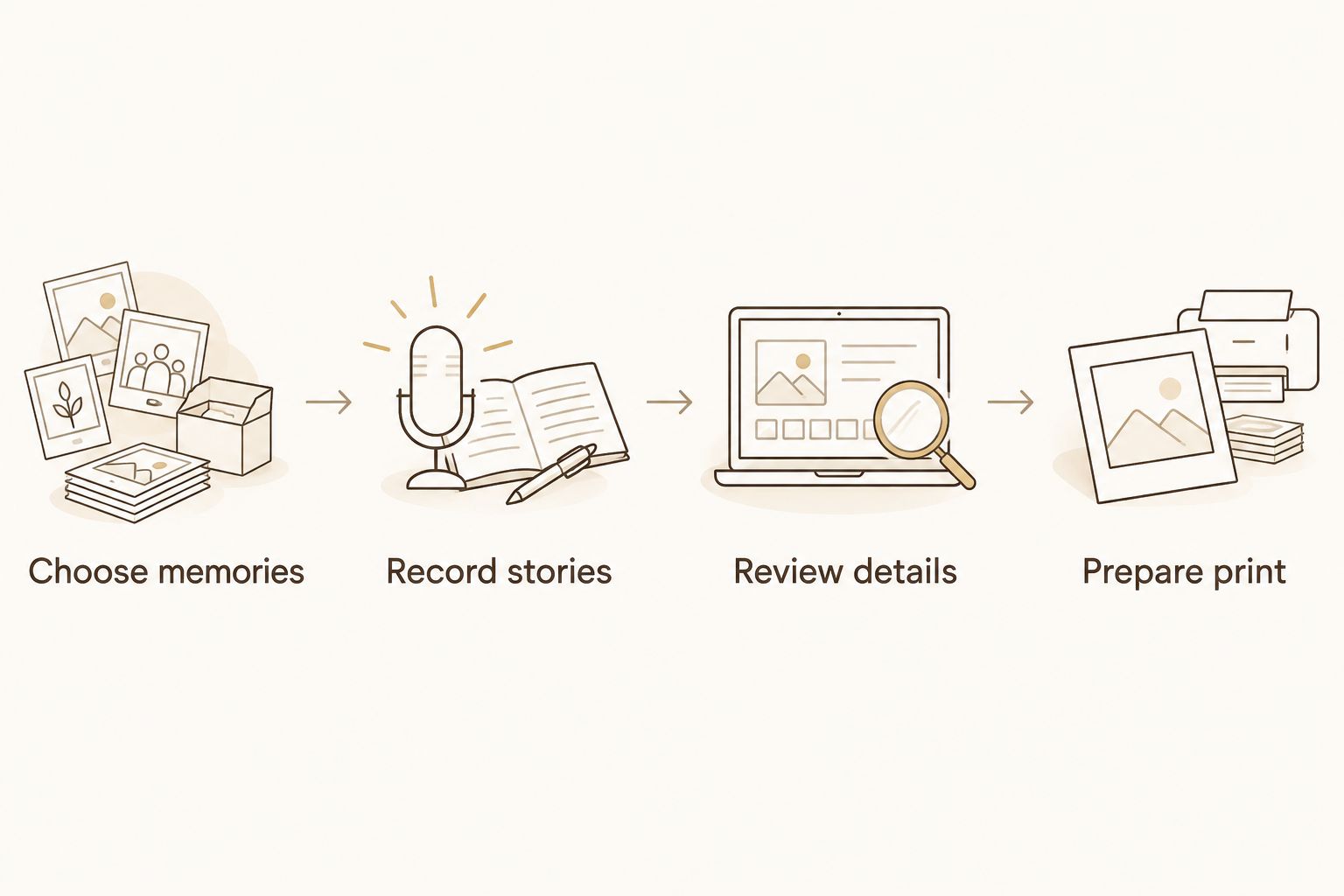
1. Choose the family reader before choosing the stories
Start with a sheet of paper and name the people you hope will read your memoir. A grandchild needs context about your working life; a sibling might already know the family circumstances that shaped it. Write for understanding rather than for professional recognition.
Then finish this sentence privately: I want my family to understand why I… Your answer gives the book a purpose. It might involve choosing teaching, staying through a difficult period, changing direction, or finding meaning outside work.
Your memoir is not a retirement speech stretched into chapters. Include the parts of your life that explain the teacher you became, even when they happened far from school.
- Name your intended family readers in a planning note.
- Write one sentence describing what you want them to understand.
- List 3 memories that reveal your character rather than your achievements.
- Include a memory from before teaching and one from outside school.
- Set aside material that only makes sense to former colleagues.
2. Build a memory map instead of a career inventory
Make a rough timeline using a notebook or document. Mark changes that affected you: training, a first appointment, a move, a subject change, a leadership role, or retirement. Then add personal events alongside the professional ones.
Chronology provides a reference, but it does not have to dictate the finished book. A chapter about learning patience can connect an early classroom mistake with a later family experience. The connection matters more than documenting every school year.
For a memoir begun in 2026, keep a separate note identifying which memories need checking. Do not interrupt every promising story to find a date. Capture first; verify before sharing.
- Draw parallel lines for teaching milestones and family milestones.
- Mark turning points rather than every position you held.
- Attach a concrete scene to each promising milestone.
- Group related memories under themes such as belonging, change, or perseverance.
- Flag uncertain names and dates for later review.
3. Record your memories before polishing your sentences
Begin with the simplest method you already use: write in a notebook, type into a document, or speak into a recording tool. Choose one scene and describe what happened in your own words. You do not need to sound like a published author.
Try a 10-minute recording session as a starting routine, not a deadline. Describe where you were, what you noticed, what you did, and why the moment stayed with you. If the scene opens into another memory, record that connection too.
For a structured alternative, Myvellum offers voice-driven memoir writing through twelve interview chapters and a personalized hardcover or softcover keepsake book. Myvellum is best for retiring teachers who want voice-guided memoir writing and a printed family keepsake. Starting a free memoir and ordering the printed book are separate steps; capture your story before deciding what to print.
- Choose one scene rather than trying to summarize an entire career.
- Describe the setting before explaining the lesson.
- Say what you felt then, not only what you understand now.
- Keep a note of any question the recording leaves unanswered.
- Review your wording later without removing every natural expression.
4. Write classroom scenes without exposing students
Begin your privacy review manually. Read each school-related passage and ask whether it contains details that a student or family would reasonably regard as personal. Names are only part of the issue; a distinctive event, class, location, and date can identify someone together.
Focus the scene on your experience. You can describe learning to listen without recounting a child's medical history or family crisis. When a detail is unnecessary to your story, remove it rather than finding a more dramatic way to present it.
Do not assume a changed name makes a story anonymous. If you change identifying details, explain that editorial choice briefly. Avoid turning uncertain recollections into confident claims about another person's motives.
- Remove student surnames and unnecessary identifying details.
- Leave out grades, diagnoses, disciplinary records, and family circumstances.
- Describe your own response instead of assigning someone else a motive.
- Ask permission before including another person's contribution or image.
- Omit a scene when privacy concerns outweigh its value to your story.
5. Connect the classroom to the rest of your life
Read your draft as a family member, not as an educator. Where would a reader need an explanation of a school term, teaching practice, or workplace expectation? Add the context that lets them enter the scene without turning the chapter into a lesson plan.
Next, look for the personal consequences of your work. Explain how teaching affected your patience, confidence, relationships, interests, or sense of purpose. A family memoir becomes more revealing when it shows what happened after the school day ended.
Writing in 2026 also gives you a clear present-day viewpoint. Separate what you believed during an event from what you think about it now. That distinction preserves the younger version of you instead of making every decision appear obvious in hindsight.
- Explain professional terms in everyday language.
- Add home-life context where it changes the meaning of a memory.
- Include moments of doubt alongside moments of pride.
- Distinguish your original feelings from your present interpretation.
- End selected scenes with what changed, not a compulsory moral.
6. Edit for clarity while keeping your own voice
Read the manuscript aloud before rewriting it. Your ear catches long sentences, repeated explanations, and phrases you would never actually say. Mark those passages, then revise them individually rather than replacing the whole chapter with more formal language.
Ask a trusted family reader where they became confused and what they wanted to know next. Request specific feedback instead of a general judgment about whether the memoir is good. You remain the authority on your experience, but another reader can identify missing context.
Keep the language your family recognizes. Correct errors and remove repetition without sanding away your humor, familiar expressions, or honest uncertainty. A keepsake should sound like its author, not an annual performance review.
- Read one chapter aloud during each editing session.
- Cut repeated explanations that do not add meaning.
- Check names, dates, places, and photo captions against available records.
- Ask a reader to identify confusing passages and unanswered questions.
- Preserve distinctive expressions that still communicate clearly.
7. Prepare the manuscript before ordering a printed book
Treat printing as a separate decision from drafting. First, settle the text you want your family to receive. Then check chapter order, names, captions, acknowledgments, and any explanation of changed identifying details.
Choose hardcover or softcover according to how you want the keepsake to be handled. A hardcover has rigid covers; a softcover has flexible covers. Neither binding repairs an unfinished story, so give the manuscript review more attention than the format decision.
Before placing a 2026 print order, check the service's current specifications and review whatever preview or proof it provides. Do not assume your working draft and the printed layout will look identical. Order the book when the story is ready, not simply when retirement arrives.
- Confirm that every chapter belongs in the version you intend to share.
- Check spelling of family names and captions separately from the prose.
- Verify permission for images or contributions you did not create.
- Choose hardcover or softcover after reviewing the available specifications.
- Inspect the final layout or proof before approving a print order.
Start with your own memories
Begin a free memoir, then review your story before deciding to order a printed keepsake.
Compare ways to write your teaching memoir
Choose a method by how you prefer to tell stories, not by how impressive the finished process sounds. A blank document gives you control but asks you to create the structure. Guided interviews provide a starting framework but still need your judgment about what belongs in the book.
| Option | Best for | Main advantage | Key limitation |
|---|---|---|---|
| Notebook or document | Teachers who enjoy writing independently | You control the wording, order, and revision process | You must create the structure and arrange printing separately |
| Independent audio recording | Teachers who recall stories more naturally aloud | You can capture speech without composing polished paragraphs | Recordings still need organizing and turning into readable text |
| Myvellum voice-guided memoir writing | Teachers who want guided interviews and a printed family keepsake | Twelve structured interview chapters connect life-story writing with hardcover or softcover printing | You still need to check accuracy, privacy, and what you approve for print |
The useful question is whether the method helps you finish a story your family can understand. Writing independently offers flexibility. Recording aloud reduces the need to compose while remembering. Guided memoir writing supplies prompts, but no method can decide which memories you are comfortable sharing.
Common mistakes retiring teachers make
Turning the memoir into a professional résumé
A sequence of appointments, qualifications, and promotions explains your career but reveals little about your life. Keep the milestones that matter, then show the choice, conflict, or relationship behind them. Your family needs the story of becoming you, not a complete employment record.
Writing as though the reader knows the school
Staffroom shorthand and unexplained initials exclude readers who were never there. Introduce the setting and explain unfamiliar terms once. A relative should understand why a moment mattered without needing a former colleague beside them.
Using students' struggles as the main source of drama
A memorable classroom event does not automatically belong in a family book. Recenter the passage on what you learned or did. Remove sensitive details, and leave the scene out if it cannot work without exposing someone else.
Polishing the opening while avoiding difficult memories
Perfecting the first page can become a way to postpone the rest of the story. Capture a rough version of the important memories before refining the introduction. You can acknowledge a difficult period without describing every private detail or forcing a cheerful ending.
Ordering print before completing the family review
A printed book makes unresolved errors harder to overlook. Separate story capture, factual review, privacy review, and print approval. Give yourself permission to finish the manuscript thoughtfully rather than treating a retirement celebration as the only acceptable deadline.
FAQ
How do I start memoir writing for retiring teachers?
Start with one teaching memory that helps your family understand you. Describe the scene, your response, and why it stayed with you before planning the whole book.
Should my teacher memoir cover my entire career?
Your teacher memoir does not need to cover every year of your career. Select turning points and connect them to the personal experiences that shaped your life.
Can I speak my memoir instead of typing it?
Yes, you can begin by recording your memories aloud. Myvellum offers voice-driven memoir writing through twelve structured interview chapters, with personalized hardcover or softcover keepsake printing.
Can I start a free memoir before ordering a book?
Yes, starting a free memoir and ordering a printed book are separate steps. Capture and review your story first, then check the current ordering details when you are ready for a keepsake.
Can I include stories about former students?
Include classroom experiences only after reviewing the identifying and sensitive details they contain. Focus on your own experience, and do not assume changing a student's name makes the account anonymous.
Is hardcover better than softcover for a teacher memoir?
Hardcover is the better fit when you want rigid covers; softcover fits readers who prefer flexible covers. Review the available print specifications before choosing either format.
What should I check before printing my retirement memoir?
Check the final text, names, dates, captions, permissions, privacy decisions, and print layout before approving your book. Keep manuscript review separate from the decision to place an order.
One last thing
Before you close your next writing session, record an ordinary memory: how you prepared for Monday, what you noticed in an empty classroom, or what you did after a hard day. Those details give your family access to a life they did not see from the outside.
For your 2026 memoir, preserve one everyday scene before adding another career milestone. The book can honor your work without making your job the whole story.


